

Having seen my wife off on the train to Glasgow on Friday I had the weekend to myself and was looking forward to getting out and about to do some birding.This idea was soon scotched by the onset of rain and wind later that day and my optimism was replaced by a pervading sense of gloom as I contemplated the prospect of a weekend confined to remaining on the couch at home. Never something I can countenance with equanimity for very long.
A rare Isabelline Shrike had been reported daily from a seaside village called Thurlestone on the coast of South Devon for the last few days and this had sparked my interest. It was still there on Saturday. By Sunday I was feeling distinctly fractious as another day of rain and wind presented itself to me as I looked out of a rain spattered bedroom window onto a soggy wet lawn below. It was all too obvious how heavily it had rained in the night. I checked the forecast and a ray of hope presented itself with a prediction the rain would gradually move eastwards and maybe by lunchtime Cornwall and Devon would be free of the rain.
It was a long shot but I just had to get out of the house so I decided to go for the shrike which had already been reported from Thurlestone early this morning, despite the rain. I left home in a continuous downpour at just after nine and headed west through the North Cotswolds, the trees lining the rural roads looking distinctly autumnal now in shades of gold and yellow, while the endless rain stripped leaves from the branches, sending them falling in whirling parabolas across the partially flooded roads.
I joined the Motorway and entered a living hell of opaque spray and fast moving vehicles. I took it easy in the inside lane as there was no real hurry and I certainly did not want to arrive at Thurlestone in the rain. Two hours later, Marge (the satnav) directed me off the Motorway onto still wet and partially flooded secondary roads and we wound our way through the increasingly narrow lanes leading towards Thurlestone. The road, sunk between high banks, eventually became just a single carriageway lane for the last two miles with passing places but this did not seem to deter the locals from driving at breakneck speed and it was with relief that I finally entered the small, cramped village of Thurlestone, situated on a hillside above the South Devon cliffs.
By now the weather was improving, it had stopped raining and there were even patches of watery blue showing through the mainly grey and white clouds. A sliver of optimism permeated my being.
The first impression I got of Thurlestone was hardly one of benign welcome, as, like many scenic west country coastal villages, traffic has come to dominate and govern the life of a village which once must have been a tranquil and delightful place to live.The narrow road that winds through and around Thurlestone is embellished with continuous double yellow lines, and parking a car anywhere, if you are not a resident, is virtually impossible. The village's situation is such that it cannot possibly cope with many cars and what it must be like in summer does not bear thinking about. It must be a nightmare, both for the residents and visitors alike.
I also got the impression that Thurlestone is quite an upmarket place, with, at one end of the village, a private lane down which I had to walk, bordered on both sides by absolutely huge, tasteless, modern houses commanding prices in excess of a million pounds, leading to a golf course that lay between the end of the lane and the coastal cliffs above the sea.
 |
| The Millionaire's Lane leading to the golf course and cliffs |
I got my gear together and walked downhill and back into the village, past the church and village stores and down 'Millionaire's Lane' its entrance guarded by stern notices saying access for cars was by permit only.
 |
| 'Millionaire's Lane' leading to the golf course and cliffs |

 |
| The view from the coastal footpath, looking down and southwards out to sea |
I headed off across the golf course and duly turned onto the coastal footpath by the green hut to join a half dozen birders, standing and regarding the rough area of brambles and scrub.
Enquiring about the shrike I was told it was here but was currently out of sight as it spent a lot of time perching low in the brambles to keep out of the strong northerly wind. Just at that moment the shrike flew up to perch prominently on a spike of bramble.

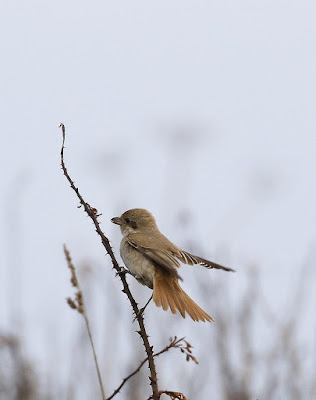
It then flew closer and I took a few photos of it perched in the brambles before it flew further up the sloping area of rough ground and was, once again, temporarily lost from sight.


After a while it became obvious the shrike had certain perches it preferred to hunt from and contrary to what I had previously thought it was quite happy to perch relatively high up and prominently, braving the strong wind without any apparent discomfort, swaying and balancing in the gusting wind whilst looking about for prey.


Being a Sunday and with the weather now set fair, the coastal footpath was becoming well used and almost crowded with serious walkers and people just out for a stroll. Invariably they would stop to ask us what we were looking at but after a while this got a little tiresome as there is only so many times you can repeat oneself. So I walked into the rough grass away from the footpath, not so far as to disturb the shrike, but far enough to not have to answer anymore enquiries.


The shrike carried on hunting insects from its various favoured perches and it appeared to have little problem in locating and capturing prey. I saw it catch various unidentified insects including a bee and a hoverfly. On a couple of occasions it flew high up into the air above us to seize a high flying insect and then descended in a bounding, bouncing flight back to the brambles.
The overall colour of the shrike was pale sand brown on the upperparts and creamy white on the underparts which also showed some scaling on the flanks. There was not a major contrast between the upper and underparts, thus creating an overall image of a pale looking bird. The indistinct darker brown face mask on this bird extended only from the eye backwards across the top of the ear coverts. The unmarked rufous rump and tail being the only parts of the bird that were strongly coloured. Judging by its plumage, which was fresh and almost pristine, this was a first year bird making its maiden journey south and managing, in this case, to get it spectacularly wrong.

The first part of the bird's name, Isabelline, comes from the Latin word isabellinus, used to describe a colour that is greyish yellow and thought to be based on the unsavoury historical fact that Isabella the First of Castile (1451-1504) is said to have promised not to change her undergarments until Spain was freed from The Moors! The paleness of its plumage certainly served it well when it was perched low down in the similarly coloured pale stems and dead withered grasses, as it became almost invisible until it moved.


The taxonomy of the Isabelline Shrike is complicated and still open to some conjecture and mild controversy. Isabelline Shrikes were at first thought to be conspecific with the more familiar Red backed Shrike and it was only much later that it gained full species status in its own right, but as from 2018 the Isabelline Shrike has itself now been superceded and split into two species, Daurian Shrike and Turkestan Shrike, although Isabelline Shrike is still used when it is impossible, for us mere mortals at least, to differentiate between what are two almost identical species.

The separation of Daurian from Turkestan Shrike is based on subtle plumage tones which themselves are notoriously variable due to differing light conditions, hence the uncertainty concerning the Thurlestone individual's true identity, which has yet to be convincingly established. It is likely to be Daurian, as that species, based on past records, is the more prone of the two to wander to Britain and western Europe.
Daurian Shrikes breed from Mongolia and south and eastern Russian Transbaikalia south to north and northwest China and winter in Arabia and northeast Africa.
Turkestan Shrikes breed in western and north eastern China and partially overlap with the breeding grounds of Daurian Shrikes, which further complicates matters concerning interbreeding and the resulting progeny. Turkestan Shrikes do, however, winter in a separate area from Daurian Shrikes, being found in Pakistan and northern India.
Now that the Isabelline Shrike has been split into two species, at least for now, birders who keep a list are keen to establish that they have seen both Daurian and Turkestan Shrikes, although the latter is the less likely to occur in Britain and western Europe.
 |
| Birders on the coastal footpath and the Green Hut beyond |


It then flew closer and I took a few photos of it perched in the brambles before it flew further up the sloping area of rough ground and was, once again, temporarily lost from sight.


The shrike carried on hunting insects from its various favoured perches and it appeared to have little problem in locating and capturing prey. I saw it catch various unidentified insects including a bee and a hoverfly. On a couple of occasions it flew high up into the air above us to seize a high flying insect and then descended in a bounding, bouncing flight back to the brambles.
The overall colour of the shrike was pale sand brown on the upperparts and creamy white on the underparts which also showed some scaling on the flanks. There was not a major contrast between the upper and underparts, thus creating an overall image of a pale looking bird. The indistinct darker brown face mask on this bird extended only from the eye backwards across the top of the ear coverts. The unmarked rufous rump and tail being the only parts of the bird that were strongly coloured. Judging by its plumage, which was fresh and almost pristine, this was a first year bird making its maiden journey south and managing, in this case, to get it spectacularly wrong.

The first part of the bird's name, Isabelline, comes from the Latin word isabellinus, used to describe a colour that is greyish yellow and thought to be based on the unsavoury historical fact that Isabella the First of Castile (1451-1504) is said to have promised not to change her undergarments until Spain was freed from The Moors! The paleness of its plumage certainly served it well when it was perched low down in the similarly coloured pale stems and dead withered grasses, as it became almost invisible until it moved.


The separation of Daurian from Turkestan Shrike is based on subtle plumage tones which themselves are notoriously variable due to differing light conditions, hence the uncertainty concerning the Thurlestone individual's true identity, which has yet to be convincingly established. It is likely to be Daurian, as that species, based on past records, is the more prone of the two to wander to Britain and western Europe.
Daurian Shrikes breed from Mongolia and south and eastern Russian Transbaikalia south to north and northwest China and winter in Arabia and northeast Africa.
Turkestan Shrikes breed in western and north eastern China and partially overlap with the breeding grounds of Daurian Shrikes, which further complicates matters concerning interbreeding and the resulting progeny. Turkestan Shrikes do, however, winter in a separate area from Daurian Shrikes, being found in Pakistan and northern India.
Now that the Isabelline Shrike has been split into two species, at least for now, birders who keep a list are keen to establish that they have seen both Daurian and Turkestan Shrikes, although the latter is the less likely to occur in Britain and western Europe.


