Tuesday, 16 October 2012

I may be onto something 16 0ctober 2012


The main criteria for distinguishing adult from first winter Purple Sandpipers is given in reference books as the  difference in shape, colour and patterning of the lesser and median coverts on their wings. Adult birds have square ended  lesser and median coverts with diffuse grey fringes which provide little contrast whereas first winter birds have rounded tips to the lesser and median coverts with prominent white fringes providing a marked contrast and scaly appearance to the closed wing, much different to adult birds. 

The following images are ones I took of both first winter and adult Purple Sandpipers in early winter at Brixham where there is a regular wintering flock. Note the difference in colouring to the legs, feet and base of the bill of  first winter birds compared to adults. The first winters show bright orange legs and feet combined with a reasonably extensive orange base to the bill whereas  adults have duller greenish yellow legs, feet and base to the bill. The colouring on the bill base of the adult also appears to be less extensive. The difference in colouring of the bare parts was very obvious at the time and appeared to be consistent amongst the seventeen individuals present on the rocks. This feature was easier to use than the wing covert patterning to distinguish between the two ages. I cannot find any reference to this difference in any reference book including BWP but it may be worth using when next a Purple Sandpiper turns up in Oxfordshire or anywhere else you are lucky enough to encounter one or more. Please note this observation was in early winter and as the winter wears on there maybe changes in the bird's plumage and colouring but it certainly seems to work for the period before January of the following year

First winter Purple Sandpiper.

Note the orange legs, feet and bill base combined with the retained juvenile lesser and median wing coverts showing rounded tips with prominent white fringes


First winter Purple Sandpipers


Adult winter Purple Sandpiper. Note the dull greenish yellow legs, feet and bill base combined with the diffuse grey fringes to the square ended lesser and median wing coverts showing much less contrast than on first winter birds


Adult winter Purple Sandpipers


Monday, 15 October 2012

Clinging on 14 October 2012


Pagham North Wall
A sunny autumn Sunday proved enough to get me out of bed and down the A34 to one of my former haunts in West Sussex - Pagham Harbour. How I miss the sea, those huge skies and wide horizons and with what joy I found myself on the North Wall of Pagham Harbour mid morning. Sadly the four Spoonbills that had been here for the last few days did not share my enthusiasm and had moved on. I met Chris Janman, one of the locals, intently surveying a reed bed. 'There's a warbler in there showing itself intermittently and it looks quite grey. It might be interesting'. said Chris. 'OK I'll hang about. We chatted about this and that but the warbler did not show itself so we moved along the wall and then back again covering all the angles and extent of the reed bed. I was just about to give up when said warbler shot up into the air, flycatching from the reeds. It disappeared but then was up again. Then down again. Frustration. Finally it allowed us to get it in our scopes and obtain a good view of it. It now appeared warm brown. Just a late Reed Warbler then but nice to see all the same and it had provided a frisson of excitement and anticipation for an hour.

Chris left for home but I remained on the wall enjoying the surroundings. Before me was what is called the Breech Pool and which over the years has harboured many a rarity. The last one was a wintering Paddyfield Warbler earlier this year, in exactly the same reed bed as our Reed Warbler of today. Behind me the open harbour, still with the tide well in, stretched to the open sea and the water on the horizon became invisible in the bright sun. 

Pagham Harbour 
Little Egrets roosted on a grassy island waiting for the water to recede. Wigeon whistled and floated around in groups. There was that unique quiet calm of a high tide on a still day as everything ceased moving and waited, waited for the tide to recede and the saltmarsh to become once more exposed. Before me the edges of  the Breech Pool sheltered dozing Teal, the drakes still only half way to acquiring their full beauty. A Shoveler drake swam out of the reeds, its harlequin colours shone bright on the blue, sky reflecting water. Three Black tailed Godwits slept in the lee of some reeds, the birds pivoting on one leg as they kept one eye on their surroundings and Common Snipe hid in the long grass by the water's edge. A Greenshank, very pale in the sunlight, flew inland calling loudly and a flock of Curlew took off from the fields behind the Breech Pool and headed out into the harbour, their wild, loud cries accompanying them into the distance. A much harsher squealing betrayed a Water Rail concealed in the reeds. Finally a small brown passerine flew across the Breech Pool and perched right on the top of a small hawthorn. Not the usual Reed Bunting this time. Oh no! A female European Stonechat, but unusually not accompanied by a male. Perhaps she was a migrant getting ready to, as one of the old bird books I regularly read, charmingly said of this species, ' take the tour of the Continent'. Yes, it was a very old book but quite readable and how much more gentle and quaint birding seemed to be in those days. The first two weeks of October are the peak time for passage of stonechats on the south coast. 

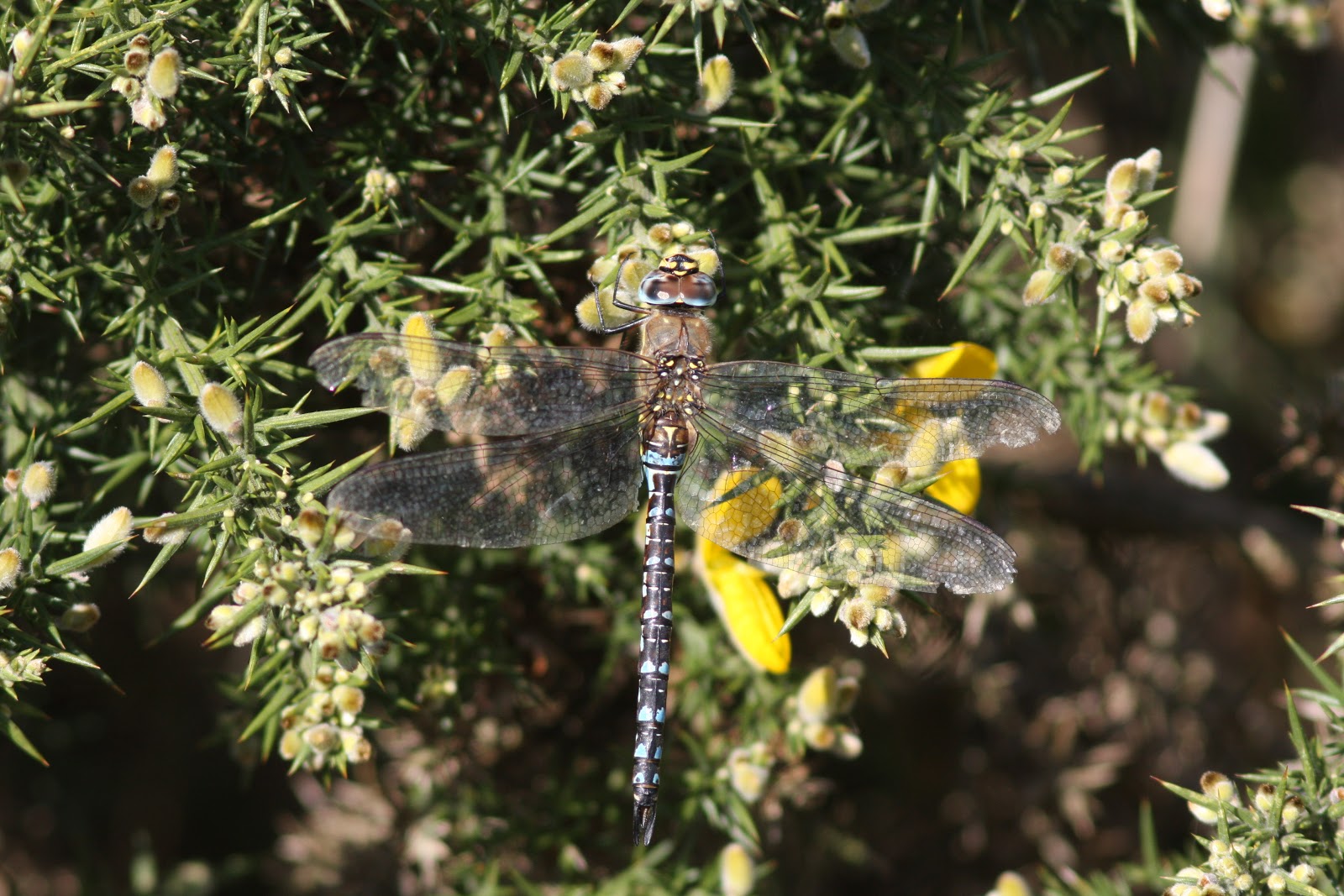
My plan was now to go for the remainder of the afternoon to the other side of the harbour at Church Norton looking for Firecrests in the Churchyard, a favourite spot and possibly also to seek them in the wind blasted gorse and bushes sheltering the footpath running along the western edge of the harbour. Both failed to deliver a Firecrest but I did find two Goldcrests in the Churchyard. Along the harbour footpath a male Migrant Hawker was flying in a sheltered recess behind the gorse, shielded from any wind coming in off the harbour. 

Field Parasol
Nearby a Field Parasol fungus lurked like, well, a parasol, in the long grass under the gorse. The hawker sailed around aimlessly in it's little warm arena and then settled on some sun soaked gorse all ambition gone. Maybe this was the day when the sun on its tattered wings would be it's last. 

Migrant Hawker male
Back in the Churchyard a couple of Red Admirals spiralled listlessly upwards, parted and drifted like separate, spent leaves down onto the grass. Their tired, energy expired flight pressaging their oncoming nemesis. Similarly a Peacock, resplendent in paint box colours, found a warm, sun soaked gravestone to fuel one last day and one last flight. 

Peacock
No birds were to be found in the churchyard but plenty were now out on the exposed saltmarsh. Common Redshanks and Little Egrets were regularly spaced out across the harbour. Five Knot, all fussy and dumpy probed the mud in a small channel and a single Sanderling fed with a Grey Plover. The plaintive echoes of Grey Plover calls permeated the harbour and Turnstones flew back out to the rocky seashore. In the binoculars I found a large, all white wader, quite distant and in fact so distant I had to get the scope on it. What on earth was it? I increased the magnification and to my surprise saw it was a leucistic Curlew. This was definitely a first. It was not pure white but a very pale off white with the occasional random pale brown streak on the upperparts. The bill was the normal black and the legs the normal grey green colour. I like to imagine it had a close encounter with the local Peregrine and the shock turned it white. 

Leucistic Curlew
While looking through the bins at the Curlew I also saw a Brent Goose mixing with the loafing Cormorants on their favourite island out in the middle of the harbour. I have been WeBS (Wetland Bird Survey) counting Brent Geese for twenty four years at nearby West Wittering so know something unusual about a Brent Goose when I see it. This one appeared to have very white flanks. The sub-species of Brent Goose that winter in the south of England and especially around here is the Dark bellied Brent Goose which do not have white flanks. Virtually annually now we get a vagrant Black Brant, the North American version of our Dark bellied Brent Goose, mixed in with the flocks of Dark bellied Brent and less often we get a displaced Pale Bellied Brent Goose which normally winter in Scotland or Ireland. I needed the scope again to confirm my suspicions but the identification was not difficult. An adult Pale bellied Brent Goose. Quite early and a very nice find to round off an unspectacular but very fulfilling day by the sea.

Sunday, 14 October 2012

Still here 14 October 2012


Some years ago our then new neighbours cut down a lovely mature ash tree that grew in their garden next to our house. Residents in Kingham like cutting down trees to make way for extensions or conservatories that add value to their property. 'You must be really pleased we have removed that dreadful tree' they enthused in their naivete. Well no, actually. This tree for years had attracted all manner of bird species and Nuthatches always bred in it every year bringing their young to the feeders in our garden. With the loss of the tree they disappeared along with the Spotted Flycatchers, assorted tits and finches that used the tree for shelter and as a food resource. I was therefore delighted to see a single Nuthatch hanging upside down on our peanut feeders the other day. It is now a regular visitor. So welcome back and long may you remain.


House Sparrows have declined by over 70% and are extinct as far as I know in London and other large cities. Here in our garden at Kingham we still have a regular flock of around 20-30 birds that visit in a garrulous group to feed on the peanuts, often monopolising the feeders, fighting off the tits and moving in and around the overgrown hedges surrounding our garden, always as a group. They chatter away incessantly in the high holly hedge that runs alongside our drive when I leave for work in the morning and are there when I get back in the early evening. The holly hedge seems to be their headquarters, providing refuge from the daily marauding Sparrowhawk, a place to loaf and preen and a secure roosting site. 


The Great Spotted Woodpeckers are still regular visitors to our feeders, flying first into the huge Acacia tree before flying down to the feeder. We have both female and male visiting but never at the same time.They are very intolerant of the smaller birds and if one of the tits or sparrows gets too close it is seen off with a vicious jab of it's beak. Sometimes the woodpecker will just cling on the feeder apparently resting, quite content, and can be there for up to twenty minutes just doing nothing before flying back into the Acacia tree. The minute it has gone the tits immediately return and recommence feeding


Saturday, 13 October 2012

White's Thrush. Lucky for some. 13 October 2012


This enigmatic species is a very rare visitor from Siberia to the UK, usually found in September and October following strong north easterly winds and is much desired by UK birders, especially twitchers. So far this autumn there have been at least four that have arrived on our shores. One caught on the Farne Islands, one seen flying over South Ronaldsay in the Orkney Islands, a third seen briefly in the far west of Cornwall and another recorded from Barra in the Outer Hebrides today. 

For this species this is an almost unprecedented annual influx into the UK. They are notoriously hard to re-locate once they have been initially flushed, although you know they are somewhere nearby and for such a large thrush (it is larger than a Mistle Thrush)  they manage to conceal themselves so well as to become virtually invisible. Only the lucky original finder that flushes them, usually from deep cover gets to see them and those that dash to see them afterwards often fail or only get the briefest of views although there have been exceptions. 

I have never been lucky enough to see one in the UK as they are typically only seen once and never again and I have never been near any of the locations when they have been found. Realistically one's only chance of seeing one is to be near enough to the location to get there the same day and even then your chances are very slim at best, although again there have been exceptions where a bird has remained for some days and allowed visiting birders adequate views of it


However, I  have been lucky enough to see no less than four separate individuals in China and two of these very well indeed. The first was in the middle of Shanghai, in the Botanic Gardens surrounded by high rise flats with all the concrete and noise of a large and bustling city. It was flushed from under some trees and flew up into one of the  trees and perched there immobile but in full view for at least thirty minutes allowing me to study it at leisure in my telescope. I could not believe my luck as I had, until this encounter, always assumed, based on reports of birds seen in the UK, that they were exceptionally hard to see and never gave prolonged views. Not in China apparently. Apart from the wonderfully patterned plumage two features of it's appearance struck me. The first was the large dark eyes and the second the bright pink legs. The latter are  really quite striking in the flesh. It remained absolutely still throughout, just occasionally changing its position ever so slightly and appeared relatively relaxed although keeping a close eye on me. In fact towards the end I was getting a little bored as it  remained so still. I left it there still motionless when time ran out and I had to be elsewhere. Maybe the fact they remain so still and well up off the ground is one of the  reasons they are not easily re-found in the UK as most people would look at ground level for a thrush and also by remaining immobile with their patterned plumage they would not attract attention. 

The second encounter with this species was on the coast, a couple of hours from Shanghai, in some small trees by a path through a village. It  repeated the same performance as the first by flying up into a tree as I approached unaware of its presence, and then remaining there motionless, but unlike the first, after about forty minutes when I moved away, it dropped to the ground behind me and commenced feeding, allowing me to take some photos with a digital camera attached to my scope. 


Note the large dark eye and bright pink legs
Looking at these photos I confess to being tempted by the bird just found on Barra. If it stays I might try my luck.There again I am due to go on a business trip to China early next year so maybe I will wait until then but it would be nice to see one in the UK

Wednesday, 10 October 2012

Ain't this Boogie a Mess. 6th October 2012

Eastern Kingbird

Belted Kingfisher

Myrtle Warbler
                                 We could have seen all three of these but didn't!

Friday afternoon, the 5th of October and all is quiet on Otmoor as I trudge around The Pill. My mobile rings. A call from Badger. A mega of all megas has been discovered on the Aran Islands in Southern Ireland. An Eastern Kingbird. Not only a first for the British Isles including Ireland but also for the Western Palearctic. This is big time. It does not get bigger. Everyone will be booking trips to Ireland. 

Frantic plans are made by Badger to book himself, Justin and myself on the dreaded Ryanair flight to Shannon tomorrow morning and the onwards ferry to Inishmore, the largest of the Aran Islands,  lying off the Galway coast and where the Eastern Kingbird is flycatching from a wall. 

Back and fore go the phone calls with Badger acting as Master of Ceremonies. The Ryanair flight at the outset is £60.00 each but by the time we get organised there are just a few seats left and the price has risen to £130.00. Badger ducks out as does Justin. I am now the sole survivor but also drop out as I do not fancy the trip on my own. Badger suggests he comes round to my house tomorrow morning and we will go to Slimbridge. Hardly compensation for what had been tantalisingly in store a few hours ago. 

I must admit I was really up for an adventure and the adrenalin rush of a high risk twitch and was not prepared to give in easily. In the meantime to add to the drama a suspected 'grey kingfisher' seen at Lough Fee in nearby Connemara turns out to be a Belted Kingfisher! Another mega. I go to work that evening on the internet and have an alternative travel plan all worked out in a few hours by using sea ferries instead of Ryanair to get to the Emerald Isle.

We will go overnight by Stena from Holyhead to Dublin, taking the Black Audi and then drive through the rest of the night across Ireland to Galway. We will have loads of time as the ship gets to Dublin at 0045 and in theory it then only takes two hours to get from Dublin to Galway and then another hour to Rossaveal which is the location for the ferry to Inishmore. What could be more simple than that? 

Saturday morning duly arrives, sunny and mild. Badger arrives a little bleary and over a cup of tea is confronted with me in my best salesman mode waving printouts of vessel sailing times and ferry schedules and although at first sceptical he slowly warms to the idea. We decide to sit and await news of the birds whilst eating chocolate biscuits. The Eastern Kingbird has apparently disappeared without trace but the subsequent search for it by visiting birders reveal there are also possibly two Myrtle Warblers, yet another mega, on the island. The Belted Kingfisher however has been seen first thing in the morning so is definitely still around. We decide that the kingfisher is priority - so it is all now go, go, go. 

Mid afternoon Saturday and we are finally on our way to Holyhead. The Stena ferry sails at 2130 hours from Holyhead. We arrive just before dusk and manage distant views of two winter plumaged Black Guillemots in Holyhead Harbour. After a long wait we get on board, a Stella for Badger and a Budweiser for yours truly at the usual depressingly extortionate prices and then we crash out on the bench seats. The ferry is due to arrive at Dublin at 0045. It's going to be a long night. I manage one hour of sleep.We negotiate our way out of Dublin and onto the two lane motorway that will take us right across Ireland to Galway. We discover that Irish motorways have tolls and also the most cheerful of attendants even at 2am in the morning. 

On arriving in Galway in the dark we unsurprisingly get lost and do an involuntary tour of that fine city before finding the relatively minor road that will take us to Rossaveal. This is where we plan to park for a while and sleep before heading further into Connmemara to look for the kingfisher at dawn. Rossaveal in the early hours of the morning was bleak and deserted. An expanse of concrete, wasteland and rusting trawlers illuminated by very unforgiving neon lighting. I feel very down.We slept fitfully in the car and decided to head for Connemara, about an hour's drive away and by which time we calculated it would be dawn. I think it was the road signs that were confusing but maybe it was us in our dazed state that confused ourselves but eventually we got mind and body together and somehow we managed to get to the right location. We carefully drove around sheep encamped on the narrow roads and first passed Lough Nee where the kingfisher had originally been seen before it flew off on Saturday morning only to be re-found later on Lough Maladrolaun in the grounds of Kylemore Abbey a few miles up the road. The abbey was closed until 9am so we checked the other loughs but drew a blank. This part of Connemara is a National Park and is spectacularly beautiful. Even with the non appearance of the kingfisher one could not fail to find one's spirits lifted by the presence of such awesome surroundings. So no Eastern Kingbird and no Belted Kingfisher. Plan Z then was to take the ferry to Inishmore and find a Myrtle Warbler.Our last chance at a mega.

Inishmore Ferry. It's surprisingly spacious inside
The ferry was crammed with tourists of all nationalities but we were the only birders. There had been over 250 birders yesterday. Somewhat worrying. I narrowly avoided an international incident when a Japanese tourist, in his haste fell over my feet, going headlong in the aisle and accusing me of being responsible for his loss of dignity when in fact he should have been more careful. Inishmore is very reminiscent of the Hebrides and indeed the inhabitants are all native Gaelic speakers and regard it as their first language. They are also some of the most friendly and accommodating souls you could wish to meet and everywhere on the island we were met with courtesy and interest about all the birders that had invaded their island the day before and what they had hoped to see.

View from Kilmurvey. Anything could be in those hedges and fields
On docking at Kilronan we first headed for the school as that was where a Myrtle Warbler had been seen and checked out what was an awful lot of potential habitat. We failed to find anything except numerous Coal Tits which along with Dunnocks seem to be the default bird for here. The most noticeable thing about the tits was the yellow hue to their cheeks which is a characteristic of this species in Ireland. Thomas, in a red van stopped by us and offered for 30 Euros to drive us around the island to wherever we wanted to go. There are numerous modes of transport available to the tourist ranging from pony and trap to the more popular bike hire. We opted for the comfort of Thomas and his red van. So, via a few stops to view European Stonechats on the numerous dry stone walls, we headed for Kilmurvey House at the north end of the island which is where the kingbird had been doing it's stuff on Friday. Thomas told us most tourists came to see the ancient Celtic Fort  Dun Aonghasa above Kilmurvey House but our minds were on other matters today. Although not overly hopeful of seeing it, another Myrtle Warbler had been seen in the vicinity of Kilmurvey House yesterday so we reckoned we had a slim chance. Needless to say we did not find it. If there were warblers in the trees and bushes they kept very well concealed from the increasingly strong wind. 

Warbler habitat! Kilmurvey
Eventually after staring at and into trees and bushes I saw a flicker of movement in a Sycamore and got a brief glimpse of a warbler with greyish underparts, a yellow wash to it's breast and olive green upperparts. Then it was gone. Badger saw it fly across a gap into another tree, above a fuschia hedge, but both our views had been inconclusive. The mystery warbler disappeared. Two Choughs flew over us. Badger wandered off around the other side of the fuschia hedge and houses but I stayed put by the hedge. Suddenly a warbler popped out of the hedge and perched openly for a minute or two on the very edge. A pale bill, open expression, yellow underparts, no wing panel on the olive upperparts and greyish legs all pointed to a Melodious Warbler. 

Melodious Warbler location, Kilmurvey
Fantastic. I tried to call Badger on my mobile but there was no signal. I shouted to him but by the time he got there the warbler had gone back into the hedge and we never saw it again. We saw the other warbler a few more times and got good enough views to put it down as a northern race of Willow Warbler. By now I was tired but not disappointed. Although we had failed on all fronts I was still getting a buzz from birding an island where literally anything could turn up and I had found myself a Melodious Warbler after all. Badger wandered off still hoping, whilst I retired to the nearby cafe for a reviving soup and homemade bread.

Gaelic speaking Cafe!
Most of the people in the cafe were speaking Gaelic but were perfectly friendly and indeed I was yet again asked about the strange birds that had caused such a commotion on the island the day before. So the time came to leave Kilmurvey to catch the ferry back to Rossaveal. Thomas drove us back to the school at Kilronan where we had one last look for an American Warbler. But no joy, just lots more jaundiced Coal Tits flitting about with Goldcrests. Thomas told us the population of the island was 750 and the main income of the island was fishing and tourism and there was nothing to do in the winter. We bade him goodbye and got back on the ferry with a united nations of tourists many clutching bags with Aran sweaters or other similar tourist  purchases.


Get your Aran sweaters here!
Badger's pager went off as the ferry was half way to Rossaveal. A Blackpoll Warbler had just been found in a garden  at Kilronan on Inishmore! If we had turned left instead of right when we got off the ferry earlier that day we would have had a good chance of finding it. Downhearted? Not a bit of it. We just laughed. This is birding in the modern age. Disembarking at Rossaveal, we collected the Audi and it was then just a hard slog back to Blighty. A brief detour to show Badger Nimmo's Pier in Galway City, where up until recent years one could see all manner of white winged gulls in the winter and then on to Dublin and back on the ferry for a 2am sailing to Holyhead. 

We slept soundly on the almost deserted ferry, arriving at Holyhead at 5.45am and getting home to Oxfordshire at around 10am. It felt like we had been away for days but in fact it was only 43 hours door to door, for most of which I was awake or felt I was! Were we disappointed and fed up? Well frankly, no and I can say that truthfully. It would have been nice to see one of the rare birds we set out to see but we did not and there was little point in dwelling on the fact. Despite everything we had a lot of fun, we had been to some beautiful and stimulating locations, met some very nice people and when all is said and done we were just big kids 'jumping the fence' of convention and going for it. 

Roll on the next one

Kilronan, Inishmore


Sunday, 23 September 2012

A Tale of Two Moors 22nd September 2012

On Friday evening I lost the car keys. Not an unusual event and no need to panic. I usually find them eventually. This time was different. We searched high and low in all the usual places. No trace. Rising panic. I have plans to go birding for the whole of tomorrow, starting early on Saturday, but with no car keys that will be impossible. An hour of searching, checking everywhere, twice, thrice and nothing. 

"They must be here somewhere" I moaned. 

Relax dear you will eventually remember where' came the comforting words from my wife. 

I eventually gave up and later in bed, lying awake, I recalled having them in my hand by the garden shed at the bottom of the garden. Yes, they must be there but now it's dark and there was no way of checking. I slept surprisingly well and even managed to avoid any marital strife in the morning by stopping the alarm going off before my wife was awake. Downstairs and into the garden. 

"Right shed, hand them over". 

I got to the shed, no sign of any keys. A strange constricted feeling comes into my throat. I look around the outside of the shed but no sign. I looked in the recently tidied shed and there were the keys, safe and sound on top of a box. Floods of relief. Car unlocked and loaded with scope, bins and jar of mustard for Badger (from my cousin who makes the stuff) and then off down the drive. This particular Saturday morning at 6.30am was still and misty with a distinct fresh feel to it but a clear sky and growing light in the east augured well.

As I headed for Otmoor through the country lanes, the sun rose as an orange globe of glory behind the trees. So low on the horizon it flooded the rural Oxfordshire lanes and the car with an intense white light, making driving difficult. Forty five minutes later and the Black Audi came to rest in the car park at RSPB Otmoor. I rendezvoused with Oz, Pete, Andy and a post birthday celebration Badger. 

Happy Birthday Badger. 

We set off up the main track to the reserve. The weather was just glorious, still a little fresh but the wind of the last few days had subsided into gentility and the sun was strengthening all the time. Autumn is most definitely here with the hedgerows full of ripening blackberries and slashes of red and orange where the hawthorn berries and rose hips hang heavy in the leaves. We scanned Greenaways and the cows lined up at the gate and with heads lowered, scanned us. Little was to be seen although another sure sign of autumn was the presence of a few Meadow Pipits, flying and making their peeping calls over the grass and Goldcrests calling in the hedgerow behind us.

With a rustle of a bag Badger produced some vegetarian jelly worms which he had received as a birthday gift. I selected a lurid lime green one. Very tasty all the same. Just before we got to the track leading to the viewing screens we stopped to scan the posts securing the electric cattle fence. These have been much favoured by Whinchats all week and this morning there were two Whinchats perched atop a post each. Numerous birds were also flitting in and out of the reeds behind the posts but these all appeared to be Reed Buntings.Whilst looking at the Whinchats a third chat popped up onto a post, and much to Pete's delight there was a male European Stonechat, resplendent in his black busby, flicking his tail and wings with nervous energy.

Male European Stonechat @ Otmoor
c Badger 
Much excitement amongst us as this has been a much anticipated and desired arrival, especially by Pete, and those of us with cameras or video went into overdrive to record the moment. The hedgerow along the track to the first screen was alive with Reed Buntings plus a few Blue Tit's which flew between the hedge and the reeds on the other side of the track as we walked along.Try as we might we could only find two Whinchats and the one European Stonechat in this throng and despite several optimistic moments, every time the mystery bird ended up as a Reed Bunting. The first screen yielded very little apart from two Black tailed Godwits which have been around for some days now and the bizarre sound of wasps chomping the reed screening to carry off to make their nests.

On along the track to the second screen, accompanied by Reed Warblers, Reed Buntings and the occasional ChiffChaff, all zipping along the brambles and hedgerow in front of us. Their sheer pace of life and constant movement a never ending source of entertainment. The second screen as per usual was a bit of a dud. Just the usual wildfowl with Wigeon numbers building up and Gadwall drakes giving their curious duck decoy call from the reeds. However, a beautiful Lesser Whitethroat enlivened proceedings, distinctive with it's gleaming white underparts and dove grey head, quietly tacking away in the hawthorns behind us. A male Blackcap joined it a little later. Zoe, one of the full time RSPB reserve staff looking after Otmoor joined us at the screen. A slow amble back to the first screen but there were no vacancies as this had now been commandeered by photographers, some in that ridiculous army camouflage gear, with huge lenses lined up at every aperture of the screen. The cameras and the military clothing made the screen look like a wartime battery awaiting some invading force rather than the more gentle arrival of a Kingfisher, which was apparently the target.

We harrumphed off back to the Bridleway. Oz and myself saw another Lesser Whitethroat whizz into the hedge never to be seen again and another Goldcrest made its presence heard. There was now a parting of ways with some of us opting to head for Noke and others back to the Roman Road to look for Brown Hairstreaks. Myself, Pete, Badger, Zoe and now joined by Paul headed for Noke to look for more chats. Continuing the autumnal theme our plan bore fruit - sorry - when a Northern Wheatear duly appeared on one of the fence posts surrounding the farm buildings at Noke. There were also some other passerines perched on the wire fence. They looked to be Meadow Pipits but were too distant to be absolutely sure although in my opinion the tails were too long for them to be Whinchats. A Common Buzzard flew over and a whole host of waders and ducks arose seemingly from the middle of the grass on Ashgrave but in fact there was a good expanse of water hidden from our view in a dip in the field. In the brief flurry of activity we saw, in flight, a Green Sandpiper and a Common Snipe but best of all a single Ruff. They have such a languid, elegant flight almost caressing the air as they fly effortlessly in their element. This individual was being chased by a group of Jackdaws but really it was chalk and cheese with the frantic flappings of the clumsy corvids just enhancing the elegance of the Ruff's flight. Pete left us and after noting a couple of Yellow Wagtails we retraced our steps and commenced the long walk back to the Car Park, stopping off on the way to admire some ten or so Hornets stripping bark from a small Ash tree by the Bridleway. 

I left the others and tried my luck on the Roman Road looking for Brown Hairstreaks. I like this part of Otmoor, as it is secluded and away from the main focus of birders so consequently is quiet and contemplative. I waited under the favoured Ash trees but there was no sign of Brown Hairstreaks. A Red Kite drifted over and Common ChiffChaffs, both young and old hoeeted frantically around me. I wandered up the old road and came to my favourite spot. A recess of brambles, surrounded on three sides and sheltered by taller vegetation. It is a tiny world of it's own which you can freely enter in your mind if it is open to such things and leave the cares of our human world for as long as you wish. In summer and autumn it is always alive with the activity of insects. Today the brambles were a mixture of full, ripe and shiny blackberries contrasting with the hard red buttons of the unripened fruit and attended by a host of bees, wasps, hoverflies and a couple of Commas and Speckled Wood butterflies. Further along Migrant Hawker dragonflies were making the most of the weather conditions. Soon it will be over for all of them. 

Back to the car and reality. Two photographers were trying to outdo each other by showing their respective images to each other in the Car Park. Is this the new trainspotting? Not a telescope or binoculars in sight just cameras and images. 

Nic Hallam once wisely counselled me with the words  

"Ewan, there are birders that take pictures of birds and photographers that photograph birds. You are the former. Stay that way"

I try!

Now those of you that follow my blog know I have been getting very excited about Dunlins at Farmoor lately. According to some people worryingly so. Well, five were reported this morning on Badger's pager so how could I resist such an opportunity to confirm my membership of anoraks anonymous? 

I arrived at Farmoor just after 2pm via two sandwiches and a bottle of orange from a roadside garage. It was 'tequila time' at the yacht club as I passed by, with all the outside tables taken and people sprawled or picknicking in the sun. A male Tufted Duck did its version of sunbathing below them by the water, allowing one to walk right up to it. Unusual, perhaps it was not well? 


A regatta appeared to be taking place on Farmoor 2. I scanned the grassy banks by the Water Works but unusually they were almost devoid of birdlife apart from two wagtails. I looked at these two and to my surprise found one was a White Wagtail feeding unconcernedly with a Pied Wagtail. Good start! Back up the Causeway and I made my first contact with  two juvenile Dunlin and a little later there was the Northern Wheatear flirting its black and white tail as it perched on the wave-wall. 


Northern Wheatear
Admiring the wheatear and then, suddenly, I could hear Common Redshanks calling but where were they? I scanned the skies. Nothing. Err? I looked along the edge of Farmoor One and found them ranged along the waterline but they were soon flushed when two passers by got too close. They took to the air, flew past me, calling evocatively and disappeared over to the far side of the reservoir.

Part of the flock of Common Redshanks
I counted eleven. I carried on up the Causeway and found the other three Dunlin. Now forgive me my moment of triumph but I took my pictures and three of the Dunlin were different to those of yesterday. Yes, I know, totally uninteresting but a tiny triumph for yours truly if no one else! 

Different Dunlins!
I met Ian Smith and we chatted for a while. The usual birder drivel, exchanging sightings, comments about work and life in general, other birders, Farmoor and the price of fish, gently but mercilessly slagging off everything and anything. As we chatted Ian got a text from Badger - a Red Veined Darter had been seen at Radley. Now Ian is a bit of a dragonfly afficionado. Me? Well I am not so sure, but it was now quiet at Farmoor so why not? It would be nice to see something I had never seen before. We decided to go for it. Ian's enthusiasm was infectious and he at least knew what he was looking for but we did have to pass the Yacht Club tea room on the way to the car. I changed and re-changed my mind about heading for Radley several times on the way down the Causeway. If the tea room was open I would buy a cup of tea, maybe even a Mars Bar and remain at Farmoor, if it was closed it was Radley. The tea room was closed. I followed Ian to Radley. Needless to say there was no sign of the darter just Badger and Gnome staring at willow bushes. 

So for me it was straight back to Farmoor for the gull roost. It was now 5pm and the gulls were coming in. I duly arrived back on the Causeway and made my way up to opposite the roost and commenced scanning. Matt Prior of Thames Water came driving down the Causeway in his official vehicle and stopped by me.We got talking and he told me he had seen two strange waders but did not know what they were but they had white rumps. We debated what they could have been but came to no firm conclusion and he left to go back to his office. I could hear both the Redshanks and Dunlin calling but I was now in gull scanning mode. Frankly it was a relief to just sit and rest my feet after such a long day. Looking at the gulls in the scope I could also clearly see the far bank of Farmoor One and decided to see how many redshank were actually there. I counted nine scattered along the water's edge and then a wader appeared in the scope that was not a redshank. It was slightly larger in size and bulkier than a redshank and all over dull grey with a short blunt bill and plover feeding action. A juvenile Grey Plover! It was being harassed by a Magpie. What is it with corvids? Why can they not leave anything in peace? It flew. A broad white rump and black 'armpits' were added confirmation as to it's identity. It landed further up the waterline. 

Then there were two of them on the waters edge! 

Juvenile Grey Plover

Excellent. I called Badger to inform him of their presence. He was at home and had just opened a can of Stella so said he would put the news out but was staying put. Two minutes later my phone rings. It was Badger again. 

"I'm coming. Let me know if they fly off."  

I remained scanning the gull roost and eventually the plovers were flushed by some walkers and flew over the reservoir to land very close to me. 

Frankly it was not such a difficult decision to remain where I was as I see literally hundreds of Grey Plover on my monthly WeBS counts at West Wittering in Sussex, so it's no big deal for me when two arrive on an inland reservoir. I was genuinely unaware of how desirable a species this is in Oxfordshire. 

Anyway, the outcome was I was joined by Badger who got to see the plovers before we had to leave Farmoor due to the the gates being closed at 7.30pm. As we left, the Redshanks and Grey Plovers were in flight over the reservoir, calling, and for one brief moment the saltings, mudflats and boundless horizons of sea and sky came to a reservoir in landlocked Oxfordshire. 


Saturday, 22 September 2012

Admirals and Apples 22 September 2012


At this time of year as everything drifts inexorably towards shorter days and colder nights the occasional sunny day attracts a last fling from butterflies, especially Red Admirals. We live up a private, unmade drive and our neighbour at the end of the drive has an apple tree. The apples are allowed to fall and are either crushed by visiting vehicles or are partially eaten by Blackbirds. The crushed apples in particular attract Red Admirals which find nutrients in the over ripe and crushed flesh of the apples. Today there were three or four Red Admirals feeding on the fallen fruit in the sun. Red Admirals are magnificent butterflies, especially in a pristine state.Thankfully they are still relatively common around here and I always welcome them to our garden, mainly at this time of year. There is a poignancy in their presence as it signals the end of summer and  the onset of autumn and those Red Admirals that survive will soon be seeking warmer climes or a dark sheltered place in which to hibernate through the long winter months.