Monday, 3 September 2012

Hiding in the Lower Windrush Valley 02 September 2012


Well Sunday dawned dull, grey and drizzly. Already depressed by the grey gloom, rather than add to this by getting wet and frustrated I reasoned that viewing from some Hides would be the best option in such weather so I headed for Pit 60 where I knew there were two Hides and I had a key. The longish walk down the narrow paths to the Hides was enlivened by numerous warblers, mainly Blackcaps and Phylloscopus warblers 'tacking' or 'hooeeeting' away whilst feeding on elderberries in the bushes by the path. 

The warblers were moving along the hedgerows in roaming groups which is a familiar phenomenon at this time of year. One group was very large and moving surprisingly fast through the hedgerow. I estimated there must have been around fifty individuals at least in this group. Blackcaps, Willow Warblers and ChiffChaffs made up the bulk of the flock from what I could see but I counted at least two Garden Warblers and four Goldcrests with them plus the inevitable Blue Tits and Long tailed Tits. 

There is such energy in these groups, with birds whizzing in a constant stream across gaps in the hedge and a ceaseless movement of small shapes in amongst the vegetation. The Hides were, frankly, a disappointment and yielded very little apart from a Little Egret looking impossibly exotic on the muddy shore with its sulphur yellow feet and snow white plumes almost luminescent in the gloom. A couple of Common Sandpipers and a Green Sandpiper gave the briefest of views before disappearing behind a muddy bank. All suitable expanses of water now seem to be attracting post breeding flocks of Coots and bored, I counted 142 feeding along the far shore by the reeds. 

So back to the car.

The other Hide I had in mind was at Rushy Common and after a short drive I soon found myself ensconced in yet another deserted Hide looking over yet another expanse of open water but this time relatively Coot free. There were however at least seven Red crested Pochard in various parts of the lake with a group of four juveniles feeding together, a single eclipse male still with his rosy bill off to my left and a female  right in front of the Hide, who by upending was feeding on weed.


A raucous cackle came from the large Oak tree on the nearest island and there were a pair of Egyptian Geese having 'a domestic' about who was perching where in the tree. A pair of Great Crested Grebes attended their three half grown young which were still displaying their stripey faces and necks. A final scan of the lake and my eye just caught what I thought was a movement in the reeds on the far shore. I looked again but there was nothing. Had I imagined it? Was it just a feather blowing along the water? After what seemed an age but was only about five minutes a small duck slipped out of the reeds and fed along the edge. A Garganey! So a dull and somewhat depressing morning reached a little climax of pleasure at this find and just as I left the sun broke through.


Monday, 27 August 2012

Cannot get enough of this rain 27 August 2012


After my soaking at Pendeen I know no fear of foul weather. My birding clothes have finally dried out although retaining a slight odour of damp but this was not enough to stop me chancing my arm at Farmoor today. A wet Bank Holiday Monday at Farmoor is just about the epitome of despair but rain often brings down birds onto the reservoir. So there is always hope. I got there late at around 10am and found the Wickster, Clackers and Badger had already 'done' Farmoor and predictably found nothing and were all about to give up and go off  and do various good deeds. Wickster however joined me for a jaunt up the Causeway. It was now raining steadily but Common Swifts suddenly started to appear and by the time we got to the far end of the Causeway we estimated there was in excess of fifty. We also saw a Yellow Wagtail and the Egyptian Goose was still consorting with the hundreds of Greylags lining the concrete bank. Wickster went to the Hide to sit and wait in anticipation of terns arriving on the reservoir with the rain. I decided to walk round both reservoirs looking for the Little Stint and set off round Farmoor One. Just about as far away from Farmoor Two as I could possibly be and Wickster calls on his mobile to inform me that twenty 'probable' Arctic Terns had just flown through and had not stopped! All I could come up with was one Common Sandpiper and a couple of Reed Warblers. I trudged on and coming up to the Waterworks found a juvenile Dunlin and juvenile Ringed Plover sharing each other's company on the concrete bank. Very confiding, they appeared untroubled by my taking their photos and the Dunlin even went to sleep at one point. 


Juvenile Ringed Plover


Juvenile Dunlin showing off its flexible upper mandible
I carried on right round Farmoor Two seeing nothing of interest and re-joined the Wickster. No sign of the Little Stint. We retreated to the Hide and sat morosely looking at a dreary, tern free reservoir and bemoaned our fate. Bank Holiday Monday blues were coming on strong. Stirring ourselves we headed back down the Causeway and arrived at the Yacht Club. There was now no sign of the Dunlin and Ringed Plover. The 'odd' Common Tern was perched on the pontoons so I took its picture. It has been here for some time now and it's bill is all black and its plumage pretty threadbare. I just do not know what to make of it. Seen close to there appears to be a dark line along the lesser coverts which would indicate a second calendar year bird but its hood is completely black. It does not look quite right as though something hormonally is wrong but it seems energetic enough patrolling the reservoir banks but it seems reluctant, unlike most terns to fly out over the water to feed. It would not surprise me to find it dead one morning.

Aberrant Common Tern

Migrant Arctic Terns
Just as we passed the Yacht Club another light rain shower came through. I took one last scan of Farmoor Two and a scattering of white at the far side materialised into a flock of terns. Through the scope I could see they were Arctic Terns-a mixture of adults and juveniles and there were 23 of them. They flew in a loose flock, feeding by dipping down to the water and flying in a ragged line back and fore across the reservoir. After about twenty minutes they settled with some Black headed Gulls sitting on the water. I have only ever seen Arctic Terns settle on the water at Farmoor. Common Terns never seem to do this. They bathed and preened energetically but after a few minutes, almost as one, the entire flock arose and ascended higher and higher, circling until they were almost in the clouds above Wytham Woods and we lost sight of them. There really is something so exciting about seeing such obvious visible migration before one's very eyes


Gone West 25 August 2012


'Large Shear!'

Well where did all the time go? Another August Bank Holiday already. No surprises that the traditional horrendous forecast of gales and rain had everyone moaning apart from manic or is that maniac seawatchers, who commenced planning the long trip west to Pendeen in anticipation of seabirds and a good soaking. 

To increase the excitement and ratchet up the tension, a Fea's Petrel had been seen the previous afternoon off Porthgwarra the other side of the peninsula. I tried to persuade Badger to come but Friday night was apparently Stella night. We will say no more! 

So it was that I found myself with the Black Audi going solo and westbound on the M5 at one am on Saturday morning, aiming to make a rendezvous with a long missed birding pal, Hugh Wright who was staying with his parents and girlfriend Emma at a holiday cottage in Penzance. Hugh is doing a Doctorate on the critically endangered White-shouldered Ibis in Cambodia and has finally finished so had recently bought himself a top range Swarovski scope and was raring to put it through its paces at Pendeen.

Collecting Hugh at the cottage at 5am as arranged we made it in a few minutes to Pendeen Lighthouse, to be greeted with an almost full car park and dark figures resolutely donning anything waterproof, gathering up food supplies, chairs and optical equipment in preparation for the anticipated marathon seawatch. It was not even light yet. 


We stumbled down the cliff steps and found an elevated position below the lighthouse wall and settled ourselves in amongst our fellow seawatchers. A dawning wild sky pressaged turbulent weather but where were the forecast high winds? Not here at any rate and an increasing realisation sank in that maybe the long journey had been in vain as the forecast was plainly wrong But stoicism is a prized asset possessed by any hardened seawatcher. We were here, there was nowhere else to go and we may as well stick it out.

For quite a time there was nothing, not even a Manx Shearwater but then some good birds began to trickle through although it was slow going in the light wind. A few Arctic Skuas, a Sooty Shearwater, Manx Shearwaters, a Pomarine Skua and small groups of waders. I would like to go through a chronological list of birds seen but just looking through the scope after my marathon drive and no sleep the night before was hard enough work and thankfully, Hugh being conscientious, kept a record of all we saw or should I say all he saw while I saw some of them!

The morning dragged on and we got our first soaking from a short shower followed by a little break of calmer weather and then just as we were drying out another soaking to make our lives miserable again. Thankfully the showers were only short lived. Finally the showers ceased and a break in the sky had everyone's spirits rising but later, glancing northwest to my left I noted the sky had become ominously grey again and I could see the rain literally racing towards us across the sea and on arrival came down with a vengeance. This time it looked like it was here to stay. I glanced over the wall more in desperation than hope to see if it was going to clear as before but there was  no chance. It was grey to the horizon. Not that you could really see the horizon. To compound the misery the lighthouse foghorn commenced booming, as it had become that gloomy. I became ever more wet. I was dripping. The rain was relentless and crept into every unguarded and non waterproof spot of my clothing. In the end the waterproofing on my jacket gave up the ghost. It may be alright for a rainforest Paramo but it ain't Pendeen proof! 

It was now about lunchtime and finally the predicted rise in wind speed had come about along with the un-predicted steady rain. In the end I just stood up to allow the rain to run off me rather than settle in my lap. The rain instantly formed a puddle in my chair instead. I battened down the scope to keep the rain off the lenses and just as I got everything shipshape a hardy soul to my left still looking out to sea shouts, 'Large Shear!' Oh Gawd! Scramble. Fumble. Rain on my glasses, in the scope, tripod leg sticking, focus scope and find the bird in the vast trackless sea in front of me. By the time I got everything set it had passed me by and was gone forever. Desolation. Apparently it was a Great Shearwater. Well that was nice to know and certainly taught me a lesson.

I decided to remain standing as I felt distinctly less soggy that way and more in charge of my increasingly frayed faculties and with scope at the ready I was now in position to take full advantage when the shout went up again. 'Large Shear! Over the middle rock. There's two of them. Cory's'. I got onto these double quick and there much to my relief were a couple of Cory's doing their languid thing over the waves in the mid distance. And so it went on for the rest of the day with regular shouts of 'Large Shear!' modified a few moments later by 'It's a Great or it's a Cory's' and scrambles to find the darn things in the rain and murk. People were shouting for directions but the problem with Pendeen is that once the birds have passed the three rocks that constitute 'The Wra' there is nothing to act as a marker - just miles of featureless sea. Shouts of 'It's just below a Gannet' are meant to be helpful but rarely are as there are always numerous Gannets milling about. So it goes on and you just have to do your best and either find your own bird or hope you get lucky and find the bird with or without the shouted instructions.

Eventually the weather cleared and with the wind constantly strengthening, we all dried out and birds were now coming apace. Manx Shearwaters increased markedly and with them every so often was a chunky Balearic Shearwater. Sooty Shearwaters, possibly my favourite, were regular, some coming so close that you could even discern the silver centres to their underwings and of course every so often a Great or Cory's Shearwater would arrive to keep everyone on their toes.

In between or sometimes coinciding with the birds there was a steady parade of Basking Sharks. They look so menacing in the scope with that huge paddle shape dorsal fin and sickle shape tail fin. Black and sinister - like a submarine but in reality gentle giants consuming nothing more substantial than plankton on an heroic scale. There were also sightings of the crazy looking Ocean Sunfish. Lying on their side like a dustbin lid with a pointed fin flapping feebly in the air like the arm of a drowning man they look as if they cannot possibly traverse the world's oceans. But they do. A first for me was to see four together. I always assumed they preferred their own company but here they were flapping around together like synchronised swimmers, near to The Wra, an apparently favoured location for them. 

It was now approaching 4pm and frankly my reserves of mental and physical energy were just about bankrupt. Hugh's girlfriend Emma arrived and we left soon after and went back to the cottage for reviving cups of tea, scones and for me a change of clothes. I dallied for an  hour or so but I knew if I did not leave soon for the long drive home I was never going to make it. So I set off in glorious sunshine and was home by 9.30 that evening. Looking at the totals below it was a really good day but it will take a couple of days to recover before I can really appreciate all that we saw.


The Wra
Totals @ Pendeen 0550-1600
Wind NW 4 increasing 7 @ 1200
Heavy rain showers then sun mid afternoon

Great Shearwater 4
Cory's Shearwater 6
Large shearwater sp 2 - too distant to ID
Sooty Shearwater 9
Balearic Shearwater 9
Manx Shearwater 800+
Great Skua 9
Pomarine Skua 1
Arctic Skua 14
Northern Gannet 1000+
Sandwich Tern 6
Commic Tern 26
Arctic Tern 3
Storm Petrel 4
Fulmar Petrel n/c
Kittiwake 5
Dunlin 10
Ringed Plover 6
Turnstone 23
Whimbrel 50
Grey Plover 50
Oystercatcher 6
Common Scoter 34
Northern Shoveler 2
Peregrine 1
Rock Pipit 1

also 


Ocean Sunfish 7
Basking Shark 15
Common Dolphin 8

Thursday, 23 August 2012

Great White Egret 23 August 2012

Managed to catch up this evening with the Great White Egret which was found today by Clackers at Pinkhill, Farmoor Reservoir and then relocated at Cassington GP's this afternoon. After fighting my way down and through a very overgrown footpath with fearsome nettles I made it to the designated spot.  It was seen very well on the far side of a shallow flooded pit feeding and looking superb in flight against a backdrop of dark green trees. I had never noticed how small their head is. It is barely wider than the very thin neck. This one gave much better views than my first one for Oxfordshire which I saw at Otmoor RSPB a few years ago

Supporting cast of 5+ Grey Heron, 1 Little Egret, 20+ Common Snipe, 120+ Lapwing, 20+ Northern Shoveler and 30+ Common Teal

Tuesday, 21 August 2012

Hold that Tiger! 21 August 2012


At last a real cracker of a moth to admire. A Ruby Tiger! Not unusual, in fact relatively common but what a beauty and a new one for me. As you can ascertain from my enthusiastic tone it really took my fancy and it was great to see it. Nice and docile when posing for the camera as well. Apparently the "tiger" comes from the black spots giving the impression of lines or stripes on the body. The body is really bright red and comes as a surprise when the moth spreads its darker red upper wings to reveal the body in all its glory plus bright pink hind-wings!

A few new moth species for me this morning so all in all a good session. I am really getting into this and enjoying the identification problems posed each morning. Still very much the novice but getting there by applying the same principles as employed in bird identification. I just love the realisation that all this beauty is flying around and about in our garden at night as I lie asleep. I just never knew but now I do and just cannot get enough of it. Just in case anyone is concerned all moths are kept safe and released either that same early morning or the following evening in the dusk after the birds have retired for the night


Ruby Tiger

The Magpie

Green Carpet

Rosy Rustic

Willow Beauty
Did you know that many of the pubs in Harlow, Essex are named after moths? My sister lives in Harlow and right next door is the Archers Dart - now sadly closed. I have also been in The Willow Beauty - very nice and The Poplar Kitten. Drinker must surely have been considered as a name for one of the pubs but sadly it doesn't exist nor does Manchester Treble-bar. What a shame

Moths caught last night:

Ruby Tiger; Green Carpet; Flame Carpet; Dark Arches; Flame Shoulder; Ear Moth; Lesser Broad-bordered Yellow Underwing; Large Yellow Underwing; Lesser Yellow Underwing; Rosy Rustic; Flounced Rustic; Single Dotted Wave; Riband Wave; Willow Beauty; The Magpie; Setaceous Hebrew Character; Orange Swift; Brimstone Moth; Iron Prominent

Monday, 20 August 2012

Birding by Pager 19th August 2012


Sunday dawned glorious and sunny as predicted and by prior arrangement myself and Badger were destined for the New Forest for one final attempt to see a Honey Buzzard. Time is running out to see them this year as they have already been seen heading south in various coastal counties. I had failed miserably in three previous attempts to see this most elusive and unpredictable of birds in the New Forest this year but was up for giving it one more go. I duly collected Badger from Abingdon at 8am and the Black Audi was pointed southwest down the A34. 

Badger has a pager which alerts him literally within minutes to anything and everything birdwise that is found on a daily basis. A pager is an essential tool for what we get up to - namely chasing after rare and not so rare birds at a moment's notice. In fact I believe the pager may be part of Badger's anatomy so closely does he keep it by his side. And no bad thing I say as I also get the full benefit of his regular pager updates. 

We were approaching  the divergence of the M27 - left to Ringwood (New Forest) and straight on to Portsmouth when Badger checked the pager and announced 

Spotted Crake at Farlington Lagoon near Portsmouth. 

Dilemna. 

We are travelling at 70mph and filtering right to Ringwood. 

Shall we divert and go straight on to the crake? It's not far. 

You're the driver it's up to you entirely to decide, says Badger helpfully.

I carry on to the New Forest. 

The Spotted Crake can wait - maybe after we have seen the Honey Buzzard? I somewhat optimistically reply.

With my luck we are going to be fortunate to see a Honey Buzzard at all so will probably be in the New Forest all day. We arrive at Piper's Wait at around 9.15am (the irony of the second part of this name will not be lost on Honey Buzzard watchers) and install ourselves in our chairs to scan, from an elevated position, a wide area of forest before us where it is rumoured Honey Buzzards may appear. Fifteen minutes in and I have already eaten all the sandwiches which are meant to last me all day. 

Why do I do this? I have always done it since I was a child. Thirty minutes have passed and what happens? 

No. 

Wrong. 

A glorious male Honey Buzzard, grey on the upper-parts and white below appears in front of us in the sky and soars around for five to six minutes before disappearing below the tree line. We cannot believe our luck and eagerly await the next appearance. But it never happens. Literally just a few Common Buzzards soaring overhead. I fall asleep and at 1130 by mutual consent we decide there is more to birding than staring at an empty sky. 

                                                                            Nice hat!                                                                       
Badger's pager has confirmed the continuing presence of an adult Night Heron at Pennington Marshes which is relatively nearby on the Hampshire coast. We set off in the now blistering heat and via a car crash (not us) at Beaulieu and gridlock in the miniscule car park at Pennington eventually find ourselves on a bank overlooking some marshy pools. This is not where the Night Heron is but a perfectly acceptable collection of waders parade before us comprising six Wood Sandpipers, three Green Sandpipers and a juvenile Ruff. The Wood Sandpipers to me, always appear so much more graceful and slimline than the Green Sandpipers which always manage to look clumsy and obtuse alongside their more elegant cousins. But where is the Night Heron? 

Some local birders gave us directions and we set off on foot in the opposite direction from the car park to find a small lake with a marvellous show of white water lilies. A small island in the lake has a large willow tree growing on it and near the base is a Little Egret preening but higher up is our quarry, perched absolutely still. The Night Heron. I would like to say we saw it well and we did but only bits of it at a time, as in typical fashion it was well hidden in the depths of the tree, obscured by twigs and leaves, so all of it was not visible at one time. I saw it's yellow legs and feet, its dove grey front and when it imperceptibly moved its head, a wine coloured eye and a black cap. We watched its various bits for thirty or so minutes and then took up the original pager challenge and headed for Farlington Lagoon. 

I know this area well as it is a former haunt from when I lived in nearby Sussex so we soon arrived at the lagoon where the Spotted Crake had been regularly reported on Badger's pager throughout the day. It was now around 4pm but we had timed our visit right as the tide was fully in and the sun was behind us, so the lagoon was filled with waders waiting for the tide to turn and the viewing conditions nigh on perfect. 

All very well but first let's find the crake. Badger and I were separated along the seawall with other birders in between us. I looked at the muddy fringes of the reeds on the other side of the lagoon and there was the crake bang slap in the middle of the scope.

Badger. Over here! I called. 

A sea of faces turned towards me. From previous experience when you shout to your colleague everyone supposes you have found the bird and deluge you with requests for directions. This is all well and good but it had been a long day and I was not yet ready for this. I adopted the pose of someone just calling to his friend about nothing in particular. Badger wandered over and casually I told him where the crake was and he found it with little bother. Then and only then did I alert the others but even with specific instructions it was a struggle to get some of them onto it. 

This is always the dilemna in these situations. You locate the bird, want to see it and watch it but know if you announce you have found it you will waste valuable time assisting others with directions. It was not so critical in this case but if you have been waiting hours for an elusive skulking bird it may be only seconds you have to see it. Even with the crake, although we found it quickly a friend earlier had to wait 3.5 hours to see it. The crake eventually put on a grandstand performance for us, bathing and preening in the open but always remaining close to cover. 


The lagoon was alive with other birdlife. The evocative calls of the various waders and the constant movement providing a counterpoint to the incessant background roar of vehicles traversing the nearby M27

I counted the following waders on the lagoon.

Common Redshank 410
Black tailed Godwit 275
Oystercatcher 273
Grey Plover 100+
Whimbrel 2
Common Greenshank 3
Ringed Plover 2
Common Sandpiper 1
Little Stint 1


 And Port Meadow thought they were having a good run!

Behind the lagoon a Whinchat and a family of European Stonechats were perched on a wire fence.We watched the crake for an hour before it finally disappeared into the reeds. We walked back down the seawall to the car. 

Fancy seeing an Osprey?

Don't mind if I do' replied Badger. 

Come on then, there is time and I know just the place. '

You're the driver. 

We went a few miles east to Thorney Island just into West Sussex.  A look over a five barred gate at Thorney Deeps and there to round off a now perfect day was an adult Osprey perched on a post

Nice one!

All pictures courtesy of Badger productions

What the ****! 18 August 2012


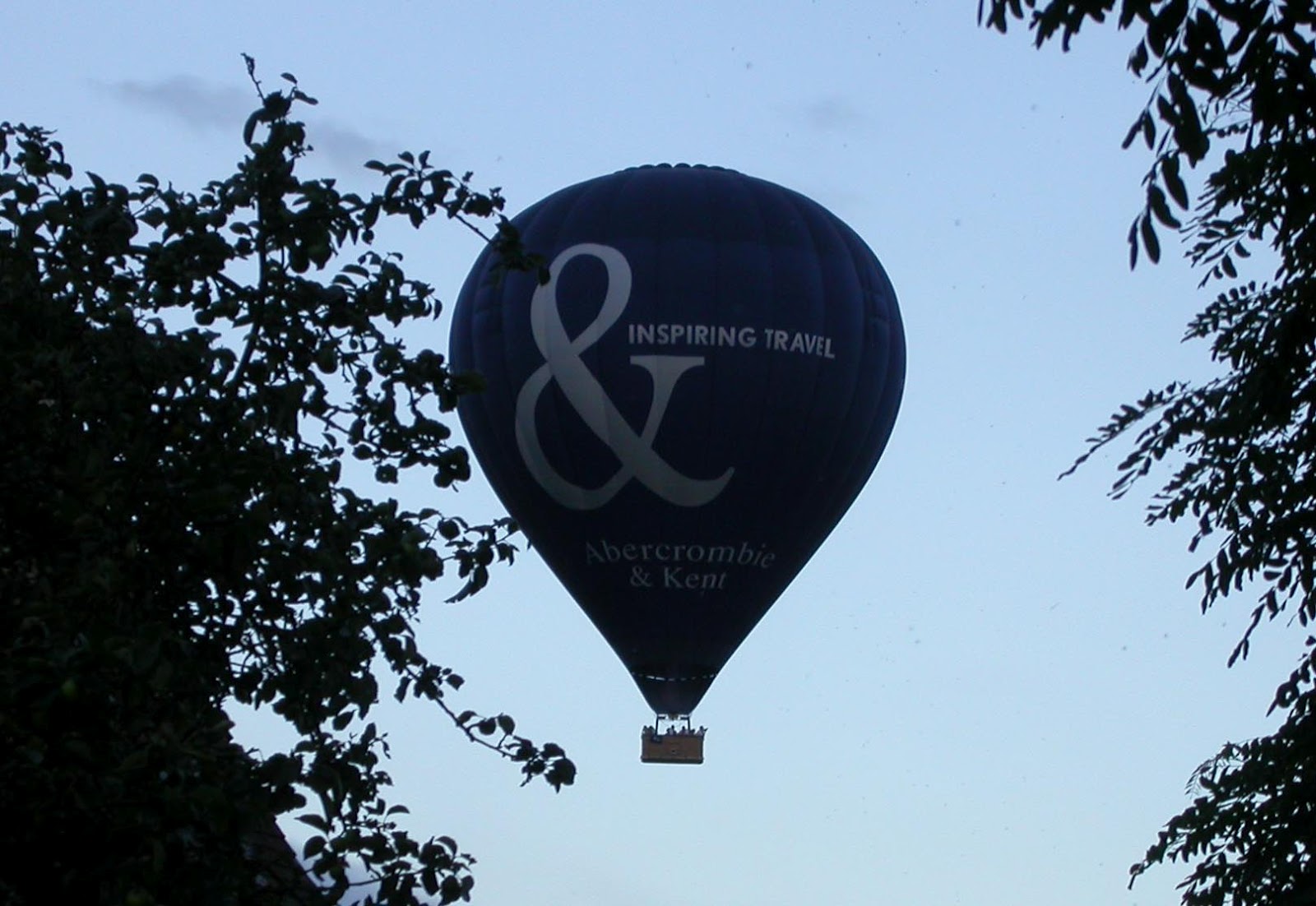
Just setting up the moth trap when this comes over the house at just above roof top level, blotting out the light and setting the neighbourhood dogs barking. I must say I am really impressed by these Robinson moth traps. They say they are the best and I have to agree. Not only do they attract a host of moths but helicopters and now hot air balloons. It will be the Red Arrows next .The balloon was so low that some joker in the basket shouted down a drinks order to my wife in the garden - 2 lagers and a packet of cheese and onion crisps! She told him to chuck down a tenner and she would see what she could do. They landed in the field just behind the house. Some new moths caught later that night were Magpie; Chinese Character; Canary-shouldered Thorn; Green Carpet and the dark form of Coxcomb Prominent.Nothing rare or unusual but nice to see them close up.The moths that is!