Tuesday, 22 October 2024

A Little Bunting on Shetland 4th October 2024


After the excitement of yesterday we returned to earth and a familiar place, The Burn of Sound just on the western fringes of Lerwick and where I had seen a Common Rosefinch, not too many days previously.This site is checked regularly by birders and for a couple of days a confiding Little Bunting had been reported from here.

On a rather dank and dreary morning we joined a handful of birders standing hopefully on the wooden bridge that spans the burn waiting for the Little Bunting to show itself in an adjacent alder tree, if indeed it was still around.For a good twenty minutes it looked like it wasn't as we saw little apart from three Common (Mealy Redpolls) that came to feed close to us underneath the alder tree by the burn.

Common Redpoll

One birder jumped the gun crying 'I've got the bunting' as one of the redpolls, deep in shade under the tree did a good impression of being the so far absent bunting.

Fifteen minutes later the real thing flew in but further up the slope that rises from the stream but luckily was still close to the footpath. Transferring there we found it in a small birch, delicately and methodically picking off black aphids from the undersides of the yellowing leaves. 


For a long time it remained in the centre of the small tree, obscured by a myriad of twigs and leaves  contentedly and ceaselessly picking at the aphids on the leaves but once they had all been examined it moved outwards to the furthest twigs and leaves, becoming much more visible and it has to be said photographable.It was here that you could appreciate just how small it was.


They are, as their name implies diminutive, about Linnet sized and superficially resemble their larger and commoner cousin the Reed Bunting but differ in their bolder white eye ring and bright chestnut cheeks.This bird was quite fearless and showed a total lack of concern at our presence and I am sure if you wished you could have walked right up to it.


For the best part of an hour it fed in its favoured small tree or the one adjacent  allowing us plenty of opportunities to photograph it


Little Buntings are a rare but regular vagrant to Shetland in autumn and are guaranteed to draw admirers. They breed in northeast Europe and across Russia, usually wintering in northern India and northern areas of South East Asia although a few are found wintering in Britain in most years.

to be continued


A First for Shetland and Scotland 3rd October 2024

The Eastern crowned Warbler that I saw at Bempton in 2017.I did not manage to
photograph the Shetland bird but this image pretty much replicates the view I
finally got of it in the willows at Turriefield after a long and frustrating wait

Well satisfied with our visit to Aith and seeing the Golden Oriole we left there in the early afternoon to head home to Scalloway, stopping at a cake fridge by the side of the road.The first cake fridge  commenced in 2012 at Bixter and similar fridges have since proliferated over Shetland to sell all sorts of produce and not just cakes.They are a popular Shetland tourist attraction and rely on the honesty of passers by to leave money for the items they take from within the fridge. With shops only in the main towns and villages  they are also a handy souce of sustenance for the likes of us, out all hours of the day chasing birds in the wilder parts of Shetland!

Cake Fridge near Aith

When on Shetland I join the three birding WhatsApp groups that exist to constantly update visiting and local birders on bird sightings; one is for common birds, another for scarce birds and a final one for rarities  As per usual I checked my phone every time it pinged with an alert to keep up with the latest news.

We were not far down the road when a ping came from the Shetland Rare Bird News WhatsApp.This, as its name would imply, is the one that everyone takes notice of and checks immediately

What was it this time? I looked at my phone's screen and read out the message to Mark who was driving.

'Eastern Crowned Warbler at Turriefield, West Mainland. Feeding in willows along west side of large garden area. Access outside of the trees only'

This was a total mega as it was a first for Shetland and indeed Scotland and was only the fifth to be ever found in Britain.

Eastern crowned Warblers breed in eastern Asia, southeast Siberia, northern and central China, Korea and Japan. They winter in sub tropical areas of Assam, Bangladesh and South East Asia. 

So welcome to Shetland!

Where's Turriefield we both asked out loud and plugging in to Birdguides directions discovered it was near Sandness, a good forty five minute drive away on the west side of Mainland.We were currently on the east side. 

Sandness is fairly isolated and to get to it you drive on a mainly single track road with passing places. Desolate, uninhabited moorland undulates away on either side as the road winds tortuously through it  and to all extents and purposes you could be on the moon it is that deserted and featureless.A landscape populated by sheep, ravens, crows and little else

You cannot drive fast on such roads due to the many hidden bends and blind summits so we took it relatively easily which was sensible as we had to stop occasionally for oncoming cars.

I had already seen  two Eastern crowned Warblers in Britain and Mark three, so although this bird was a must see mega it did not quite have that edge that it would if it was a new species for us.

The big concern, as it always is, was about parking. Just about every birder within range would be heading for this bird including all the local Shetland birders as it was a new bird for them. Would there be space for all the cars in what is after all a small isolated village.

The road, a narrow grey ribbon continued snaking around the whale backed contours of the featureless moors as we headed ever westwards. Another birder's car driving too fast caught up with us but had to slow and follow us heading west

We eventually reached Turriefield which lies on the outskirts of Sandness and looked very much like a market garden wth poly tunnels and rows of vegetable plots. A Shetland version of civilisation after all the barren landscape we had passed through.


From the road we saw the line of willows and a lot of birders standing or sitting in a field on a high sloping bank which gave a panoramic view down the slope to the willows at the bottom.Remarkably, considering the crowd and number of cars we easily found a place to park as the road for some unaccountable reason widened so we would not be blocking any passing car by parking at the side of the road.

We were out of the car in double quick time. the adrenalin now kicking in.There was no time to lose.We followed many other birders walking up the road, then to cross a hazardous barbed wire fence, trying not to lose our balance and dignity encumbered as we were with cameras, lenses and bins, then climb up a slope to join the throng gathered there and looking down on the willows.I recognised some from the Golden Oriole this morning and most of the familiar Shetland birders had made the pilgrimage too

It was obvious that the bird was not currently on show and there was an expectant buzz of conversation in the crowd and constant movement as more and more birders arrived to swell the crowd, everyone with eyes trained on the willows below waiting, waiting for that shout of discovery when someone detected a movement in the trees that was not a wind stirred leaf. 

When it came it was not a shout but a concerted movement left that alerted us and rapidly turned into an undignified crosscountry run as birders ran round the end of the hedge where it turned at a right angle away from us.

Here the field was less hilly and more marshy but we all dutifully stood in a line as someone spoke instructions as to where the warbler was in the hedge.I was fairly near to where it was but just could not pick it out despite regular indications from other birders locating it moving in the trees and bushes.I just could not get onto it.


Eastern crowned Warblers or at least this one, unlike many other leaf warblers do not move constantly and rapidly in the usual hyperactive manner of leaf warblers and.you might think this would be an advantage to finding it but it was the opposite as when it perched motionless for some time unless you had detected it when it moved it was very hard to get onto.I failed comprehensively to locate it when it was stilL but managed a few brief views of it  silhouetted as it moved through the twigs.Most of the time it was at the back of the trees and bushes, obscured by a mass of twigs and leaves which did not help my cause.

No one got a decent photo and most of us initially only saw a flicker as it moved through the hedge. Now it was looking to be heading back to return around the corner of the hedge.

Various shouted confirmations of it being sighted verified this and eventually we were all back on the steep slope where we had started.There came convoluted directions from those who were on it. others with thermal imagers related where it was in the trees but I still had not seen it properly 

The crowd I would estimate as well in excess of a hundred, some said three hundred and sadly not everyone felt able to observe birding etiquette and allowed their anxiety, panic, you name it, to get the better of them by standing in front of others and being inconsiderate.


An eldery gentleman sat in front of me and I gently tapped him on the shoulder only to find it was the legendary Dennis Coutts, someone I am honoured to call a friend and who has seen more bird species than anyone else in his native Shetland.Dennis is now all of ninety but had still the energy and will to cross the fence and yomp across the field as good as the rest of us.

Dennis you are blocking my view.

Here sit next to me.

I  made room for him

Can you see it? he enquired

He gingerly sat down, remarking he might not be able to get up again and I supported his back with my hand.

A minute later revelation came as, at last I located the warbler on a branch mid way up a tree in front of me.As per usual it just perched there for a minute or more not moving at all.I had a clear view of the three broad buff lines on its dark head and snow white underparts contrasting with the green of its upperbody and wings
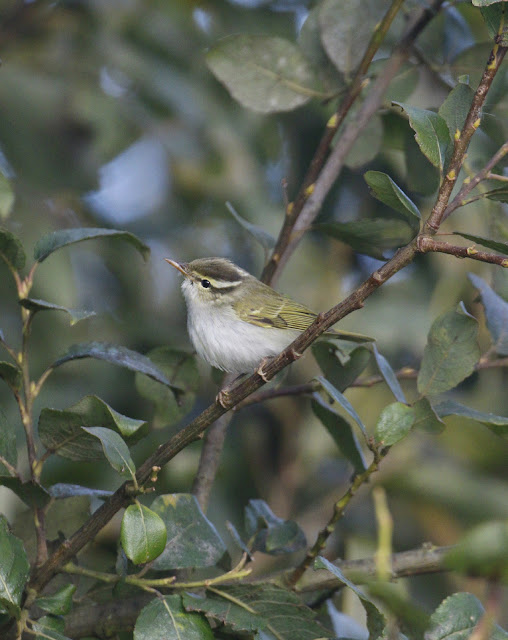
Another image from Bempton

I can see it!  I exclaimed and tried to get Dennis onto it but for one reason or another he could not find it.Then it dropped down much lower near to a tree stump and again perched quite still and fully visible.I could see it but many others could not.

What can you do? I gave Dennis more directions involving tree stumps and fence posts and finally he saw it. By now many others were viewing it too and so it went on as the bird disappeared and re-appeared.

I gave up on the camera as it insisted on focusiing on the leaves and twigs aound the warbler rather than on the bird itself. Too distant for my lens and for many others too.

And so we followed its progress through the trees and in the end I wearied of trying to constantly follow it. Then it all went quiet, the warbler had somehow absented itself without anyone noticing. If truth were told probably most had seen it well by now and settled for that. Others remained in the hope of re-finding it which I believe they did and Penny Clarke managed a really good photo after most had departed.

Mark and myself mutually agreed that it was as good a time as any to leave The early evening light was fading and  the land growing quiet and cold

Quite a day.


Sunday, 20 October 2024

A Golden Oriole at Aith in Shetland 3rd October 2024

A report of a Rosy Starling yesterday, associating with its commoner cousins in a berry hedge at Aith and subsequently in surrounding fields, found us heading northwards once more this morning. It was another sunny day but the strong wind made it feel a wee bit raw.

This was very much a speculative trip as the starling could now be anywhere in the coastal village of Aith. As we arrived much more sensational news arrived via the Shetland Scarce Bird News WhatsApp as it informed us that a Golden Oriole had recently been seen in trees by the Charity Shop in Aith. How convenient that we were at that very moment approaching Aith and we soon found the Charity Shop and somewhere to park right beside it.

All thoughts of the Rosy Starling were promptly abandoned as neither of us had ever seen a Golden Oriole on Shetland and in Autumn they are a very rare bird and only marginally less uncommon in Spring. In fact it has been a very long while since I have seen a Golden Oriole in Britain, the last was when they used to breed at Lakenheath  in Suffolk, more years ago than I can remember.

An additional incentive to catch up with this bird, if one were needed, was the fact we had dipped one, possibly this very same individual, yesterday in a conifer plantation at the Loch of Brouster, near Walls, the bird having flown off strongly to the east just ten minutes before we got to the plantation.

There was no sign of the bird at Aith when we arrived so we split up to cover those parts of Aith that looked to have suitable trees. I met another birder who told me that about thirty minutes ago he had seen it fly from the garden of a house with large sycamores that was just down the road from the Charity Shop  and it looked to have landed in a row of willows near to the local school a few hundred metres away. I wandered over to the willows but there was no sign of the oriole or even the Rosy Starling for that matter.

The news of the oriole naturally brought other birders to Aith too and after some forty minutes of fruitless searching it was discovered back in the garden of  the house it had originally flown from, feeding in the sycamores that surrounded the house. Around twenty birders gathered at the gate of the house and scrutinised the driveway and its line of sycamore trees. The oriole was a nightmare to locate in the leaves of the large trees, its colouring matching to perfection the faded greens and yellows of the dead and dying leaves and to add to our misery the constant movement of the leaves, stirred by the strong wind effectively masked any movement of the oriole.

Various cries of 'I can see it' or 'There it is' inevitably came too late to be of use as the bird effectively hid itself in the tree it was occupying

Frustration levels began to rise

For quite a while all I could detect was the fleeting silhouette of the bird before it was lost amongst the leaves again. We moved to the side of the house where a small cul de sac granted us a different aspect into the garden.


It was a tight squeeze and there were more birders than room so it was far from comfortable viewing.The oriole moved from tree to tree but persistently contrived to remain either invisible or viewable for a few seconds only.


Eventually it showed itself to some for a little longer but I was in the wrong place and failed to see it. More frustration and no little despair! Then suddenly and thrillingly I saw it clearly in the top of a sycamore, peering around searching for prey. It was for moments only but enough to see its greenish yellow upperparts, dark wings and white, dark streaked breast. 


Judging by its plumage I think this bird is a first year male

Many birders having seen the oriole were satisfied with their views of it and departed and hey presto with less of a crowd the oriole showed itself more frequently.Occasionally it made sorties out of the garden to cross the road to trees in other gardens but always gravitated back to this one particular garden where the trees were tallest and leaves thickest.

Then the oriole seemed to disappear and after a long period of absence everyone left to look for the Rosy Starling which had been re-found on a nearby rooftop.

Mark and myself hung on and as we suspected the oriole was still in the sycamores and with only the two of us looking for it eventually showed itself once more and to better effect.


We got our photographs and satisfied we too headed off to look for the starling. Needless to say there was no sign of it on any rooftop but I noticed that there were many Common Starlings congregating in the Community Woodland at the back of the school and walking through the wood came out on the other side to find the Rosy Starling feeding with its cousins in a field full of sheep,The views although distant were adequate.

I called Mark to inform him of my find and he joined me and so a nice double was achieved in Aith but something much, much better, was to come

to be continued


A Red backed Shrike at Sullom Shetland 1st October 2024


This morning after our customary coffee at The Cornerstone Cafe in Scalloway we set off to see a juvenile Red backed Shrike.

This would entail a drive northwards to Sullom, a small settlement of houses that lies on one side of Sullom Voe with the huge Sullom Voe Oil Terminal. situated further up at the head of the voe (a sea inlet

It was a bright but very windy morning as we set off and on arriving at Sullom we found only four other birders standing by the road looking for the shrike 

It had been reported from here for a couple of days and photographed only yesterday from literally by the roadside where the edge of a plantation met the road.This plantation was quite extensive and like most similar plantations across Shetland was presumably acting as a windbreak, although standing on the road it did not appear very effective today due to the wind's direction.


Of the shrike there was no sign so we split up to walk through the plantation and cover the surrounding area of small gardens and fields. Forty or so minutes passed before the shrike was discovered sheltering in some rosa bushes on the leeward side of the plantation and close to the road

We gathered together to admire it and took photographs  as it hunted bees, wasps and other large insects visiting the rosa bushes. It had been reported as having met with some mishap which manifested itself in the form of a suspected broken left wing and indeed when it moved up from a post into a tree by a series of giant hops you could see the wing hanging down but from experience I knew the wing was not broken but badly sprained.


Dire predictions came from Mark that it was a doomed bird but I pointed out that having rescued and recuperated several birds in such condition in my youth, with time the wing would heal. Time however was not on the bird's side but if the weather was kind (not a given with Shetland's capricious climate) and the apparent plentiful supply of prey remained it might stand a good chance of resuming its southward migration.

It certainly did not appear to inconvenience the shrike which despite the drooping wing was highly mobile, using both wings, damaged and otherwise, to assist it in progressing from ground level to the tops of the plantation trees with little apparent difficulty


The other four birders moved on leaving us alone in the road to  watch the shrike moving about, at one point showing much interest in an alarmed  Yellow browed Warbler which after some anxious hopping around and calling in anxiety near to the shrike left for safer surroundings.

We lost sight of the shrike and after a bit of searching discovered it had descended to the wire fence that ran along the leeward side of the plantation and rosa bushes and was a nice sunny spot well out of the wind.

The fence separated the plantation from a large grass field and I suggested to Mark we could get closer to the shrike and improve on any photographic efforts by climbing the fence which would put us in the field right opposite the shrike as it perched on the fence

In Scotland there is the right to roam enshrined in law and in Shetland provided you do not damage fences or leave gates open in areas such as this field it is not a problem to venture into such places.We duly crossed the low wire fence and stood in the wet  field.The shrike for its part showed absolutely no alarm at our presence and we came to realise it was one of those individuals that would tolerate a close approach.


The shrike continued hopping from fence post to fence post and we watched it regularly catching large insects that blundered into the prolific
rosa bushes or caught beetles in the grass below.


We shared a pleasant two hours entirely alone with the shrike which remained for the most part in its sheltered corner of the field. Half way through the owners of the field came down from the top of the field checking on the fences and stopped to chat to us, asking about the shrike and telling us they had no problem with us standing in their field which I may say is typical of Shetland and its inhabitants and leaves one with a very pleasant feeling.


We went back a couple of days later to see the shrike and by now it was capable of flying relatively strongly so its prospects were hopefully positive.


Saturday, 19 October 2024

A Yellow browed Casualty in Scalloway Shetland 29th September

Our accommodation at Scalloway is a house at the top of a hill that overlooks the town with a garden surrounded by huge sycamores whose leaves still cling stubbornly but lifeless to the trees, whilst others that have fallen congregate in drifts of withered brown at the back door, blown there by the wind that eddies around the house on most days.

This morning, leaving the back door, a tiny corpse lay in front of me underneath a ground floor window. It was a Yellow browed Warbler, possibly the one we had heard calling from the sycamores a day earlier.

I picked it up, its feathers sodden from a rain shower and left it to dry on a paper towel in my room. It was so poignant looking at its tiny form, hardly bigger than a Goldcrest  and realising what a vast distance it had travelled  and how perilous was its journey only to end prematurely by colliding with a window.


The sight of one of these world travellers flitting through the trees on Shetland always brings a thrill. Often its presence is revealed by its anxiety call, a loud tsweeet note.You look up into a sycamore struggling to detect a movement that is different to the constant flickering of leaves in the wind.You find the bird eventually and in the bins it is revealed as a tiny avian gem of moss green upperparts and yellow stripes above the eye and across its wings.Then it disappears into the leaves and becomes as one with them once more.

This autumn has seen many Yellow browed Warblers arrive in Shetland.For instance on the 2nd of October one hundred and thirty were counted in Shetland and there must have been many more that went unrecorded. It is no longer classed as even scarce but accepted as common by resident Shetland birders.

No one can be sure why part of the population of a species that normally heads southeast to southern Asia, from its breeding grounds in Siberia,  is now migrating northwest, in exactly the opposite direction and expanding its range into western Europe. 

The increase of records in Shetland correlates with those in Britain with around seventy being reported annually fifty years ago, rising to more than eight hundred in 2003, then up to two thousand in 2017 and showing no sign of stopping.Some years are better than others but the rise in numbers is inexorable, the birds seeming to arrive in waves.


An unprecedented five have so far been recorded this autumn in my home county of Oxfordshire too

Reflecting on the Yellow browed Warbler, I kept the warbler theme going on a grey morning by heading to the outskirts of Lerwick and Clickimin Loch in particular which is bordered by a popular pathway much used by the public and visiting birders.The sides of the pathway are bordered by mainly birch and other species of small tree and attract many migrants. Who can forget the White's Thrush that resided here for a few days in 2022? see here

No such mega today though but a Barred Warbler was reported as showing well in the birches.This is a robust, bulky bird with a long tail, more like a small thrush than a warbler and can be very confiding.Invariably they are first year birds dressed in an overall plumage of pale grey with very little variation and are unmistakeable when seen.

I soon found the bird near the top of a small birch picking black aphids and the occasional berry from the undersides of the birch's yellowing leaves.It had none of the finesse of a male Blackcap also feeding in the tree but  moved ponderously from twig to twig as it examined the leaves.


Barred Warblers breed in southern Scandinavia eastwards through Russia to Siberia and normally winter in East Africa.They are not uncommon on Shetland at this time of year especially with the northeast winds that have been prevalent  for some days now


I had already seen four this autumn before this confiding bird but they are always nice to see especially when allowing such close views

to be continued

.


Friday, 18 October 2024

A Pechora Pipit at Quendale Shetland 28th September 2024

Mark and myself, being based in Scalloway had been mainly concentrating on birding that part of Mainland, the largest island in Shetland, south of Lerwick and today we had an incentive to return there like no other, as a report came in the early morning of a Pechora Pipit being discovered at Quendale Mill.

Quendale Mill is a well known and very popular place to go birding as many a major rarity has been found there and it is covered daily at this time of year from dawn to dusk by various birding groups and independent birders such as us.

It is a forty five minute drive from our house in Scalloway to Quendale Mill and we knew when we got there we would be in the company of many other birders keen to see this charismatic ultra rarity from the East.

Pechora Pipits are one of those select species that any serious birder who comes to Shetland hopes to see.They breed in northern Siberia, northeast China and southeast Russia and spend their winter in Indonesia and The Phillipines.So this bird at Quendale had come a very long way and in the wrong direction.

They used to be a Fair Isle speciality, a bird of myth and legend that you had to make an extreme journey to go and see on that fabled island, lying between Shetland and Orkney.In latter years it has been encountered in other parts of Shetland too. To date 122 have been recorded in Britain and 95 of those are from Shetland which constitutes a remarkable 82% of all records. Very much a bird of the North.

The last one recorded in Shetland, which I went to see, was at Hillswick on Mainland in October 2022 which was frequenting an extensive iris bed and prompted a large twitch resulting in only flight views of the bird and brief views of it perched on a wall.It was not a particularly edifying spectacle with the bird never visible on the ground and consequently being continually flushed.

Would it be the same at Quendale? Probably not as the topography was not so conducive to the bird being flushed.

We arrived at Quendale Mill to find a reasonable crowd but not as many as I had feared and nowhere near the scrum that had been at Hillswick.Everyone was well behaved and stood on the track that runs away from the Mill towards a disused quarry. 


On one side of the track was a fence beyond which lay an adjacent burn, iris beds (known as seggy's in Shetland) and rank vegetation and on the other, similar irises, rough grass and a drystone wall.

As we headed up the track we could see birders looking at presumably the pipit in the irises by the burn but almost immediately the pipit flew up and over the track to disappear into the irises on the other side by the wall.

Well that was quick.At least we have seen it. I remarked 

Obviously we wanted to achieve much better than this but at least some of the inevitable anxiety and pressure that comes with chasing rarities was assuaged.

Mark however was determined to get a decent photograph

We joined the crowd and waited to see what would happen but.the pipit remained hidden for quite some time before flying up out of the irises onto the wall and perched there for a couple of minutes giving spectacular views. 


I have seen three including this one, in Britain and went to see my first one, not in Scotland but in Pembrokeshire in 2007. In appearance they are boldy streaked on their upperparts, this impression accentuated by prominent white stripes along the sides of the mantle.The wings have two prominent wing bars and the white underparts are heavily streaked with black on the breast and flanks. 

Having revealed itself to one and all ithe pipit flew down into the irises and was gone from view. 

Both of us then stood around until it showed itself again on the wall and was, as before, just as obliging and this behaviour formed a pattern throughout the day.The pipit disappearing for some time then re-appearing for a brief spell on the wall as if to check all was well.

We were both pleased with our photos and as the bird was so showy many were satisfied with the views they had got and departed and as the number of birders decreased the pipit became more showy still.

We spent almost the entire day here watching and photographing it.Mark being the keen and very good photographer he is likes to get the ultimate image so we were not going anywhere but that was fine with me.

For some variety I went to a small copse by the start of the track and found a Yellow browed Warbler. Quendale Mill is now a visitor attraction and is situated amongst a working dairy farm, the buildings stark and the roads permanently wet and muddy.I wandered around the back of the barns and found a couple of Barred Warblers in a stand of nettles with a huge flock of House Sparrows and Starlings


Quendale Farm

We went home but Mark never satisfied wanted to go back the next day assuming the pipit was still there.Who was I to argue.

The report of the pipit's continued presence duly arrived in the morning and we set off for Quendale

When we got there we discovered the pipit had transferred to the other side of the track where the burn ran alongside and iris beds proliferated. As with yesterday it was almost immediately on view and continued to be so for most of the day, threading and weaving its way, with pink legs and long pink toes over and under irises and grass, much like a combination of a Lanceolated Warbler and an Olive backed Pipit. I mainly watched it today rather than take a huge number of photos and saw it bathing at least three times in the burn and pulling small worms from the mud as well as catching other invertebrates.It was constantly active and feeding apart from the bathing sessions and when on several occasions it came particularly close I indulged myself with my camera.Well who wouldn't? 


By the end of the day we were down to only four of us diehards but two days with a showy Pechora is what it is all about.I doubt I will ever get to see a Pechora Pipit so well again.

to be continued