Saturday, 6 July 2024

Marsh Helleborines in Oxford July 2024

Within the city limits of Oxford there is a narrow and shallow valley of greenery that runs from north to south between housing, two hospitals and all the other manifestations of urban life This is the Lye Valley, a Site of Special Scientific Interest (SSSI) in Headington, a suburb of Oxford and part of the Lye Valley Nature Reserve owned by Oxford City Council and jointly managed with BBOWT (Berks, Bucks and Oxon Wildlife Trust). It is without argument a delightful surprise  to come across this unexpected  oasis of tranquillity and calm amid all the bricks and concrete that crowd in around it.

Apart from its aesthetic and recreational properties the Lye Valley is ecologically significant as it comprises a 14000 years old, internationally rare habitat, a tufa forming, alkaline spring fed fen that represents 1.5 hectares of the only 19 remaining hectares of this habitat in England. It supports over 20 species of plant rare in Oxfordshire of which 14 are also on the Red List of Threatened Species compiled by the  International Union for the Conservation of Nature (IUCN). The Friends of Lye Valley (FOLV) are a group of volunteers who tend the reserve in order to maintain its ecological diversity.

The plant and animal species of the Lye Valley fen are thought to have lived there since they colonised the spring areas after the retreat of the last ice age, between eight and ten thousand years ago. However being situated in a city it is under constant pressure from development as there are a number of different landowners who can and do make planning applications for the various parts of the valley they own to be developed for housing but so far the aim of restoring the whole valley as a natural green area of land with a mosaic of wet and dry habitat remains on course.

Dr Judy Webb who founded FOLV and is an ecologist has said,

'Either we make a special case for protecting this most important area or we give up and go home'.

Lye Valley is stuffed with rare plants and nationally scarce invertebrates that make it an absolute delight to walk through on the boardwalk that forms the northern part of the footpath that passes down the middle of the reserve and which is best known to me for its breeding frogs which come for a brief few days in early Spring to mate and spawn in a series of small ponds right by the boardwalk. see here

Today I had something else on my mind, Marsh Helleborines which although declining nationally grow here in good numbers (1689 flower spikes were counted in 2023) and are to be found close to the boardwalk. However all is not well as the helleborines grow in two distinct wet areas of the reserve. one in the northern part,(North Fen) the other in the southern part (South Fen) and are separated by a large dry area of woodland that has encroached over the years.The hope is to unite the two wet areas by removing the trees, as currently the main pollinator of the helleborines which is a hoverfly cannot traverse the dry woodland area as it is too wide for them to negotiate.

Parking the car in a typical suburban road, situated at the northern end of the valley, I walked a few hundred yards south to an opening between the houses that granted access to the valley.

The reserve today was lush with many varieties of wild flora, Common Spotted Orchids and great masses of golden yellow Greater Bird's Foot Trefoil being particularly prominent. 

The North Fen and boardwalk looking north

Following the boardwalk as it gently descended, alongside the Lye Brook which feeds the fens I eventually came to the helleborines, lurking a little way off to the right of the boardwalk, growing amongst orchids, horsetails and various other plants in the boggy North Fen.


Marsh Helleborines are classed as uncommon and in most areas of Britain are decreasing, especially in southern England.They are mosttly found in calcareous fens, wet meadows, marshes and dune slacks in coastal areas of East Anglia, south and southwest England and Wales.They are rare in Scotland but occur on the west coast on some of  the Hebridean islands. In Oxfordshire I know of three sites. all protected reserves where the water levels are maintained so they can thrive.One of the main reasons for their decline is the trend to drier summers and a loss of habitat due to drainage and water extraction.

Marsh Helleborines are very attractive, arguably one of our most beautiful native orchids and can be said to conform with the layperson's idea of what a typical orchid should look like.The flower spike that may be up to 60cms tall can carry up to twenty small flowers, all on one side of the stem and each a masterpiece of colour and composition. This morning each flower's white lip with a citrus yellow base shone with an enhanced brilliance in the sun, surrounded by a bonnet of three sepals of pale greenish white on the outer surface and streaked pink on the inner.


I had no real need to leave the boardwalk to admire these appealing and glamorous orchids as they stood in the sunshine in their boggy habitat.Their often underestimated beauty there for all who cared to see. 

Wednesday, 3 July 2024

Pyramids in Gloucestershire 2nd July 2024

Well it was back to normal this morning as the weather reverted to being grey and chilly, courtesy of low cloud and a northerly airflow. July is traditionally said to be the hottest month of the year but not today that's for sure.

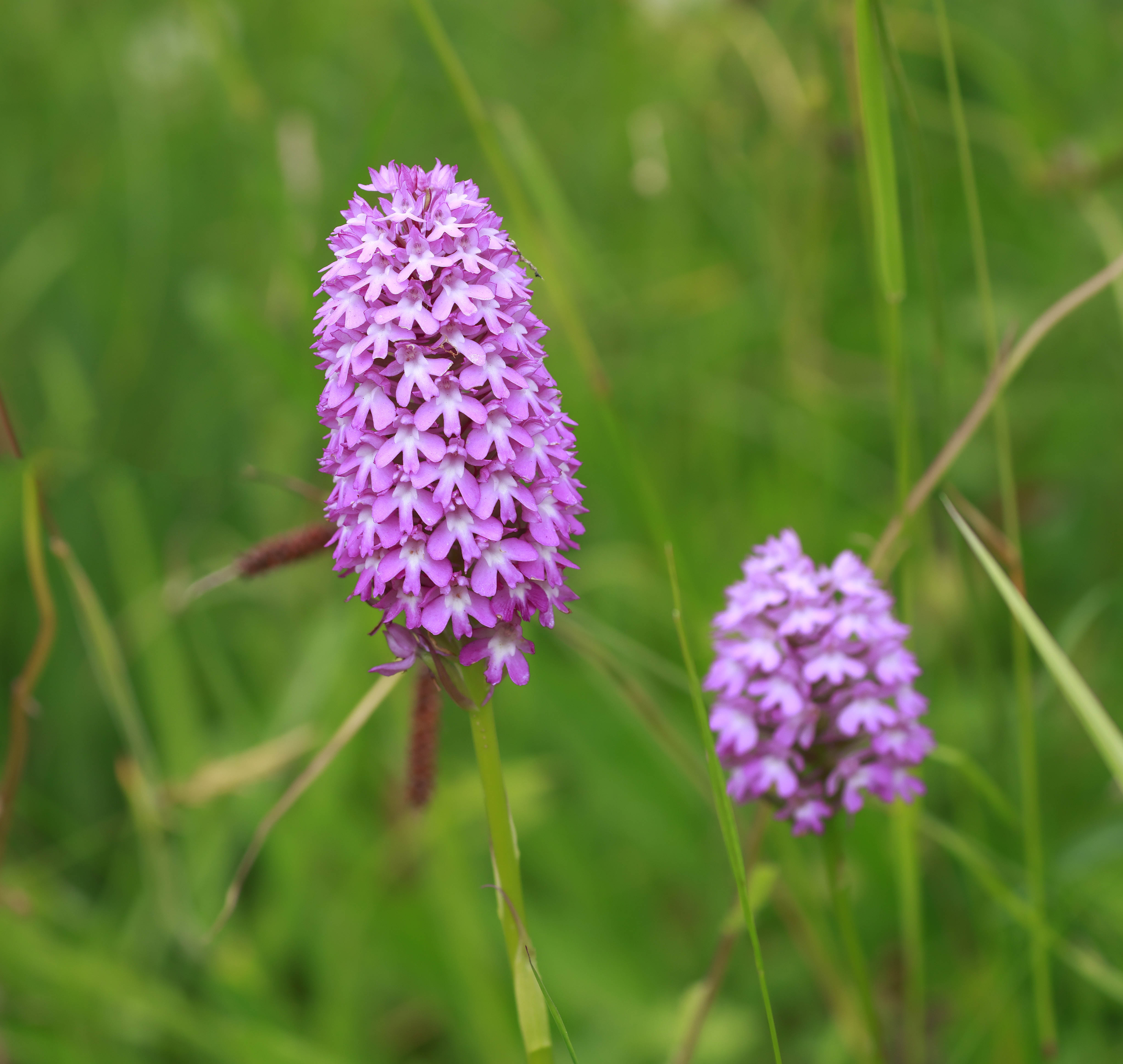
Thankfully my current obsession with orchids is unaffected by the weather.Unlike butterflies they remain obvious and detectable even in the worst of weather.This morning I made a relatively short journey to The Cotswold Water Park in neighbouring Gloucestershire in search of a variant of what still is a widespread and locally common orchid, the Pyramid Orchid. 

I can do no better than quote from David Lang's excellent book 'Britain's Orchids' in which he writes:

'It is a robust colonist and can add a welcome splash of colour to roadside verges,abandoned quarries and even industrial wasteland.'

Today hopefully I would get my first ever sight of the rare alba (white) form of this beautiful orchid.

I was following up a lead given to me by Duncan that directed me to a rather unlikely orchid  location by a roundabout on an intersection of the A419. Between this busy road and another lay an area of undisturbed grassland you could almost call it waste ground that has been either ignored or deliberately left by Gloucester Highways Dept to grow unrestricted, and here, un-remarked and to a greater extent un-noticed, lay a veritable treasure trove of Pyramid Orchids amongst waist high grass.

And not just orchids but a wealth of other flora lurked amongst the waving stems of grass. Drifts of hazy blue meadow cranesbill, white oxe eye daisies with egg yolk coloured centres, yellow hawkbit and ragwort, clover both white and red were here in abundance. No one else was likely to venture here unless they knew. Cars passed alarmingly fast and close by me as I stood at the margin of this delight.

I was pleased that no one would come here to destroy this habitat.But here is the sad part - it is only in forgotten pockets like this or nature reserves with habitat carefully and artificially maintained  that much of our natural flora can now thrive. Many roadside verges are still mown unnecessarily, turning the natural into sterile anonymity.

Even amongst all this hidden beauty lay the less appealing evidence of uncaring humanity with discarded drink cans, an empty coke bottle and discarded sandwich wrappers thrown needlessly from passing vehicles into the grass.Out of sight and out of mind.

Averting my eyes from this disgrace to the overwhelming presence of so many Pyramid Orchids was a joyful and welcome diversion.And what superb specimens they were. I have never seen larger, more  magnificent specimens. Inches tall magenta cones of flowers, each pulsing with intense colour, crowning a single green stalk and in such profusion.There must have been in excess of a hundred and fifty plants here.


But where to park the car to access the grassland in what was after all a hostile and intimidating location for anyone on foot?  There was nowhere apparent but circumventing the roundabout in my car for a second time I found a small lane adjacent to the orchid area where I could leave the car, somewhat precariously, on a bare patch of earth away from passing vehicles.

Retrieving my camera from the car I walked back to the busy road and set about searching, on the near  side of the road, a narrow strip of scrubby grass and found a wealth of normal pyramids but not a sign of any alba specimens.

Logic told me they must be on the larger area of grassland on the other side of the road.At least that is what I hoped

I waited until it was safe to cross the road as a huge truck passed at speed within feet of me.

Wading into the high grass I marvelled at the profusion of Pyramid Orchids and their magenta pink heads   but although a magnificent sight I was unable to appreciate them fully until I found the true prize -the white examples that I had been told about.


White Pyramid Orchids are rare and hard to find so I was keen to locate them and set about searching the grass. Again normal pyramids were here in abundance, they seemed to be everywhere but where were the white ones?


Near to the road in a small depression I finally found the large head of a pure white Pyramid Orchid.Unmistakeable and such a delight to see. Close by were others although not many.I counted ten.That was more than sufficient.


The flower head on the first one I had discovered was easily the finest. A fat and fulsome tower of pure white flowers more cylindrical than pyramid shaped and contrasting with its more populous magenta coloured neighbours.

An absolute beauty and as with anything new, exciting to see.

I wandered around this small area but could find no more so left the orchids in their unlikely roadside sanctuary and rewarded  myself with a coffee and brownie at a nearby cafe.

What a pleasant and fulfilling morning.


Sunday, 30 June 2024

Frog Orchids in Oxfordshire 29th June 2024


Enthused by my recent trips to view some of the fifty or so different species of orchids growing wild in Britain I am naturally keen to continue the experience but although immensely grateful for information being passed to me by Duncan and Peter about where to go to look for wild orchids I  now felt the urge to attempt to find my own.

I decided on the Frog Orchid. 

Quite some time ago I saw a small colony of them at Aston Rowant NNR, that lies just within the southern boundary of Oxfordshire but never went back to check on them, spending all of the subsequent years being distracted by looking at the many species of butterflies found on the reserve.

With the weather set fair for sunshine and a pleasant warm breeze I decided to take a chance and go back to Aston Rowant and see if I could locate the Frog Orchids, assuming they were still there. I could remember approximately where they had been on what is a very large reserve but not the precise location and the subsequent passage of time would certainly have dulled my memory.

I left it until early afternoon to visit but my journey was disrupted by a serious accident on the M40 motorway  which brought traffic to a standstill just before the junction where I needed to turn off. Frustratingly, three lanes of traffic edged at a snail's pace  towards the turnoff but eventually I made it and was soon parking in an unexpectedly deserted car park at the top of the reserve.

I took a track that runs along the top of the slope looking down to the motorway and saw the lanes of static traffic on the southbound carriageway had now cleared.

I rejoiced that I had escaped the motorway and was now high on the hill enjoying the surrounds of nature.Between me and the distant motorway lay a steep and sloping escarpment, a sea of summer grasses swaying in the wind with the bright magenta heads of  Pyramid Orchids, hundreds of them, glowing like precious gems within the grass.


I walked onwards, uncertain of how far to follow the track but pursued it to the end where it wound off to the right and over a rise, closing out the sound of the motorway. I passed through a gate at the very top opening onto an area that looked familiar but was daunting in its extent. A carpet of multi coloured downland flora and herbs greeted me and frankly, even if I failed in my mission, I felt the effort would still be worth it just to experience this sensory overload of colour and floral profusion. I encountered no one in this lonely spot and commenced wandering across the expanse of sward thay lay around me. Still unsure if this was the right place.


To walk on this ground was refreshing after the hard chalk of the track as the density and springiness of the short vegetation underfoot cushioned my feet, almost as if I was walking on a deep pile carpet with all the while the faint scent of wild thyme lingering on the air. Another half an hour passed, still with no result and I found myself back at a spot I was sure I had covered before.My eyes felt strained from constantly and closely scrutinising the ground below me.

Vague tracks left by the sheep which graze here in winter meandered through the flora.I followed one as orchids often have a preference for such tracks but met with no success. I began to doubt myself but persisted in my search.Maybe that patch over there? Maybe this one? I was floundering I had to admit. 

Much of the habitat was so alike but also looked a little too lush for orchids so I looked for areas with shorter grass, that were more open and sparsely vegetated. Areas where herbs such as wild thyme, salad burnet and other low growing plants I could not name grew.

Frog Orchids are short and unspectacular, just like the Musk Orchids I saw on Wednesday, marginally duller and blend perfectly with their surroundings which makes them the devil to locate.The flowers vary from yellowish green to reddish brown and with a generous use of imagination can look vaguely like a frog.You really have to concentrate to pick them out from all the weird and wonderful confusion of flowers, leaves and stalks at your feet.

Frog Orchids are described as local and are in long term decline. The Plant Atlas 2020 describes them as potentially Britain's fastest declining orchid which does not bode well.  Although widely distributed in northern and western Britain they are only to be found at a relatively small number of sites and have also declined in central England and East Anglia but are said to be still present in reasonable numbers on the chalk hills that run from Sussex to Wiltshire.The reasons for its decline are linked to improvements in agriculture, undergrazing and more recently droughts.

Over an hour of fruitless searching had passed and I had all but given up and was returning to the main track and as I did, there right at my feet was a Frog Orchid. A eureka moment instantly followed by relief that I had managed not to tread on it..

My sense of achievement was almost overwhelming. An absolute joy of discovery and a feeling of self satisfaction enveloped me. I even let out a  cry of triumph, there was no one around after all.

For a minute I stood looking down on my unassuming  prize - no more than two and a half inches high with mostly tightly furled buds giving it a distinctive knobbly appearance.It will soon open its buds in the coming days but this did not concern me, all that mattered was it was a Frog Orchid, I had found it myself and best of all, despite declining nationally there were still Frog Orchids growing here after all the years that had passed since last I had found them here.


I took some images, careful not to flatten the vegetation in case it would betray its presence but need not have worried as the vegetation underfoot was so thick, short and tightly bound together it just sprang back and you  would never know anyone had been here.

Fired with renewed enthusiasm I endeavoured to look for more.All those years ago I had found quite a number.Surely there should be more or was this the only one left? Careful not to tread on any undiscovered orchids I wandered around looking but for some while met with no success but then with 'my eye in' I found another two and then another three in discrete pockets nearby and so it went on until I had found exactly thirty spread over two relatively close areas.

Most were nowhere as tall as the first one I had found and were very hard to discern unless you knew that they were likely to be there.So unassuming in both colour and form they almost melted into their surroundings. As with the Musk Orchid this works to their benefit as few if any will notice them even though they are relatively near to a track used by dog walkers and hikers.


I found another small colony nearer to the gate, right by the track and one of these was of the reddish brown form as opposed to the original one that was yellowish green. Even better as I took its image I noticed it was more advanced with its frog shaped flowers more fully open.


I had spent two very pleasant and rewarding hours up here, in my own world and encountering absolutely no one.I returned the way I had come and there was time to admire a Clustered Bellflower and an aberrant pale pink Pyramid Orchid as I made my way back to the car, feeling a palpable sense of triumph at having found the Frog Orchids.


Clustered Bellflower


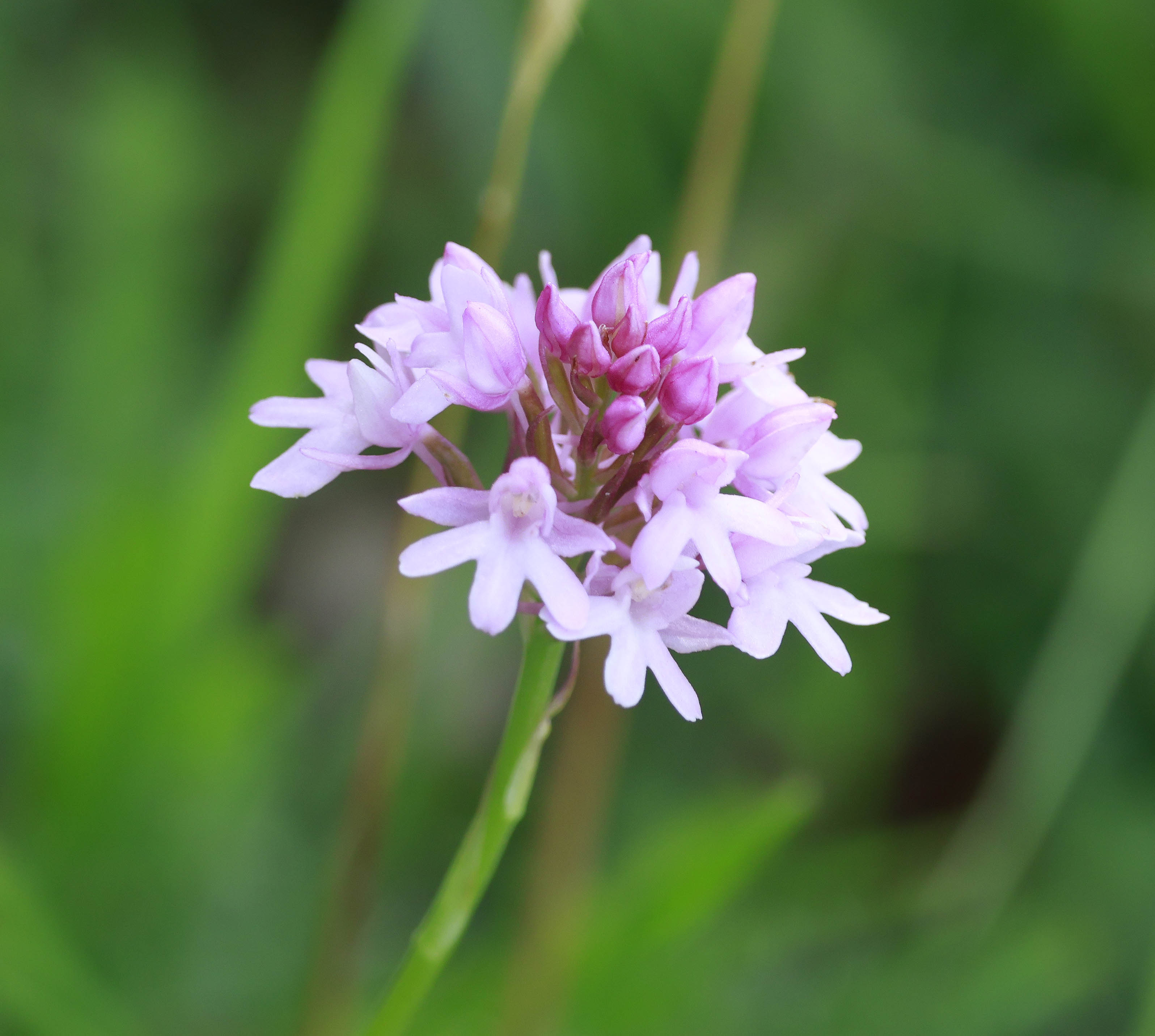
Aberrant Pyramid Orchid

There is no better feeling. Little inconsequential things such as this are the stuff and variety of life that make it all worthwhile.

Postscript

I went back on Sunday the 7th of July and conducted a more thorough search and found no leas than fifty two Frog Orchids including two that were at least fifteen centimetres high.


Friday, 28 June 2024

Musk Orchids in Gloucestershire 26th June 2024


Another summer's day and one predicted to be the hottest so far this year, not that there have been many to compete with. I took a notion to take full advantage and go to Cleeve Common which lies some 330m above sea level and is part of the  limestone escarpment that forms the northern edge of The Cotswolds. From here you can look west, down and over to Cheltenham in the distance  with its famous racecourse and then beyond to the River Severn and even into Wales.


The
 reason for my visit was to see some Musk Orchids that grow beside a narrow track that runs aslant the western face of the hill, an area of limestone grassland designated as an SSSI. Musk Orchids are designated as Nationally Scarce, mainly due to loss of suitable habitat such as the ploughing up of old grassland, and scrub encroachment due to the reduction of sheep grazing. Their habitat preference is very precise in that they will only grow in short turf on chalk or limestone, favouring the contour hugging terraces formed by sheep trails on steep and sunny slopes.They are restricted to southern and south eastern England and The Cotswolds mark the northernmost extent of their range

The last time I saw Musk Orchids was a very long time ago when I lived in Sussex and on behalf of Sussex Wildlife Trust acted as Honorary Warden  of Ditchling Beacon Nature Reserve near Brighton. That was some thirty plus years ago. I found many growing in the old chalk pits, their other favoured habitat, that lay beside the infamous road that rises steeply to the top of the Beacon. Few ever came to see them as they were well removed from the main part of the reserve and could only be accessed by a very hazardous descent from the top. For the ten years I lived in Ditchling they were a treasured secret known just to myself and the Trust.

I expected such a well known beauty spot as Cleeve Hill to be popular on a day such as this but was surprised to find only one other car parked at the top. I was entirely alone as I took the track out onto the steep grassland slope. The joy and benefit of being outdoors on a day such as this, surrounded by a wealth of grassland flowers and particularly orchids in some abundance was not to be underestimated.

Musk Orchids are I suppose an enthusiasts orchid and lack the spectacular form and colourful presence of many of our other wild orchid species. They are yellowish green, very small, tiny even and rarely grow much above six inches, often a lot shorter, dwarfed by the limestone grasses and flowers. They are a hidden, honey scented gem, difficult to spot, that brings a delight way out of proportion to their size when they are discovered.

My task at finding them was made far easier with directions courtesy of the estimable Duncan D so I knew where to look for them but it still took a while to get my eye in. One great anxiety was would I remember what they looked like after a gap of over thirty years!

In my search I inevitably found other orchids.The always fascinating Bee Orchid was present in good numbers, its flowers a marvel of mimickry on their strange convoluted stem and surprisingly hard to see amongst the escarpment's grasses.


More obvious were the many Common Spotted Orchids, well you could hardly miss them they were so prolific, raising their towers of pink flowers well above the grass on sturdy stalks.

Most spectacular of all were the Pyramid Orchids.Unmissably colourful, the pyramid of rich, bright pink flowers almost glows with the depth of colour, as it is held aloft amongst the waving grasses on a long and firm stalk of green. Unlike the spotted orchids each plant is spaced well apart from others of its kind, the plant appearing to prefer to grow in isolation and maintain its own space which only serves to enhance their individual beauty. However in other locations I know they can grow closer.


I walked the particular part of track I had been directed to and found the bench that was also mentioned in the directions and there were two Musk Orchids right by the track. I realised later that I must have walked past several others that were not so obvious but not to worry, the main thing was I had found two at least. One was a good height for a Musk Orchid, being almost almost five inches high. The other next to it somewhat shorter.

Once the honours had been done and the unremarkable duo photographed I could relax and enter the spirit of the  place. I had achieved all that I wanted  but was loathe  to leave such a pleasant spot. Having planned this trip and made the journey I felt I should give it more of my time as I would undoubtedly feel unfulfilled if I left now.Thirty years is a long time and the Musk Orchids deserved better of me!

I slowly walked the track again, back and fore, even descending down the steep slope a little way and as usually happens I began to find many more Musk Orchids hiding discretely in the grass. A minority were so tiny they hardly made it above ground but most were around a couple of inches high and usually in twos or threes although occasionally I found a larger grouping and in one case up to eleven were together. At times I had to lay on the warm ground to photo them from ground level they were so small.

I counted over a hundred but there were many more, of that I am sure, hidden in the grass. their pale greenish yellow flowers hardly making them conspicuous. I reflected that their inconsequential presence and unremarkable colour was probably their salvation in that they are so easily overlooked unless specifically searched for and as a consequence are left undisturbed.

I wearied of walking and taking photos in  a sun that was now very hot so sat on the bench and regarded Cheltenham far below me in the distance.

I had no desire to be in a town and it was as if I was in an alternative world up here on Cleeve Hill

But the time came when it was right to leave and I made my way back to where I had left the car beside the lane. A Tree Pipit sang from the top of a hawthorn as I made my way back up the track to the lane. Taking one last glance at a mass of spotted orchids I thought one looked  different.

My interest in British orchids is still in its infancy and I am the first to admit I have much to learn. Not quite sure what it was I took some images and back at home after checking some reference books found it was, I think, a Chalk Fragrant Orchid, possibly of the alba form. It looked very white in real life but my images show a hint of pink. Help!


At least I think it is a Chalk Fragrant but if anyone feels I may be mistaken and wishes to enlighten me please feel free to let me know.