After thoroughly enjoying two days birding in Norfolk a month ago, Mark and myself decided to repeat the experience and thus arrived at Burnham Deepdale on Wednesday morning. Like last time we would stay at the hostel there on Wednesday night.
Both of us in our own idiosynchratic way find Norfolk in winter very much to our taste as it provides a diversion from the various troubles and anxieties that are currently ongoing at our respective homes. We would be re-charging the metaphorical batteries, if you like, after a long winter.
Unlike last time there were no rare birds to see but that was alright as we were content to just go back to basics, watching commoner birds and enjoying their undoubted beauty while photographing them.
What is not to enjoy either sitting in a hide or on a bench, overlooking a saltmarsh with camera in hand?
On Wednesday we spent the day at the RSPB's Reserve at Titchwell, taking in whatever we found with a free wheeling of spirit.
Here are some of the encounters during our visit
Black headed Gull
Basing ourselves initially in the Island Hide at Titchwell we looked out to a small scrape of mud in the lagoon that had been commandeered by Black headed Gulls, already well into the spirit of the season by displaying and sorting themselves into pairs prior to the business of building a nest, laying eggs and rearing young.
One of the gulls was flushed with a delicate rose petal pink on its breast and belly, quite distinct from the other surrounding Black headed Gulls. I have seen this plumage on only a few occasions and it is by no means as frequent in Spring on Black headed Gulls as it is, say, on Little Gulls but when it does occur it imparts a certain extra elegance and visual delight to what is already an attractive gull in its breeding plumage.
From its behaviour it looked to be a male and for some time adopted the various postures and contortions that comprise its nuptial display. After an hour it and the other gulls ardour seemed to subside and the displays and interactions dissolved into indolence although this male was keen to remain and protect that part of the island it considered its territory.
Dark bellied Brent Geese
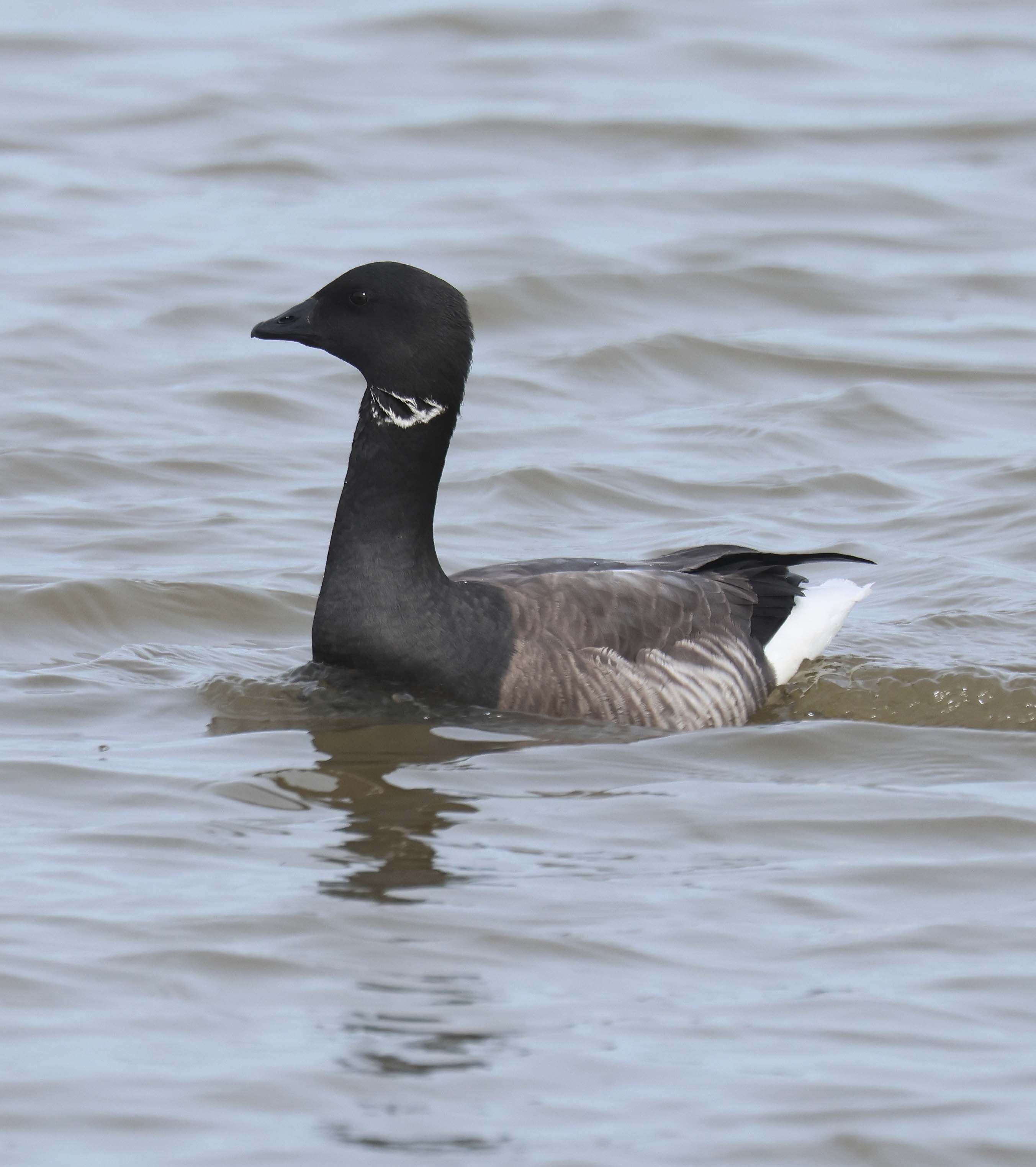
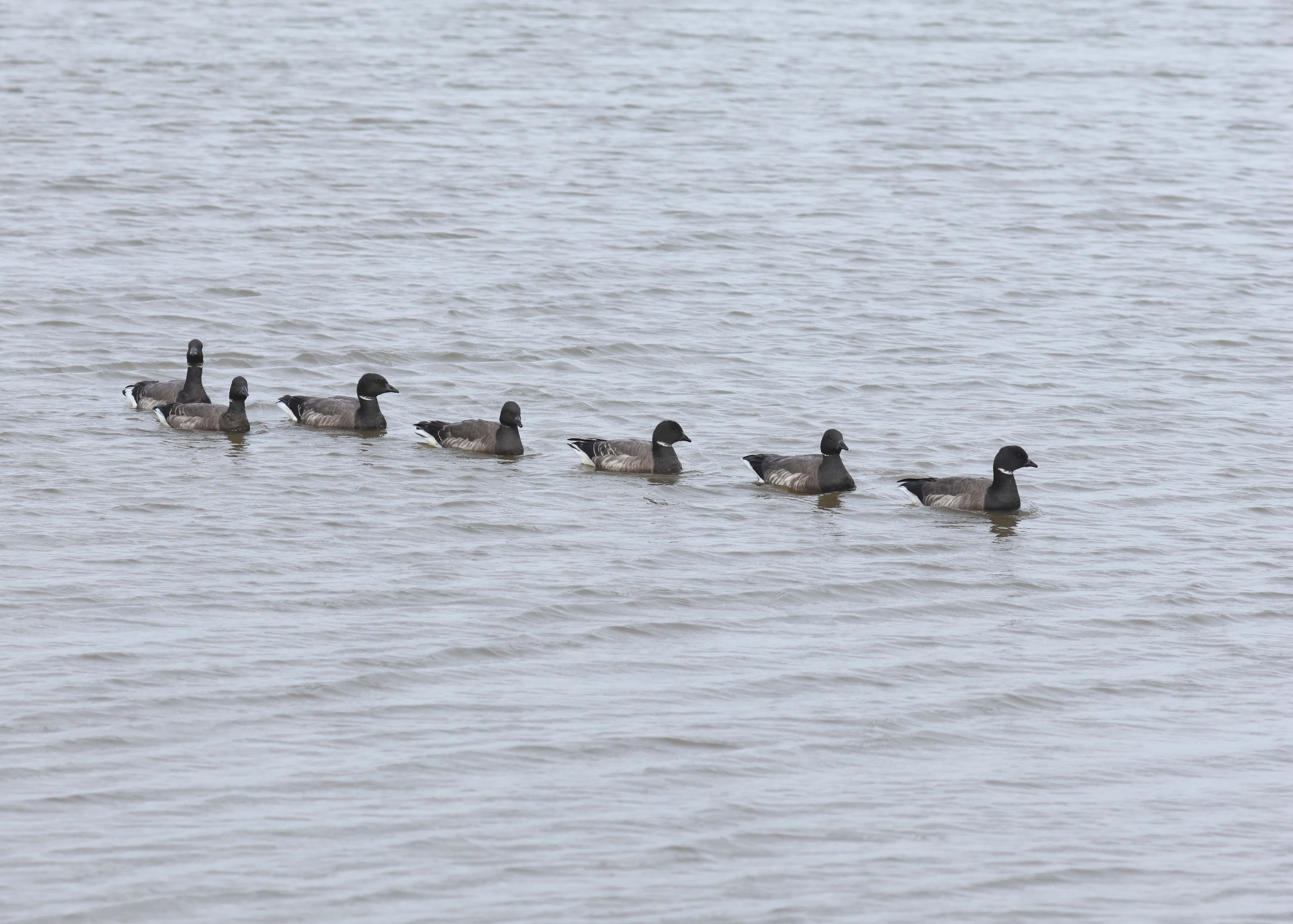
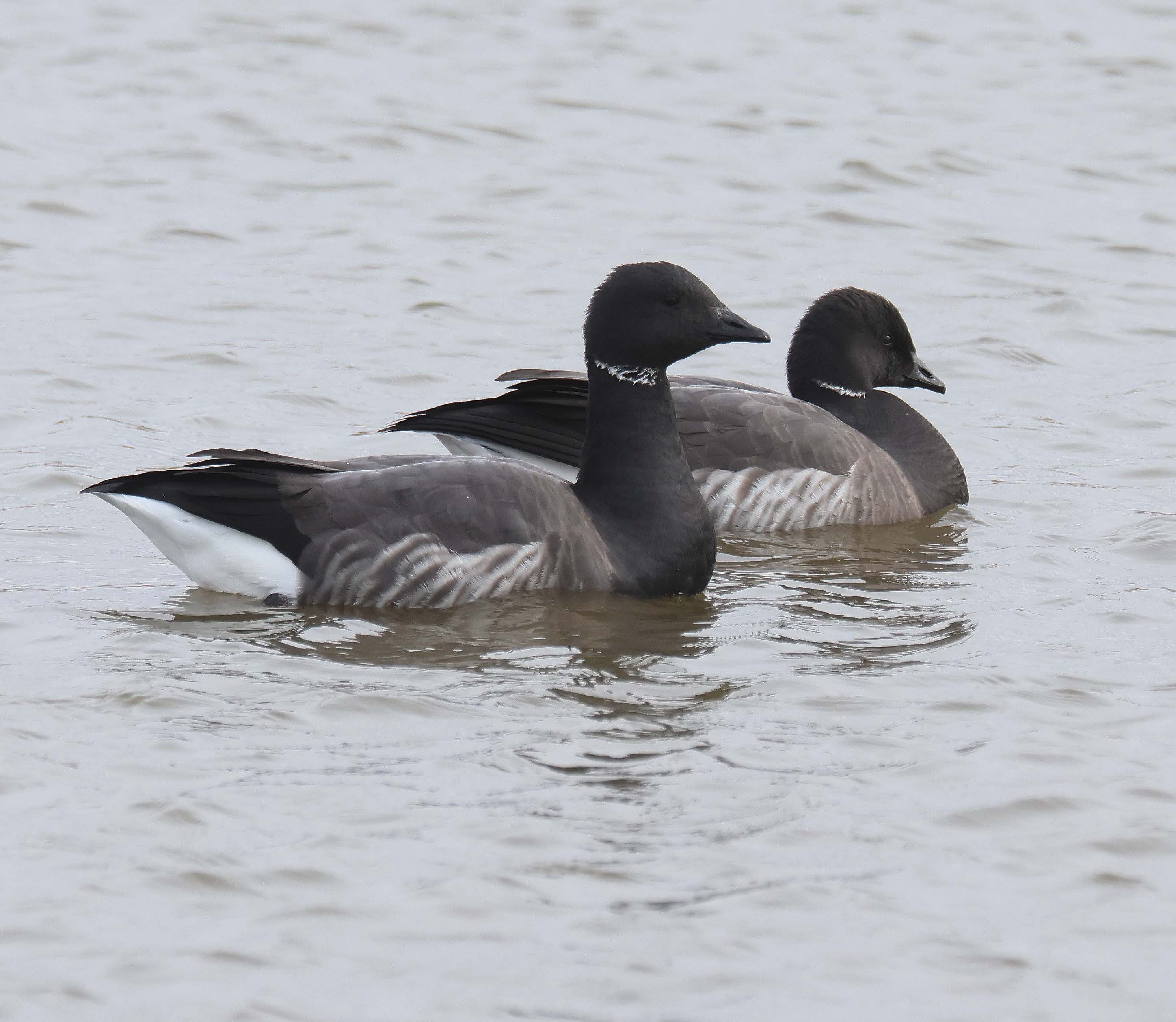
Up to a hundred and fifty Dark bellied Brent Geese were feeding on the saltmarsh behind the hide and periodically would fly back onto the lagoon in front of the hide to rest and swim about before returning to the land. I feel a great affinity with these small dark geese, hardly larger than a mallard, as for twenty five years I counted them during the winter at West Wittering in Sussex as part of The Wetland Bird Survey (WeBS) and watched their fortunes wax and wane year on year. Always, on seeing them I feel a melancholy come over me remembering happy times in Sussex and wondering where did all the time go and how fast the years seem to have passed
They will soon be departing northwards to the Waddensee, an intertidal zone in the southeastern part of the North Sea, that lies between Denmark, Germany and The Netherlands where they will remain for a few weeks fattening up on their favourite food, eel grass, before setting off on the long last stage of their three thousand mile journey to breed in the arctic tundra of Siberia.
The flock is never silent, the geese chuntering amongst themselves, a quiet, guttural, contralto crrronk, creating a comforting sursurrus of natural sound as the geese swim on the water or feed in close company on the land.
Their name comes from the Old Norse word brandgas meaning burnt, a reference to the goose's charcoal coloured plumage. It is also the only goose to have an oilfield named after it - The Brent Oil Field found in the North Sea!
Northern Shoveler
Now sitting on a bench overlooking the lagoon I watched shovelers and teal swimming and feeding close to the bank. Presumably so used to the almost constant passing of humankind walking the mile long path that skirts the western side of the reserve out to the beach and sea, they no longer retain their usual fear..
My first encounter with a shoveler was many years ago, when at school we formed a bird club and our first expedition was to St James's Park in London, whose collection of exotic waterfowl was a revelation after the mallards at my local park's lake. I can recall my innocent wonder and delight on seeing a male shoveler in its exotic plumage for the first time and ever since I have held a special affection for them.
Shovelers as the name implies possess an outlandish bill, a spade like appendage, broader at the tip than at its base. This would be thought to render them unattractive and a freak but in fact it is quite the opposite.The bright tortoiseshell colours of the drake's plumage ameliorate the impact of the bill's appearance, putting it in a harmonious juxtaposition with the bird's brightly coloured body. A body that is small and compact, this emphasised by the huge bill that is longer than its head
After a while I put the camera down and watched the shovelers going about their lives, letting my mind slip into a freefall of thinking about them.
A pair of Shoveler were feeding in front of me, heads and bills submerged in the shallow water sifting the mud below. In fact, for only a brief second would one or the other raise a submerged head to check all was well before resuming their quest for food.
I found myself wondering if it was possible for the shoveler when sleeping or in repose to snuggle its bill into its back feathers like other ducks and came to the conclusion it must be nigh on impossible with such a bill but probably I will be proved wrong
I considered its bright yellow eye and found myself asking what other dabbling duck has similar. Many diving ducks do i.e Tufted Duck and Goldeneye but I could not think of another species of dabbling duck that does.
Eurasian Teal
Teal are the smallest of our native ducks. So small, they were known as a half duck by wildfowlers in times past. Tiny and portly and like many things small, possessing an abundance of character. Like the shovelers they are confiding at Titchwell and allow very close views, all the better to admire the drake's exquisite plumage.
Eric Ennion wrote the following about a drake teal
At a distance the males just look dark unless they happen to veer round and get caught four square in sunlight.Then suddenly the rich chestnut head with its emerald slash across the cheek flares out.The buff lines light up on the face, the black rimmed yellow wedge appears below the tail.Even the pencilling of the body plumage and the flecks on the tawny breast stand out sharply for a moment. And then the vision fades.........
They swim like buoyant clockwork toys across the water and are rarely seen without a mate or the company of other teal. Their call is a distinctive and pleasant, melodic chirrup and the name teal is thought to be an imitation of the sound of their call and dates back to at least the thirteenth century.
The collective name for a group of teal is 'a spring of teal' which refers to the duck's capacity to rise almost vertically from the water and depart at speed in a swerving twisting flight. Their diminutive size in compact flocks can often give an initial impression that they are a flock of waders
Sanderling
It is almost a rite of passage on any visit to Titchwell to make my way to the sea.Following the path through the dunes I descend onto a huge expanse of sand stretching into a distance on either side of me and in front lies the sea. It is forever exhilerating, this sense of space, after the closer confines of the hides and narrow footpath of the reserve that I have left behind me.
I walked to the edge of the sea and there, as hoped, found a small group of Sanderling. Their existence is one based almost exclusively on seashores below open skies, running energetically back and fore following the tide.
In winter plumage of grey and white they are virtually invisible on the shining wet sand as they hurtle along on black legs, only to come to a sudden stop to probe the soft sand. and then rush to catch up with their fellows, for they are sociable birds.
Today they were concentrating on feeding amongst the long dead razor shells cast up by the sea and stretching in irregular lines along the high tideline. Walk over the shells and a satisfying scrunch accompanies every footstep.
Shorelark


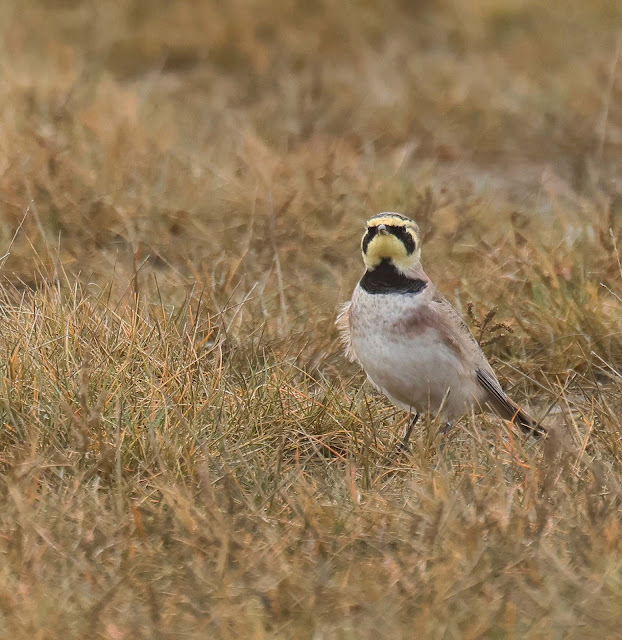
The next day we decided on a visit Holkham to try and see a small group of Shorelarks that spend their winter on the saltmarsh in most years. Holkham, if you are a birder, can be a very frustrating place as it is often besieged by dog walkers and other visitors who can show little overt concern about the birds or more annoyingly birders. During our previous visit to Norfolk last month we resisted going to Holkham for that very reason.
Holkham is a beautiful area of sand, sea, dunes and saltmarsh, which in winter, at least, retains a measure of semi wildness and I can understand the attraction.The saltmarsh is also attractive to the Shorelarks and to allow them to remain for the most part undisturbed Holkham Estate have roped off an extensive area of the saltmarsh with signs asking dog owners and anyone else to remain outside its perimeter.
.jpg) |
| Two birders scanning the roped off area of saltmarsh for Shorelarks |
For the most part this seems to work or at least it did on our visit
However it was still with some trepidation, after paying the usual overpriced parking fee, that we made our way out onto the sand and saltmarsh. Leaving the boardwalk that passes through a stand of pines we turned right and after a fair walk eventually came to the roped off area
Possibly because it was a dull and grey weekday in winter we found ourselves virtually on our own which gave cause for optimism. The task now was to locate the shorelarks. Not so easy as they could be anywhere in a large area and our first scan through our bins was not rewarding. Skylarks sang overhead and Meadow Pipits flew up every so often but finding the shorelarks, which shuffle low to the ground when feeding amongst the short withered grass, dead stems and folds of the saltmarsh, can be tricky.
Periodically we would stop to scan another section of the roped off area and on about the third or fourth scan I thought I saw a bird on the far side that was not a pipit but possibly a skylark standing on a raised fold of ground Closer scrutiny revealed a yellow head and black face mask.
There's one Mark.
It's over the far side.
We'll have to walk round.
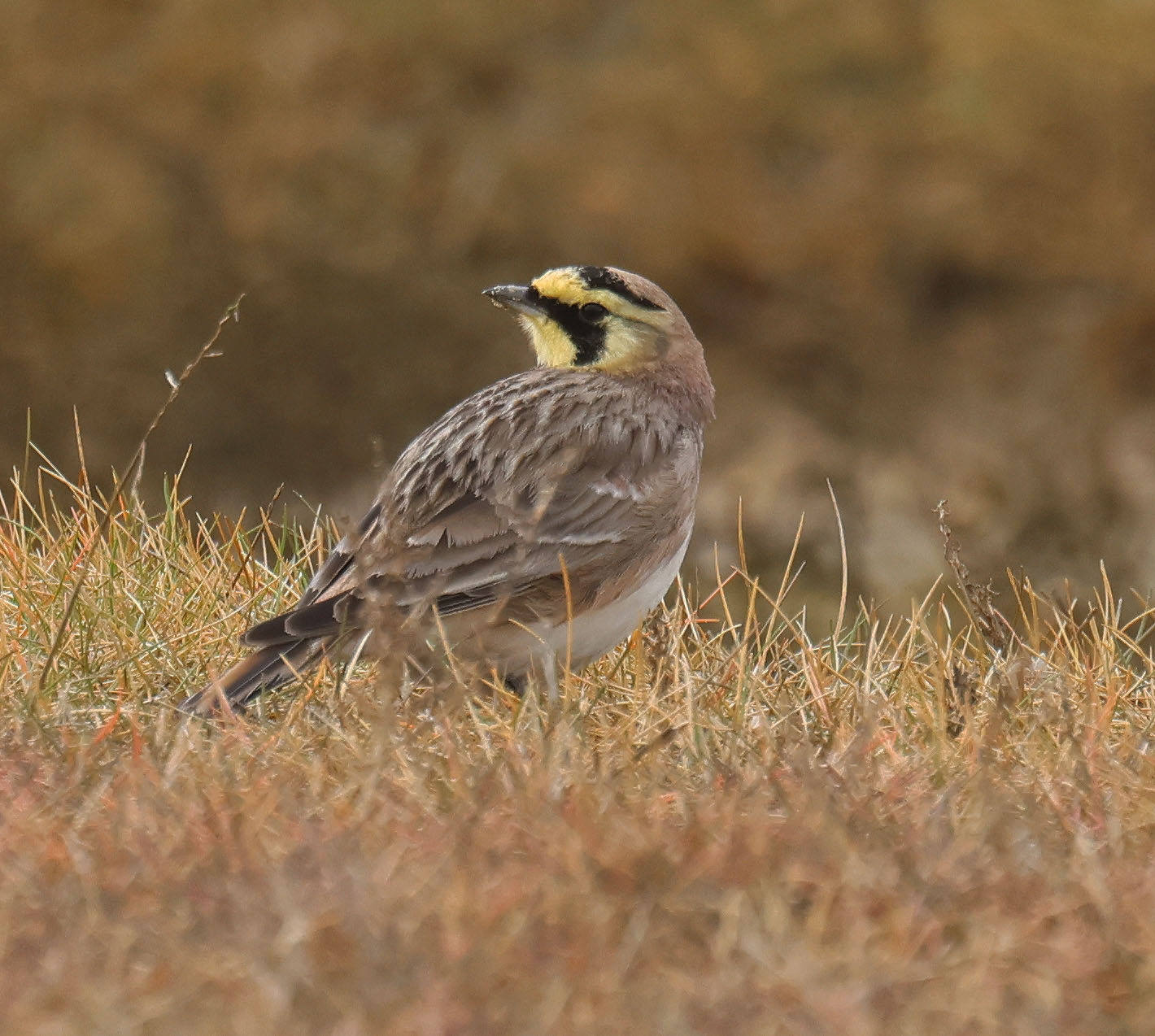
This entailed quite a walk but eventually we got to the general area and after a short time found a shorelark and then four others. They are lovely looking birds with their yellow and black faces and variegated brown plumage. Slightly chunky, they crouch low to the ground with bent heads as they hunt for seeds amongst the low grass and stalks, often disappearing into folds in the ground. Keeping track of them is not straightforward as their meanderings render them at first visible and then invisible. At least they tend to keep together so find one and you generally find the rest.
Fortunately, every so often they pause and stand proud to check their surroundings and this gives the best opportunity to see them well. A bit distant for photography, we concentrated on watching them as this is not a bird that we see that often.
We adopted a strategy to stand and wait. At first it looked doomed to failure as the birds moved further away and became invisible amongst the vegetation. We waited, praying that no dogs came our way and in this we were fortunate.Eventually the shorelarks gradually shuffled their way in our direction and at at last we could get a reasonable look at them before they once more wandered back into the centre of their protected area of saltmarsh.
It is remarkable that the birds are faithful to this area as there is plenty of other suitable habitat outside the roped off area.Presumbly the birds have come to realise that this area is free of disturbance and are content to remain within its confines knowing there is no shortage of food.


.jpg)
.jpg)










.jpg)


.jpg)