Saturday, 23 May 2020

An Abundance of Sanderlings 21st May 2020


This May has been exceptional for small waders arriving at Farmoor where they briefly rest and feed  on their long northward migration. Dunlins, Ringed Plovers, Turnstones, Sanderlings and memorably no less than two Curlew Sandpipers have, so far this year, graced the concrete shores of this most inland of reservoirs.

I always assumed that bad weather would be the prerequisite for waders dropping in to Farmoor but I have been proved wrong as waders continue to arrive daily in the most pleasant of conditions. How many more must pass unseen, high overhead, taking a shortcut across Britain to their northern destinations without putting down, can only be wondered about but it must be considerable. In an earlier post from two days ago I referred to my hope that the Sanderling passage would continue and I would get to see more of them and today I was not disappointed.

At ten this morning, which is when the reservoir now opens under its new covid restrictions, I scanned along the southern edge of the causeway and was delighted to see a group of six small waders running along by the water's edge. Too far away to identify initially, I set off down the causeway to get closer  to them and in great anticipation of what I would discover. Dunlin probably, as they are the most frequent wader to visit here, but you never know it could be different this time.

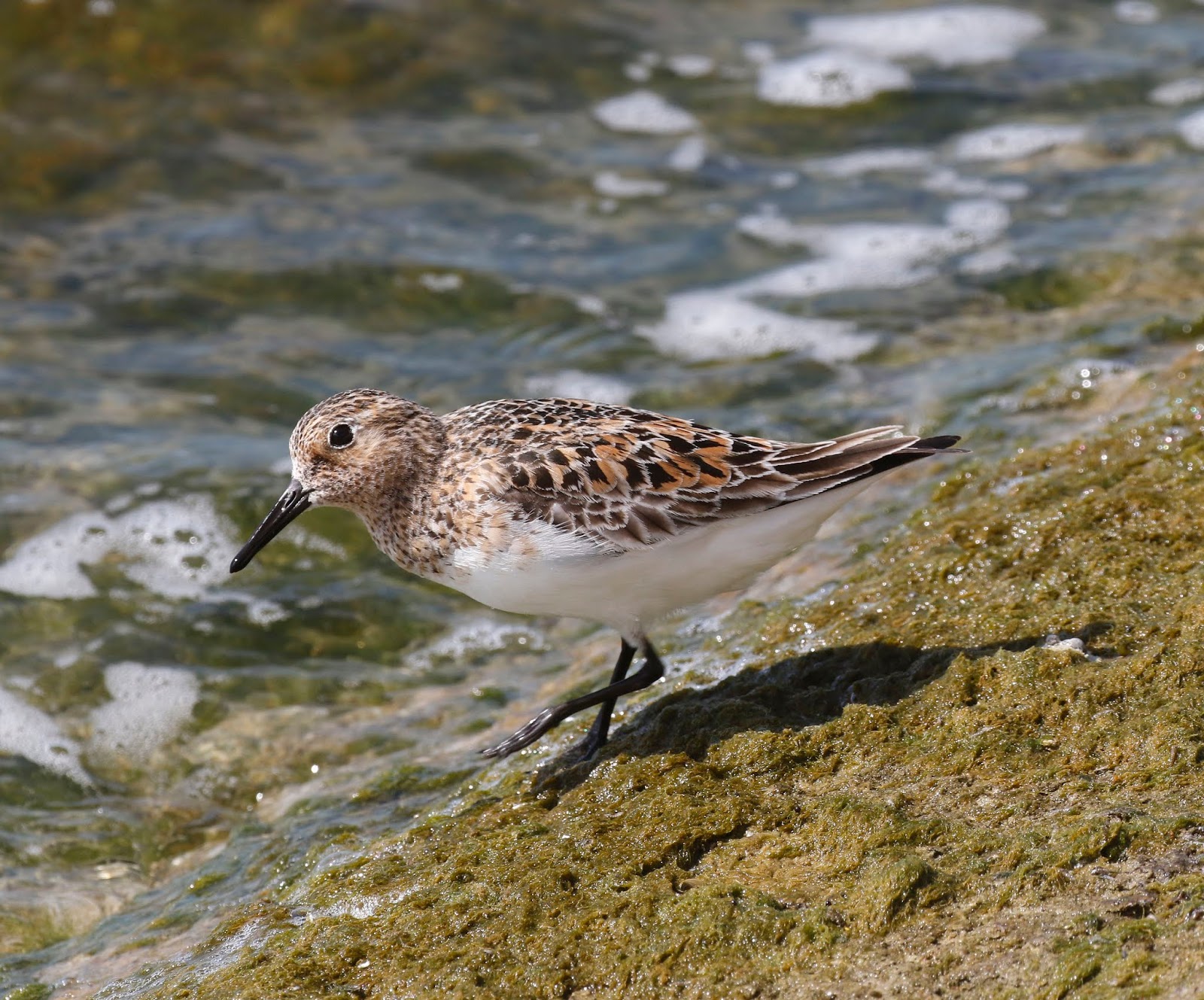
I slowed my pace as I got nearer to the waders so as not to alarm them, then stopped and looked through my bins.To my great delight I found myself viewing no less than five Sanderling and one Dunlin. The five Sanderling were, typically, all in differing plumages, three quite pale still but the other two stood out as being darker due to their more rufous tones and one of these was the most colourful of all, possessing a rich rufous blush to its face and breast and with upperparts liberally suffused with a similar rufous colouration, the feathers with black chevrons in their centre creating a pleasing marbled effect. A Sanderling in its full summer breeding plumage is the holy grail as far as I am concerned. This was my reward for all those long unrequited trudges up and down the causeway, hoping, forever hoping it would happen and now it finally had. Here at last, a properly summer plumaged Sanderling on lowly Farmoor.

All six waders with the Dunlin on the left and five Sanderling showing the wide range of plumage they exhibited


The Sanderling was an absolute picture, a glorious combination of rufous and white highlighted in the morning sunshine and more to the point only the second one in this advanced colourful plumage that I have seen at Farmoor, which made it even more pleasurable.


Now, if you will indulge me, there follows quite a lot of images of Sanderlings, well one in particular but hopefully its beauty will bring as much enjoyment as it did to me and convey my sheer delight at seeing both it and its companions so close to me on the causeway.


Thankfully they were not skittish, as some are that visit here, and they would allow me to walk right up to them provided I made no sudden movements. It was one of those moments when forlorn hope becomes reality  and I sat on the low retaining wall and watched and photographed them to my heart's content but, not unnaturally, my attention always drifted to the richly coloured individual as it fed on the weedy concrete.


It is always a conundrum coming to a definitive diagnosis of a Sanderling's plumage in Spring. Regarding the paler ones, which always predominate, are they just later in their moult or, as the books tell me, is it that some individuals will remain paler throughout the breeding season? Maybe even a combination of both?

One of the paler Sanderling with hardly any rufous on its  head and upperparts apart from on some of the scapulars.
Note the unmoulted wing coverts and faded tertials.Will these be moulted or retained?

Two of the paler Sanderlings

A paler Sanderling at the front.The more colourful individual at the back

The two most colourful Sanderling together
But then it could be that they will all moult into rich rufous colours, like the one individual with them  today that was so markedly more bright. Only one other Sanderling was approaching a similar colour but was not  so rich in tone or extent and consequently appeared duller in comparison.

The two most colourful Sanderling together with the brightest individual at the front
The sun continued to shine down as the Sanderlings communicated with each other by means of a quiet conversational twittering. The rufous Sanderling was a truly beautiful looking creature and I thanked my stars that I had this opportunity to see it. 


Sad to say the Dunlin  and the other Sanderlings hardly got a look in, as thoroughly distracted I feasted my eyes on the bright Sanderling but I can make no apology, as I knew not when this would happen again, if ever. Here today was a perfect combination of good weather, no disturbance and a group of totally confiding waders with one sensationally coloured individual amongst them. The last time I saw a Sanderling in plumage as advanced as this at Farmoor was many years ago, when it too was in a flock of paler individuals but was very wary and it was in wet and miserable conditions.

An enormous military aircraft from nearby RAF Brize Norton was practicing manoeuvres over the reservoir. It was a machine packed with wonderful and hugely expensive technology, tonnes of it held in the air by enormous screaming jet engines, a miracle of engineering. I regarded its ominous and threatening presence and turned to the Sanderlings, creatures of a natural evolution that has brought them to their present delicate beauty and innocence, each weighing just grammes, their lives under constant threat but fearlessly embarking on a journey to the far ends of the earth, with no compass or navigation aids, possessing nothing but instinct, wings and feathers to get them there. The incongruity was not lost on me.


Today will live long in my memory. After an hour I left the Sanderlings to their meandering along the water's edge, having put the news out so others, quite rightly could come to see and photograph them.

For me it was all about this moment and a very special exclusive hour in their company. Where, I pondered will they stop next  to refuel and rest? North Uist in the Outer Hebrides maybe, before heading northwest out over the Atlantic, perhaps via Iceland before crossing to Greenland to breed or maybe across the North Sea to Scandinavia before heading east to the trackless wastes of Siberia?

It's still not the end of May. 

Dare I say it would be nice if a few more Sanderling came along to Farmoor. 

Please ...............


Friday, 22 May 2020

Strawberry Banks Forever 21st May 2020


Another day of glorious sunshine and a warm breeze put me in mind of butterflies and one in particular, the Marsh Fritillary. Boldly chequered with a combination of orange, buff and brown it is one of the most striking of our native fritillaries. Their size and general patterning can vary from colony to colony and numbers in the colonies can also vary tremendously from year to year. In a good year a colony can number in thousands, in other years be far less and colonies can die out for no apparent reason.

Like most fritillaries it is considered to be endangered and is now only found on reserves where its habitat requirements can be managed to ensure it survives. Although favouring damp grassland, contrary to its name it can also be found in woodland clearings and dry chalk and limestone grassland.

For me the nearest reserve to find this lovely colonial and scarce butterfly is Strawberry Banks in Gloucestershire, which is a very steep slope of limestone grassland comprised of two 'unimproved' fields, 5.06 hectares in extent and which is an SSSI (Site of Special Scientific Interest). Up to December 2018 it was managed by Gloucestershire Wildlife Trust but has now reverted to the private landowners who thankfully are continuing to manage the site sympathetically, so the Marsh Fritillary's future here is assured. Mind you it is a difficult butterfly to cater for as it requires abundant Devils-bit Scabious (its natural foodplant) in habitat that has to be subject to low intensity grazing. At Strawberry Banks this is achieved by grazing horses and ponies on the reserve and work parties removing encroaching scrub in the winter months.


Strawberry Banks is so named because it was once used to grow strawberries and it is also a site where a German bomber crashed in the Second World War. There is now no trace of the wreckage although there may be a few ghosts lingering. It is a very beautiful location for a reserve, sited as it is on a very steep slope which forms one side of a valley lying below the attractive Cotswold village of Oakshot Lynch, four miles east of Stroud. The reserve forms part of a chain of nature reserves that run through an area called Stroud's Golden Valley 


I parked the car by the village green and walked down a steep path, passing through a field, over a stile and then through a small wood, emerging out into the sunshine and the reserve, following the path as it dropped down on one side of the reserve to the valley bottom. There are two tracks across the reserve and I followed the upper one looking for a Marsh Fritillary. 

Marsh Fritillaries are slow flying compared to other fritillaries and keep low to the ground, rarely moving more than a hundred metres from where they  emerge. It would, I hope, be easy to locate one and sure enough, fairly quickly I got a brief glimpse of one, fluttering just inches above the path but it flew off up the slope and in the heat of midday I was disinclined to follow. 

I walked onwards towards the far end of the second field where an area of Wood Spurge was growing at the edge of a wood and there I  got my first close view of a Marsh Fritillary. 


It was nectaring on the curious cup shaped flower heads of the Wood Spurge and I followed it around from plant to plant as it fed continuously, apart from occasional spats with a Peacock that seemed intent on claiming the flowers for itself. Matters settled down and  I contiued to follow the feeding fritillary around the flower heads as before. I soon had enough images of the obliging butterfly's upperwings and lovely though they are, it is always a view of the exquisite underwing pattern that excites and this proved a lot harder to achieve as the butterfly was disinclined to close its wings.


Marsh Fritillary nectaring on Wood Spurge
Growing weary of clambering up the very steep slope and having to brace myself  on the steep sides of the field while photographing the butterfly, I retreated and dropped down to the lower track. The heat of the day was becoming oppressive, the sun beating down in a white shimmering light from a sky of palest blue. Lower down there was no longer any breeze but I was enjoying myself making a reunion and communion with a butterfly I had not seen for a few years. 


Now I had 'my eye in' so to speak I was finding Marsh Fritllaries regularly and finally I got the opportunity to get some images of the underwing pattern as a couple of fritillaries obligingly closed their wings. 


Satisfied, I wandered the reserve again, just enjoying being here and once more retraced my steps on both the upper track and the lower track. I was mostly on my own for the couple of hours I was on the reserve. Tired, hot and thirsty but really pleased with my Marsh Fritillary experience I took the steep path back up the valley side to return to my car. parked in the shade of an oak tree by the village green.

Thursday, 21 May 2020

Today it was Sanderlings 19th May 2020


The month of May always brings a heightened expectation of finding migrant Sanderlings at Farmoor that have put down for a brief time to pause, rest and feed during their long migration north.They can be found running along on the concrete shelving at the water's edge. Invariably they choose the causeway and a regular walk up the causeway will sometimes pay dividends when one or two or even more, often in the company of Dunlins can be discovered feeding and resting by the water.

This May, Farmoor has become very popular with the general public, most of whom are not working due to the corona virus pandemic.They choose Farmoor as a safe place to walk and relax especially in this current fine spell of weather, when the waters are blue, a gentle warm breeze blows and the reservoir creates an experience as near, as such an artificial body of water can. to being by the sea. Consequently there is much more disturbance than usual and most waders soon depart when the reservoir is opened to the public as they are unable to settle for long.

Today I was lucky in that two Sanderling and one Dunlin were confiding enough to put up with the constant disturbance. The day before another two Sanderling only remained for an hour after the reservoir gates opened and left when the disturbance along the causeway became to much to bear. Not today however, as despite being regulary pushed into flight the three birds would fly out over the reservoir, circle and then land back at the water's edge.

Two Sanderling and a Dunlin.
Sanderling vary to a possibly greater extent in summer plumage than any other small calidrid waders. No two are exactly the same with some more advanced than others in adopting the rufous hues of  summer plumage. These two were still quite pale, or at least one was while the other was markedly more rufous and when seen together the difference was apparent.


Sanderling - the paler individual


Sanderling - the more strongly marked inividual

The two Sanderling side by side for comparison
Although looking pale, in their case this might be as far as the plumage change from the predominantly white and grey of winter goes or they might yet, on the journey north, become ever more rufous  on head, chest and upperparts as the moult transistion can be rapid. It's impossible to tell.  I have seen other Sanderling here that have been considerably more rufous than these two but then others that will remain paler, like these, throughout the breeding period.That is the fascination and the thrill of daily visits to Farmoor at this time of year as you never know what stage and state of plumage any Sanderling present will show.

Today I determined to make the most of this opportunity although, as always with these hyperactive birds, this was easier said than done. Sanderling can run very fast and took every opportunity to do so, running away from me each time I sat on the retaining wall to photograph them. This was obviously not going to work and another strategy was clearly required if I was to be successful. First  I had to consider the position of the sun which at eleven was almost due south. The causeway runs east to west, so I could sit on the wall and face west which would put the sun almost behind me.This still meant they ran away from me but I suspected that any person or persons coming down the causeway towards me would persuade the Sanderling to reverse and come closer and closer towards me provided I sat absolutely still. When I saw a family or couple strolling towards me and the Sanderling I would slowly walk towards them until about fifty metres away when I would sit on the wall and hope the Sanderling between me and whoever was approaching would come in my direction. It did not always work but on a couple of occasions it worked perfectly and I got the images I desired when the Sanderling stopped and stood facing the water, in a quandary, not sure how to react, caught between me and whoever was approaching from the other direction.

They are pretty little waders, fractionally larger than the Dunlin which today was accompanying them. Waders are sociable birds outside of their breeding areas, living and moving in large flocks to protect themselves against predators and it is entirely natural that the Dunlin, by instinct should team up with the Sanderling to travel together. 

Compared to their smaller companion, the two Sanderling were more robust in build with a shorter black bill and feet that have no hind toes.Their upperparts are pleasingly patterned in scattered irregular hues of grey, black and rufous, the latter mainly on their scapulars, breasts and their faces which were adopting a blush of rufous as the winter feathers were slowly being replaced by those of summer.

Dunlin
On reflection and studying my photographs I think these two Sanderling were still in the process of adopting summer plumage and would moult more of their winter feathers and become more colourful. Whatever, it is always a joy to see the dull grey and white plumage that waders adopt outside of the breeding season, replaced by the shock of colour and a variety of complicated patterns that comprises their breeding plumage. From unexceptional in appearance they transform into something truly beautiful, the pleasure all the greater as you know it will be seen so briefly unless you travel to their summer home in Greenland or Siberia.


The Sanderling remained all at Farmoor all day, running or walking back and fore, feeding along the water's edge,  their tiny forms almost invisible on the pale concrete shelving and often going completely un noticed by the general public as they passed up and down the causeway.

I do hope they will not be the last to be seen here at Farmoor this Spring but their arrival is unpredictable, although waders such as the Sanderling can still be passing northwards until the middle of June. Let's hope a few more may grace the reservoir before it is all over for another year.

There is however still the return autumn migration to look forward to.

I wonder where the world of humans will be by then.