Sunday, 29 December 2019

Surf's Up on Arran! 28th December 2019


Not a great photo I admit but considering the weather conditions I took it in today, it's a minor  miracle that I managed anything at all. 

The image was taken from the garden gate of our rented cottage at Catacol on the west coast of the Isle of Arran, as I cowered behind a hedge from a gale force southerly wind and lashing rain, looking out onto the heaving seas that have battered the island for the last two days.


But let us go back a few days to the 21st December, the day after we had arrived at our cottage.
       
It is my custom to check the sea that lies in front of the cottage several times a day when we are here and certainly every morning. The area of sea is Kilbrannan Sound, separating the west coast of Arran from the Mull of Kintyre. Usually the sea is dotted with the ubiquitous dark forms of Shags, their slim bodies  held low in the water and snake like heads distinctive, as is their customary head first leap to propel themselves under the water to hunt for fish. Even at great distance this leaping action allows them to be easily identified. Similar looking from distance, but bulkier, are one or two regular Great Northern Divers that haunt Catacol Bay whilst the smaller Red breasted Mergansers, numbering one to half a dozen, fish closer in to the shore.

Oystercatchers pipe their excited kleeping calls, as they pass the cottage, the surprisingly loud notes ringing off the sea and stony shoreline as they fly to their high tide roost to join a small gathering of Curlews, Turnstones and Ringed Plovers,


It was at noon on 21st December but in much more pleasant weather conditions that I looked out on Kilbrannan Sound, 'just in case.' Discovering something unusual, even rare, requires such unending persistence. A dedication that will go unrewarded in the majority of cases but sometimes bears a dividend of something differing from the normal.

Scanning the sea for half an hour, looking for any Otters that might be fishing offshore I was disappointed but it was not unpleasant as I sat on a bench scanning a timeless vista of sea and sky with the dark hills of Kintyre beyond.

A dark brown duck flew up from the sea, far out to my right, having been disturbed by a Herring Gull  that landed too close to it and it flew in my direction, then circled around, still a long way out, before settling on the sea,  Its body was round and bulky so this ruled out Red breasted Merganser on size and shape or Mallard on distance, the latter sometimes are here but without fail are always to be found on or about the shoreline.

Due to all our luggage and Christmas paraphernalia, space in the car was at a premium when we came north, so I had not brought my scope and tripod with me. Thus it was down to my binoculars to try and make sense of what kind of duck I was looking at. I studied it for some time and its profile suggested a bulky duck with a distinct  large and wedge shaped bill. It appeared to be dark brown all over and when it stood in the water to flap its narrow wings I could see no wing bars and on a second wingflap, when it was facing me, I could see its belly was pale, even white.That was as far as it went. It was just too distant to make out any more detail. Based on the information to hand I settled for an educated guess and  tentatively  identified the duck as a female Eider Duck, a species which is unusual for around Catacol and therefore I could feel happy at finding a bird slightly out of the ordinary.

However there was something that troubled me. Female Eider's, to my knowledge, do not have a white belly. I was in a quandary as with no scope there was little I could do to get a better image through my bins and by this time the duck had commenced diving and did not look as if it would come any closer.

Then a thought occured to me. Why not use my camera and lens? This would give me a record of what I was looking at and then I could upload the image onto my laptop computer and increase the magnification significantly. The image would be aesthetically dreadful but at the very least it would confirm whether it was indeed a female Eider I had been looking at.

I took several images and left the duck diving, still distantly, out in the Sound. Back in the cottage  I uploaded the images, magnified them on my laptop and there to my delight was conclusive proof of the identity of the duck. It was not an Eider but something much better, a female Surf Scoter!


The image, although blurry, clearly shows the distinctive two pale patches on the side of the head; a large pale oval at the base of the bill and a smaller triangular patch behind the eye.The disproportionately large bill with a slight swelling on the upper mandible is also evident.

I reported the sighting to Jim Cassells, Bird Recorder for The Isle of Arran, and he told me that this was the second ever record for Arran, the first also being a female Surf Scoter, probably this one, which was seen and photographed at Catacol on 24th November this year but not seen since.

I looked for the scoter over the following days but there was no sign of it but then on 25th December it was reported by another visiting birder, from Pirnmill, just a few miles south along the same coastline and then again on Boxing Day.

Finally, today, it was again in front of our cottage, the only duck or seabird to be seen in the fast running seas and roaring wind. Watching it ride the waves, Surf Scoter was definitely the right name for it. All the reported sightings, both in November and December are, I would assume, of the same bird which appears to have decided to spend the winter on this stretch of Kilbrannan Sound.


A nice unexpected birding gift for Christmas. Arran does it again|!                                                                                                    

Sunday, 22 December 2019

Merganser Magic on The Isle of Arran 22nd December 2019


We have taken ourselves off to the Isle of Arran for this Christmas and New Year, renting our favourite cottage at Catacol, a tiny hamlet which lies on the quieter and wilder northwestern side of the island, overlooking the Kilbrannan Sound and across to Kintyre. It is remote and quiet and suits us just fine.


At night no un-natural sound disturbs the peace, We can lie in bed and listen to the sea lapping at the stony shore less than fifty metres from our window, through which we watch a million stars in a sky untroubled by artificial light of any sort.

The western side of the island is rocky for the most part, relatively unpopulated and is a favourite habitat for wintering Red breasted Mergansers which are present on Arran in large numbers, nationally significant numbers in fact, scattered in pairs or small groups all along the deserted winter coastline. Resident birds are joined by migrants that come from Iceland and Fenno Scandia  to spend the winter here. 

Red breasted Mergansers are slim, long bodied seaducks that live on small fish that they capture underwater with their bright red, uptilted bills, the mandibles serrated to allow them to seize their slippery prey firmly and give no chance of escape. The most characteristic and prominent feature of both sexes is an unkempt tuft of spiky feathers on their crown, that imparts to them a certain eccentricity and devil may care schtick


The male is quite dashing with an iridescent bottle green head that looks black at any distance, a white neck band and streaked breast of cinnamon brown. The upperparts are black with a prominent white gash of feathers along each side and a series of white mirrors.The flanks are silvery grey with fine vermiculations.Their legs and feet as crimson as their eyes.


In comparison the female is dull with a chestnut brown head and overall grey body plumage

The slim forms of the mergansers dot the sea close to shore as they hunt for fish. At this time of year many are paired but there are occasional groups of males frantically displaying to a female even though she has already selected her mate.

I found such a group consisting of three males, competing for a female who already had a mate, the couple stoically ignoring the three suitors as they contorted their bodies in display to the female or chased after each other, seemingly more intent on stopping their rivals rather than impressing the female. Only occasionally would they stop chasing each other to dip and stretch head and body into an extraordinary contortion as they briefly remembered the main purpose of their presence.


The display of the male is entertaining but brief, lasting only a few seconds, as he extends his head and neck upwards with bill held open, bobbing his breast and lower neck below the water while at the same time raising his posterior clear of the water but with  tail depressed, He then continues to swim as close to the female as he can get before indulging in another of these rapidly executed convulsing, curtseying movements, And so it continued at random intervals.


It was rather comical watching the amorous drakes endlessly chasing each other, as well as the female, but all to no avail. Two males appeared obsessed with getting the better of each other, with one paddling frantically to get near the female while the other male would attempt to head it off by paddling equally frantically towards its rival, eventually charging through the water towards the other which fled but refused to give up and returned time and again to try its luck, only to be forever  rebuffed by the other. Although they came close these encounters never resulted in physical contact, only theatening with an opened bill and an aggressive rush through the water. 


The female would dive with her partner, whether to feed or get away from the suitors I could not tell but such was their ardour the suitors immediately followed her underwater. What occured there I was unable to know but all the birds quickly resurfaced and the frantic chasing on the surface would begin again.

I watched for some time as the three suitors endlessly tried to entice the female away from her partner or chased one another. The female was having none of it. Having selected her partner she was content while mayhem carried on around her.

I left them on a grey sea, being churned into a minor localised turbulence by the amorous males.

Wednesday, 18 December 2019

The Black throated Thrush revisited at Whipsnade Zoo 18th December 2019


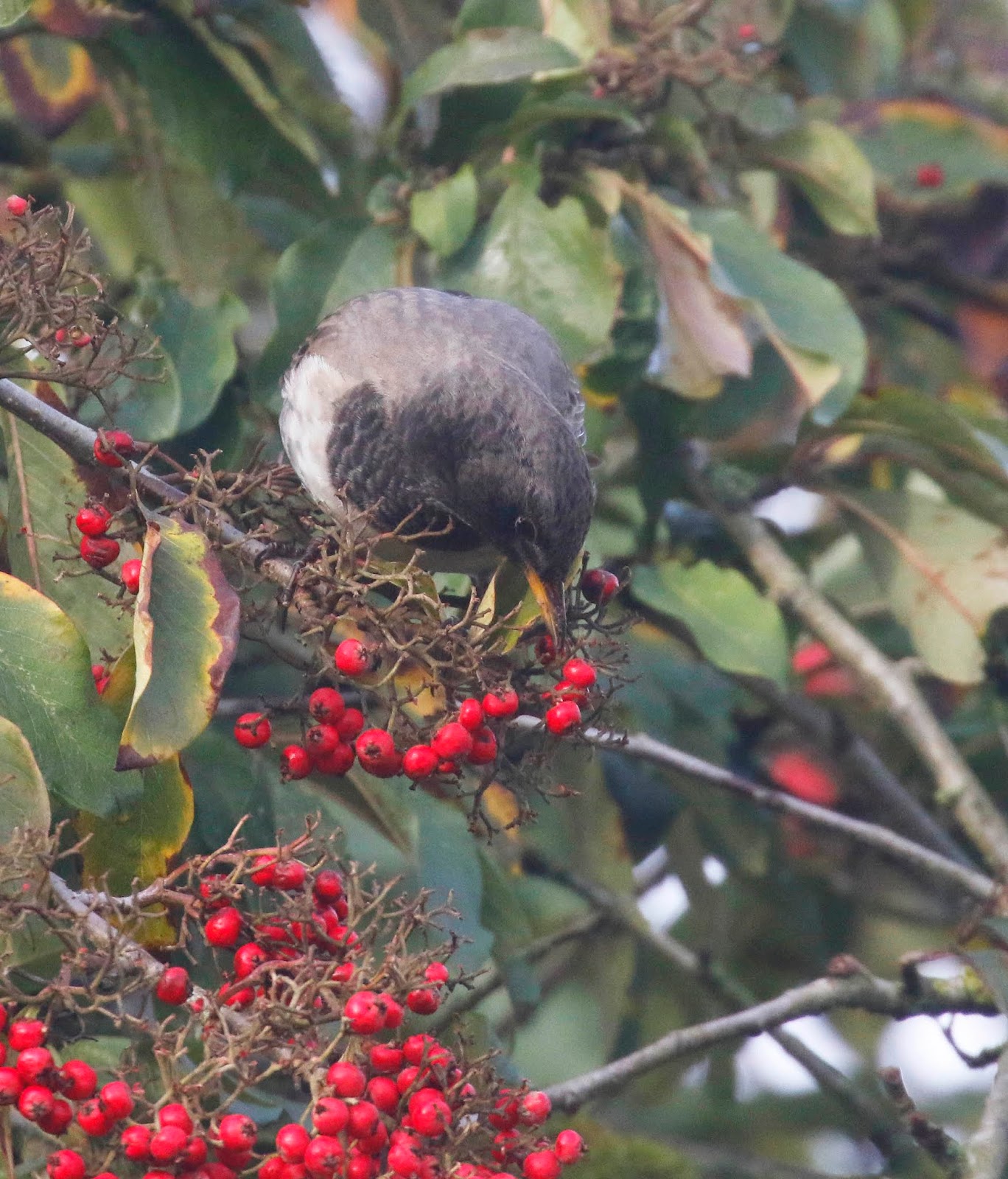
I felt more than a little underwhelmed with both my views and images of the Black throated Thrush at Whipsnade Zoo last Saturday and, with its continuing presence at the zoo, I determined to return and try to see the thrush closer, for longer and achieve some half decent images of it.

The question was, when could I manage to go, and crucially would the weather co-operate? With Christmas looming ever closer and my impending departure with Mrs U on Thursday, for two weeks on the Isle of Arran, time was definitely at a premium. Monday and Tuesday were taken up with voluntary duties with MIND, so Wednesday was the only available day.

Fortunately the weather was predicted to be sunny on Wednesday, well sort of, and the wind, so chilling on Saturday would be less fierce and from a milder quarter.

I spoke to Mark, who also fancied a return visit so we agreed to meet at the Zoo when its doors opened at 10am. It was foggy when I left my home and even before I left our village there had been a  road accident by the local primary school, necessitating a detour into the wilds of Oxfordshire but eventually I got back on track and the rest of the hour long drive to Whipsnade was blessedly uneventful.


I arrived at the zoo just as the sun broke through the mist and paying my entrance fee made my way to Hullabazoo, the childen's play area based around a small, currently unoccupied pig pen and the now familiar large berry tree. I had hoped, being a weekday, there would be less of a scrum of birders than on Saturday but on rounding the corner, there before me were over fifty birders all pointing scopes, cameras and lenses of varying lengths at a twiggy bush to the right of the berry tree.

I joined the throng and found Mark in their midst, who pointed out the thrush, which was sat on a twig in the bush and reasonably visible. It was facing us and appeared as half black, namely its face, throat and breast, and half dull greyish white, this being the rest of its underparts. The yellow on its bill was also very noticeable.


It was as quick and easy as that to see the thrush and in marked contrast to my experience last Saturday. The thrush sat, immobile on its chosen twig for a few minutes but there was dissent in our ranks. Mark, never one to be afraid to venture an opinion suggested everyone was too close, so the thrush would not fly into the berry tree, and we should all move back. Of course no one took any notice and when someone else said the same thing he was ignored also.

So the thrush did not fly to the berry tree but instead flew onto the grass below the berry tree, joining a Blackbird and a couple of Redwings. Its behaviour on the ground was very similar to a Fieldfare as it progressed with bounding hops and head held erect, in between hops.Sadly it was soon disturbed from here by a couple of ordinary visitors and flew back into the twiggy bush. It remained here for some time before flying towards us and landing  behind us in the vacant pig pen whose fence we were all standing by. The thrush then proceeded to hunt for worms and invertebrates amongst the woodpiles, logs, mud and waterloggged grass of the pig pen. 

The Berry Tree -much favoured by the Black throated Thrush


The Pig Pen- another favourite feeding area for the Black throated Thrush
Everyone just about managed to control their desire to rush to surround the pig pen and clicked away with their cameras from a sensible distance, so presumably anyone who had a mind to got at least one half decent image. The thrush did not remain feeding in the pig pen for long but flew back to the bush it had originally been in and ascended to the top of it and then flew even higher to the very top of a large tree on one side of the pig pen before flying off towards the miniature railway sidings some six hundred metres or so distant, calling a series of high pitched, squeaky shree shree shree notes as it went.


This prompted a mass exit of birders towards the railway, us included, but when we got there the thrush was nowhere to be seen, just a few Redwings feeding on the grass under the trees. It seemed futile to remain here for long so we made our way back to Hullabazoo and got a coffee from the cafe there.

Redwing
Then, for some of us, it was back to stand by the pig pen fence and stake out the berry tree. Nothing happened for a while apart from some Redwings and Blackbirds flying in to feast on the berries but finally the Black throated Thrush flew in and landed in the pig pen once more. Now with less birders around it was more at ease and this allowed me to get some really nice images of it feeding on the ground and perched on the wooden fence surrounding the pig pen. It then flew from here to the berry tree and we made our way there to stand and hope it would come out from the centre of the tree and feed on the clusters of red berries. This would give everyone the chance to get the image they were really waiting for - the thrush and the berries in the same frame.


At first the bird was completely hidden by the foliage. Then you could see its tail and occasionally its bill but finally it popped out and unobstructed by foliage, facing us, perched on top of a cluster of red berries. It remained virtually immobile for what seemed an age as if it was not quite certain whether it was safe to commence feeding on the berries but finally it bent its head down to pluck a berry from the bunch. A fusillade of camera clicks recorded the moment. Every move of its head and plucking of a berry was faithfully recorded multiple times by everyone with a camera


By now every birder had made it back to the play area and a phalanx of fifty to sixty birders/photographers papped away at the thrush as it sat in the tree, gobbling berries. Really, one could not ask for more, although some with enormous lenses and expensive cameras were forever self critical but finally even they seemed to be  content with their efforts.

I certainly was and could not have asked for better views of the thrush or opportunities to take its picture. Eventually the object of our desire flew off back towards the railway sidings, calling loudly and we pursued it there but again to no avail.


In the end I decided that running around after the thrush was both a waste of time and energy and considered it was highly unlikely I would see it anywhere else but here by the berry tree and pig pen. So I mounted a vigil with a few others in the hope it would return but it never did.

No sign of the Black throated Thrush
However, standing and waiting was not an unpleasant way to while away the time as I chatted with Mark and other birding acquaintances such as Graham, Richard, Chris and Joan. The situation today, after the initial tense moments and bickering when I first arrived, was much more relaxed and friendly which in itself is a nicer aspect of twitching.You know you will always bump into someone familiar and possibly only see at events such as this, giving an opportunity to renew an acquaintance or friendship, have a good old natter and usually start dissing someone else's behaviour at a previous twitch, such is the nature of twitching folk. In general such criticisms are usually harmless, just gossip and rarely malicious.

By one in the afternoon the sun was becoming blurred by cloud and the light, which was never good, was now dull and flat. The wind had also begun to strengthen and that time had arrived when you just know there is no point in hanging on any longer. Even if the bird was to return I would not get better images than those I had obtained earlier in the morning.

I departed but not before visiting the Lynx Enclosure, something I had promised myself before I arrived at the zoo. I was not disappointed as a magnificent Lynx sat, regal and inscrutable on an elevated platform, regarding me, while another slept below in its den.


A final visit was made to the zoo shop for some last minute  minor Christmas presents and, before I left, the lady at the counter told me the arrival of the Black throated Thrush had been a godsend for the zoo as they had been so quiet. It is estimated that over six hundred birders have so far visited the zoo to see the thrush, bringing much welcome revenue to the zoo.

I said goodbye and headed home to Oxfordshire. 

Tomorrow we go to Arran.