
The email came yesterday afternoon from Robert, informing me John had died. John Reaney, my bird artist friend and birding colleague for over forty years and still living in Brighton, Sussex in the same house in which he was born, making a precarious living selling his art.
I first met John when, newly married, I moved to Ditchling in Sussex and commissioned him to do me a painting of Brent Geese which I still have. I was never happier than when we lived in Ditchling and had many adventures with John, birding in Sussex and then the two of us venturing further to Norfolk and to Scotland, and memorably, once on a whale watching trip to Bilbao in Spain. We had like minds, a similar sense of the ridiculous and enjoyed each other's company immensely, sharing many wonderful and exhilerating birding sorties, laughing, being silly and gently chiding each other as we birded around Sussex.
John and Sussex, for me are inseparable, memorable for what was perhaps the happiest ten years of my life. Forever linked to John's quiet humour, undemanding character and humility are the Nightingales singing on a warm early summer's night in a bluebell wood deep under the South Downs, endless hours in Spring spent watching migrating skuas, terns, ducks and divers streaming past the end of Newhaven Pier, watching Honey Buzzards on a summer's day, displaying high over the forest at West Dean, doing monthly winter WeBS counts of waders, ducks and geese at West Wittering, walking the sandy beaches and dunes of East Head, finding rare prizes like Snow Buntings and even a Little Auk.
Then I moved away to live and work in Oxfordshire and the connection with John and Sussex became ever more important to my equanimity during a very difficult time of adjustment. We continued our monthly meetings to count waders at West Wittering and spoke on the phone regularly to swap our various birding experiences and still managed to go out for the occasional day of birding together in Sussex.
John and Sussex, for me are inseparable, memorable for what was perhaps the happiest ten years of my life. Forever linked to John's quiet humour, undemanding character and humility are the Nightingales singing on a warm early summer's night in a bluebell wood deep under the South Downs, endless hours in Spring spent watching migrating skuas, terns, ducks and divers streaming past the end of Newhaven Pier, watching Honey Buzzards on a summer's day, displaying high over the forest at West Dean, doing monthly winter WeBS counts of waders, ducks and geese at West Wittering, walking the sandy beaches and dunes of East Head, finding rare prizes like Snow Buntings and even a Little Auk.
Then I moved away to live and work in Oxfordshire and the connection with John and Sussex became ever more important to my equanimity during a very difficult time of adjustment. We continued our monthly meetings to count waders at West Wittering and spoke on the phone regularly to swap our various birding experiences and still managed to go out for the occasional day of birding together in Sussex.
A notable excursion with John that comes to mind was to see a ridiculously fearless and confiding Red backed Shrike at Newhaven Tide Mills a few years ago. I drove down from Oxfordshire to collect John from his home. He was not too well and could not get out of the house on his own but I drove him the short way from his home to see the shrike which lifted his spirits enormously and we enjoyed an afternoon in pleasant sunshine by the sea, just like we had done so many times before.


I spoke to John two weeks ago and he told me he was going to see the doctor in the morning and I commiserated with him about his continuing bad health and how his doctor seemed unable to ascertain what was wrong with him. His final words to me were 'We had some good times birding, didn't we Ewan?' I told him I would call him in the morning to find out how he got on at the doctor but my phone calls went unanswered and then yesterday came the worst news possible.
I slept fitfully during the night, The death of John creating a turmoil of reminiscences and anguish in my mind. As in a trance I got dressed and left the house at five in the morning. Sleep had eluded me.I had to be alone and knew of a place where I could sit and just think of John, the good times we had together and say a gentle, personal goodbye.
It was the hide at Shrike Meadow that I had in mind as a place of meditation and solace. For sure there would not be anyone there this early in the day and I could sit in the tranquil surrounds and hopefully find some inner peace and resolution.
The land was shrouded by a light mist that brought a chill to the air and extended to tree top height, creating a spectral like atmosphere as I took the familiar track beside the river. Imperceptibly the season is changing from summer to autumn, the thrust and vigour of new growth has long ceased and there is now a hiatus before this year's growth dies back and the land subsides into dormancy to await another spring.
Above me the sky in the east was turning the colour of peach flesh as battalions of large gulls left their roost on the adjacent Farmoor Reservoir, calling loudly as they passed overhead, a chorus of guttural exclamations to greet a new morning. They passed over me endlessly, in their hundreds, silhouettes in a windless, lightening sky now acquiring the salmon pink flush which heralds the sun's breaching of the horizon. Greylag Geese left the reservoir too. A gang of them, each goose joining in a chorus of loud rhythmic cackling, gregarious birds, never silent for long, re-affirming their companionship with other members of the flock. They disappeared across the meadow that was just visible beyond the river, passing over a vague impression of bulk which were trees marking the far boundary of the field, trees made fantastically gigantic, a distortion of the mist.
The river was as glass, smooth and unruffled by any movement of air with every tree and shrub on the river bank perfectly replicated in the opaque green water. The grass underfoot was damp with dew and the land about me muffled by the slowly dissipating mist and any sound was at a premium, now the gulls and geese had flown. Singing Wrens punctuated the stillness with loud trills and quietly ticking Robins, a true indication of autumn, were now beginning to find their voice after a month of silence, readying to set up territories for winter. Slowly my troubled senses settled, soothed by the timeless continuity of the river and the gentle Oxfordshire countryside through which I was walking.
I opened the door to the hide and the familiar musty odour of wood and a slight dampness enveloped me. I had the hide to myself and sat at an open window in the far corner and looked out at the familiar pool, the ranks of reeds surrounding it and the trees beyond. It was calm here and I needed this re-assurance of the familiar, a life-raft in a sea of emotional turbulence. Mysterious watery noises, plops and gurgles, came from deep within the reeds, breaking the silence surrounding the secluded pool. Moorhens most likely, as they have raised at least two families here already. The soft churring of juvenile Reed Warblers also came from the reeds and every so often the hidden presence of one was betrayed by the erratic movement of a reed stem.They hardly ever left cover, just briefly to cock an eye at the hide before diving back into the density of the reeds.
Naturally I hoped the Kingfisher would arrive soon but it didn't seem to matter too much when it failed to do so. I had come to terms with my feeling of loss over John's death, sat in surroundings he would have loved and that was all that mattered. Now I could reflect on and embrace the happiness I had known in his company and look back on our long association with, admittedly, still some sadness but mostly joy.
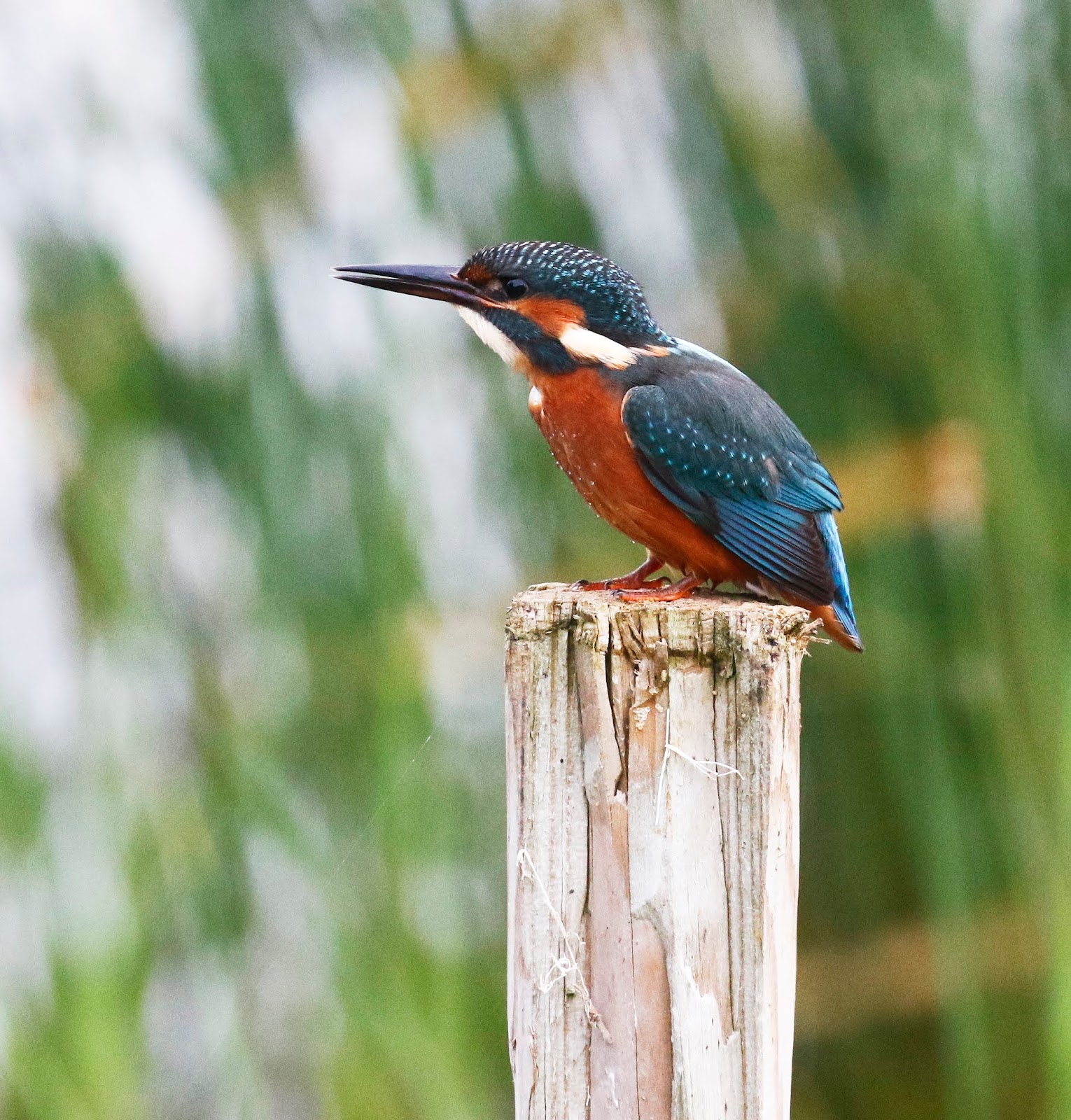
For an hour or so I was on my own and then Tricia joined me which saved me from becoming too introspective, bringing me back to the present and we talked as we awaited the arrival of the Kingfisher. It visited briefly, sitting on the post for a minute or two, allowing some photos but something unseen outside the hide unsettled the Kingfisher and with that it departed.

Such a prima donna, always leaving its admirers wanting more.
A long wait then ensued before it put in another stellar performance.
It flew in, not to the post but to the far end of the pool and perched on a reed stem bent low over the water, where it sat for some minutes, as two Moorhens fussed in the reeds underneath, with one even climbing the reeds as if curious about the Kingfisher.


I willed the Kingfisher to fly to the post which it duly did and sat looking, as it always does, sensational in the gentle morning sunlight. It cocked its head and shifted its position on the post. A bob of the head and an upwards flick of its short cobalt coloured tail signified it had seen something in the water and it looked downwards more intently.


It dived from the post to hit the water with some violence and returned to the post with something wriggling in its bill. It was a newt which the Kingfisher proceeded to whack to death or at least into submission on the post, twisting its neck while firmly grasping the newt between its mandibles and then untwisting its neck liked a coiled spring to bring the newt down with some force against the top of the wooden post. Several blows were administered and then the subdued newt was manouevred to be swallowed head first. The Kingfisher sat for some while afterwards, its appetite satisfied for now and then flew off towards the river. It was over in fifteen minutes.


This second interval with the Kingfisher proved the ideal distraction from thinking about John and with its departure my world again seemed bearable and grief was diminished.


We waited for a couple of hours but the Kingfisher did not return. We spent the time watching the various dragonflies that frequented the pool. A Migrant Hawker hovered in front of the hide, the blue patches on its segmented body a pale imitation of the Kingfisher. A male Banded Demoiselle, as exotic looking in its bottle green and blue iridescence as its name, settled on a blade of reed.
I left the hide to walk out into a warm, sunny, late summer's day following the grass track I had walked this morning and stopped to look down on the river. I stood on the very edge of the river bank betwixt a large clump of purple loosestrife, the purplish pink flowers infested with bees and butterflies, swarming over the flowers, intent on pilfering their nectar and a bank of similarly fragrant and insect populated water mint, pushing up pale lilac, cylindrical heads through the grass.
I thought of John and the sadness that this beauty of nature was no longer his and similarly will not be mine to enjoy when the end comes but then I rallied. I have after all the benefit of some of John's artwork hanging on the walls of my home which will remain as a constant reminder of him.
John may be no more in life but he will travel with me through what remains of my time on earth and bring certain happiness as I recall the memories he has left me.
Goodbye dear friend.


I spoke to John two weeks ago and he told me he was going to see the doctor in the morning and I commiserated with him about his continuing bad health and how his doctor seemed unable to ascertain what was wrong with him. His final words to me were 'We had some good times birding, didn't we Ewan?' I told him I would call him in the morning to find out how he got on at the doctor but my phone calls went unanswered and then yesterday came the worst news possible.
I slept fitfully during the night, The death of John creating a turmoil of reminiscences and anguish in my mind. As in a trance I got dressed and left the house at five in the morning. Sleep had eluded me.I had to be alone and knew of a place where I could sit and just think of John, the good times we had together and say a gentle, personal goodbye.
It was the hide at Shrike Meadow that I had in mind as a place of meditation and solace. For sure there would not be anyone there this early in the day and I could sit in the tranquil surrounds and hopefully find some inner peace and resolution.
The land was shrouded by a light mist that brought a chill to the air and extended to tree top height, creating a spectral like atmosphere as I took the familiar track beside the river. Imperceptibly the season is changing from summer to autumn, the thrust and vigour of new growth has long ceased and there is now a hiatus before this year's growth dies back and the land subsides into dormancy to await another spring.
Above me the sky in the east was turning the colour of peach flesh as battalions of large gulls left their roost on the adjacent Farmoor Reservoir, calling loudly as they passed overhead, a chorus of guttural exclamations to greet a new morning. They passed over me endlessly, in their hundreds, silhouettes in a windless, lightening sky now acquiring the salmon pink flush which heralds the sun's breaching of the horizon. Greylag Geese left the reservoir too. A gang of them, each goose joining in a chorus of loud rhythmic cackling, gregarious birds, never silent for long, re-affirming their companionship with other members of the flock. They disappeared across the meadow that was just visible beyond the river, passing over a vague impression of bulk which were trees marking the far boundary of the field, trees made fantastically gigantic, a distortion of the mist.
The river was as glass, smooth and unruffled by any movement of air with every tree and shrub on the river bank perfectly replicated in the opaque green water. The grass underfoot was damp with dew and the land about me muffled by the slowly dissipating mist and any sound was at a premium, now the gulls and geese had flown. Singing Wrens punctuated the stillness with loud trills and quietly ticking Robins, a true indication of autumn, were now beginning to find their voice after a month of silence, readying to set up territories for winter. Slowly my troubled senses settled, soothed by the timeless continuity of the river and the gentle Oxfordshire countryside through which I was walking.
I opened the door to the hide and the familiar musty odour of wood and a slight dampness enveloped me. I had the hide to myself and sat at an open window in the far corner and looked out at the familiar pool, the ranks of reeds surrounding it and the trees beyond. It was calm here and I needed this re-assurance of the familiar, a life-raft in a sea of emotional turbulence. Mysterious watery noises, plops and gurgles, came from deep within the reeds, breaking the silence surrounding the secluded pool. Moorhens most likely, as they have raised at least two families here already. The soft churring of juvenile Reed Warblers also came from the reeds and every so often the hidden presence of one was betrayed by the erratic movement of a reed stem.They hardly ever left cover, just briefly to cock an eye at the hide before diving back into the density of the reeds.
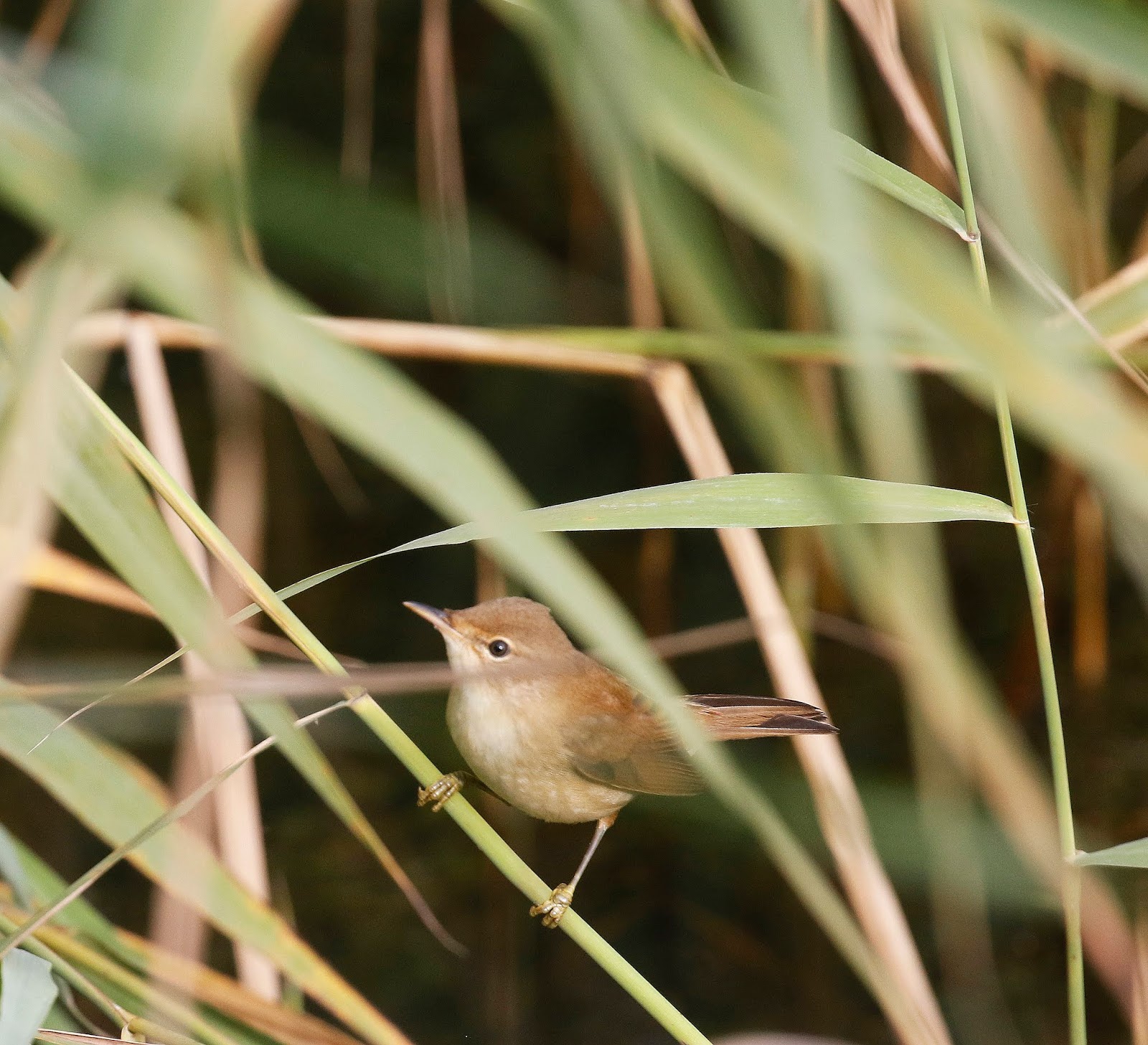 |
| Reed Warbler |
For an hour or so I was on my own and then Tricia joined me which saved me from becoming too introspective, bringing me back to the present and we talked as we awaited the arrival of the Kingfisher. It visited briefly, sitting on the post for a minute or two, allowing some photos but something unseen outside the hide unsettled the Kingfisher and with that it departed.

Such a prima donna, always leaving its admirers wanting more.
A long wait then ensued before it put in another stellar performance.
It flew in, not to the post but to the far end of the pool and perched on a reed stem bent low over the water, where it sat for some minutes, as two Moorhens fussed in the reeds underneath, with one even climbing the reeds as if curious about the Kingfisher.


I willed the Kingfisher to fly to the post which it duly did and sat looking, as it always does, sensational in the gentle morning sunlight. It cocked its head and shifted its position on the post. A bob of the head and an upwards flick of its short cobalt coloured tail signified it had seen something in the water and it looked downwards more intently.


It dived from the post to hit the water with some violence and returned to the post with something wriggling in its bill. It was a newt which the Kingfisher proceeded to whack to death or at least into submission on the post, twisting its neck while firmly grasping the newt between its mandibles and then untwisting its neck liked a coiled spring to bring the newt down with some force against the top of the wooden post. Several blows were administered and then the subdued newt was manouevred to be swallowed head first. The Kingfisher sat for some while afterwards, its appetite satisfied for now and then flew off towards the river. It was over in fifteen minutes.


This second interval with the Kingfisher proved the ideal distraction from thinking about John and with its departure my world again seemed bearable and grief was diminished.


We waited for a couple of hours but the Kingfisher did not return. We spent the time watching the various dragonflies that frequented the pool. A Migrant Hawker hovered in front of the hide, the blue patches on its segmented body a pale imitation of the Kingfisher. A male Banded Demoiselle, as exotic looking in its bottle green and blue iridescence as its name, settled on a blade of reed.
 |
| Male Migrant Hawker |
 |
| Male Banded Demoiselle |
I thought of John and the sadness that this beauty of nature was no longer his and similarly will not be mine to enjoy when the end comes but then I rallied. I have after all the benefit of some of John's artwork hanging on the walls of my home which will remain as a constant reminder of him.
John may be no more in life but he will travel with me through what remains of my time on earth and bring certain happiness as I recall the memories he has left me.
Goodbye dear friend.


