|
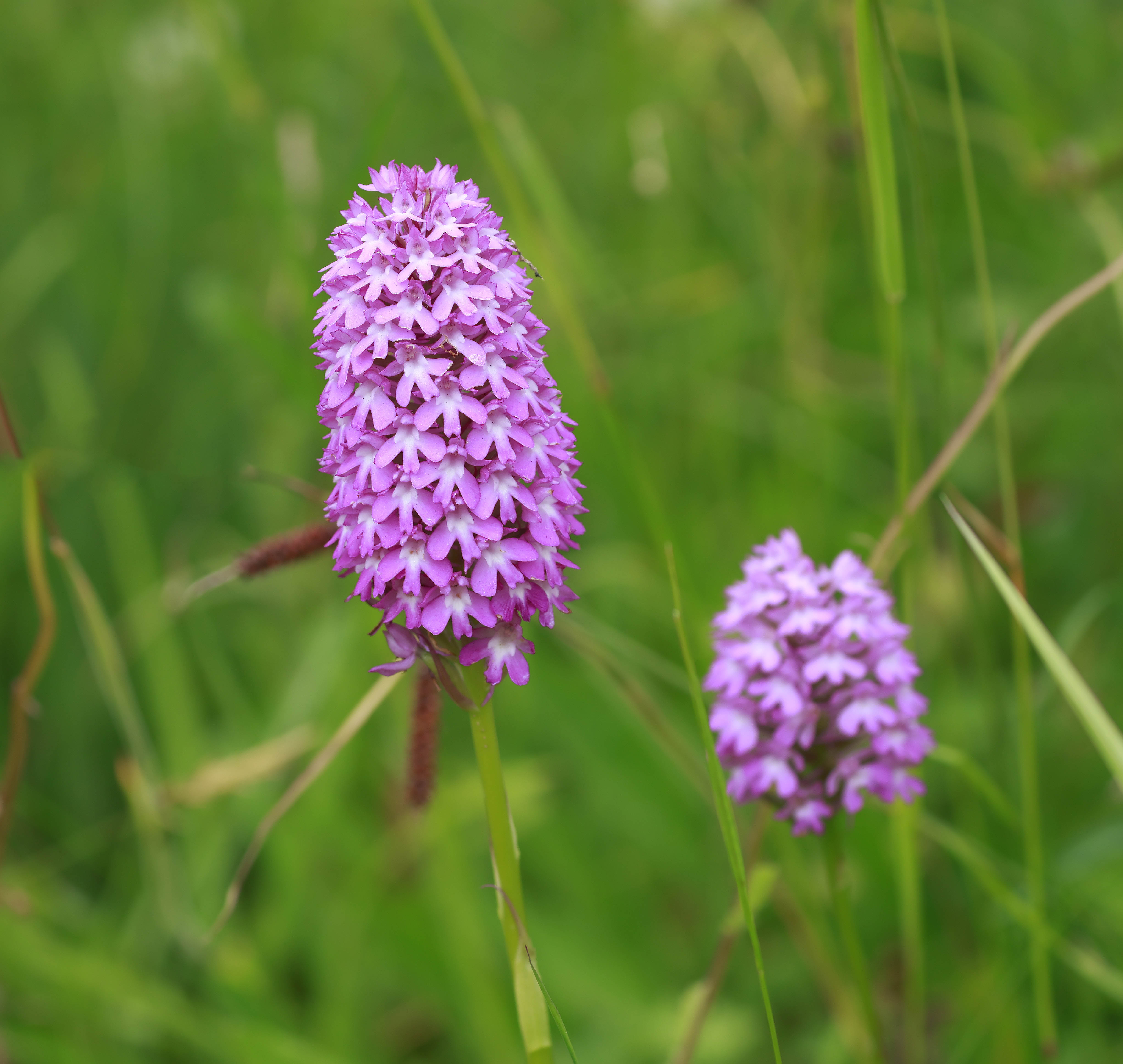
| Marsh Fragrant Orchid |
My orchid education continues
Well, to a certain extent!
Peter called on Tuesday to tell me he had obtained permits to visit two of Hampshire Wildlife and Isle of Wight Trust's reserves near Basingstoke.
The reserves in question were Mapledurwell Fen and Greywell Moors Fen, both being lush and relatively wet fens.The former definitely requiring wellingtons to traverse, the other not so much.
Now here comes the difficult bit. Peter explained we were going to see Marsh Fragrant and Southern Marsh Orchid. All well and good as I had definitely not knowingly encountered a Marsh Fragrant Orchid before. However the group of orchids in the genus Dactylorhyza to which Southern Marsh Orchid belongs are notorious for posing one of the more difficult identification tests due to their tendency to readily hybridise with one another and with Marsh Fragrant which is in another genus.Gymnadenia This results in such a degree of complexity that it often prevents reliable identification and the parenting of such plants can only be guessed at. It requires expert knowledge to identify the orchid involved and even the experts can be flummoxed by some hybrids,so for a relative novice such as myself such a situation would prove a daunting prospect to tackle, if at all.
As if this was not enough the Hampshire Wildlife Reserves Officer told us that Pugsleys Orchid, a very rare subspecies of Southern Marsh Orchid grew in Mapledurwell Fen but the latest official taxonomic pronouncement is that Pugsleys does not occur in England south of a line drawn from The Severn to The Wash and that any orchid thought to be this form found south of that line is now a subspecies of Southern Marsh Orchid called schoenophila.
Rather than get in a tizz I decided that I would concentrate on the two main orchids and leave the minutiae of hybrid and subspecies identification for another day.Worrying about such differences would to my mind take a lot of the pleasure out of the day. Others may differ which is understandable but for now it is beyond my capabilities so best to leave well alone until I have studied more about the subject and feel more confident.
Our orchid day commenced with an early start at 7am to avoid the rush hour traffic around Oxford with our first destination being Mapledurwell Fen that lies close to the M3 motorway and the large conurbation of Basingstoke.
For once it was a beautiful day, sunny and warm as we headed southwards to Hampshire.
Mapledurwell Fen, we were informed on our permit, is a three hectare area of wet fen, sandwiched between the large car park of the brilliantly named Conkers Garden Centre and a building site for new homes and our permit told us access could be gained through a metal gate by entering a supplied four digit code to unlock the gate.It sounded so simple but wasn't as it took some time to find the gate, well hidden from the road down a bank of thick vegetation and when we did locate the gate it was obvious it had not been opened for months if not years and there certainly was nowhere to enter a code.Huh!
I surveyed the fen, a dense mass of tangled rampant vegetation that in places near the gate was almost neck high. Daunting but someone had to go in and find if this was the correct location.

Gingerly climbing over the metal gate I entered the fen forcing my way through rushes, sedge and other riparian vegetation at its summer lushest.

 |
| Southern Marsh Orchid |
The Southern Marsh Orchids were obvious, you could call them robust, for their variable and impressive heads either towered above those rushes and sedge which had been flattened and beaten down by the previous days of wind and rain or remained half hidden but defiant in the rushes that enveloped them. Some had passed their best but others were in prime condition, standing resolutely on a single, long green stalk.

 |
| Southern Marsh Orchids |
I returned to collect Peter and we made our way out to the orchids and set about photographing them. I found a Fragrant Marsh Orchid amongst the more numerous Southern Marsh and would like to say I did this by acute observation but achieved my identification by bending to sniff the purple head and being rewarded by its sweet smell. Easy! Closer inspection did show it had narrower leaves than a nearby Southern Marsh Orchid and to my eyes it and the others of its kind I think I found seemed to consistently be a paler shade of pink than the Southern Marsh Orchids that shared the fen with them.

 |
| Marsh Fragrant Orchids |
We spent a happy hour wandering through what was akin to a mini jungle of rush, sedge, grasses and areas that were wet underfoot.No one came to join us and it was as if we were in an alternative world, hidden by the waist high vegetation from so called civilisation that lay all around us beyond the fen's boundary hedge.
 |
| Peter in action |
We found Marsh Helleborines too.Their flowers can be quite variable in colour and some of the ones here appeared paler than the normal reddish brown although not as white as the variety ocroleuca which completely lacks the red brown colours of the commoner form. They are not particularly tall plants, the tallest ones here standing no more than thirty centimetres high, coyly raising their flowering stalks amongst and through the rushes, each with its fragile cargo of pale flowers.


 |
| Marsh Helleborine |
We took a last look around and our scan revealed some previously unobserved orchids in bud, almost invisible amongst the grass and rushes.Their flower spike came to a distinct point and we identified them as Marsh Fragrant and speculated that their pointed tops might be a way of distinguishing them from Southern Marsh Orchids which, to our eyes at least, tend to have more rounded tops.

 |
| Emergent Marsh Fragrant Orchids |
In a flight of fancy I wondered if they might even be the Southern Marsh subspecies schoenophila that has replaced Pugsleys but honestly I did not have the skill or knowledge to tell. Hopefully one day I will.
The human condition that everything must have a name put to it and be classified has I suppose resulted in the confusing taxonomy concerning these and other related orchids. The ongoing discussion and changes are both interesting and stimulating.but standing here in the middle of this, the Hants Trust's smallest reserve, the sun warm on my face, chest high in rushes and marshland vegetation and surrounded by many magnificent native wild orchids was, to me rewarding in far more ways than if I had identified everything.
Content that we had made the most of our time here we returned to Conkers car park and availed ourselves of a rather good coffee in the garden centre's cafe before moving onto our second reserve.
Our next destination was Greywell Moors Fen where we would find more of the same orchids but in much greater numbers as there were meant to be hundreds of both species as well as many Marsh Helleborines, including the white variety ocroleuca, which although not particularly rare would be new to me and Peter.
Located on the outskirts of the genteel village of Greywell in attractive rural surroundings, we concentrated on the northern part of the thirteen hectare reserve. After some confusion, as the reserve extends on both sides of the road and inevitably we tried the wrong side first, we found the entrance to the northern part of Greywell Fen behind Southeast Water's pumping station. Again access was via an unmarked metal gate, although we did not have to climb it this time as it was unlocked and immediately we passed through we were in similar surroundings to Mapledurwell Fen.


 |
| Marsh Helleborines - the white variation ocroleuca |
After a photography session with the white helleborine we followed the trail northwards, passing through an open wooden gate to come across a veritable sea of Marsh Helleborines and a good number of Marsh Fragrant Orchids. Personally I have never seen Marsh Helleborines in such profusion as here.

There must have been well over a few hundred and the number must have far exceeded this over the entire northern part of the reserve.Walking further we came to a large dry reed bed and off to the right was a mix of both Marsh Fragrant and predominantly Southern Marsh Orchids with possibly some hybrids amongst them.

 |
| Marsh Fragrant Orchids |


 |
| Southern Marsh Orchids |
The number of orchids at Greywell was one of the largest congregations I have ever seen, the large purple heads of the Southern Marsh Orchids dominating the scene as they stood statuesque in loose groups amongst the gently waving grasses. Groups of Marsh Helleborines were also growing amongst them although in much smaller numbers and we found one or two more of the white variety here as well
By early afternoon we felt we had done sufficient justice to the orchids of these two reserves and thanks must go to the Hampshire and Isle of Wight Trust and its volunteers for looking after these two reserves. It is nice to know they are protected for posterity and will remain as such for anyone with an interest in orchids to come and enjoy.