Wednesday, 16 August 2023

Autumn Ladies Tresses 15th August 2023

The native orchids of Britain are a new fascination for me.My obsessive nature temporarily transferred from twitching birds to seeking out the different species of orchid that still manage to grace our increasingly degraded natural landscape. Another huge bonus is they remain where they are unlike birds which all too often fly off!

A colleague invited me to join him on a trip to not far away Greenham Common in Berkshire to seek out the latest of our native orchids to flower - Autumn Ladies Tresses. Known as such because the arrangement of the flowers on the stem resemble the curly locks of a woman's hair.

I have only ever seen them once before and that was many, many years ago at Beachy Head in East Sussex  so my memory of what they looked like was hazy due to  the passing of so much intervening time I recalled they were small and delicate with white flowers and at the time I felt it was a great privilege to see them but that was the sum of it.

Greenham Common was bathed in warm sunshine below blue skies as we walked a short distance from the car park in the general direction of an open area of short heathland grass which was studded with the yellow starlike flowers of Dwarf Hawkbit and Horseshoe Vetch, a delight to the eye to be sure but where were the tresses?

We split up and it was not long before my colleague Peter called me over and walking to join him there were the Autumn Ladies Tresses at our feet. Tiny, no more than a few centimetres high they hardly stood out even amongst the short grass. I crouched down to look closer and the intrinsic delicate  beauty of these orchids became apparent. The white and green flowers twisted upwards, for all the world like a fairy spiral staircase, around a pale greyish green stem. the lower flowers in full bloom, the uppers clenched tight, awaiting their time to open.The twisted shape was not unattractive, looking like some intricate piece of jewellery one would pin to clothing. The spiral impression is the origin of its Latin name Spiranthes spiralis


Once my eyes became familiar with the appearance of the tresses,  I commenced to find more and more. I had got my eye in. They were here in profusion, coming into the early stages of flowering.So small were they, one had to tread so very carefully to avoid crushing these delicate spires of white.

In situations like this I find myself entering into a parallel world where my general surroundings fade to inconsequence as I focus mind and body solely on the flower, which seems to draw me into its influence and its own private world, an amalgam of not only its living presence but its folklore and life history. Possibly this comes about due to viewing the flower through the constrictions of the camera's viewfinder, the sole image visible being the flower. Whatever the explanation it is a far from unpleasant sensation and for all the time I was photographing these floral gems nothing else intruded.

We found our own spires and called to each other to come and look at our latest discovery, a benign competition to try and find the finest and tallest to delight each other but really there were so many that in the end we just meandered individually across the sward seeking out yet another discrete congregation of tresses in the grass.

Wherever we went we regularly encountered populated areas full of them and then areas that were bereft and it became apparent there must be thousands upon thousands randomly scattered in colonies large and small all over the common. As on my last visit to see Dartford Warblers I found myself contrasting these delicate flowers and their now pleasant surroundings to the former use of this land as a no go base for nuclear bombs and planes..I wonder if the tresses were here then, innocently growing un- noticed by the side of the runway and if so rejoice they have outlasted the military planes that thundered past them. I like to think so. 

They are perennial, flowering from mid Augsut to the end of September.. Growing no more than 10-15cms high they prefer areas of short grass such as that nibbled by rabbits and sheep, meadows, heaths and even the edges of pine woodland. In Britain they are absent from Scotland but widely distributed throughout southern England, reaching as far north as Lancashire and are also found in coastal Wales.Further afield they are distributed throughout Europe,North Africa and Asia.

Alhtough still plentiful in Britain it has decreased markedly in the last 80 years as a result of the loss of suitable habitat brought about by a change to a more intensive agriculuture..Due to  this it is now classed by CITES (Convention for International Trade in Endangered Species) as Near Threatened.  

If its preferred habitat is left unmown it can appear in thousands and its preference for very short grass means it can sometimes appear on garden lawns and in boom years can be found in astonishing numbers such  as over 3000 on one lawn in East Sussex and a front lawn in West Sussex that had 672 spikes in an area approx 230 yards square.

For a couple of hours with the sun on our backs we enjoyed these delightful unprepossesing orchids still managing to grow and thrive here in abundance under the protection of BBOWT.(Berks,,Bucks and Oxon Wildlife Trust).

Monday, 7 August 2023

Hairstreak Gold 3rd August 2023


There are five hairstreak butterfly species native to Britain and the largest and last to emerge is, in my opinion, the best of all - the Brown Hairstreak, which traditionally flies in late July and early August and is with us until the end of September. All five species are rare and elusive and due to  habitat loss consequently endangered and none more so than the subject of this post.

Last year I made a cursory visit to a local site in my home county of Oxfordshire to try and see them but failed miserably and never got around to going back to try again.

This year the time of their emergence has coincided with continuous dreadful weather of rain and wind so it was hit and miss if I\could find a window of opportunity where the sun shone long enough to make it worth my while travelling to my favoured location in search of them.

I took a chance on Thursday and although it looked touch and go, for a time the weather relented to bring some warm sunshine but with a forecast it would cloud over by noon.

The location I go to is sheltered, so wind is rarely a problem on the narrow grass track that runs between overhanging trees and bushes, a mix of hawthorn, blackthorn, ash, elder, willow and oak with a tangled and riotous understorey of brambles, thistles, nettles, umbellifers, bindweed and willowherb. 

Its cloistered warmth and shelter provide a welcome benign environment for butterflies of a number of species but the Brown Hairstreak is undoubtedly the crown jewel.

The Brown Hairstreak's overall range has contracted by over 60% in recent decades and as a result they are a top conservation priority They are a butterfly of predominantly southern England with their northernmost colony located in north Lincolnshire and notable strongholds in West Sussex, Surrey, Buckinghamshire, Oxfordshire and North and South Devon.They are also found in Cardigan and Carmarthenshire in Wales and on The Burren in Ireland.

The main causes of their decline are the removal of suitable hedges from the countryside and farmland and the now normal practice of annual indiscriminate roadside cutting of hedges by tractor mounted flails as opposed to the traditional periodic manual, and consequently less brutal pruning of hedgerows.Brown Hairstreaks lay their eggs on the new shoots of blackthorn on which the larvae hatch and feed but many are now destroyed by the flails..

Fortunately the site I visit is protected and the hedgerows are sensitively managed to ensure the colony will survive and prosper..Unfortunately there is a cloud on this optimistic horizon in that the female Brown Hairstreaks can cover several square miles laying their eggs in suitable habitat and some of that habitat will not be protected and subject to flailing or even removal.

Brown Hairstreaks are late risers so I knew there was little point in arriving before around 10am as the sun does not penetrate between the hedgerows until then. Once the magic hour is reached it is a matter of patience until a hairstreak descends to nectar on the many thistle flower heads growing in the tangles of rampant vegetation or settles on the bramble flowers  festooned over the lower branches of hawthorn and blackthorn. So it proved this morning as I waited for the sun to slowly edge down onto the brambles and thistles.

It was no real hardship whilst waiting as it is quiet and tranquil. a balm for the soul, being surrounded by a profusion of summer vegetation and myriad insects. A Willow Warbler sang briefly, no more than a whisper of notes, a last farewell to summer. A Raven's staccato calling came from afar.  Amongst the ubiquitous Gatekeepers, winking their bright eyed wings in the sunshine and an  inquisitive Comma checking every intrusion into its self selected domain, I was entertained by a fresh Red Admiral, flirting its poster paint coloured immaculate wings on a bramble flower. It has been such a good summer for them, and they seem to be everywhere this year in large numbers, dashing away from leaf and flower at my approach only to circle and double back in erratic glides to settle once more.. Every hedgerow in this part of Oxfordshire seems to harbour them at the moment, this boldest and most obvious of butterflies, even out and flying in dull cloudy weather which other butterflies shun.

Gatekeeper

Red Admiral

I came across my first hairstreak at around 1030am, nectaring high up on a spray of bramble. It was nice to renew acquaintance with what I fancifully regard as an old friend.It brought that sense of continuity and renewal one feels after a long absence from someone you cherish and with whom you naturally feel at ease and content. 

However I soon began to wish for a closer, more intimate encounter, having from past experience had them literally at eye level and just inches away. My wish was granted sooner than expected as a pristine male, possibly hatched this very morning, descended to imbibe nectar from a thistle flower..


If you read about this hairstreak's life history and behaviour you are told that they spend most of their time high in the surrounding trees feeding on honeydew (the excretions of aphids) from the surface of the leaves and rarely come down lower to feed on flowers. Here that is not the case, in my experience, and if you wait long enough you are pretty certain to encounter one, if not more, at eye level or even lower, feeding on a thistle or bramble flower.

The male hairstreak settled low down on its selected thistle head and commenced a detailed examination of the pale purple florets for nectar. Round and round, both upright and upside down it explored every aspect of the flower head, probing with studied deliberation each tiny purple floret for its minute drop of nectar and then after a complete circuit of the flower, repeated the process as if concerned it had missed something. I watched for an hour and it was still on the same flower head when I left.


Others descended soon after I had discovered the first until there were four individuals in front of me each on their particular flower head and, like the first, never moving from their flower of choice. This was truly exceptional and something I have never encountered before in many years of watching Brown Hairstreaks here. Usually it is one or two, if at all, after a long wait  but today was different. 


It has been suggested that after prolonged rain, such as occured in the days prior to my visit the honeydew gets washed off the leaves and this persuades the hairstreaks to transfer their attentions to substitute sources of nectar such as thistles and bramble flowers.This could well be true in this case or possibly it was just a chance happening.In all I saw six hairstreaks, the other two being nearby along the path.

It was noticeable that when the sun was obscured by clouds a couple of individuals opened their wings to absorb any residual warmth and by so doing revealed a lack of orange markings on their chocolate brown upperwings, signifying they were males.It would have been nice to see a female as they have a large and attractive splash of orange on the upperside of each of their forewings but one cannot have it all and I was content to remain philosophical and enjoy the moment.The sight of any hairsttreak is one to be savoured no matter what.


#

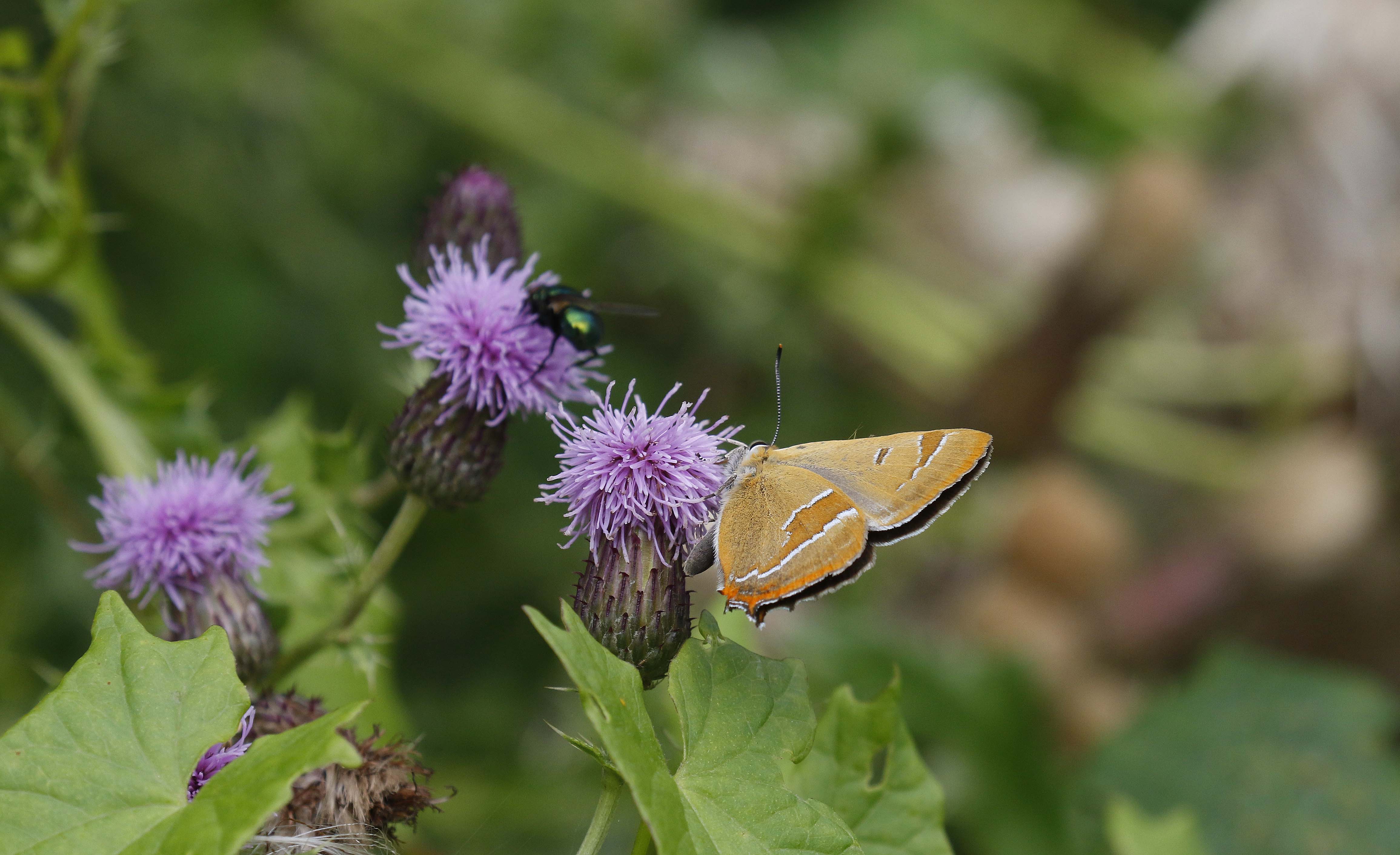
Male Brown Hairstreak

There is one particular hotspot along the path where it narrows, sheltered and with an abundance of bramble as well as numerous thistle flowers and if one has to wait then this is the prime and most rewarding place to do it.

Brown Hairstreak heaven!

Brown Hairstreak is such an uninspiring and unimaginative name and does not do justice to this charismatic, beautiful butterfly. True it is brown when it opens its wings but as they mainly keep their wings firmly closed they appear pale orange with bands of richer orange bordered by delicate wavy threads of white. It is such a shame that a former name for them, Golden Hairstreak has fallen into disuse as this seems  much more suitable to describe this gem of an insect. 

So a pleasant few hours were whiled away as I stood in this sequestered, peaceful place with a couple of other enthusiasts for company, all of us enjoying the hairstreaks. Unnoticed the clouds began to gather and the sun slipped  away, my prompt to leave, well satisfied with my hairstreak fix for yet another year. 


Wednesday, 2 August 2023

Black winged Stilts at Frampton Marsh 31st July 2023


Black winged Stilts first bred in Britain in 1945 in Nottinghamshire. This year has seen a marked influx of Black winged Stilts into Britain with pairs breeding in both Kent and Lincolnshire (for the first time). In May this year birds were reported from fifty separate sites in Britain, including an individual at RSPB Otmoor in Oxfordshire. near my home. The British Trust for Ornithology (BTO) now classify them as 'colonising breeders'.

Black winged Stilts have a cosmopolitan distribution throughout most of the world and in western Europe are to be found in most southern countries, migrating in winter to Africa, north of the Equator. The stilts currently gracing our avifuana are perhaps yet another indicator of the warming global temperature. As they spread north it is thrilling to see them here but at the same time they bring a sense of unease about the way the world's climate is heading and the fact their normal range in southern Europe is suffering record high temperatures, wildfires and drought.

There are two pairs of Black winged Stilts breeding at the RSPB's Frampton Marsh Reserve in Lincolnshire, one pair at the far end of the reserve and the other pair at the opposite end in the vicinity of the Visitor Centre. Between six and eight are thought to be present, comprising four adults and four young. We saw at least seven when we visited the reserve.

Mark, my birding pal, saw some images, taken over the weekend and posted on social media of one of the two families of  Black winged Stilts at Frampton.The stilts were seen and photographed from the visitor centre and indicated the birds had shown very well.. 

Mark had been on about the Frampton stilts for some time in the past weeks but I was not wildly enthusiastic as I had been to see a long staying Black winged Stilt at Slimbridge WWT in neighbouring Gloucestershire on at least two occasions and had very good views of it. However Mark persisted and after offering to drive to Frampton any resistance on my part, if it ever was such, faded and we met on Monday and made our way to Frampton on a cloudy and windy day, getting there at around 11am as there was no real need to rush.

The RSPB's Visitor Centre at Frampton has had a major makeover and is rather pleasant, still small but now wth a nice cafe attached to it with picture windows that look directly out onto an expanse of  reeds, floods, sandy spits and islands populated by assorted waders,ducks and large numbers of Greylag and Canada Geese. 


With high hopes of seeing the stilts we ascended the steps to the centre's entrance, proffered our membership cards and enquired as to the current situation with the stilts.

I should have known.

The dreaded words were delivered by a far too cheery volunteer.

There's been no sign of them today so far. You should have been here yesterday as they were right outside the windows giving fabulous views 

Now we were confronted with a dilemna.Should we wait here or in the cafe in the hope the stilts might fly in or, as suggested by the volunteer, walk to the East Hide which was about a mile away and where the other family of stilts had been reported this morning.Taking one look at the cafe's prices for food, tea or coffee (£6.50 for a sausage sandwich anyone?) we opted for the walk to the East Hide.

Digressing for a wee moment I do not understand why the RSPB charge so much for any form of sustenance in their cafes. Personally I think it self defeating as now we bring our own sandwiches, rolls or whatever and eat those and I am sure the same goes for many other visitors.as the cost of food rises ever upwards.

Back to the birds.

Our day at Frampton, it is fair to say, had not got off to the best of starts but we were here and so may as well make the best of it.The weather forecast had been for no rain but of course this is Britain where you take any forecast with a large dose of scepticism and sure enough it began to rain, not too heavy but enough to be an inconvenience.We followed the path towards the East Hide as it wound through the head high whispering reeds. The one highlight was a Weasel, hunting along the edges of the path, dashing around like an animated saveloy but on noticing us shot into the reeds and that was that.

We entered the East Hide and looked out to the flashes and scrapes.To nobody's surprise there was  not a sign of any stilts, just a lot of geese, ducks and gulls with a large number of Sand Martins, hunting flies low over the water in the strong northwest wind. Scattered Black tailed Godwits were feeding in the muddy flashes and a few Ruff wandered the narrow stretch of mud that formed a shoreline of sorts in front of the hide.Most noticeable and right in front was a truculent Avocet unecessarily protective of a juvenile, almost as large as itself.

Half an hour passed watching the comings and goings of various waders when Mark made a good find in the form of an adult Little Stint, running around on the mud of the windswept shoreline, all ginger brown in its breeding plumage.It was making its way towards us, as we waited with cameras poised but the Avocet had other ideas and chivvied it away. Next along the shore came a moulting male Ruff which received similar treatment from the Avocet and departed. The Avocet, now getting into the swing of things set about scattering a family of Mallards.I never thought I would find cause to curse an Avocet  but now I certainly did.

It became obvious that with the Avocet deeming this particular area its exclusive domain we were unlikely to see any wader for more than a few seconds nor have the opportunity to photograph them The Ruff and the stint both kept coming back but each time were sent literally flying by the feisty Avocet. A lovely Knot in pale orange and spangled summer plumage chanced its luck and it too was summarily chased off. The only bird that we got close views of was the young Avocet as it passed back and fore in front of the hide.

Juvenile Avocet

Ever persistent, the Little Stint returned once more and as.I was focusing my camera on it, in flew a Black winged Stilt, an adult male with a snowy white head, and glossy black upperparts, supported by those incredible coral pink knitting needles it calls legs.It waded elegantly in the shallow water and commenced coming towards us.


For a minute or two we enjoyed anticipating seeing this lovely bird close to the hide but were confounded  when in swooped the Avocet and away flew the stilt. I decided that was it for me but Mark said he wanted to stay.I argued it was pointless as the stilt or stilts were unlikely to return to face the Avocet and even if one or more did they would certainly be driven off.

We agreed to differ and I said I would go back to the visitor centre to try my luck with the other stilt family there and we could liase by phone if there were any developments at either location.Leaving the hide I looked along a channel of water and there was the stilt family, someway distant and sheltering under a bank from the wind and rain.They looked settled and perfectly happy where they were with not an Avocet in sight!

Back at the visitor centre I was told a stilt family were on the other side of the approach road  to the reserve, on a pool reached by taking a public footpath.They were also distant but at least I could get to see them which I did, a family of four, consisting of two adults and two full grown young but after a few minutes they flew as a group,calling to each other and were lost to view.

I made my way back to the visitor centre and found Mark had already returned.He told me he had seen  a Great White Egret near to the centre so with precious little else to see I headed off to look for it. A helicopter with clatterring rotor blades flew low over the reserve.A minute later my phone rang.It was Mark.

With only one bar on my phone the message was garbled but just about decipherable

'The stilts are in front of the centre! Now!'

I rapidly made my way back and found Mark in the cafe which had two windows which could be partially opened and through the gap in one he was photographing a male and female Black winged Stilt accompanied by a fully grown juvenile.

The helicopter must have disturbed them and caused them to fly back to the scrapes. They were really close and allowed us to get some great images as they stood in the shallow water, for all the world as if deciding what to do next.


Black winged Stilts are incredible looking birds,unreal,almost as if a child had been asked to create a bird and got the proportions wrong.The head and slim body are predominantly snow white apart from the back and wings which are black.The bird is all points and angles,from the long,black,pencil thin bill to the black wing tips extending far beyond its white tail.The attenuated body is supported on legs so thin and fragile you feel they could snap at the slightest opportunity.They stalk around in perfect balance, tilting to pick at items from the ground with an elegant bend of the legs at the knee.It is impossible for the bird to be anything else but graceful,being granted this grace by its impression of great fragility.Only in flight do they look slightly less elegant when their long outstretched legs trail far beyond their tail.


This unlikely trio stood for a while before separating and commencing to feed, stalking through the water like circus artistes on those long legs, bending the knee at forty five degrees to dip downwards to pick something from the water or sand. 


The young bird was a shadow of the adults in appearance, its upperparts dull grey brown, each feather neatly scalloped with a thin buff fringe, its head and hindneck smudged with pale brown feathering, the legs dull pinkish brown. Its movements, however, replicated the adult's elegance and grace


Juvenile Black winged Stilt

In contrast the adult male looked sleek,its upperparts glossy black and its head and underparts snow white with legs that were bright coral pink.It is the legs that always draw your attention, so extraordinary, they are just as long above the knee as they are below. 


Adult male Black winged Stilt

The female was, unsurprisingly,duller than the male with darker, more extensive markings on its head and neck.I would like to say they were black but they were dark brown as were its upperparts which showed some buff fringes to the hindmost feathers. 


Adult female Black winged Stilt

The adults separated and flew further out to another scrape but for the next hour and a half they remained in the  vicinity of the scrapes in front of the centre, sometimes coming close, sometimes remaining more distant.Although separated by some distance the birds were obviously keeping in contact with each other, calling when they flew with an unmusical, loud tyikk tyikk tyikk. 

By now we had abandoned the cafe to stand in a little viewing area by the fence at the side of the cafe and although the stilts were certainly aware of our presence they remained where they were.The young bird came incredibly close at one stage and was less wary of us than the adults. 

In the short periods when they were out of view we were entertained by a female Marsh Harrier collecting material for presumably a late nest secreted in the reeds, a moulting male Ruff feeding close to us  and Little Ringed Plovers, Green and Common Sandpipers running along the water's edge. Even a Spotted Redshank put in a late appearance.

Our afternoon with the Black winged Stilts came to a natural conclusion as the skies of early evening darkened with rain clouds once more. 

Time to go.