Thursday, 23 June 2022

The Great Reed Warbler in Nottinghamshire 22nd June 2022


Unable to sleep, a millon things churning in my head and with reading a book not doing the trick, I rose at 5am, reasoning that some sort of physical activity would take my mind off the cares and worries that steal up on one in the night. I headed for Nottinghamshire where a Great Reed Warbler has taken up territory, since June 4th, in a reedbed at the RSPB's Langford Lowfields Reserve which lies to the southwest of the small Nottinghamshire village of Collingham in the Trent Valley.

Great Reed Warblers are a rare vagrant to Britain (308 records to date) but one or more are recorded annually, with this year delivering another singing male to Snettisham in Norfolk. They are often first identified by their lusty singing and can remain for extended periods in the hope of attracting a mate which is very unlikely. Their breeding areas lie further to the south and east of Britain, in northwest Africa, continental Europe from southern Sweden, Estonia and western Russia to the Mediterranean and east as far as Ukraine and Asia Minor. They spend the winter in tropical Africa from Senegal and Kenya south to northern parts of the Cape Province in South Africa.

Despite the early hour the sun had already broken the horizon on this, the day after the summer solstice. Due to the timing of departure from my home in Oxfordshire I encountered little problem heading northwards on the roads and the day was promising to be fine, hot and sunny. My spirits were immediately lifted at the prospect of fine weather and a rare bird to see and arriving in the small reserve car park at 7.30am I found I was the only person there and feeling good about life.

The walk to the reserve proper takes about twenty minutes, following a narrow dusty track, first through a wood and then bounded by high hedgerows which at various points bower overhead to form a living tunnel of lush greenery. The hedges were alive with birds, warblers mainly, Chiffchaffs, Willow Warblers and Common Whitethroats. A male Blackcap stopped on a branch to let me pass. Its bill full of a blue and black damselfly destined for its young in a nest nearby.


Further beyond the hedgerow, Reed and Sedge Warblers sang from their hiding places in reed fringed lagoons whose waters faithfully reflected an almost cloud free, blue, morning sky. Here, before and around me, was summer at its most bounteous and a day in which to rejoice at being alive, all cares now forgotten.

Reaching the wooden gate in the hedgerow that grants access to the reserve I could already hear the Great Reed Warbler singing despite it still being over a hundred metres distant. The strength of its voice is extraordinary. Passing through the gate I walked down to the grass track that winds around the main lagoon that lay, glass like, before me.


The reserve itself is a joint project between the RSPB and Tarmac, who were and are extracting sand and gravel from all around here. The aim is to create wetland habitat on a grand scale so initially, once quarrying had ceased on a 35 hectare area it was converted into a reserve of lagoons and large reedbeds with wild flower meadows, scrub and woodland. Further quarrying will be taking place in succession further along the river valley so the reserve has the potential to grow ever larger.

A gentle breeze blew intermittently but I sensed that today was going to be very warm indeed as I walked the fifty metres of grass track to where the warbler was in full voice.The reeds it has chosen are right by the track separated only by a thick bramble hedge, its white flowers in full bloom and a nectar paradise for bees, butterflies and other insects. 


The reedbed itself hardly looks substantial or extensive enough to be suitable for this larger cousin of our familiar Reed Warbler, being narrow and inconsequential compared to the much larger reedbeds scattered around other parts of the lagoon. However the warbler has decided this is the spot for him and has set up territory here accordingly.

Great Reed Warblers are about a third larger than a Reed Warbler, bulkier and thickset, with more clumsy movements but possess a similar plumage of warm brown upperparts and creamy buff underparts.The throat is pure white, especially noticeable when swollen in song and compared to a Reed Warbler its head is larger in proportion to the body and more strikingly marked with a broad pale supercilium and a darker line through each eye. Not a striking bird as such but its exceptionally strident song, and the sheer volume of a series of croaking, squeaking notes, make it unmistakeable and impossible to ignore.

I stationed myself opposite where the warbler's song was coming from, looking over the bramble hedge to the reeds just metres beyond and below. I could hear it plainly enough but where was it in the jumble of pale dead reed stems and emerging fresh green blades of reed? Eventually I found it on the far side of the reeds by the lagoon's calm blue waters, perched on a reed stem but very much obscured by other intervening reeds.


To get a clear view of it and a decent image was not going to be easy if it remained partially concealed like this. However I had all day to wait if necessary and knew it would move position regularly through the reedbed. It was just a matter of being patient and hoping it would eventually choose to perch somewhere which was more open. Two hours later and I was still hoping, having only achieved tantalising views of it in the reeds, always partially and frustratingly obscured. 


I was however still on my own with not another living soul anywhere to be seen on the reserve. It looked like it was me and the warbler to the finish.

The sun was now most definitely warming the land and shining on most of the reedbed and this brought about a  change in the warbler's behaviour. The increased warmth and sunlight seemed to embolden it and it showed definite signs of perching higher and more openly.


Through the first three hours it sang constantly, even when preening or chasing insects. It never stopped. A Cetti's Warbler was given short shrift as the Great Reed, espying it from its swaying perch on a reed stem, chased it out of the reedbed and into the hedge behind me, sending the Cetti's on its way with a volley of croaks, gurgles and explosive chattering. Satisfied the Cetti's had got the message it quickly returned to the reed bed and resumed its singing.

The song is very, very loud and comes across as a series of hoarse guttural notes, delivered slightly rthymically. and at times  are an almost frog like croaking and at others a series of higher grating squeaks, both repeated over and over. Rarely silent, the song was to be an almost constant accompaniment as it moved through the reeds and there was no mistaking where it was, even when invisible, due to its ceaseless singing.When visible and in full song the rich orange colour of the inside of its wide open bill stood out as it moved its head from side to side.


Finally it began to show itself more  and now, at last, a few opportunities materialised to catch it fully or almost fully in the open. However there always seemed to be a reed head or reed stem to thwart my attempt at a decent image. 


In a way this was no bad thing as it retained my interest although at the same time trying my patience and equanimity to the very limit. Eventually it all came together for a few brief minutes.

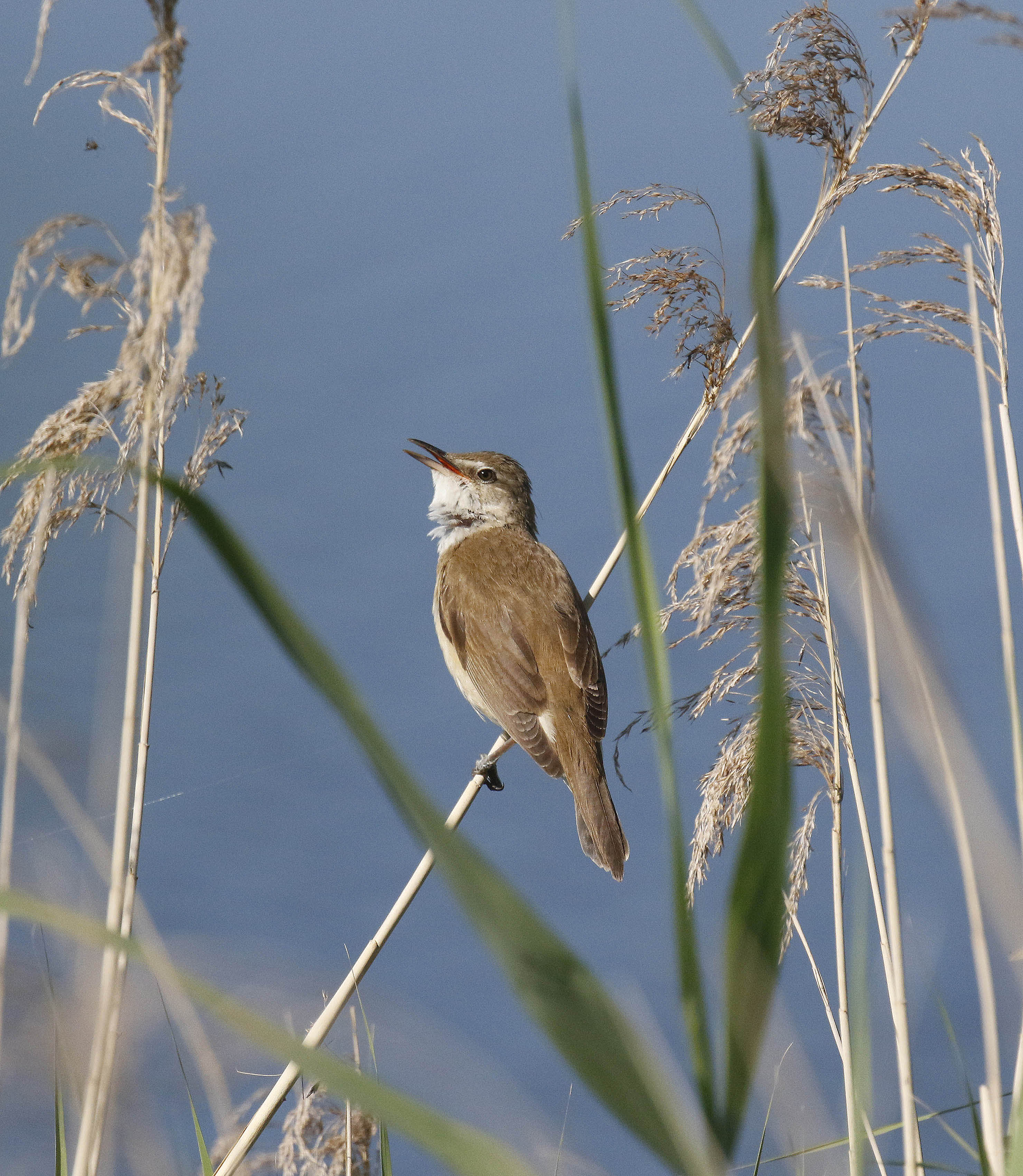


That's photographing warblers for you, even ones as large as this magnificent Great Reed Warbler. 

Twenty five minutes drive further north is Yorkshire Wildlife Trust's Potteric Carr Nature Reserve, currently blessed with a pair of Black winged Stilts and four young. This is quite a notable event and as I was so close it made sense to go and have a look.

After a rather slower drive than anticipated up the A1 I made it to the reserve and set about the half hour walk to the far end of the reserve where the stilts were viewable from a hide overlooking a shallow flash of water.

I was not disappointed as both adults and their four young were visible, albeit a trifle distantly.The parent birds were very attentive, chasing off anything that came too close to their offspring. This included Little Egrets and an unfortunate Gadwall, with one or the other of the stilts flying at them, calling loudly.


To see these elegant waders with unfeasibly long and delicate pink legs was a nice and unanticipated ending to what had already been an enjoyable day. 

Black Hairstreaks Revisited 20th June 2022

 
I was somewhat disappointed with the results of my search for Black Hairstreaks the other day.True I had found a couple but only saw them for a few minutes before they flew back up into the tops of their favourite blackthorn bushes.

I knew of another place that I considered worth trying which is situated just over the Oxfordshire border in Buckinghamshire. Much of the land about here has been decimated by the expensive folly and vanity that is HS2 but the quiet lane I had in mind manages still, to retain a vestige of rural charm, peace and quiet while a mile up the road the countryside is being scandalously trashed in the name of progress.

The road is bordered by a hedge, containing amongst other plants, Wild Privet and, best of all, the hedge  is allowed to grow freely and not be flailed to pieces. Behind the hedge is a narrow bridleway running between the hedge and a wood of mature trees and this small, almost forgotten area is the haunt of a colony of Black Hairstreaks. Some  years they are present in good numbers but in other years not so. I had not been here for a couple of years so did not know what to expect but hope springs eternal so I went to find out.

On a pleasantly sunny afternoon, hot enough to partially melt the tar on the road, I wandered down the bridleway checking the privet blossoms which are a favourite nectar source for the hairstreaks. The  white waxy cones of flowers dispersed a sweet scent, not at all unpleasant, to linger on the air.

My initial stroll along the length of the hedge brought qualified success, as I found a Black Hairstreak but with tattered wings, the edges frayed and torn from wandering through the blackthorn. It was also well above head height, on top of some privet growing through the blackthorn and almost immediately got into a fracas with one of the many Meadow Browns also nectaring from the privet and departed into the trees. 

Getting to the end of the hedge I returned along the other side which borders the road but with no further success, until about half way along I came to a generous patch of privet and stopped. I often find it useful to halt my progress, to stand and look for a while, waiting, as often a hairstreak will eventually reveal itself, for they can at times become almost invisible when seen head on or from the rear as their wings (always closed) are tissue thin. One has to wait while they move around the cone of flowers they are examining to give a side on view, when they are more likely to be discovered, appearing as a mouse brown coloured triangle.


My eyes were constantly registering the many Meadow Browns as they restlessly flitted and flickered around the flowers. They too are dull brown, although larger but can superficially look very much like a hairstreak until examined more thoroughly. After checking inumerable Meadow Browns I finally found what I was seeking. A Black Hairstreak and better still, one that was fresh, maybe even hatched this very day. It was imbibing nectar incessantly, wandering up, down and around each cone of privet flowers,  probing for nectar and once every flower in the cone had been given the once over and emptied of its nectar, the hairstreak would move onto the next and repeat the process. This is the way of Black Hairstreaks, nothing will deter them when on their quest for nectar and you can almost touch them without any response, so engrossed are they in feeding.


For half an hour I watched it feeding, delicately traversing the cone of flowers, head up, head down, a bravura balancing act as its tiny, thread thin legs gripped the flowers to hold it in position and its two antenna moved independently, like a blind person with a stick, to reconnoitre the flower's surface. A blundering Meadow Brown managed to disturb it, the two butterflies whirling up into the air in conflict before realising they were not the same species or in competition. The hairstreak went and sulked on a leaf of an overhanging tree but it was not long before it descended to nectar some more.


I became completely absorbed, transfixed, entering into the hairstreak's world and its brief life on earth  being enacted before me. I found myself wondering what constitutes a Black Hairstreak's world or any hairstreak's for that matter.What is the extent of that world, surely just a matter of a few feet of hedge leaves and privet flowers, maybe also the tree above. There is nothing beyond in their compass. This is the sum of it and for thirty minutes I joined the hairstreak in another less troublesome, less complicated universe.

Monday, 20 June 2022

Hairstreaks and Peregrines 15th June 2022

On what was predicted to be one of the hottest days of the year I decided to attempt a double delight by going to look for some local Black Hairstreak butterflies and then, in the afternoon, check out a family of Peregrines, on a church just over the county border in Buckinghamshire.

Oxfordshire is fortunate in being one of only three counties that provide a home for Black Hairstreaks, the rarest and arguably the most sought after of Britain's five native hairstreaks.

Mid morning and the sun was shining brightly but a gentle breeze provided some welcome respite from the heat as I wandered along the side of a blackthorn hedge looking for any sign of a tiny butterfly, jinking amongst the topmost leaves and twigs, which is where Black Hairstreaks like to spend most of their time, imbibing honeydew from the surfaces of the leaves.

I  was alone in my quest and for a good length of the hedge found nothing but many bees and other insects going about their lives. About three quarters of the way along and with disappointment becoming a distinct probability I found what I was looking for. No more than a tiny black outline against the bright sunlight. one could so easily miss it, as it flitted briefly from leaf to leaf, having been disturbed by a passing insect. So small and indistinct are they, that it is always a trial to follow their erratic progress but finally it settled.


Moving my position I endeavoured to get the sun behind me and, with this achieved, I was then able  to discern the intricate patterning on its wings. It was pristine and thus presumably a newly hatched individual. For quite some time it remained, frustratingly, where it was but then was disturbed once more by another bee bumbling its way through the leaves and to my immense pleasure the butterfly flew out from the hedgetop and downwards to settle in the long summer grass, almost at my feet.

I have seen them do this before but it is not that usual. However I accepted this good fortune and determined to make the most of it. The tiny insect spent a minute or more in the grass, wandering up and down stems as if confused at where it found itself. It was not long before the inevitable happened and it made a direct flight back into the top of the blackthorn. Here it took up a more usual position, sat on a shiny and hard, narrow blackthorn leaf and there I left it.

Despite another hour wandering along the rest of the hedgerow I was not able to find another and after talking to fellow butterfly enthusiasts later, I learnt that the hairstreaks seem to be scarcer than normal this year. With our capricious weather some years are better than others for our butteefly species and it would appear that this year is not so good for Black Hairstreaks or at least in this part of Oxfordshire.We will see.

From my current pleasant rural surroundings I now took to the motorway for a few miles south to eventually turn off and drive to the picturesque town centre of Marlow which lies on the River Thames in Buckinghamshire. My destination was All Saints Church, where a pair of Peregrines and their recently fledged young are currently in residence. A chance conversation with a fellow Farmoor birder a couple of days ago had alerted me to this opportunity.


The church lies in the heart of Marlow, at the end of the busy high street just before it crosses the bridge over the river. I was convinced parking, as it is in most towns now, was going to be a problem on this sunny day with so many people out and about enjoying the sun while sitting outside the cafes and pubs lining the street.

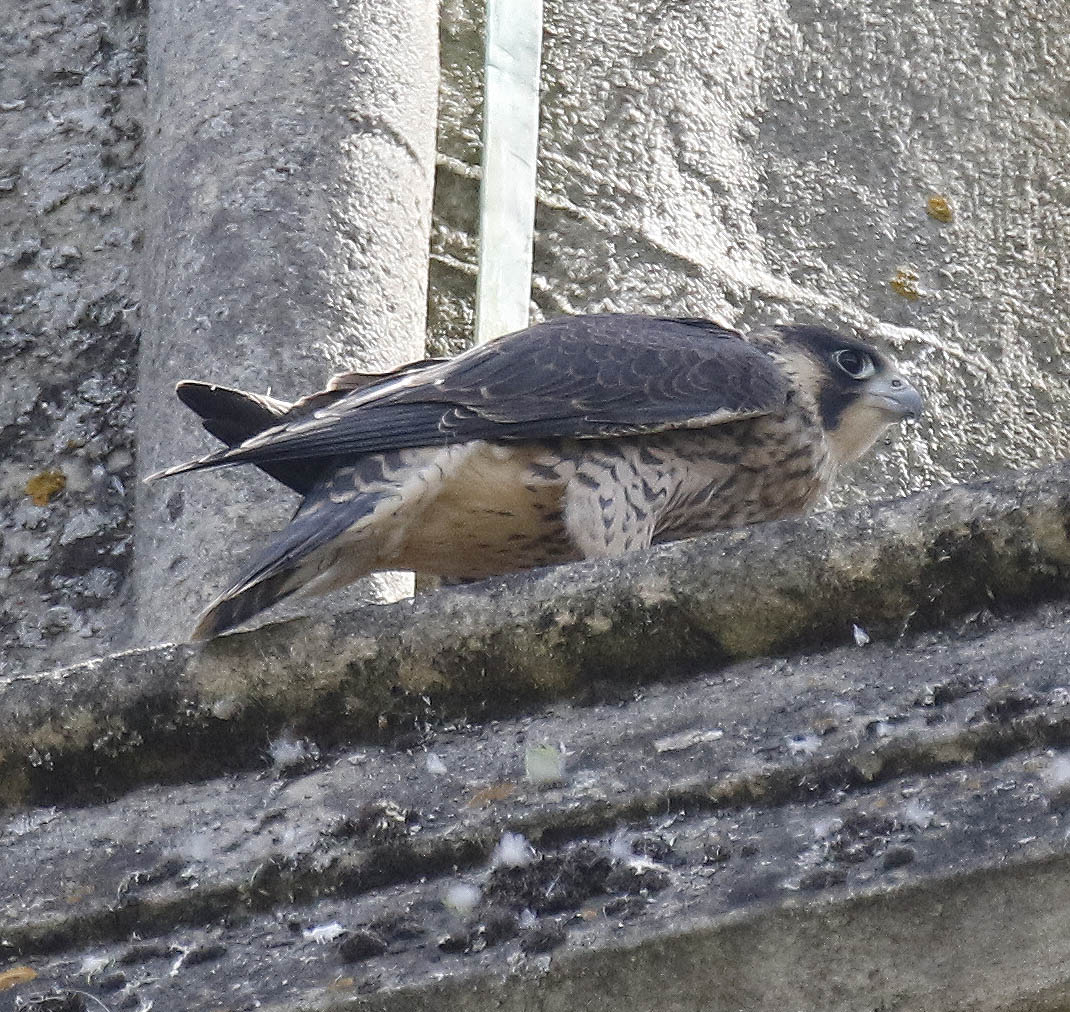
I was therefore pleasantly surprised to find that parking on the high street was free for an hour and there were spaces available. A walk of a few hundred metres from where I parked my car was all that was required to bring me to the churchyard and looking up to the impressive spire, there was a juvenile Peregrine perched on a buttress fast asleep in the afternoon heat.


There was a gathering of mourners standing outside the church door having attended a funeral so I discreetly positioned myself by a yew, well away from them so as not to be thought insensitive. Scanning the spire with my bins I found two more juvenile Peregrines at the other end of the buttress and then much higher, perched half way up the lofty spire, one of their parents which by its size  looked to be the female. She preened and sat quietly on her perch, constantly looking up and taking an intense interest in any passing bird as if sizing up whether to give chase.


Two of the departing mourners came over to talk to me about the Peregrines, telling me this was the second or third year they had bred here and they had become quite a celebrated feature of the town.

The sleepy juvenile awoke, preened for a while, took a long lazy stretch of its wings and then proceeded to shuffle around on its perch of solid masonry, the next best thing to a proper cliff. It stretched its wings once more and then moved along to nibble at a dead pigeon that one of the parent birds had presumably brought for it.


I remained for about an hour, watching and photographing the Peregrines and then retraced my steps back into the busy throng of cars and people in the high street. Marlow seems a nice town but I was glad to leave the mass of people and head for my home in a more rural and quieter part of Oxfordshire.


Sunday, 12 June 2022

The Kingfisher's Return 11th June 2022


Some years ago I and many others could enjoy the sight of a Kingfisher that would come to fish very close to a hide situated by the River Thames, near to my home in Oxfordshire. Sadly the bird's visits ceased and the hide reverted to its usual unpopulated existence, no longer entertaining a constant passage of birders, photographers and anyone else wishing to see such a lovely creature.

This summer a Kingfisher has returned to the self same location, a quiet pool that is hidden from humanity by reeds and bushes, and there it fishes from a post especially placed in the shallow water overlooked by the hide. 


The Kingfisher is a young bird, not long fledged from its nest hole and can be told by its brown rather than wax red feet, fresh plumage and a pale tip to its bill. The pool it frequents is ideal as it is not visited by its fiercely territorial parents who will be busy rearing another brood and certain to be hostile if they encountered the young Kingfisher. Half of all young Kingfishers die in the first two weeks of their life due to their inexperience in fishing and finding enough food, hence adult birds have up to three broods a year, so this individual is doing well to survive so far, mainly on a diet of water beetles and young newts that inhabit the pool.

I entered the hide on an afternoon of summer warmth, the old planks of the ancient hide having absorbed the heat to create a sultry, soporific atmosphere inside, the smell of the sun infused wood not at all unpleasant. I had the hide to myself and opened the viewing slats wide to allow what breeze there was to circulate.
 
Commandeering one of the heavy wooden benches I sat and pondered. All was still. Some words from the famous poem 'Adlestrop' by Edward Thomas came to mind - 'no one left and no one came'

Outside little moved on the pool apart from dragonflies, which cruised in  erratic and constant fuss over the shallow water, sometimes settling to cling to the thinnest of the reed stems and sun themselves but never remaining long, the urge to investigate precipitating them back into flight. Dragonflies are an insect from science fiction, terrifyingly alien in their primitive appearance, having arisen from under the waters they have lived in as larvae, to cruise the aquatic surroundings above, in the brief final stage of their lives.

An hour passed dreamily with no sign of the Kingfisher as I resisted the onset of drowsiness. A Grass Snake, swam across the pool, only its head above water while its long body, a living ripple of scaled olive green skin, curved with sinuous grace its slow passage across the water's calm surface. I watched, as like a beacon, the black and yellow colours on its head reached the bank and it wound its long body up to the top of a dead tree stump half hidden within the reeds, to coil there in part shade, part sun. Secure for  now from prying eyes.

A Grey Heron flew in to fish by the emerging lily flowers, huge, waxy, creamy white cups with egg yolk centres, floating exotically amongst plate sized, flat pads of deepest green and brown.The heron's infinite patience in its quest for prey matched the mood. 


It stood silent and motionless for many minutes on end, its reptilian eyes, expressionless, focused unrelentingly on the opaque water in which it stood. The slightest of ripples came from the edge of the lilies and instantly the heron reacted, extending its scrawny neck low to the water. A minute or more passed and then came a slight adjustment, its neck stretching further, to its fullest extent, projecting a narrow head and huge bill, pointed arrow straight, to within an inch above the water. The violence and suddenness of the stab when it came, although anticipated, still sent a pulse of surprise through me.The heron retracted head and bill from the water to reveal a small carp held firmly in its bill. There was to be no escape for the luckless, still struggling fish, its merciless captor clamping the fish between its mandibles for half a minute before tossing the fish up so its head faced towards its throat and then the fish was no more, oblivion coming in one convulsive gulp.

Satisfied, the heron rose from the water and flew slowly away towards the river on bowed wings as I resumed my vigil. Another hour of heat and silence passed and then the Kingfisher sped silently before me and landed in a willow by the far end of the hide. It sat there contentedly for another half an hour. 


Like the snake it was half hidden in the long leaved security of the willow  branches 
overhanging the pool, the sun dappled perch it had chosen giving it an outlook on the pool without revealing too much of itself. It eventually stretched its wings and flew to the post, settling, wing half extended, to nibble at an irritating feather.


Once this was attended to, it flicked its tail in nervous energy and expectation before setting about the task of snatching  a few water beetles from the water below. 


Its large head and impressive bill are normally held at right angles to its body but when anything caught its attention in the water below it would immediately turn its head and bill to point down at the source of interest, before dropping into the water with a resounding splash to seize its victim.


Then, flying back up onto the post, it would manouevre the tiny invertebrate in its bill, still insisting on whacking the beetle on the post, an instinctive action but in this case unnecessary, before swallowing its prey. 


The beetles it captured looked hardly adequate as a meal but it caught several, so presumably its hunger was satisfied. It sat on its tiny feet for a further period before departing through the surrounding trees.


I waited for over an hour before it was back, landing on the post and repeating its earlier performance. Occasionally, after capturing a beetle, it would fly to settle on a small branch of a tree overhanging the pool but for the main part the post seemed to be its fishing spot of choice.


It returned several more times during the late afternoon, usually after a considerable wait on my part but that is the way with watching Kingfishers, and despite the long hours sat doing little the time was not wasted on me. A period of silent contemplation is ideal therapy in these increasingly worrying times and there is no better place than in the Kingfisher Hide.