Monday, 23 May 2022

One Evening at the Reservoir 21st May 2022


Of late I have taken to visiting my local Farmoor Reservoir in the evening, especially on weekends. The pandemic lockdowns and subsequent desire to have somewhere that is safe and open to walk about in has resulted in a huge increase in visitors to the reservoir as more and more people have 'discovered' the reservoir.

There is nothing wrong in that but the large number of people, the majority unaware of the birding potential at the reservoir means that for most of the day there is almost constant, unwitting disturbance and few birds, especially migrating waders, hang around.

However, in the early morning and evening the reservoir can be almost deserted and these have now become the most opportune times to find birds, especially the waders that touch down to rest and feed before continuing their long journies north.

It fascinates me that those that do descend to the reservoir must be but a tiny fraction of the birds that pass invisibly, high overhead, heading northwards across England towards their far flung destinations.

This evening I got to the reservoir at 6pm and as anticipated it was comparatively quiet. These visits can go either way, the majority resulting in little to see but occasionally I get lucky. It's all a matter of persistence.The more visits one makes the greater the chance of eventually finding something of interest. This is the reality of birding an inland reservoir.

Walking up to where the central causeway commences, dividing the two basins that comprise the reservoir, I scanned the eastern shore of the smaller basin, the sun still bright and warm and a moderate southwest wind corrugating the blue waters of the reservoir.

When most folk have departed, the yacht's people and surfboarders have ceased their activities and the cafe closed its doors, the reservoir takes on an entirely different character. Less functional and busy, the resulting sense of quiet brings a more relaxed atmosphere as the soothing sound of waves lapping  concrete shores re-asserts itself after the noise and bustle of the day.

This sense of calm is compounded by the fact that I too feel the vibe, knowing that if I find a good bird at this time I am less likely to have to endure the frustration of it being flushed by innocent passers by.Tension is now a stranger as expectation and hope transcend any anxiousness.

Looking along a shoreline stained olive green with algae due to the extended warm spell I could see two birds wandering the shore, the sun in the west turning them to no more than black silhouettes. Shape and behaviour however, can be just as good a means of identification as colour.

One was a Pied Wagtail, speed darting and pirouetting, as only they can, chasing after flies to feed its young in a nest in the adjacent waterworks buildings. The other was more bulky and compared to the wagtail methodical  in its feeding, picking gently at the algae as it slowly walked along the shore. Wader? Surely not, as most waders settle on the central causeway rather than here

I walked closer and in my bins could see it was indeed a small wader, a Turnstone no less, my first this year. Such is the nature of birding at Farmoor, this formed a triumph, a good record and total justification for my visit. 

I moved closer still and settled myself on the retaining wall, waiting for the bird to walk towards me, which it slowly did, and checking over my shoulder that there was no one approaching that would disturb me or the bird, prepared to indulge myself with the camera.

Turnstones in summer plumage are transformed from a winter garb of drab brown and white into a colourful, hotch potch, harlequin mix of black, white and rufous. and judging by the brightness and bold markings of this bird's plumage, it was a male. The panda like black  and white patterning on its head was striking in its definition, the breast an apron of black on otherwise snow white underparts. The upperparts a broth of rich chestnut, paler rufous and black feathers, mimicking the colours of the seaweed festooned rocks they so love to frequent. They are sturdy birds, possessing a low slung body supported by short and thick orange legs that provide the power and thrust to enable a stubby pick like bill to upturn the stones and weed where hides their prey. It has the heft of a wrestler, squat and muscular. A no nonsense wader, so very different in demeanour to the more frequently occurring Dunlin and Sanderlings, that are also spring migrant visitors to the reservoir.

In the absence of rocks and weed at the reservoir it contented itself by picking up lesser morsels from the concrete shoreline. It is a long way from its coastal winter home which can be as far away as South Africa and has much further yet to fly but for now this inauspicious concrete corner of the reservoir will serve a purpose until it moves on to breed anywhere from  Canada or Greenland to Scandinavia and northern Russia. 


I moved on, deciding to walk around the smaller basin rather than up the causeway. Sometimes waders disturbed from the causeway will fly to the opposite side of the basin. It's always worth a look but rarely lives up to expectations. Maybe a Common Sandpiper or two will be there. Today was the exception as I disturbed a curiously dowdy Ringed Plover, its dull, grey brown plumage rendering it almost invisible against the shelving concrete  on which it stood.

It looked scruffy, like an unfinished drawing, as if the artist had yet to colour in the rings of black on its head and neck, currently sullied with pale brown and the upperpart feathers, the colour of wet sand, were much worn and abraded. Was it a non breeder or was its moult somehow retarded? There always seems to be an unanswerable question about such birds.

It stood, uncertain, not sure whether to stick or twist, bobbing its head in anxiety, a common wader characteristic, as it regarded me with a large, dark, plover eye. I left it, still stood immobile and looking at me, making its own mind up about my intentions.

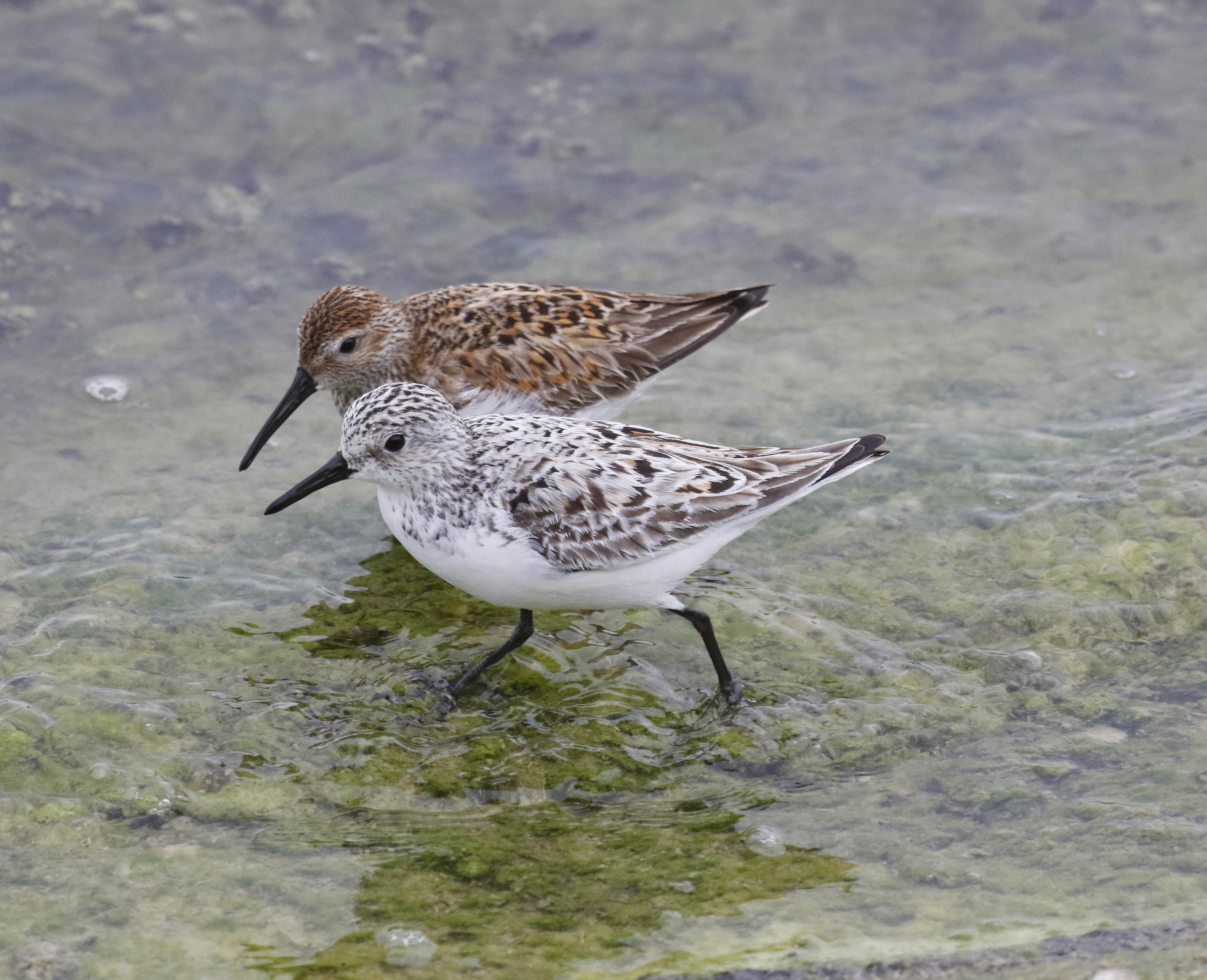
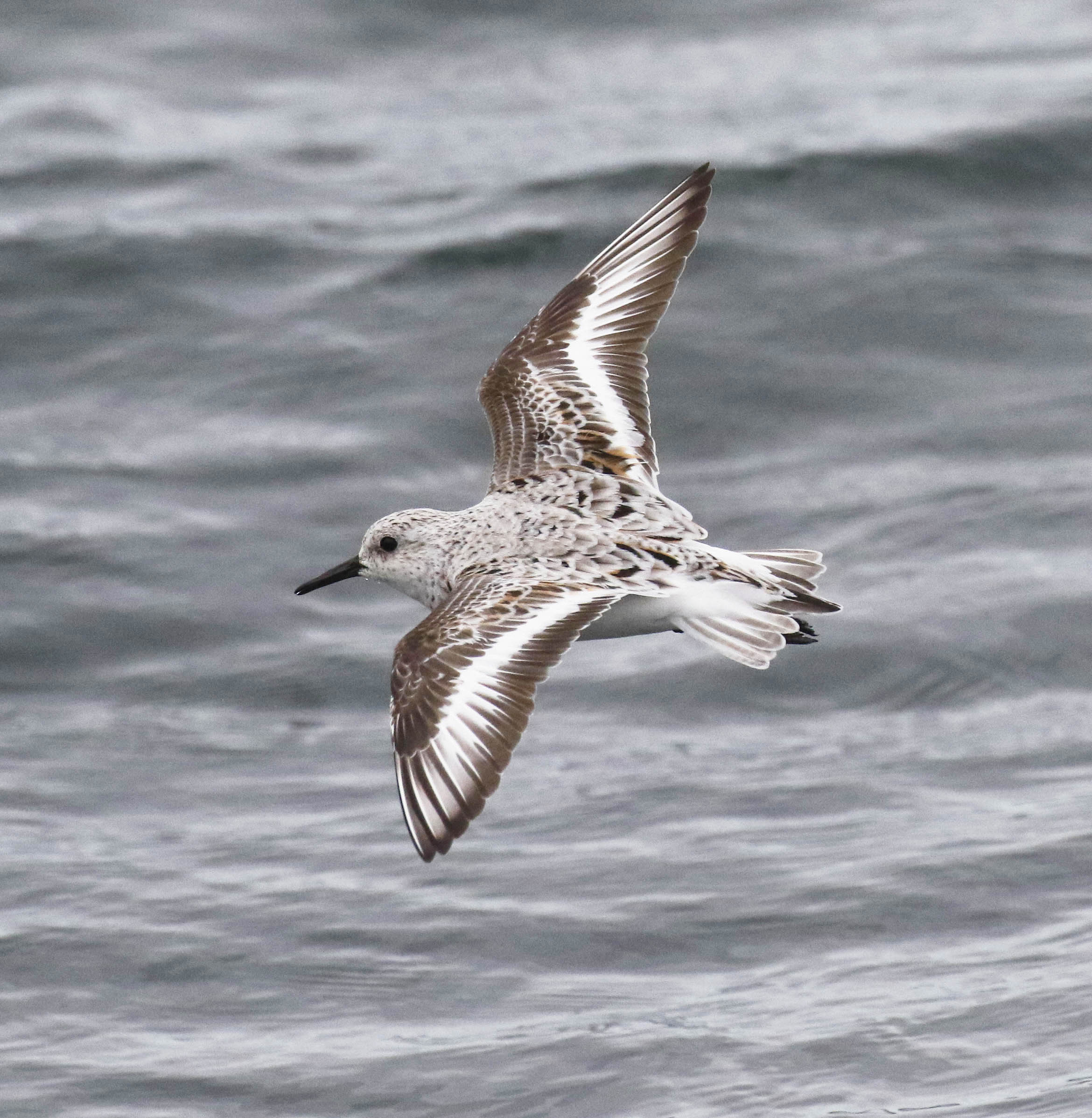
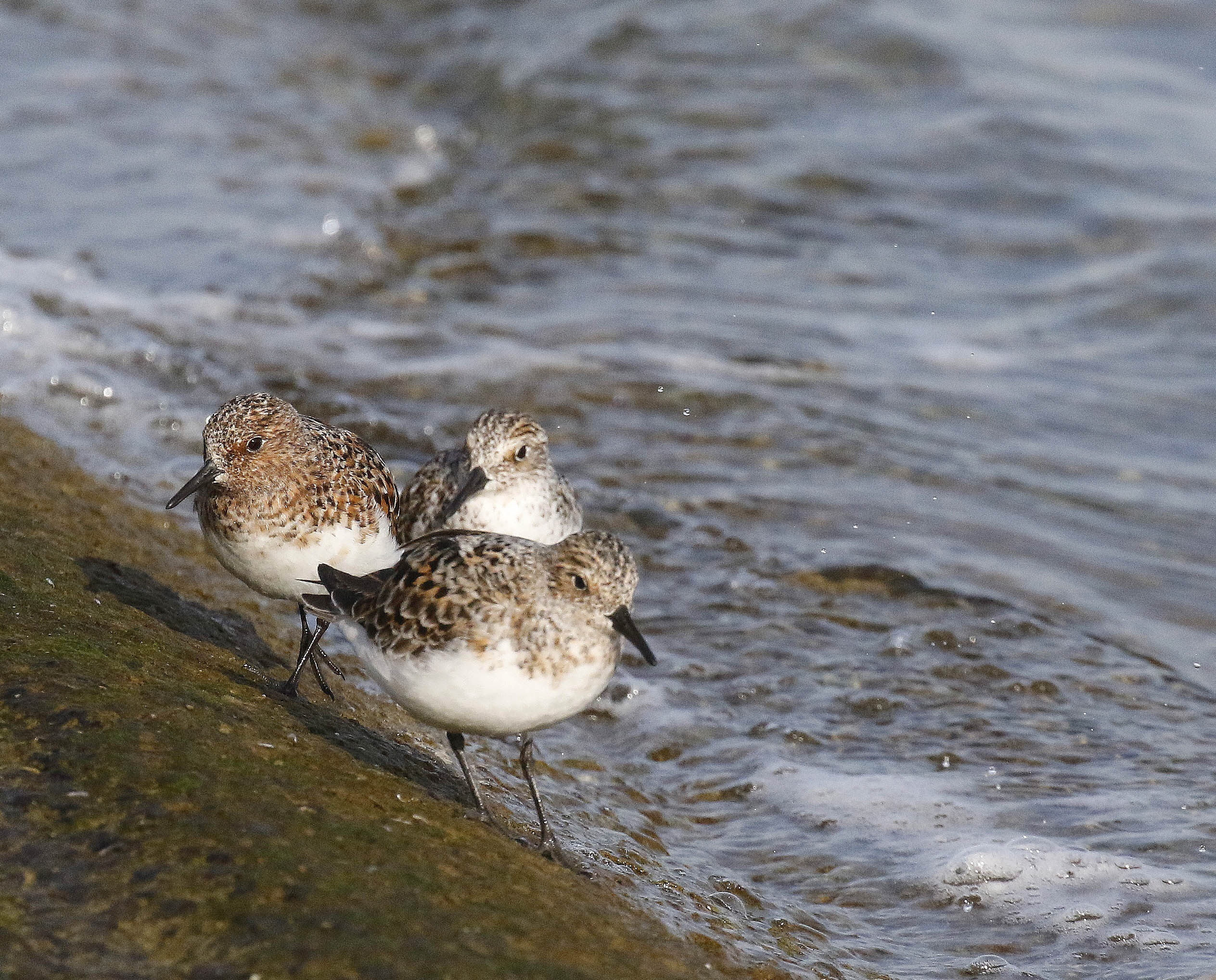
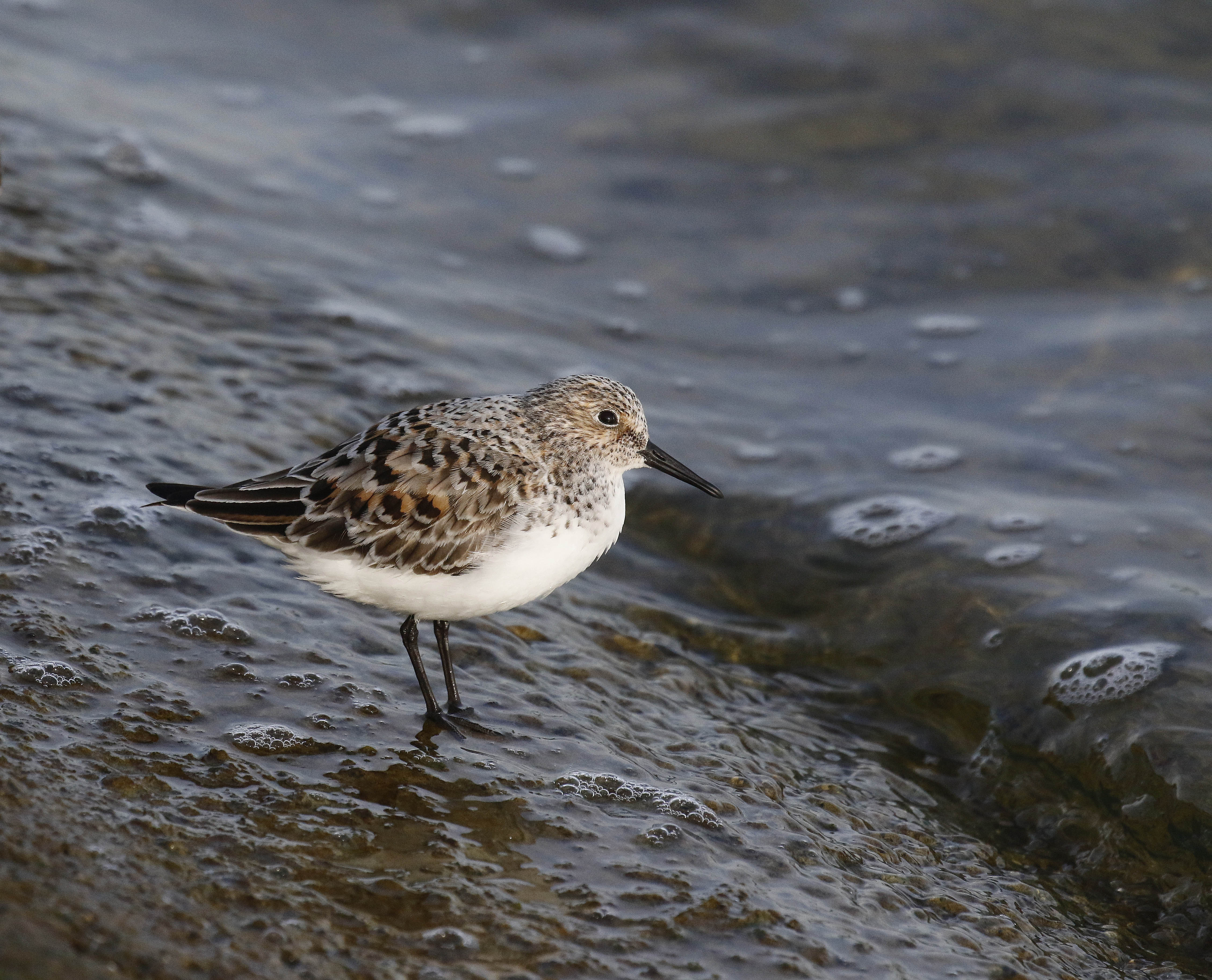
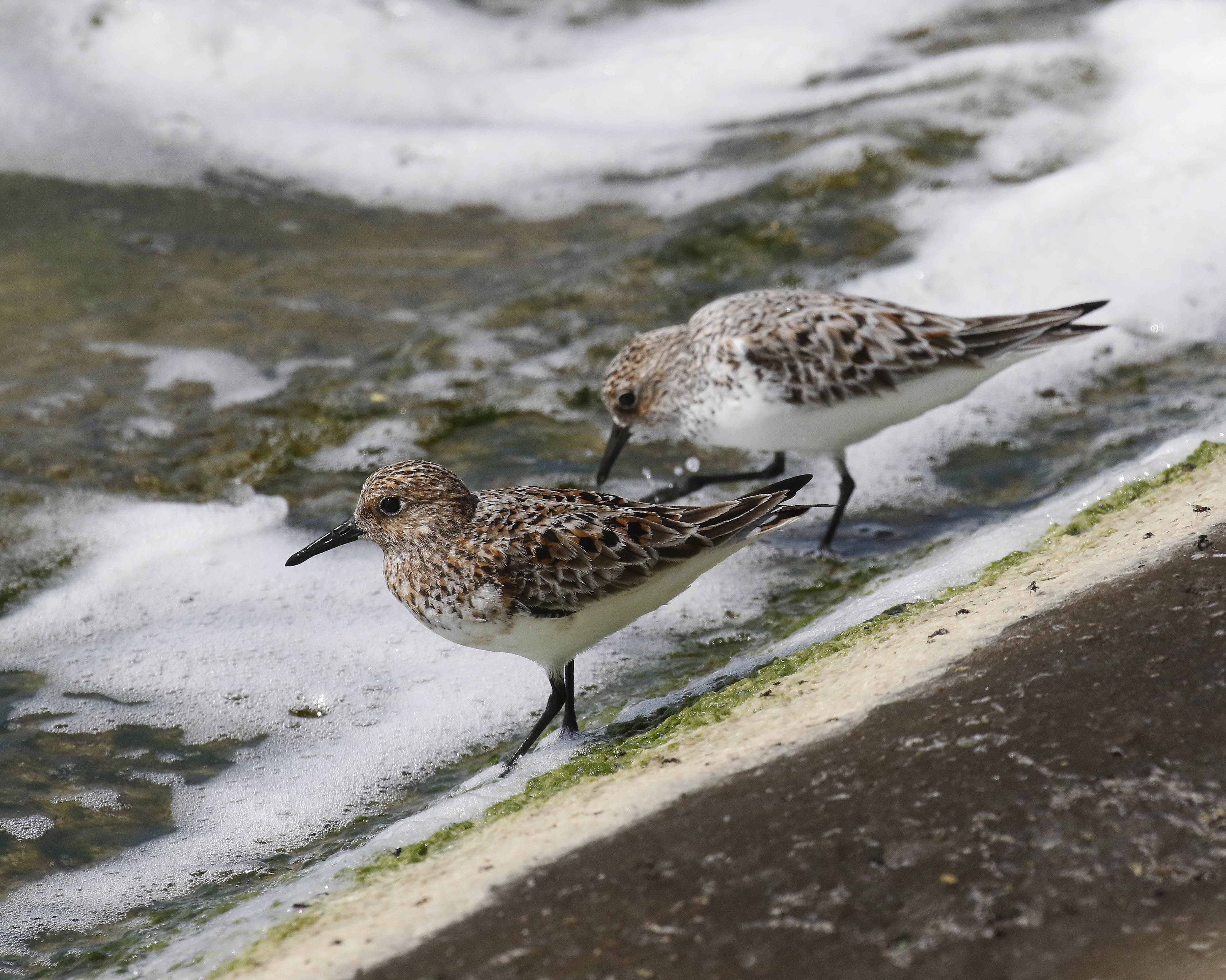
I completed the remaining two thirds circuit of the reservoir basin and turned to make my way down the central causeway. Waders, usually Dunlin and Sanderling sometimes drop in here of an evening during May, and today my luck persisted as now there were four of my favourite wader, Sanderlings, standing by the water on the shelving concrete.

Relaxed, if such a word can be used to describe a bird's existence, looking content and with rest very much a priority, they only fed in a desultory fashion preferring to preen, stretch tired wings or even to briefly sleep. Their's is a life lived at breakneck speed and one unimaginable to our sedate, controlled existence. No rules or regulations. No constraints. Everything counted in seconds, reactions immediate, always having to be alert to a multitude of threats to their lives.

As is normal with Sanderlings, the plumage of each bird was variable, with at one extreme, an individual showing much orange and chestnut on its head and uppperparts, to others retaining variable amounts of grey and white winter feathers, less advanced in their moult to the full glowing richness of summer plumage. 

The bright plumage tones of the one Sanderling were a delight to behold. It was quite literally transformed from a prosaic grey to various shades of orange on its head and upperparts  Not a plumage one sees very often anywhere, and Farmoor, in spring, is virtually the only place where it is possible to enjoy such a sight in Oxfordshire.






This was a very productive visit by Farmoor standards.It does not happpen that often but when it does it fills one with renewed enthusiasm and compensates for the knowledge that  inevitably most days will not be like this, as the reservoir reverts to normal and not deliver such delights.





Wednesday, 18 May 2022

More Northbound Waders at Farmoor 17th May 2022


A bright, warm and sunny, late Spring morning found me strolling the causeway at Farmoor Reservoir. The benign weather conditions promised little to excite and I was expecting to draw an all too familiar blank as far as birds were concerned.

Certainly it was unlikely that any northbound waders would be touching down on the sun baked concrete edges of the reservoir but I was to be proved wrong and not for the first time.

For once it was not the central causeway that delivered the birds  but further around the periphery of the smaller of the two basins that comprise Farmoor Reservoir.

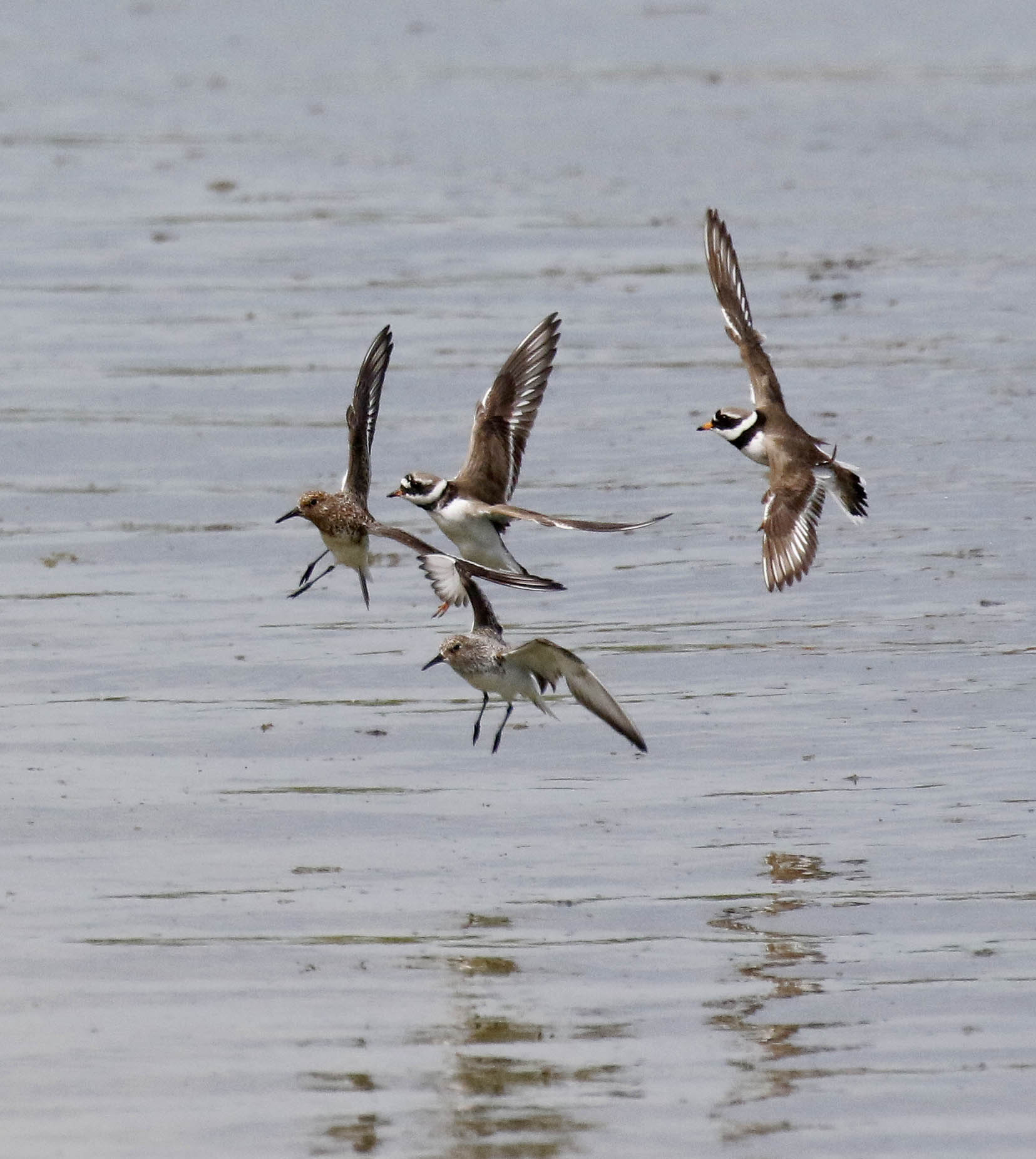
Four tiny bodies were strung along the water's edge busily feeding. Approaching closer and looking into the sun it was difficult to initially make out what they were but on getting even closer I could see that there were two each of Sanderling and Ringed Plover.

They were skittish, especially the Sanderling. The Ringed Plover were the more obliging, their more hesitant feeding technique rendering them more approachable while the Sanderling scuttled away as fast as their little black legs could carry them and that is pretty fast believe me!

The increased footfall on the reservoir, post pandemic, meant that the group of waders were regularly disturbed and they would take fright and fly out over the reservoir to land further along on the concrete shore.This happened frequently and in the end it proved too much and they departed for good. Maybe they would continue their long flight north or possibly find somewhere quieter, such as another reservoir not so far away. I would never know.

It seems such a shame that many of those now using the reservoir for relaxation are unaware of the presence of these birds as they walk by. Some do notice them or at least they notice people like me looking intently at the water's edge and stop to enquire what is so interesting and are invariably amazed to hear about these migrating birds, what they are and where they are going.

Below are some images of this attractive quartet,  gracing the reservoir as they took a short break from their long and perilous journey, one that will take them to separate northern breeding grounds.They still have a very long way to go and for now were happy to keep in each others company.

Yet again I stood in wonder at living proof, before my very eyes, of the almost miraculous feat of endurance that is bird migration.

Sanderling


Ringed Plover


Tuesday, 17 May 2022

Nightingale Time 12th May 2022

Mark (P) called to enquire if I was of a mind to go and look for the Nightingales that are found near Greenham Common in Berkshire.It is a known hot spot for them, although its location is hardly propitious, sandwiched as it is between a busy and consequently noisy road and a car park commandeered by numerous dog walkers, who fortunately eschew walking the woods, preferring to exercise their canine companions on the surrounding open space of common land.

The close proximity of a road and busy car park does perversely benefit the Nightingales by scaring off the deer that browse the wood's understorey, removing the dense underlying habitat where Nightingale's like to nest.The burgeoning deer population is now a major problem in Britain and a recognised contributory factor to the Nightingale's increasing scarcity in England.

On an early and sunny morning Mark parked the car and stepping out from the vehicle we instantly heard a Nightingale singing close to the road, only metres away in fact.Their song is unmistakeable and like no other. Astounded by both the loudness, the complexity and tonal variety of the notes that pour forth at high volume from such a small and unlikely source, you are compelled to stop and marvel at the hidden songster.

For hidden they always are, shy and shunning exposure they sing from deep in the cover of leaf and branch as if worried that the boldness of their song will attract unwelcome attention.In Europe they are far more prone to sing in the open but for some reason to see one away from a density of foliage in Britain is exceptional. We walked towards the invisible bird but held little hope of seeing it as they invariably see you before you see them and will immediately drop out of sight or fly to another more concealed perch.

We were lucky however, as within minutes we saw the bird singing on a bare branch but deep within the woodland. For a minute it carried on singing but then noticed us and fled and we heard it no more. Another was singing from the further side of the woodland and we followed the sound to find it perched deep within a willow, much obscured by branches and leaves but nonetheless satisfactorily viewable

We then heard two others, singing in a part of the wood bisected by a track that ran between the road and the dog walkers car park, a track hardly ever used and thus quiet and undisturbed. 

The track through the wood.The Nightingale 
sang from the tree on the right of the track

One bird was singing from deep within the impenetrable trees and scrub, totally invisible, totally inaccessible, but the other had chosen to sing very close to the track. Here was our best chance of seeing one well. At first we could not locate it. Perched tantalisingly close it poured forth those familiar notes. Scanning with our bins we eventually found it perched at head height on a slender bough.

I have never seen a bird that opens its bill so wide to sing as does a Nightingale. Possibly it does this to better broadcast those celebrated notes at such intensity, its lower mandible jigging up and down like a marionettte on a string, the feathers of its swelling throat distended with the effort, its body vibrating as it produces phrase after phrase of rich and liquid sound. The notes pour forth, melodious, gurgling, chugging and finally comes an extended plaintive high note of supreme purity. beseeching, imploring and repeated several times over, then brief silence follows until the next explosion of song.

Luck was again with us as this bird had not read the script about concealment and although never fully in the open was visible to such an extent we were able to see it very well. We spent quite some time standing quietly on the track and in so doing found it moved between two favoured small trees and had distinct preferred perches within the trees, from which it sang and if we waited long enough it would come to perch on one of  these and allow us to see it singing for extended periods.

They are larger than a robin and smaller than a thrush, satisfyingly robust with rich chestnut head and upperparts, an even brighter, broad chestnut tail, a greyish breast and otherwise buff white underparts..Unremarkable in appearance maybe but it is the incomparable song that elevates the bird from the commonplace to the exceptional.Immortal bird indeed!

Despite competition from two other melodious singers in the form of a nearby Garden Warbler and Blackcap, it dominated by the sheer power of its song and its delivery. Here, in a remnant of unexceptional woodland in southern England, it has brought, for the six short weeks it will sing, the mystical allure of the boundless tropical forests and jungles of equatorial Africa that are its home for most of the year.

Still only approaching 10am, Mark consulted his RBA App to discover a report of a female Red footed Falcon at a disused gravel pit near Woolhampton, which lay but six miles away from our current location. Mark had never seen a Red footed Falcon so it was obvious where we were going next.

This is a good bird to see, not just for Mark but for me too.They spend their winter in southern Africa and make a long migration to breed in eastern Europe and Asia and sadly, they too are in decline due to habitat loss and hunting. They are a rare but virtually annual vagrant to Britain, the majority of which are first summer individuals, somehow straying too far west from their usual migration route that lies well to the east of Britain. These first summer birds are in no hurry as they will not breed this year so often remain for a few days, replenishig their energy reserves before reorienting themselves eastwards.

After a somewhat circuitous route due to a temperamental satnav we finally found the location, a none too obvious layby on a narrow rural road with room for a few cars, that led to a gate and a track beyond that wound its way to the lake in question. We were fortunate that as we arrived  so did a local birder and he showed us the way.I doubt we would have found it so easily otherwise.

Eventually, after passing yet another singing Nightingale, we came to a very small gap in the trees which served as a restricted viewing area over the lake. Half a dozen birders were already ensconced there and looking at the falcon. Graciously some of them vacated their positions so we could view the bird. It was flying somewhat distantly above the lake, hawking for dragonflies, around and above two small islands. The falcon's mode of flying and hunting was similar to the more familiar Hobby that comes here for the summer and at one point was joined by one.


It was supremely agile on the wing, swooping and soaring. gliding and then increasing speed to intercept a high flying dragonfly, seizing the insect in its claws and then bringing its bunched feet up to its bill to consume the unfortunate ins.


The falcon flew constantly and effortlessly looking for its winged prey, sometimes coming low but most often remaining high in the sky and was on view virtually all the time we were there.

Females, such as this individual are to my mind more attractive than the males, which unlike the female are uniformly grey all over, whereas the female is an appealing combination of brownish grey, barred upperparts, a many barred tail and a white head  crowned pale orange with a black face mask. The underparts are orangy buff. The predominance of grey and orange plumage always pleasing on the eye.

We watched the falcon for around half an hour and then left for home.

This had been a good day.


Wednesday, 11 May 2022

Sanderling Redemption 10th May 2022


Farmoor Reservoir, on the western fringe of the City of Oxford is my local patch and during the pandemic has been my saviour, allowing, me for the most part, to ward off the worst of those joint demons, depression and anxiety that successive lockdowns and many people's deaths brought upon me and many others.

Its circular concrete perimeter and central causeway, already familiar from countless visits over many years became ever more so, as virtually daily, I became a human satellite orbiting the reservoir's three mile circumference or wandered up and down its central causeway.

The reservoir is an unlikely source of benediction, especially in the winter months when it appears birdless, souless even, in its stark functionality but on occasions in spring and autumn, but especially spring, it is transformed by the arrival of migrant birds.

Such are Sanderlings, small, highly sociable waders that forsake distant seashores in sunny southern climes or so I choose to think, to make flights of almost inconceivable endurance and distance to breed in equally far off northern lands such as Greenland and Siberia.

May is the month when I hope, in fact expect to encounter Sanderlings at Farmoor, although some years are better than others. Those Sanderling that arrive on the reservoir, often during a spell of inclement weather, are taking a short cut across Britain on their way northwest and put down alongside the central causeway to feed, before resuming their marathon flights.

In early May they are still to a greater extent in the pale frosted plumage of winter, an appearance not dissimilar to a sugar coating over the emerging chestnut breeding plumage. Later in the month they will be more colourful and varied in appearance, but for now they are predominantly white and grey.


Soon after the morning rain cleared, two Sanderlings had arrived with a quartet of Dunlins and were running with the precision of a mechanical toy along the concrete shelving at the water's edge. 

Dunlin

Sanderlings at Farmoor seem forever in a hurry, eschewing the more sedate picking up of morsels that is the way of the demure and slightly smaller Dunlins. Everything is a speed fest as if to slow down would be to their disadvantage and a denial of  the urgency that consumes them to complete their mission to breed at the far ends of the earth

For reasons which I cannot explain, many of the small waders such as the Sanderlings, Dunlins, Ringed Plovers  and Turnstones that spend a day or two here, are confiding in the extreme and provided they are not alarmed by an overtly incautious approach or taken by surprise, will allow one to come very close. Possibly they have had minimal contact with the human race since their birth last year in the arctic north and only by chance do they find themselves coming into brief contact with humans in a more populous part of the planet such as Farmoor.

So  close can they allow one, that sometimes their quiet conversational twittering can be heard, the birds conversing excitedly, like small children but more muted, as they trip along beside the water's edge on blurring black legs, like those of a racing cyclist pedalling at speed. Occasionally they take mild alarm when one or more of the many visitors who now use the reservoir for relaxation, post pandemic, walk blindly past them unheeding of their presence, but the birds only fly a short distance before resuming their feeding by the causeway


These two Sanderling are the first for me this year and another small part of the healing process after a horrible two years. It's still far from over for me yet but the lowest point has been passed and in a much better place now, a feeling of healing and restoration, of almost normality, has replaced the sense of loss and stagnation..

As  the initial  excitement at finding these new arrivals faded to one of quiet satisfaction and intense pleasure, I stood on the hard unforgiving concrete of the causeway, my mood one of  reflection at why these  tiny birds, pausing for a few hours in their frantic lives to feed here, are so totemic. Over the last two years during the worst of the pandemic, knowing that their lives are entirely separate from mine and really they do not need or care one iota about me, they have offered consolation in the knowledge and acceptance that they were free from my anxieties and uncertainties and carry on regardless of my human condition, and in that I gain immense solace.

I recently read a book  'Birdsong - in a time of silence' by Steven Lovat, which describes how he coped  during the worst of the pandemic by listening to birds and he quoted the following about birds from the British poet and writer Philip Edward Thomas

'it is their inhumanity that gives them their utmost fascination, the mysterious sense which they bear to us that the earth is something more than a human estate

How true.


Tuesday, 10 May 2022

Another Sort of Burgundy 8th May 2022


A Spring Sunday and a late start for once, as Mark and myself had arranged to meet in a farm shop cafe at Tring, in the late morning, for a coffee and chat before moving on to Bison Hill on Dunstable Downs to look for Duke of Burgundy butterflies. This would be our first butterfly foray of the year, searching for this now rare and localized, spring flying butterfly, that will be on the wing for just six or so weeks and then will become a memory until next year.

It is not really known why they are called Duke of Burgundy or were once considered to be a fritillary. In the latter case, probably it was the superficially similar patterning on their wings to that of other true fritillaries and the likeness gave rise to them being originally named Mr Vernon's Small Fritillary. Once it was discovered they were not a fritillary at all, but belonged in an entirely separate genus, the name was dropped but no one can point to why Duke or Burgundy were then thought appropriate for them, the two names being initially used separately before being combined into the name they now carry to this day. 

It was already unseasonably warm by the time we parked in a tiny layby at the side of the road ascending Bison Hill, a road beloved of serious cyclists, testing their limits of endurance as they pedal up the severe incline . Bison Hill forms part of the gently undulating Dunstable Downs and is so named because it is near Whipsnade Zoo and you can look down from the hill onto the zoo's bison enclosure over two hundred metres below. 

Bison Hill is ideal for the Duke of Burgundy, facing, as it does, northwest and consisting of short, chalk downland grass with lusher areas no longer heavily grazed, that allow cowslips, the butterfly's foodplant, to prosper. It is an ongoing task to manage this habitat and keep it  suitable, just as it is in other areas where this special and threatened butterfly is still present.

There were quite a number of people, walking the top of the downs, out to enjoy the warm sunshine but we had our mind on other matters and  followed a less frequented  track of hard, sun baked earth, winding its way across a lower part of Bison Hill.

The breeze carried the pungent, sickly aroma of emerging may blossom, a froth of white on leaves still shiny and new, like green gloss paint yet to dull with age. Profusions of cowslips formed  pale yellow shadows of colour across the varying shades of brightening green that covered the slopes. It really was an uplifting experience to be out on a day such as this.

A bank of Cowslips.Home for the Duke of Burgundy

But where were the dukes? If you are in the right area they should not be too hard to find as the males are highly territorial, defending a small select area, intercepting passing insects and in the process making themselves conspicuous. The problem is that they are now not nearly so abundant as in previous times and can only be found in small, widely scattered colonies. Hotspots if you like that require some searching for. Today we found just half a dozen in this area and all were males.

Cowslips being their larval foodplant, it seemed logical to concentrate our searching in areas where they were plentiful  but  we found our first Duke capriciously holding territory on a narrow track of bare earth, no more than a sheep track, winding an uncertain course through the grass.


I am taken aback every year at how small they are. A tiny, pugnacious and fast moving, superficially dark brown butterfly that can be hard to follow as it flies. When settled it sits on a blade of grass or bramble leaf, opening its wings to the  sun, embracing the warmth but is never still for long. Always there will be an insect or another of its kind that comes to upset it and away it goes in fast flying, helter skelter pursuit of the interloper to its territory.

You can seize the moment and crawl or walk right up to a Duke when it is still and get no discernible reaction, but make it quick, for it is forever frustrating as any passing insect causes it to fly up in investigation and one then has to search for it all over again, safe however in the knowledge it is always faithful to its small territory and will usually have settled somewhere not too distant. On occasions, if you are lucky it will even return to whence it departed

Once settled it can be seen how agreeably marked they are. A tiny dark jewell of an insect, a miracle of nature that unfailingly imparts a sense of innocent discovery and fulfilment when it is found and admired.


The open upperwings are chequered orange and brown whilst the hind underwings are beautifully patterned, similar to a fritillary, with two conspicuous bands of  irregular shaped, silver white panels.


Of course there were other butterflies on the wing and chief amongst these were Green Hairstreaks, flying hesitantly when disturbed and soon to drop into the short grass, where they wander along and examine thin grass stems with great deliberation, turning and twisting so that their emerald green underwings shimmer like burnished metal in the sun.

Green Hairstreak
Brown Argus, Grizzled and Dingy Skippers are another matter, all being much more active, their wings natural solar panels that energise them into their fast flight across the sward, testing one's patience and endurance on the steep slopes they patrol.

Brown Argus

Grizzled Skipper

Dingy Skipper

After an enjoyable three hours I was beginning to flag. A bank of cowslips adjacent to the car provided a suitable valedictory as we watched a spectacular, skyward spiralling tussle between a Duke and a Dingy Skipper.