Saturday, 8 August 2020

An Elegance of Waders 4th August 2020


Waders are always an attractive subject for photography and especially those with long legs and bills. Today, two species in particular sprang to mind and were to be found at Slimbridge WWT (Wildfowl and Wetlands Trust). They were Black tailed Godwits and a Spotted Redshank with hopefully some other wader species to complement the experience.

Two races of Black tailed Godwits occur in Europe; the Icelandic race Limosa limosa islandica of which a small number breed in Shetland but most in Iceland and The Faeroes. The birds currently at Slimbridge were of this race, amassing into a moulting flock, having recently arrived from their breeding grounds. They will either spend the winter in Britain or join others that winter throughout western Europe. The other race Limosa limosa limosa breeds in very small numbers in eastern England but is much more widespread through western and central Europe to Russia and central Asia. It is a very rare bird on passage in Britain and winters in West Africa.


As an aside did you know the Black tailed Godwit is the national bird of The Netherlands?


Spotted Redshanks do not breed in Britain but across northern Scandinavia and northern Siberia and winter in small numbers in southern England thence southwards to the Mediterranean countries and tropical Africa. 

In these straitened times it is now necessary to pre-book a visit to Slimbridge and my booking was for today where I planned to spend half a day looking at my chosen waders. In a way it is no bad thing that the numbers of people visiting Slimbridge each day are currently restricted as this ensures no hide is overly full, which they often were in those 'normal' times that seem so distant now.

The two hides at Slimbridge, where it is best to see the waders in question are the Rushy Hide and the South Lake Hide. The former, which I know from past experience, is always a good bet for Black tailed Godwits, and the latter is where the Spotted Redshank could be seen from. 

The Black tailed Godwits at the Rushy Hide were the first of many more to come, returning from their breeding grounds, while the Spotted Redshank was an adult, almost fully moulted into its non breeding plumage and may winter here or move further south. 

I joined a small line of fellow visitors waiting for the Visitor Centre to open at 9.30 and at the appointed hour was soon processed and on my way to the Rushy Hide where I found myself with just one other birder for company. Looking out I could see a phalanx of chestnut orange bodies arraigned on a muddy spit, many stood on one very long leg. They were the desired Black tailed Godwits, all of which were adults, many still in summer plumage and only beginning to commence to moult into their dull grey and buff winter plumage. A number were already almost there, appearing as overall grey birds amongst the more colourful individuals around them while some non breeding first summer birds were in a transitional plumage of orange and grey.

Many were asleep, but as is typical with sleeping waders there was a constancy of movement as individual birds rotated their bodies left and right checking on birds either side of them or for general danger. Others would suddenly awake, whipping out their long bill, hidden in their scapulars, to deal with an irritating feather and once satisfied it was adequately dealt with they would snuggle their bill into their back feathers to sleep once more.


Two Black tailed Godwits.
The individual at the back, is a male in full summer plumage and the bird in front almost moulted into full winter plumage
Black tailed Godwits possess an innate elegance, a symmetry of form, their very long legs counterbalanced by an extremely long and straight bill. The bird itself possesses a lean and muscular looking body a long neck and small head. Both the long bill and legs have a function in allowing the bird to wade deep into water and probe their bill into the mud on the bottom. 


Good numbers of the godwits were feeding in the water, wading belly deep, constantly probing with a rapid drilling motion of their bill into the mud below the water, often immersing their head in the water and then, on finding something to eat, withdrawing head and bill to throw the morsel down  their throat by way of a couple of upward jerks of their bill before resuming their energetic quest of the muddy bottom. It is a very characteristic and distinctive behaviour which identifies them immediately.


This feeding individual is in transition from summer to winter plumage


Others left the water to probe the short grass of the scrape, as always their sociability ensuring they kept company with others of their kind but they seemed to find sourcing food on land less successful than probing the mud below the water of the lagoon. Inevitably they made their way back into the water to join the others. Maybe the ground was not wet enough to allow their sensitive bills to penetrate the ground adequately.
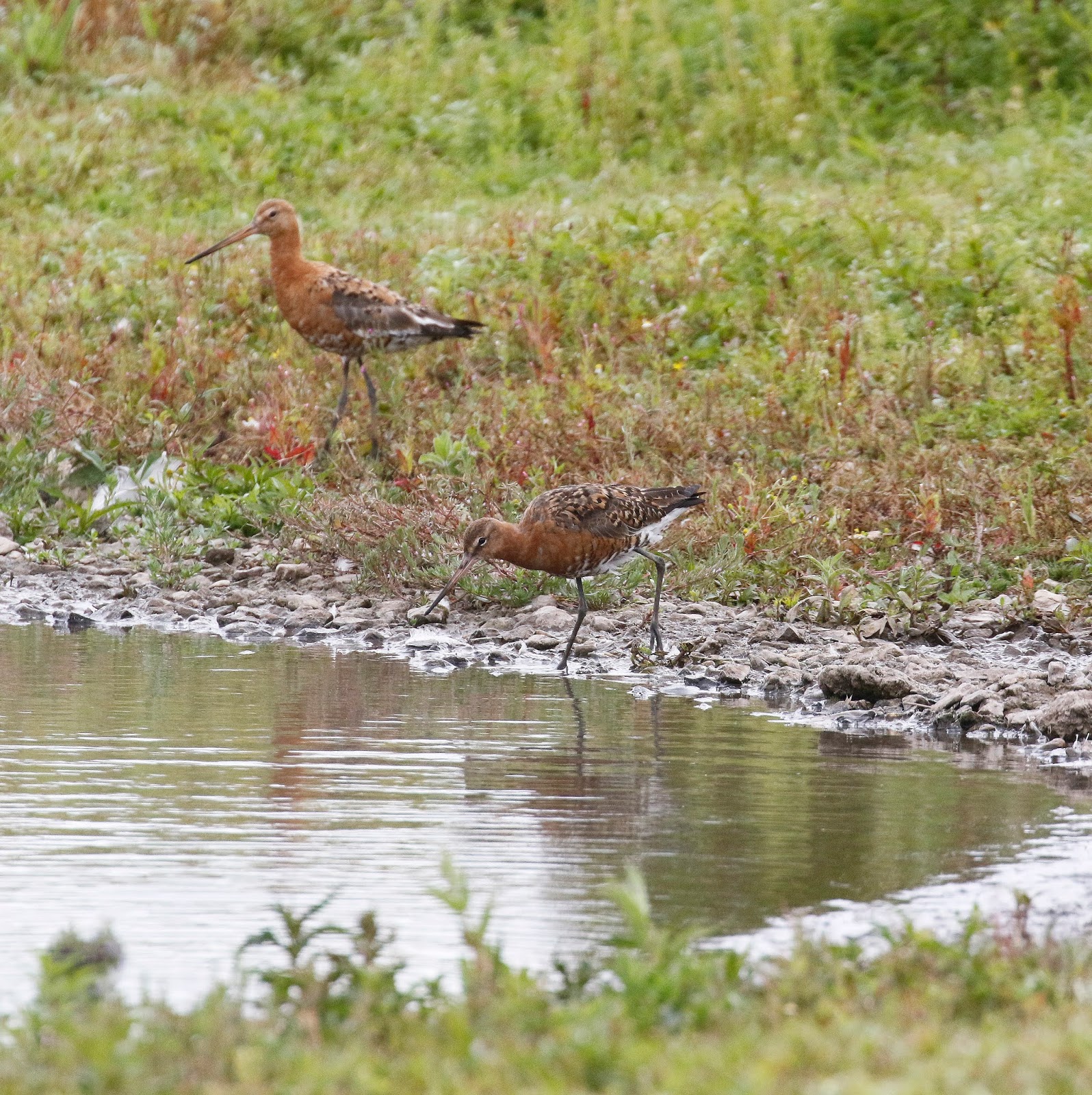


A female Black tailed Godwit.The orange colouring in particular is paler than the male and to my eyes the females often looked larger. Note also the very long legs and bill
In summer plumage they are quite superb, especially the males The head, neck, breast and upper mantle are orange chestnut while the rest of the upperparts are chequered black and orange. The underparts from fore flanks to tail are white, variably barred black. The origin of their name is revealed when they preen or fly as the black tail contrasts with the all white rump and the huge white bars on each wing are revealed.


Adult male Black tailed Godwit
It is impossible for them to appear inelegant as they stalk around on their long thin legs probing the ground or water with their equally long bills and even when preening they retain a certain grace of movement, and watching them I was touched by the way they regularly dip the tip of their bill into the water to moisten it before resuming nibbling at their feathers. 

Looking out from the hide I relaxed into the moment, joining in a form of mindful symbiosis with the godwits, their breeding urges subsided and now enjoying the long gentle decline into autumn before the hardships of surviving the winter are upon them. It is a golden time for both bird and observer. One of quiet calm and tranquillity. Something to be treasured.

There were, of course, other birds to enjoy, especially a Green Sandpiper that waded in the water up to its belly though on much shorter legs but in its own way demonstrated an elegance of a less obvious kind.


Green Sandpiper
I made my move to the South Lake Hide to try and find the Spotted Redshank. The hide itself was a contrast to the spartan confines of the Rushy Hide, being carpeted and with almost luxurious seating. Again I  was pleasantly surprised at how unpopulated the hide was and sat in a corner to observe a flock of waders stood in the shallow water, all the birds preening or asleep.There was a mixture of predominantly Black tailed Godwits and Common Redshanks with one or two Ruff amongst them.Two of the Ruff had conspicuously white heads, a remnant of their breeding plumage.


Male Ruff

A somewhat scruffy adult Common Redshank moulting into winter plumage
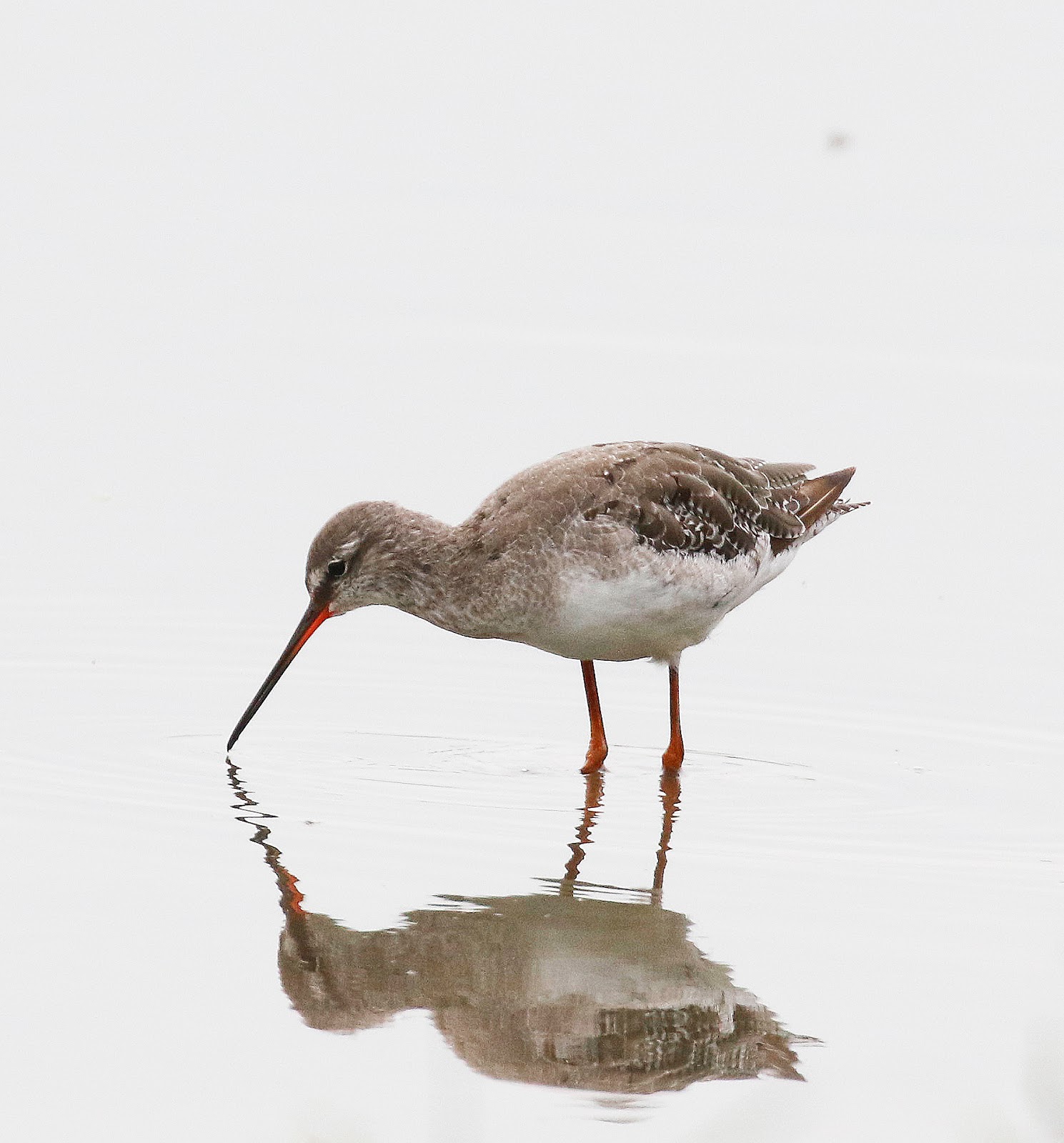
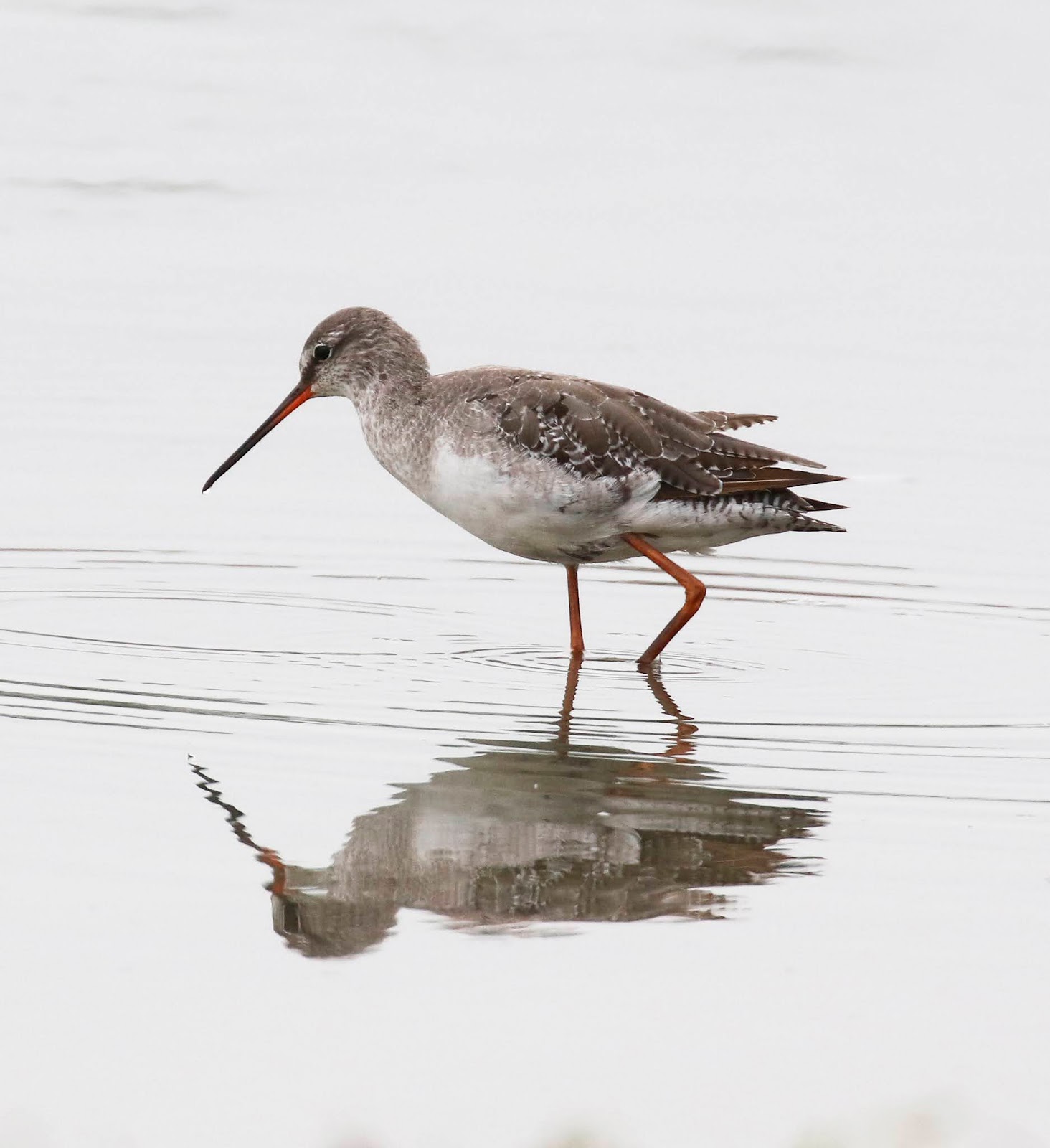
Now where was the Spotted Redshank? It was not to be found amongst the roosting waders so I checked those waders moving around in the water, feeding. Soon, I located it near to the nearside bank of the lagoon, silvery grey and distinctively pale, especially on its underparts, greyer feathers having mainly replaced its black summer plumage and with a bill noticeably red at the base of the lower mandible.However it was its energetic feeding action which most betrayed it. At times, wading deep enough in the water to almost swim, it fed with a faster motion than the Common Redshanks, sometimes sweeping its partially submerged bill rapidly from side to side as it rushed through the water.


Adult Spotted Redshank
It was moving towards me and came close to the hide which gave me the opportunity to take some nice images. Again its legginess and long, thin and tapered bill imparted an innate elegance to my eyes. Slightly larger and longer legged than the associating Common Redshanks it was noticeably slimmer in its body. Looking every bit the thoroughbred amongst its stockier cousins.

The movements and actions of both godwits and spotted redshank were almost balletic, a constant delight to watch, an enjoyment and entertainment based on entirely natural circumstances.

You know what? I am going again as it was so enjoyable.


Friday, 7 August 2020

A View from the Causeway August 2020

An occasional pictorial record of birds seen from the Causeway of Farmoor Reservoir in Oxfordshire.

This one from Friday 7th August on a day of great heat and stillness.


A juvenile Dunlin patrolling the water's edge in the early morning. Along with Common Sandpipers it is the commonest
migrant wader at Farmoor


A Great crested Grebe. They are present all year round but never able to breed due to lack of suitable habitat and 
constant disturbance

A juvenile Gadwall. One of three that managed to survive and reach independence from an original brood of ten 

Little Egrets taking advantage of the large number of fish fry
swimming in the shallows by the concrete apron of the Causeway


One of four Common Sandpipers present today and this one allowing quite close 
approach which is unusual for this species as it is always one of the 
wariest waders that visit the reservoir

A juvenile Common Chiffchaff. They are always to be found feeding at this time of year in the trees and bushes at 
the western end of the Causeway


A pair of Little Grebes, still in summer plumage and the first to return to the reservoir where they do not breed but spend the winter in small numbers

Thursday, 6 August 2020

Brown Hairstreaks 3rd August 2020


I got to the ride at around ten this morning. A grass ride that forms part of a much longer ancient bridleway, its narrow confines bordered for its three hundred or so metres by oak trees, hawthorn and blackthorn, from under which spills out a rampant profusion of late summer vegetation. Greater Willowherb and Wild Angelica stood proud, at almost head height, a mess of pink and white flowers respectively. Frothy cream heads of Meadow Sweet and the pale mauve busbys of Water Mint betrayed the hidden dampness of the ride, while brambles scrambled up into the hawthorns and Greater Bindweed wound its sinuous course through the tangled vegetation to point inverted trumpets of dazzling white to the sky.

The air in the ride was undisturbed, as the width of the ride is narrow enough to exclude the wind and when the sun began to penetrate the ride it became hot, the air warm and soporific.Today I had the ride to myself but often in this time of transition from July to August it can become populated by visitors come to see its annual hidden secret of Brown Hairstreaks.

These are the last of our five native hairstreaks to emerge and to my mind are the most attractive.They are uncommon and need some effort to find but usually one or two descend from the treetops here to nectar on the angelica or the occasional thistle head. The tiny triangle of closed wings, replicating a miniature yacht crossing a convex ocean of white angelica florets.The undersides of the hairstreak's wings are burnt orange with irregular darker bands across both wings and of course an irregular white line, the iconic 'hairstreak' that gives rise to half its name.


I wandered the bounds of the ride and found no hairstreak so stood, as one must do, to await the possible arrival of one. It is impossible to predict their behaviour. All one can know is that sooner or later, on a sunny day one or more will eventually descend but much patience is required as it can be at any hour from mid morning to mid afternoon. Standing silent, still and in contemplative mood I became aware of the aggregate hum of many insect wings combining to bring an insect tinnutus to my hearing but after a while, just like tinnutus it is so constant you just do not register it. Quiet, secretive bird sounds came from within the deep recesses of the trees and bushes. A quiet tack tack of a Blackcap or the plaintive hoooeet of a Chiffchaff or Willow Warbler.

I moved position, a few metres, to where I had seen a hairstreak just two days ago and as if by pre-ordainment there was a Brown Hairstreak nectaring on the very same angelica head. Maybe it was the same hairstreak, maybe not. Both were males, that is true, but I feel it is likely they were different individuals attracted to the same nectar laden flower head.


I luxuriated in the quiet of the ride, a balm, a benificence, while standing no more than two feet from the insect as it toured the various florets probing each miniscule flower. Other insects were also attracted to the nectar rich angelica, hoverflies and bees mainly, that busily barged into the butterfly but were rebuffed by an impatient, irritable flick of delicate wings 

For a full forty minutes the butterfly fed, confining itself to an area no more than a few inches of flowerhead before it flew to settle on a leaf, as if to shade itself from the midday heat. It moved to a nettle and slowly opened its wings to reveal no orange markings on the uppersides, thus confirming it was a male.


Seconds later it flew, flickering in the sun, rising upwards into the hawthorn tops and was gone.

Sunday, 2 August 2020

Silver Spotted Skippers 30th July 2020


If there is anything that I can now be certain of in these turbulent times it is the fact that every year there will come a day in July when the sun shines and the wind blows softly from the south and the downland at Aston Rowant will shimmer with an abundance of multi coloured flowers and butterflies.

That day this year was almost the last of the month and, with a heart temporarily free of worries and anxieties for the future of my world, I moved in spirit, lock, stock and barrel to the alternative world of  the Silver-spotted Skipper that flies over the downland at Aston Rowant at this time of the year.

I left it until noon, when the sun had brought an intense heat to the south facing slope of downland sward, where I knew the sun worshipping skippers love to bask and feed on the heads of field scabious and horseshoe vetch. I followed a sheep track that snaked through an impressionist painting, a living canvas of pastel shades created by wild flowers of many kinds and colours, the pale mauve of scabious and heavenly blue of harebell, bright yellow catsears and low islands of pink and purple marjoram rising above the swaying grasses, the summer wind all the while carrying the tantalising sweet scent of wild thyme. 

Hundreds of Chalk Hill Blues, males mostly, were busying themselves for as far as I could see, the males forever  restlessly searching for a female, crossing and re-crossing the sward, low to the ground, their wings the pale blue of a watery sky and when one came to rest, the wings, open to the sun, appeared almost grey, smudged charcoal along their extremities, the pale blue at its most intense at the base of the wings and on the thickly furred body.

Male Chalk Hill Blue

Mating Chalk Hill Blues

The focus of my quest was not so obvious as the blues and it took me some time to locate one. I knew from past experience how small Silver-spotted Skippers are but each year the surprise is the same and I marvel anew at just how tiny they are. It takes a while to get accustomed to their will o' the wisp behaviour, the tiny insects un-noticed by me, rising at my approach from where they bask on the exposed warm chalk of the narrow track, or appearing like some minor blemish on a pristine scabious head, so insignificant they are easily overlooked.


Initially hard to locate, as they are on every visit, they have their favoured hot spots, areas on the south facing, steepest slopes that have the maximum exposure to the sun's rays. Here they reside, scattered in small numbers across the downland, absorbing the sun that gives them the impetus to enact this last energetic instalment of a life that began as a tiny white egg, laid at the base of  their foodplant, Sheep's Fescue, a year ago.

It takes me a while to refresh my memory as to where these hot spots are but eventually I find one and then another but even so the tiny insects contrive to lead me a merry dance through the sward, for they are innately restless, hardly still for more than a minute, often much less. Time and again after finally finding one, as I get down on my knees to take its photo, no sooner am I in position than it speeds off on some mission and invariably I lose sight of it and complainingly rise to stand confounded.

I know Mr Packham would decry my saying it, but butterflies definitely exhibit their own unique character and none more so than this tiny, hyperactive insect. Its plump furry body and huge black eyes impart an image of robust energy, powered by high octane nectar.  Forever restless, feisty even, males sit, a perfection of camouflage on a grass stem or flower head waiting to intercept a female or chase off any butterfly or insect, large or small, intruding into what it perceives is its domain.

A Silver-spotted Skipper nectaring on Wild Marjoram

With wings closed the olive green base colour, stippled with irregular white markings, can render them virtually invisible, matching the infinite patterning of light and shade in the grass as they cling to their chosen blade or stem. 


So small is their overall form, the white markings can only be seen from very close quarters and to achieve that close encounter, nine times out of ten the butterfly frustrates you by taking alarm as you close in on it and leaves you staring at nothing but grass. It is gone, literally in the blink of an eye, as I can testify only too well.

A Silver spotted Skipper perched on Horseshoe Vetch

But that is the challenge, a bittersweet enjoyment, bitter as you try to find one and then, when you do, lose sight of it almost immediately as it somehow gives you the slip. Sweet when finally you find one that deigns to perch on a flower head for more than a few seconds and allows time to be photographed.


A Silver-spotted Skipper nectaring on a Field Scabious

I spent hours here today and for good reason, as it brought solace to my soul and a diversion from the ills of the world. These days I live for the moment, daily recharging my spirit by means of various encounters with the natural world that is all around. I did not want to leave as this was my day. A day I had nurtured in my heart and looked forward to through eleven intervening months.


Eventually the heat became too much, my ageing body wearied and rebelled at the strenuous effort required to wander up and down the steep slopes, but I now had a new day to remember, one that would carry me through what is going to be a difficult year until next July, when I will come here once more to greet another generation of the Silver-spotted Skippers of Aston Rowant.