Saturday, 18 January 2020

The Black throated Thrush still at Whipsnade Zoo 17th January 2020


An adult male Black throated Thrush has been present at Whipsnade Zoo since the 11th Decmber 2019 and is usually to be found at its favourite location in the zoo, which is around the children's play area, called Hullabazoo. Here it feeds on what remains of the bright red berries of a medium sized tree, visits the currently unoccupied pig pen or feeds on the short grass between the pig pen and the tree.

Since arriving at the zoo, the thrush has gone from being shy and wary to confiding, now allowing you, provided you are sensible, to get very close, much to the delight of everyone, be they with or without a camera. Doubtless the large number of people who have come to admire it over the past weeks have contributed to the thrush becoming settled and habituated to birders and curious visitors stopping to admire it.

Mark, my twitching friend from Bedfordshire and an avid bird photographer has visited the zoo no less than ten times, the perfectionist that he is convincing him that he could get a much better photo of the Black throated Thrush each time he visited. 


Two of Mark's superb images, taken today, of the Black throated Thrush
Personally I could not see how he could improve but then that probably says more about my photographic skills than those of Mark or indeed Adrian who joined us today. I think that is the difference between us, in that Mark and Adrian are very good photographers and know what they are doing whereas I am more a birder that likes taking pictures of birds I see and have a lot to learn about photography and possess a much less sophisticated camera and lens, but slowly it is coming together. Another difference between us is that I tend to go for behavioural images, where the bird is doing something and there is often some habitat involved too whereas Mark and Adrian instinctively go for the perfect image of just the bird. Their quality is reflected in the fact that many of their photos have been used over the years by prestigious birding publications such as British Birds and Birdwatch Magazine.

I like the flexibility that a smaller lens gives me. To get the images they do, Mark and Adrian have huge lenses and top of the range cameras but the downside is that they are very expensive, much less portable, having to be mounted on a large tripod whereas I can sling my lens and camera round my shoulder and move about at will to get a good angle on my subject.This worked well for me today as I was able to move around the tree the thrush favoured and take shots from a range of angles.

Currently recovering from shingles, Mark is not up to travelling too far at the moment so the continued presence of the thrush at relatively nearby Whipsnade, has provided more than a little birding solace to him as he recovers from his illness.

This very rare bird must be the most photographed Black throated Thrush ever in Britain, due to the fortuitous coalescing of a number of circumstances viz it is continuously present in an accessible area in the densely populated south of England, it is a male in full adult plumage, approachable and feeding on bright red berries which allow for no end of photo opportunities. The zoo are delighted with its popularity and the resultant increase of visitors must have made thousands of extra pounds for them  in what is a quiet time of the year for the zoo.

So, all in all, everyone has benefited and feels positive about the experience although I do feel the zoo's public relations department could have made more of this unique occurence. There is still time!

Today, initially promised to be bright and cold with the odd rain shower and sunny spell, so with this in mind, after enduring a week of strong winds and endless rain, myself, and my fellow twitching colleagues, Mark, Adrian and Les, arranged  for a final visit to pay our respects to the thrush. We planned to meet at Whipsnade as soon as they opened their doors at 10am.  It would be nice to see the thrush once more, in another year, especially as the crowds of birders that came earlier during its stay would now be just a memory and probably we would be on our own with the bird, which to my mind is much more enjoyable and would give us more freedom to do as we pleased.

At the appointed hour I met Mark in the free car park opposite the zoo, and rather than wait for Adrian and Les who were still fifteen minutes away, we went and paid our £21.60 entrance fee and headed for Hullabazoo. We saw the thrush immediately, it being pointed out by the only other birder present. It was sat in a tree of dense twigs and branches in the 'Frog Enclosure' which is adjacent to the berry tree. It was deep in the tree, partially obscured by the branches and twigs and for a while remained there, fluffed up and content before moving to the edge of the tree and becoming much more visible.


It was in no hurry and looked thoroughly relaxed even when visitors to the zoo passed, unknowingly, within feet of it. A couple of minutes elapsed and then it did exactly what we were hoping and flew down onto the grass right in front of us and by means of a series of bounding hops came ever closer on the grass until I estimated it was no more than fifteen feet away.


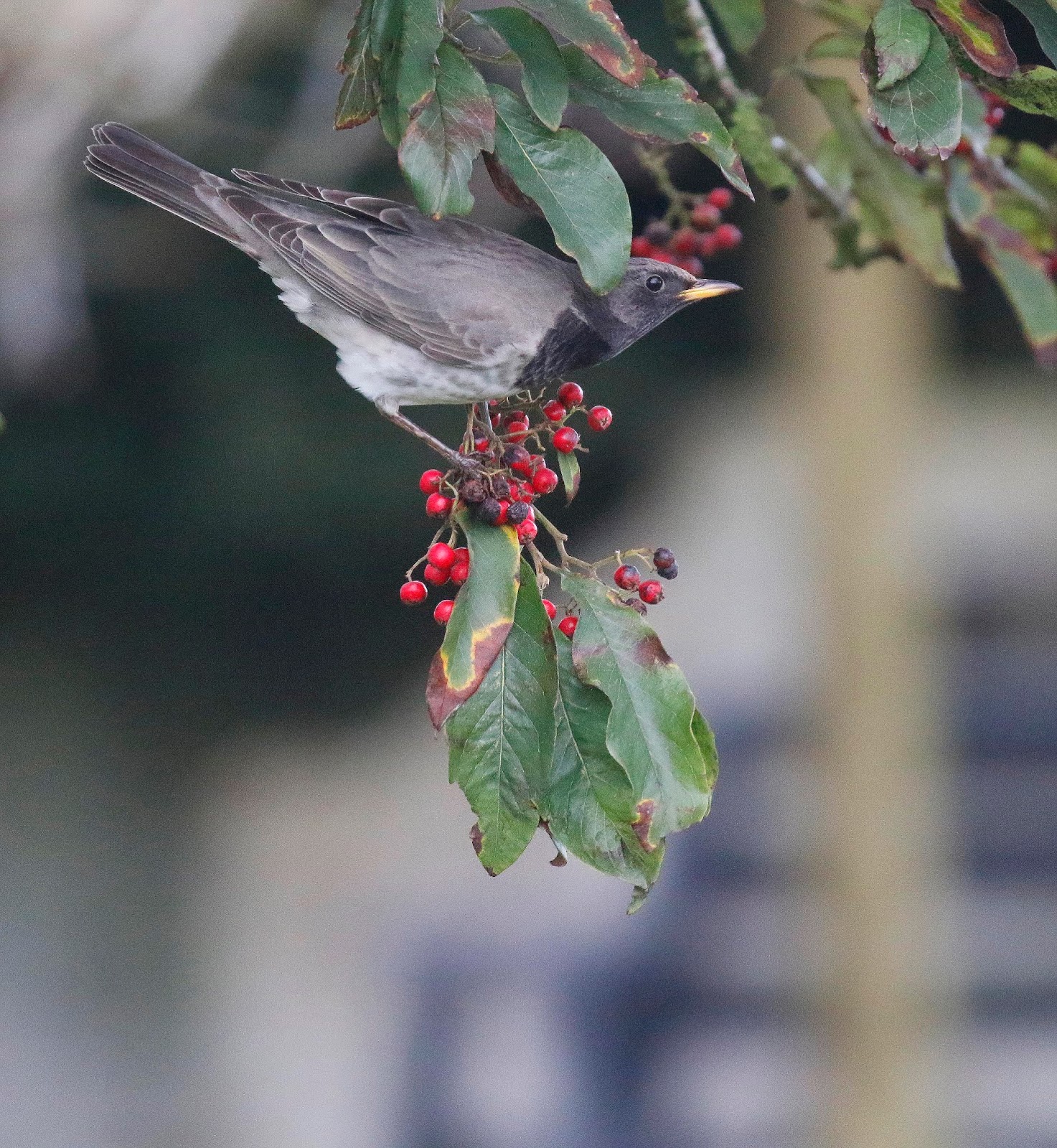
Cue the rapid fire of camera shutters and some very nice, pleasing images being obtained. What a lovely bird it is. Black of face and breast, the black feathers outlined with pale fringes, silvery grey underneath with darker brownish grey upperparts. Its bill a combination more of yellow than black.


Many of the pubished images that abound on social media quite naturally show it feeding on the berries, as such images are pleasing to the eye, especially if the bird has a bright red berry in its bill, but we wanted something different, preferably the bird feeding on the ground. Well, variety is the spice of life it is said and our wish had already been granted.

Adrian and Les joined us by which time the thrush, stuffed full of berries and worms had retreated to perch contentedly in the berry tree and did not move until it once more felt the pangs of hunger.


This was to be its routine over the ensuing five hours we spent in its company. A short burst of feeding, either on berries in the tree or, less often, worms on the ground, to be followed by a period of sitting quietly in the berry tree digesting its latest meal.


Adrian picked up a worm that was crossing the tarmac path and threw it onto the grass.The reaction from the thrush, currently sitting in a small bare tree in the centre of the grassed area, was instantaneous. With indecent haste it hopped to the edge of the tree and flew down to the grass where the worm lay. It picked up the worm and with great difficulty swallowed most of it, although this took over a minute as the worm was long and, for a while, part of it protuded from the thrush's bill. Finally the last of the worm disappeared down the bird's throat and the thrush took on a more normal and aesthetic appearance.


Mark and Les departed for a coffee but I remained with Adrian hoping the thrush might come down once more onto the grass. We were to be disappointed as it decided to remain in the tree digesting the large worm and when finally it became hungry again it fed on berries in the tree rather than come down onto the grass. Fair enough. It probably felt more secure in the tree. Undaunted I took some images of it feeding on berries in the tree. It seemed perverse not too.



The weather deteriorated, the sun never really shone and we could feel rain on the blustery wind. We were all happy with what we had achieved for now, so left the thrush to sit digesting a crop full of berries and retired once more to the Hullabazoo cafe for another coffee and to warm ourselves. 

Once the rain shower ceased it was back to the thrush but for the most part it remained in the tree with just a brief excursion onto the footpath, to seize a couple of exposed worms. The rain came down again but harder this time and we retreated to the butterfly house, a haven of warmth. Adrian pointed out two Red crested Partridge, feeding on the ground below the tropical vegetation and the huge gliding butterflies. Somehow  I had missed the partridges when I came here last December to see the thrush.

Thoroughly warmed up and revived from our spell in the butterfly house we left and went back to try for more images of the thrush, hopefully on the ground. Frustratingly we learnt it had been on the ground while we were in the butterfly house but now was once more perched in the berry tree, gorging on berries and then sitting quietly to digest them. Most of the berries have been stripped from the tree by visiting Redwings, Blackbirds and the Black throated Thrush, so all that remains are random berries on a few stalks or the occasional bunch of berries hanging at the extreme tip of the lowest of the tree's thin twigs. This necessitated the thrush having to acrobatically cling to the insubstantial twigs and lean down to pluck the berries, a delicate manouevre that was made all the more difficult by the regular and strong gusts of wind that made the bottom heavy, berry bearing twigs sway wildly in the wind whilst the thrush clung on, maintaining its balance with spread wings and tail.


Sometimes the force of the wind was too much and the thrush had to retreat further into the tree to perch on firmer, thicker branches.


This was repeated, time and again and it seemed the thrush would never come down to the worms which we gathered from the surrounding wet footpaths and threw onto the grass, in an attempt to lure it down. The thrush resolutely ignored our attempts to entice it onto the grass and I thought it a lost cause.

Bored with waiting for the thrush to fly down to the grass I wandered round to the other side of the berry tree and took some images of the thrush that was currently feeding on what was left of the much diminished supply of berries. It was in the lee of the wind here and was relaxed and not that hungry, perching on a twig and every so often picking off a berry. Finally, replete, it hopped deeper into the tree.


It was, as we were talking amongst ourselves and the thrush continued to sit in the tree, that I turned to notice the thrush had at that moment descended to the ground below the tree and was digging into the wet grass in search of worms. I alerted the others and it was action stations. The thrush saw the worms Adrian had chucked on the grass earlier and, hopping over to them, commenced swallowing the worms as fast as it could and this, at last, provided an opportunity to get the definitive shots of the bird on the ground. You could hardly fail as it was so near and obliging. It  spent only a few minutes on the ground but this was more than enough for us to garner plenty of images, before the thrush flew, once more, up into the berry tree.


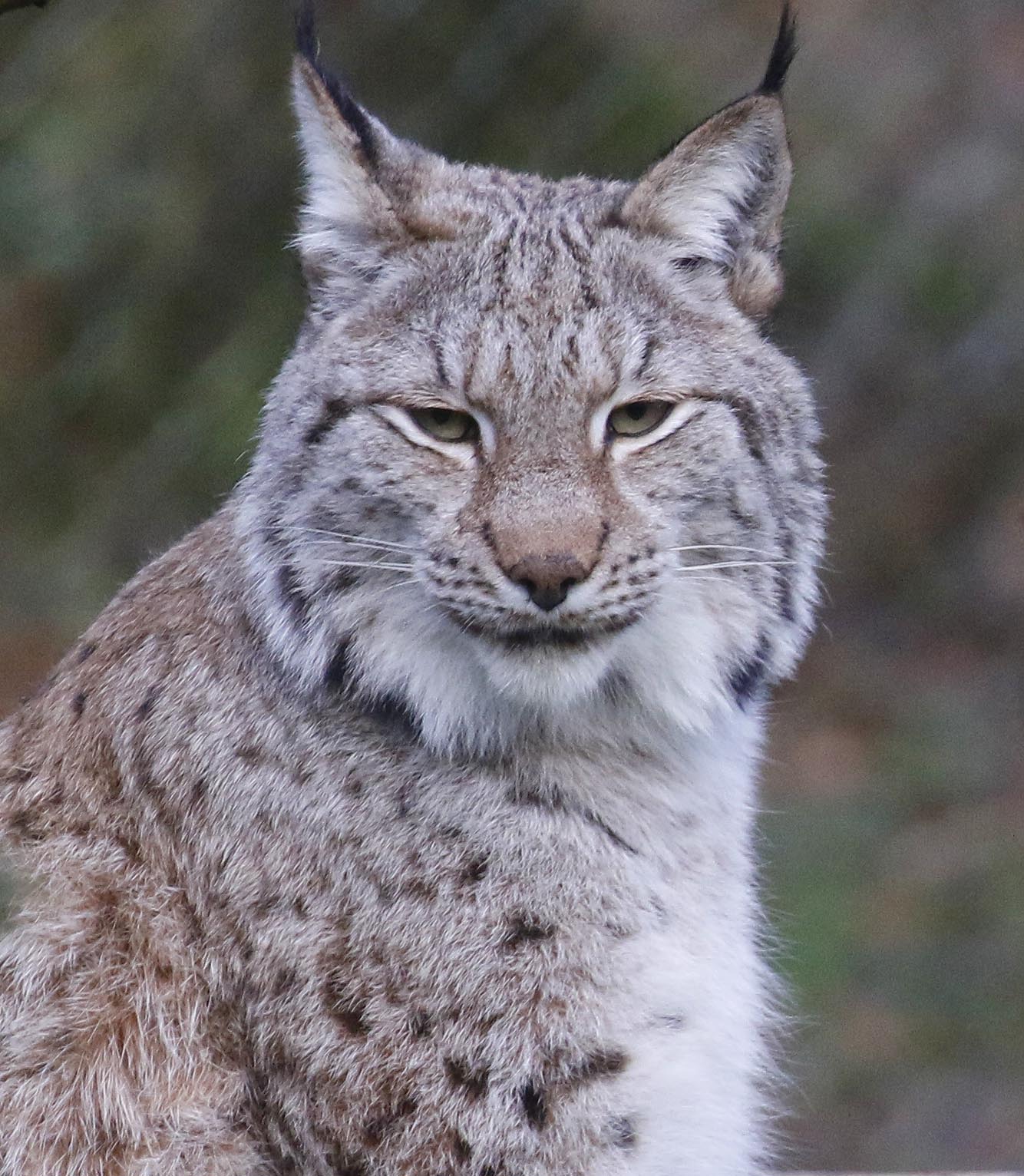
We clustered in a huddle to compare our images and thankfully everyone of us had got something to be happy with. Now, feeling the cold and with the wind increasing, we decided to call it a day but not before admiring the Eurasian Lynx in their enclosure near to the zoo's reception area.


Sustenance was now a top priority and a short drive to a pleasant pub resulted in a very nice meal to be followed by a lot of birding chatter about past twitching experiences and exploits.

All of which rounded off the day nicely.


Thursday, 16 January 2020

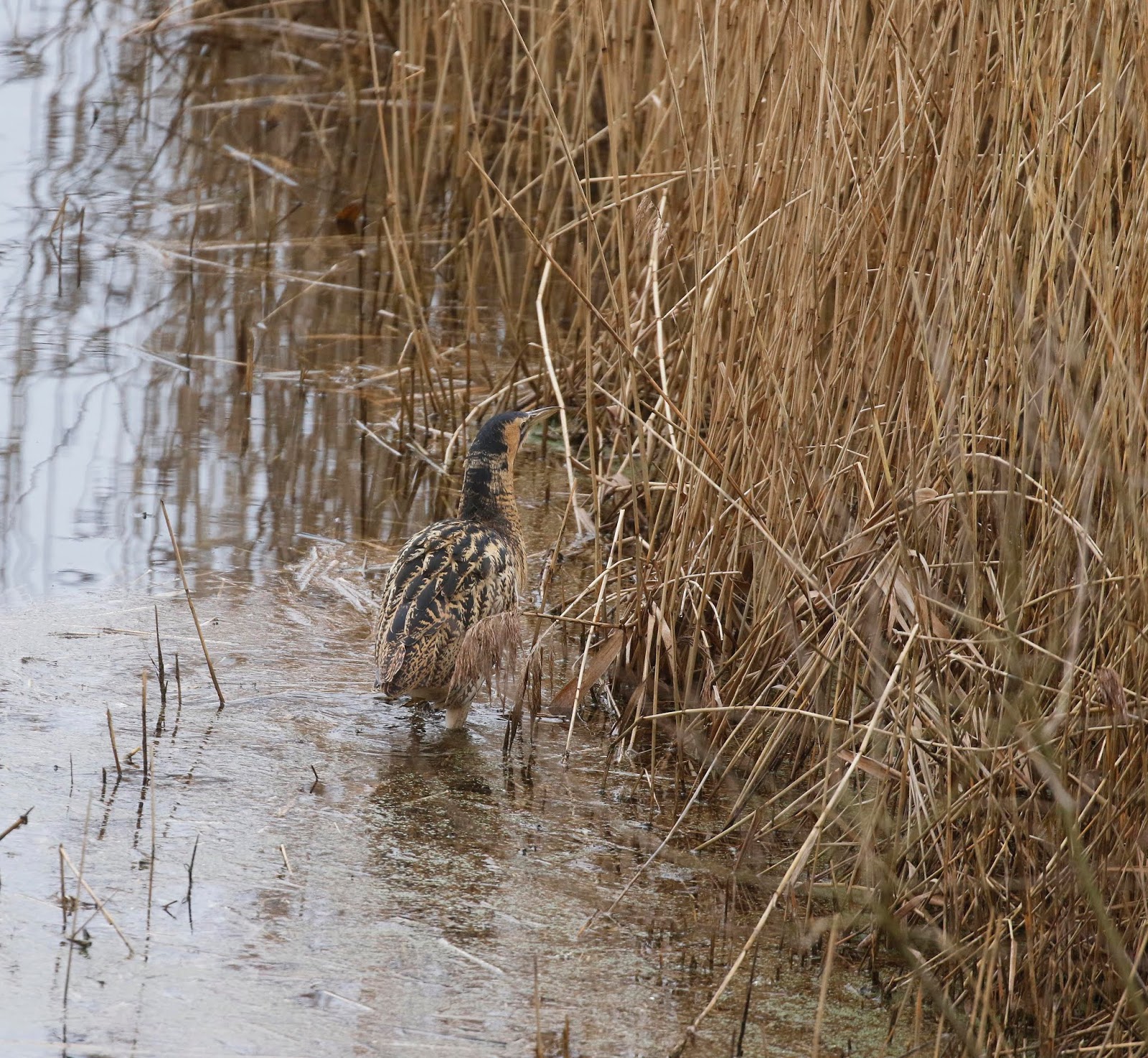
The HS2 Bittern 15th January 2020


Each year I make a trip to BBOWT's (Berks, Bucks and Oxon Wildlife Trust) twenty two hectare Calvert Jubilee Wildlife Reserve in Buckinghamshire to see the wintering Bitterns that spend their days in the sectioned reedbeds, that are situated around the lake below a tiny viewing hide. 


The reed beds and lake as viewed from the hide.The channel where the Bittern was first seen is to the left
The Bitterns do not breed here but Calvert is well known as a prime site to observe Bitterns in winter, provided you possess the attributes of persistence and patience.  Only small numbers of Bitterns, mainly from Germany and Sweden immigrate to Britain each winter so it's maybe unlikely that the Bitterns here are from Europe or Scandinavia and it has been suggested by some, although there is no proof, that the Bitterns at Calvert may be from the nearby RSPB's Otmoor Reserve, which lies just over the border in Oxfordshire and where they do breed.

Calvert Jubilee has made the national news recently as it is the latest example of the folly and disgrace that is HS2, destroying yet another reserve of irreplaceable habitat and extinguishing up to three rare hairstreak butterfly species on the reserve in the process. Not only that but HS2 took it upon themselves to commence felling trees on the reserve late last year without permission from BBOWT and it was only after a public outcry that they desisted and apologised but by then it was too late, the damage had been done.

The environmental devastation that is being wrought by HS2 is tragic and the cost to environmental sites that stand in its path is enormous and a national tragedy. Five internationally protected wildlife sites, six hundred and ninety three local wildlife sites, such as Calvert, and one hundred and eight ancient woodlands will be destroyed because of this nonsensical vanity project. I look forward to learning exactly how HS2 proposes to achieve the impossible by restoring to their 'original state'  the ancient woodlands they plan to devastate.

The financial cost of HS2 is also running out of control. Now, way over the original budget of thirty two billion pounds, it is estimated it will cost seventy to eighty billion pounds, possibly over a hundred billion. It is truly incomprehensible and all to cut forty minutes off a train journey! How much better could this money be used for social care or the beleagured NHS? 

I left my home at five thirty this morning to ensure I could secure one of the four places that is all the small but popular hide can offer. I need not have worried, as in my anxiety I arrived in the dark, having wildly miscalculated how long it took to get to Calvert, which is just over the border from my own county of Oxfordshire.

So pitch dark was it at the reserve I needed the torch on my phone to guide me down the wet, treacherously leaf slippery path to the hide. A hide that frankly has seen better days, being minus a door and shamefully strewn with litter.

I sat on an unforgiving hard wooden bench and awaited the first glimmer of dawn. All I could currently see, looking out from the hide, were the specially cut channels of water, gleaming in the moonlight, that run between the dark shapes of the separate small reed beds but slowly this abstract vision metamorphosed into something more definite, as the light improved.

Two dark shapes were the first discernible signs of life on the water in front of the reeds. Their size was exaggerated by the fact they were ill defined in the half light but by their actions I knew they were Moorhens.

A Water Rail squealed, to be immediately answered by another. A challenge or a greeting? Birds were stirring but hard to see in the half darkness. Shortly afterwards a rustling commotion of wings beating hard against the reeds, directly in front and below the hide, announced the stirring of something larger, which landed on a small strip of mud in the channel. It was a Bittern. It had been roosting in the top of the reeds, by the channel, invisible in the darkness. Bitterns roost in reeds by climbing up to just below the top of the reeds and then grab a bunch of stems with each foot and remain there for the night without moving. To us nothing can seem more uncomfortable and precarious but to the Bittern it is clearly the opposite. 

The Bittern's outline was defined by the pale water behind the strip of mud it had landed on. In my binoculars, with their greater light gathering power, I could just make out the pattern of its plumage.To my naked eyes it was a hulking shape and no more.

It was 7.26 am and for five minutes the Bittern stood ruffling feathers and preening, relieved no doubt to no longer have to cling to the reed stems. After five minutes it stalked into the reed bed on the other side of the channel and was gone.

I settled for what is usually a long wait for it to re-appear. Bitterns never do anything in a hurry, moving with stealth and at an almost funereal pace through the reeds, hunting fish and amphibians in the shallow water, content in their reed fastness, where they are concealed from view amongst the inumerable stems.

The light was now much brighter and I could clearly see birds moving in the channels of water between the reed beds and further out on the lake. Little Grebes swam close to the edge of the reeds, forever nervous of venturing too far from the cover of the reed stems into which they  would insinuate their tiny rounded forms at the slightest hint of danger. Further out on the lake, Coots were wasting no time in coming into conflict with others of their kind, hurtling across the water to face up to a perceived rival, the protagonists often joined by their respective mates and even other Coots, the latter birds seeming to be unable to resist joining a fight. There is nothing these pugnacious birds love more. Their punctuated, explosive calls, 'tenk tenk'  accompanied their combat as they sat back in the water and battered each other's breast with their huge lobed feet.

Closer, at the edge of the channel below me, a Water Rail ventured into the open from the reeds, nervously strutting around the muddy patch previously occupied by the Bittern. The rail's behaviour was remarkable in that this normally ultra shy bird showed no compunction to keep to cover and although the very paragon of anxiety, as is the way with this species, it remained continuously in the open between the two reed beds for quite a long time.


Another normally secretive bird, a Cetti's Warbler, brown and grey with a broad rounded tail, threaded its mouse like way through the reed stems, almost at water level, granting an all too rare glimpse of itself. Normally they are heard rather than seen, announcing their hidden presence with a loud exclamation of cheery notes.

The time passed slowly and apart from occasional further forays into the open by the Water Rail, to keep me mildly entertained, it was attritional. The cold and dampness in the hide permeated my very bones. My feet became painfully numb, as I sat immobile on the unforgiving hard bench, sequestered in the dank interior of the decrepit hide.

The star bird was conspicuously absent from the ensuing three cold hours which passed so very slowly. Other visitors to the hide came and went, boredom and cold eventually persuading them to seek alternative entertainment. I continued to sit it out, determined to get a better view of the Bittern. 

At just before noon a diversion came in the unexpected arrival of a BBC cameraman and reporter who entered the hide accompanied by two BBOWT wardens.

Their huge video camera and enormous tripod half filled the tiny hide.The cameraman apologised for the disturbance. My fellow birding occupant of the hide fled. I shrugged and told the cameraman not to worry about me. They explained they were doing a news item for BBC Southeast for tonight's programme. Calvert was to be the lead story, highlighting the destruction and environmental vandalism (my words not theirs) that is HS2.

They enquired of the Bittern and were disappointed when I informed them that I had not seen it for over three hours. Just as I spoke the Bittern flew up from the reed bed it had walked into hours ago and flew past us on broad, barred wings and crash landed into another reed bed to our right. It inelegantly and slowly, sank down the reed stems into obscurity.

Why now of all times? I had sat here for three numbing hours and distracted by the film crew had missed the opportunity to get a picture of the Bittern in flight, flying right past the hide. Unfortunately the BBC cameraman missed it too as he was concentrating on setting up his equipment. He did not seem too worried as he told me he had some nice shots of swans, ducks and coots. Quite.

Bitterns possess a unique aura. Almost reptilian in their deliberate movements as they stalk on sturdy green legs and huge feet  through their aquatic habitat. There are frequent stops, as if the bird is uncertain, and requires to orientate itself and check all is well. 


When walking and not alarmed it carries its body and head almost horizontally while one large foot is placed down as the opposite leg and foot are raised horizontally to its chest, in alternate large steps.


When it stops the Bittern will often extend its very long neck as high as it will go and allow the feathers to fall loose so its thick neck becomes twice the normal diameter. It will then stand motionless for quite some time before taking the next step, its head and bill inclined at an upwards angle. its brownish orange eyes looking almost cross eyed as they look along the formidable bill. Part of their weird charm is that they are so unlike a typical bird in their behaviour, slow and ponderous rather than imbued with rapid movement, maintaining that mystique of concealment as their stocky, bulky body, is for the most part concealed for long periods in reeds.The uncertainty of when one will appear is a constant concern to any watcher as is the anxiety of whether, if one is seen in the open, it will remain as such for an extended period.


The BBC reporter approached me and asked if I would pose for them by pointing my camera and lens at the lake. 

'Of course. Is this OK?' I enquired as I focused not on the absent Bittern but a Coot swimming between the reed beds. 

'That's perfect. Thanks. Just hold that pose until I say stop.' 

They took their sequence and then asked. 

'Can we take one from behind you,  over your shoulder, looking out to the lake through the viewing slat, showing how the hide is used by birders and photographers?'

'Certainly. No problem at all.' 

And that was it and they made for the door or at least where the door would have been.

No sooner had they got out of the hide than the Bittern stalked out of the reed bed and commenced to slowly wade across the narrow channel of water to the reed bed on the other side. I called to the departing cameraman 


'The Bittern is here, its coming out of the reed bed. Hurry!' 

He rushed back and thankfully the Bittern was taking its time, wading slowly through the water with great deliberation and he got some film of it. As the Bittern moved across the channel of water and through broken spikes of long dead reed stems I counted my blessings, as often they will fly across such an 'open channel' from one reed bed to another, reluctant to expose themselves in an area without cover, no matter how small. Their shyness and reclusive personality is legendary but this individual bucked the trend as it waded in slow and stately fashion through the water,  even stopping to try its luck at fishing. This gave me the opportunity to observe its curious technique. I am sure they can stab prey with their bill, just as well as any Grey Heron,  but often they will stretch their long neck downwards to the water and turn their head laterally so their bill enters the water at a sideways angle and is then held half submerged in readiness. 


The Bittern then tramps the mud underwater to create  small clouds of mud, such as occur when small prey that the fish feed on, move about on the bottom. The larger fish are attracted to these clouds and swim towards them in the hope of capturing some food item but, instead, come within range of the Bittern's bill. An alternative theory is that the tramping feet frightens the fish which then swim unwittingly within range of the Bittern's bill.


I willed the Bittern to stay in the open but I was asking too much. I was extremely fortunate to get the views I had but you always wish for more.The Bittern slowly made its way across to the opposite reed bed, wandered into the reeds and was gone. 


The BBC crew and BBOWT wardens departed for the second time. Hopefully something will come of  the publicity and the  reserve will be spared any further damage. Even better, HS2 will be scrapped.

I waited and after half an hour the Bittern re-appeared at the edge of the reed bed but this time there was to be no repeat performance as the Bittern flew across the channel of water and out of sight into the opposite reed bed. I hung on in the hope it would traverse the reed bed and come out the other side but gave up after an hour. It may well have eventually re-appeared but it was not to be while I was there. 

I had done very well and chilled to the bone I craved a warm drink and the heated seat of the Audi.