Friday, 10 January 2020

My Third Eastern Yellow Wagtail 10th January 2020


A business appointment in Chelmsford Essex yesterday, meant that I could plan to go and see my third Eastern Yellow Wagtail in the space of three months. Having already seen two individuals of this newly split species my only incentive to go and see this one was that it was a male and in a much more attractive plumage than the other two. It would also be instructive to spend time observing  the bird, the better to understand and compare the subtle plumage variations of this species, as undoubtedly others will now be discovered in the months and years to come.You never know, I may even find my own, but to do so I will need to know what to look for.

The bird itself was frequenting open farmland near to an unremarkable village called Sedgeford in north Norfolk, where it favoured two large heaps of dung to feed on and according to reports was very approachable. It has been present for over two weeks at Sedgeford and looks like it may  attempt to spend the entire winter there. It is remarkable that no less than two individuals are attempting to winter in Britain, both near the east coast and one wonders if this form of the Yellow Wagtail complex has been overlooked in the past. Maybe birders are taking more interest because it is now a full species, as records seem to be coming on a more regular basis. On the other hand, perhaps this is just an exceptional year for the species to put in an appearance in Britain.

Essex, being nearer to Norfolk than Oxfordshire, I called my sister who lives in Harlow. also in Essex and arranged to stay the night there and leave very early in the morning to make a two hour drive to Norfolk.

All went well as I left Harlow at five the next morning, taking it steadily and driving well under the speed limit along the already busy roads to East Anglia.There was no need to hurry as it would not be properly light until at least eight. I finally came to a stop in Sedgeford just after seven thirty and then followed the directions given by RBA (Rare Bird Alert) and drove out of the village northwards, for a mile, through a landscape of wet, muddy and bare winter fields. I had hoped there would be someone already there to show me where to find the dung heaps but I was too early and out of luck, so parked by what I thought was the correct place but was none too sure if it was.

I lowered the car window and the cold Norfolk air rushed in and banished the cloying warmth of the car's interior. The sky was full of geese, Pink footed Geese, noisily arriving from their roost out on The Wash, looking for a beet field in which to spend the day, feeding and resting.

Another car drew up alongside me and the driver enquired  'Where do I go for the wagtail?' 

'I was about to ask you the same' I replied. 

A man then came out of an adjacent house to open his gate and noting our confusion told us we needed to drive further down the road to the next track on the right that lead out through the fields. Two more cars stopped to join us and in convoy we drove a short way further down the road.

We parked on the grass verge, got our birding gear and  the four of us walked along a wet and muddy track.


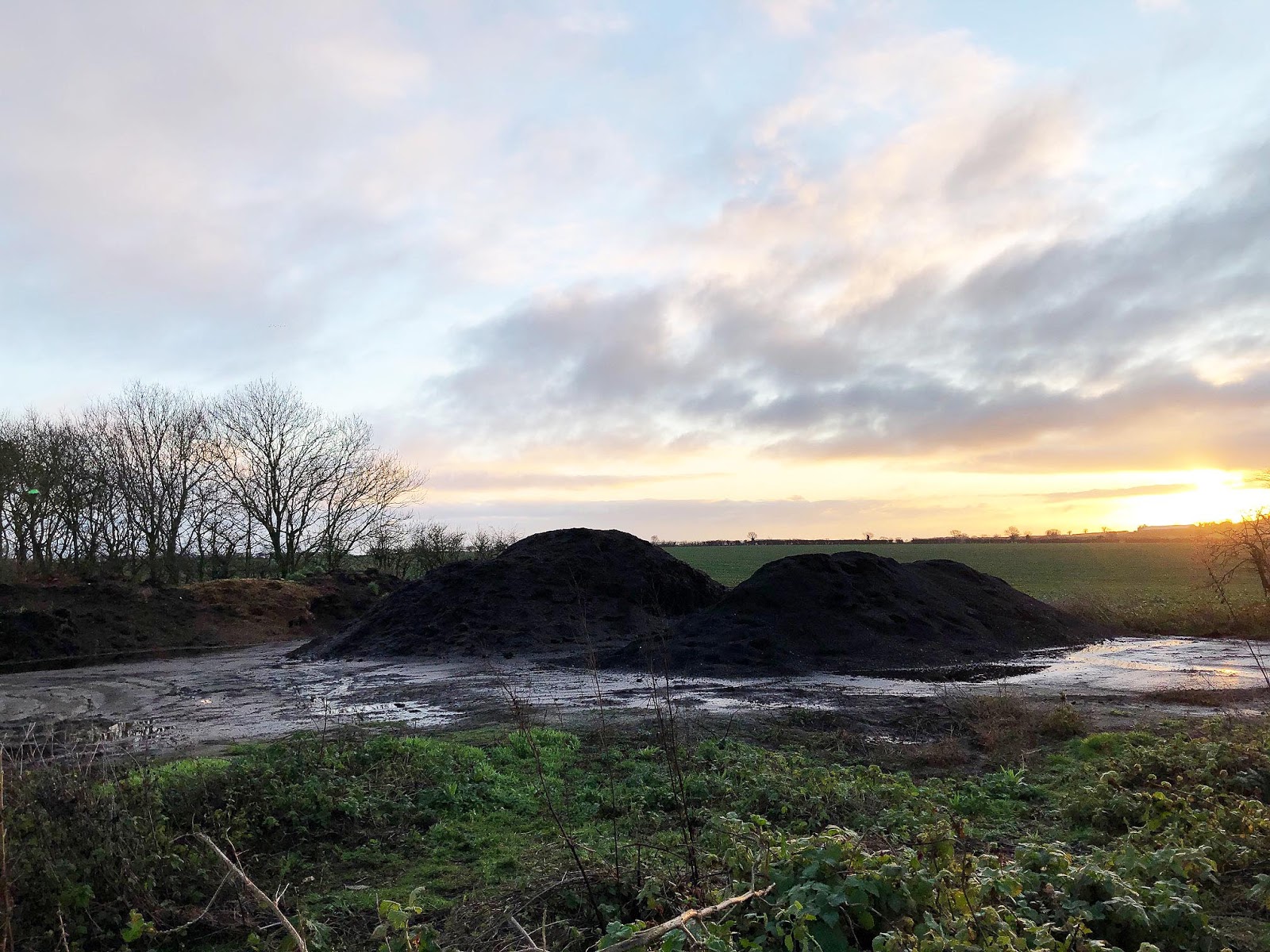
Two Grey Partridge scuttled across the large fallow field to our left as we walked up the track. Soon we came to the  now well publicised dung heaps, situated in a little open area on our right.


The dung heaps

Would the Eastern Yellow Wagtail be here?

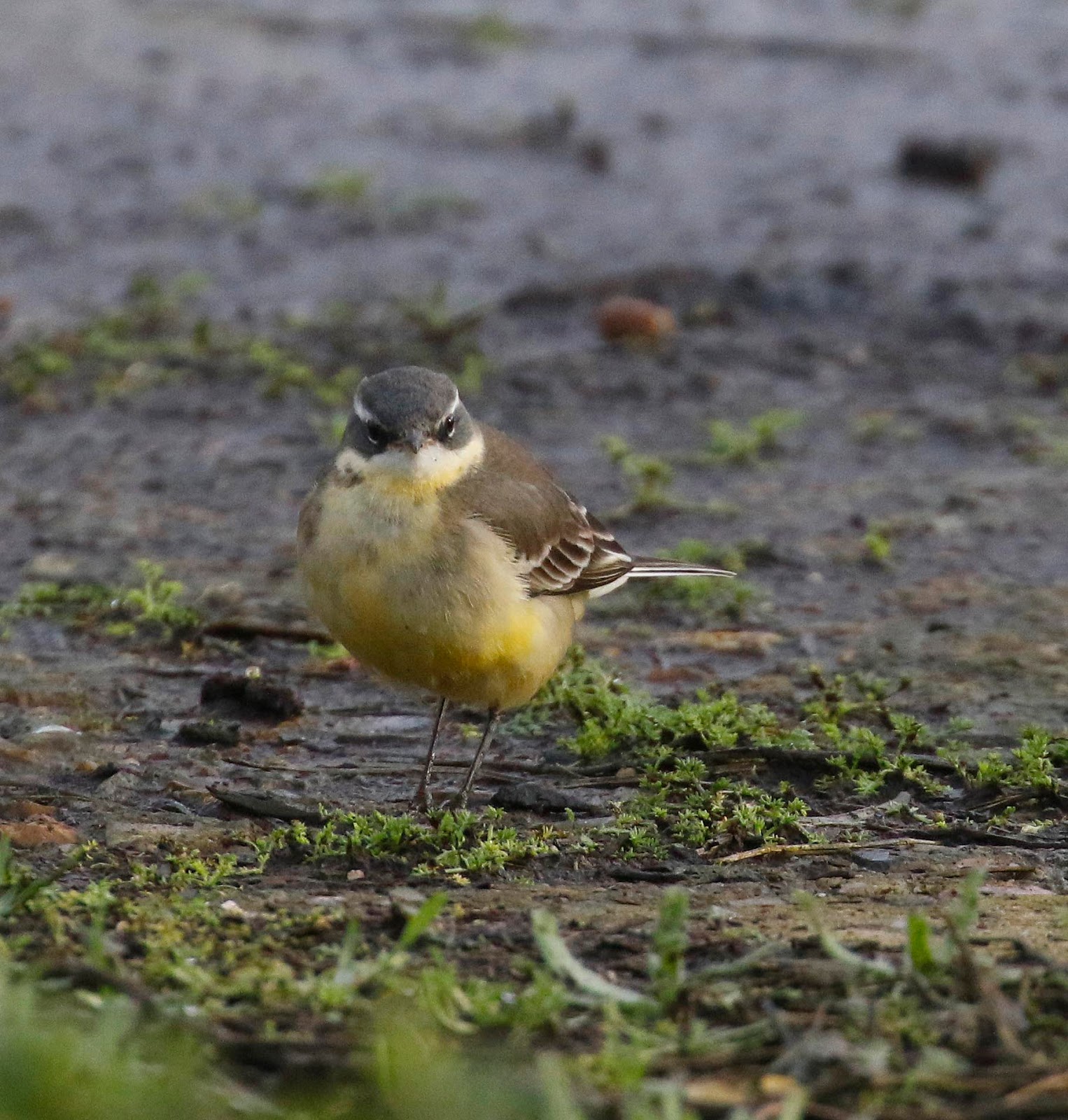
It took all of a minute to find the wagtail. It was the only bird here, feeding at the base of one of the dung heaps, just as everyone had reported it as doing on previous days. The wagtail's pale yellow plumage was in stark contrast to the dark mound of dung, as it wandered around the wet ground and puddles seeking sustenance. We stood, watched and admired, took some photos and then the wagtail ran towards us until it was no more than fifteen feet away, completely unconcerned. Brilliant, just brilliant. I admired its much more colourful and strongly patterned appearance than had been evident on the previous two duller individuals I had seen. Its head was a subtle bluish grey with a bold white eyebrow running above and flaring out behind its eye. The upperparts were greyish brown with a slight olive caste and the underparts yellowish white with patches of deeper yellow. Each side of its breast still showed a vestigial dark smudge, a remnant of its juvenile breast band and thus identifying it as a first year bird.


We watched it for around ten minutes and it looked settled but then, without warning, it rose silently from the ground and flew off to where we had just come from. I followed its flight in my bins and saw it drop over the track, to land behind a hedge bordering the vast fallow field where we had seen the partridge earlier. We did not follow but stood and waited, assuming it would soon return, as every prior report said it was particularly faithful to the dung heaps.

A very cold wind was blowing unhindered across the prairie like fields. A huge gathering of Pink footed Geese were landing to feed on a distant beet field to my right,  their squealing, bickering calls coming to us across a shallow decline in the land. Then the volume increased as the entire flock, maybe in its thousands, took alarm from a passing tractor and rose up into a multicoloured sky of pastel grey, blue and pale gold, there to circle around, before descending to another more distant field. This scene is the essence of north Norfolk in winter, evocative and made memorable by the undulating contours and desolate emptiness of the fallow beet fields with huge, windy skies above, complemented by the querulous cries and sight of thousands of geese, in ragged formations, strung across the sky or clustered in ranks on the dank wet earth below.

A winter landscape in North Norfolk
We stood and waited for the wagtail to return as more and more birders arrived up the track. From four we increased to thirty but still there was no sign of the wagtail. Chaffinches, Dunnocks and Pied Wagtails visited the dung heaps and a male Yellowhammer briefly sat on telephone wires to bring some diversion. Over an hour passed before a diagnostic buzzy call signalled the wagtail was back, or at least that is what we assumed, but it kept on going and disappeared again, far beyond the dung heaps. I mustered a resigned shrug and another freezing vigil ensued but at this point doubt was beginning to set in. My resolve was wavering. 

I consoled myself with the knowledge that I was one of the lucky ones this morning, having already seen the wagtail and very well too. Peter, a birder friend from Oxford joined me, having driven to Norfolk through the night on an abortive  trip to see a Lesser White-fronted Goose that had been frequenting a field near to Kings Lynn yesterday. At least if he saw the Eastern Yellow Wagtail his trip would not be in vain as he had never seen this species either.

Lesser White-fronted Goose is now very rare, a mega, due to its rapidly declining world population and many birders were very keen to see this one in Norfolk but to their frustration it seemed unwilling to remain in one area for more than a day and for days it is not seen at all, as it roams around the vast open spaces of north Norfolk with the Pink footed Geese flocks. Much of the farmland is inaccessible or invisible from public roads or paths which makes matters even more difficult in locating the goose. Yesterday it was seen really well from a public road but today no one could find it anywhere. 

Never mind. The wagtail was the prime target for me today but it was certainly not behaving in its usual compliant manner. By now I had lost all feeling in my wellington encased feet and my fingers were following suit  but I stuck it out, determined to wait just a little longer and see the wagtail one more time.

The cold, tiredness and boredom served to further undermine my resolve. 'I am going to give it  ten minutes more Peter and then I am going to the car to warm up and find a cafe. If the wagtail comes back I will return'. I muttered

A few minutes later I heard the wagtail's distinctive call as it dropped from the sky and landed in the fallow field on the other side of the track from the dung heaps. It could not have landed in a better place, right by the assembled birders.


Everyone made for the side of the track and there was the wagtail, stood on the wet ground. Eventually it began wandering across the rich  earth, giving everyone excellent and prolonged views in the process.


It walked towards us, completely unabashed at the sight of thirty to forty birders intensely watching and photographing it. Parading back and fore, it then stood on a little ridge, looking around, before, calling loudly, it flew across the track to descend onto the ground in front of the adjacent dung heaps.


We made our way back to the other side of the track and the wagtail duly strutted around before us, coming very close in the process. Here it remained feeding for some minutes before making its way to the dung heaps. We had been watching the wagtail for twenty or more minutes but all things come to an end and it flew up and away, back out into the middle of the fallow field again. I surmised its change in behaviour from favouring the dung heaps may have come about because the heavy rain that had fallen overnight had made the earth in the field so waterlogged it forced invertebrates to the surface and gave good feeding opportunities to the wagtail. It could not be coincidence that some Black headed Gulls, Pied Wagtails and  Blackbirds also seemed to be joining it in taking advantage of the situation.

Cue a mass departure of birders. Everyone happy and content with their exceptional views of this ultra rare bird. I was so glad I  had waited and, dare I say it, even more pleased to be able to get some circulation moving in my feet and say farewell to this bleak and sodden landscape.


We decided to reward ourselves with a breakfast and mug of tea in a tiny cafe at nearby Heacham and very nice it was too as we sat in the warm and savoured the joy of another successful twitch.

Thursday, 9 January 2020

Goldeneyes and that Grebe 8th January 2020


What a difference a day can make at Farmoor! Gone was the strong wind to be replaced with, well, no wind at all, leaving the waters of the reservoir smooth as glass. It was still overcast but not quite so gloomy as yesterday which, as a consequence, lifted my spirits as I sat in the cafe at nine thirty with a coffee, awaiting the arrival of Dave and Amanda before we all took a leisurely, companionable stroll around the reservoir.

This is another form of birding I like. A pleasant, relaxed and refreshing counterpoint to twitching and hurtling off to some far flung destination at a moment's notice, to see a rare bird, which I am prone to do and, I should add, still enjoy.

We set off up the central causeway and soon found the Slavonian Grebe, out on the deeper, open water half way along the larger basin, its small elegant form a pinprick on the vast expanse of still water. A party of Goldeneye swam out from the edge of the causeway, a drake and four females, then lifted off the smaller basin with audibly whirring wings and flew over the causeway to land on the larger basin, possibly feeling more secure there.

We visited the hide at Pinkhill and admired a dozen Common Snipe, hunkered down at the base of the reeds on the far side of the marsh. Some slept whilst others preened or just stood in the water, their elongated bills inclined downwards, resting on their breasts, the cryptic, barred and stripey patterning of buff, cream and darker brown plumage merging with the dead reeds so, unless the birds moved, they became almost as one with the reeds.


Leaving the hide we  walked up the bank of the smaller reservoir to regain the perimeter track.The plan was to walk all the way around the reservoir but there was no birdlife visible so we turned to head back to the causeway, checking a small flock of Tufted Duck to see if the two Greater Scaup were amongst them. There was no sign of the scaup but a male Goldeneye amongst the Tufted Ducks caught our attention as it was behaving oddly. It looked to be in some trouble and was constantly treading water whilst pulling at the feathers on its lower breast. We watched it for some time and it never ceased standing in the water and frantically preening. It was not possible to discern the problem but I could see a dark mark on its normally pure white breast but the distance was too far to be sure of what it was. I could only speculate that the unfortunate duck had maybe got some fishing line caught around it or even worse a hook embedded in its breast. 


I have found discarded fishing line at the reservoir before and occasionally hooks attached to line too, that has presumably broken off in the water or even been wilfully discarded. Something was certainly irritating the duck and making it almost frantic in trying to rectify whatever was wrong. It could not be rescued by boat as it was still capable of flight so reluctantly we had to leave it to its fate.

Commencing the return walk along the causeway I found the Slavonian Grebe had moved to its customary, favourite, sheltered northwest corner on the larger basin and was now close enough, despite the dull light to justify another attempt at photography. This confiding grebe must currently be the most photographed bird in Oxfordshire with a constant procession of photographers and or birders coming to see and admire it, and why not. It is not often one stays for such an extended period and allows one to get so close to it.


The others walked on, chatting but I decided to tarry a while to watch and photograph the grebe, the water so calm that sometimes only the ripples from the grebe's movements, corrugated its perfect reflection.


I reluctantly left the grebe, a rotund buoyant sphere of grey, white and black feathers sitting on the water, its silhouette defined with a precision that can only come on a day of total calm such as this. So still was it, that when the grebe surfaced, drops of water like tiny glass beads remained adhered to its head, bill and upperbody.


Further down the causeway a group of Tufted Ducks and Coots were feeding very close to the shelving concrete apron that skirts each side of the causeway. A closer inspection revealed that amongst this diving throng were six Goldeneye, two drakes and four females.They were immediately distinctive amongst the smaller Tufted Ducks, due to their large, dark, almost triangular shaped heads and the drake's striking black and white plumage, making identification unmistakeable


It is unusual for Goldeneye to allow a close approach but these seemed content, so long as the Tufted Ducks and Coots showed no alarm. This was too good an opportunity to miss and so, using a convenient lifebuoy mounted on a pole to partially conceal my profile, I managed to get very close indeed.

Male Goldeneye

Female Goldeneye
The Goldeneye were diving regularly but when they were all on the surface one of the drakes, commenced displaying to a female. The display is said to be the most elaborate of all our native duck species. It was a wonderful paroxysm of convulsing movement as the pupils of each of the drake's eyes contracted to a black pinprick accentuating the yellow. At the same time he rapidly tossed his head back so it rested on his rump as, with bill opened, pointing to the sky, he emitted a short athsmatic sneeze like note while his bright orange legs kicked up water. Craning his neck and head back and upwards he then reverted to his normal demeanour. It was  all over in a matter of seconds The display of the Goldeneye has been intensively studied by a number of ornithologists and various descriptive names have been given to elements of the display such as 'masthead', 'bowsprit' and the more obvious 'head throw back.'


What a marvellous thing it is to witness such a display. It feels almost a privilege to watch this un-selfconcious outburst of unalloyed passion, drawing one into a world and existence that is beyond ours. I confess to finding a measure of solace in watching birds such as this going about their natural lives, a re-assuring affirmation that there is order in this world and a perfect distraction from these troubled times


I walked onwards back to the cafe where a bowl of lunchtime soup and the others awaited me.

My mind wandered to speculate on the origin of these Goldeneye and why there are always more females than males in the small groups that arrive at Farmoor. The latter question I do not have the answer to but their origin can be anywhere from the north of Scotland where they breed in small but increasing numbers to the major breeding areas of Scandinavia, the Baltic States and northern Russia.

Goldeneyes normally breed in natural cavities in trees. In northern Scotland they first bred in 1970 at Loch an Eilan in Badenoch but the population was constrained due to a lack of suitable sized nest cavities in the trees. This was thought to be due to  Britain not having  a native population of the large Black Woodpecker which excavate holes that are suitable in size for the Goldeneyes to nest in, the ducks making use of any disused or abandoned woodpecker nest holes. However a scheme was launched to erect specially constructed tree mounted nest boxes, with suitable sized holes, near lochs on Speyside in northern Scotland and this has been a great success, so much so that the number of breeding pairs in Scotland had reached a hundred by the year 2000 and currently is double that figure, with random breeding records from Northumberland and even Chew Valley in Somerset.

In winter in Britain, Goldeneyes can be found on suitable large lakes, reservoirs such as Farmoor, large rivers, estuaries and around the coast.  Approximately 27,000 Goldeneye winter in Britain mainly in Scotland and northern England. Many more, up to 250,000 winter around the coast of Denmark and the Baltic Sea. In Oxfordshire only small numbers spend the winter, often to be found on Farmoor, where they rarely exceed single figures and on the nearby Dix Pit at Stanton Harcourt where numbers can sometimes reach double figures.

Most Goldeneye arrive in Oxfordshire in November or December and depart in February or March which is a similar pattern to the birds wintering in other parts of Britain.

It is a thrill to note their arrival on the reservoir and I always look forward to finding them, a highlight on my winter visits when birding can be tough going.


Tuesday, 7 January 2020

A Slavonian revisits Farmoor 7th January 2020


It was back to Farmoor Reservoir today. I replaced the natural rugged beauty of mountain and sea that has been my home on Arran for the last two weeks for the prosaic, concrete, man made surrounds of my local Oxfordshire reservoir.

My arrival at the reservoir gates was in a rain squall, which passed quickly, hurried along by a relentlessly strong wind which, despite blowing from the southwest, was cold on my face and I was glad of my padded jacket and gloves.

Not yet prepared to brave the long walk up the central causeway where the wind would be even stronger, colder and directly in my face, I diverted into the cafe and joined a few friends for a coffee and a chat. It was good to see them and our conversation renewed the tenuous bond I hold with the reservoir.

Half an hour passed in the warmth of the cafe but then it was time to venture out and face the elements. There were precious few people out walking on the causeway and few fishermen either, deterred by the strong wind which would play havoc with the casting of their fishing lines for trout.

I had a purpose to my visit and it lay at the far end of the causeway, in the northwest corner of the larger of the two reservoirs, where a triangular area of more sheltered water lay between an artificial water purification barrier and the edges of the reservoir.

The floating water purification barrier
I was seeking a Slavonian Grebe which has taken up residence in this small arc of water and seems perfectly happy to remain here, content enough to have remained for a number of days.

At the end of November last year there was another here, staying for less than a week but whether the current grebe is the same or another, is hard to tell but the coincidence is remarkable if it is not. The fact one is here at all is also worthy of comment as Slavonian Grebes in winter are a bird of the coast, spending their time in small groups feeding and resting just offshore where the sea is shallow.

They are tiny compact birds only a fraction larger than the Little Grebe's that also frequent the reservoir in winter. Unlike the plain brown plumage of the Little Grebe the Slavonian Grebe is grey and white with a sooty black cap and if you look closely, a demonic red eye.


The waters of the reservoir were the colour of pewter reflecting the skies above. There was a hint of lighter sky in the southwest, turning the water silver, but it soon faded back to an omnipresent greyness. The grebe was actively feeding, continuously diving, disappearing below the cold waters and alternating its subsequent surfacing by appearing either side of the floating barrier. On surfacing its plumage replicated to perfection the similar coloured water, making it briefly hard to discern.


I sat on the causeway wall and followed the grebe's progress as it continued to dive and surface repeatedly. I never saw it bring anything to the surface so presumably what it found underneath the water was consumed there. Despite the presence of nine Little Grebes, huddled as a loose knit group, close in to the barrier, using it as a re-assurance of security and as shelter from the prevailing wind, the Slavonian Grebe followed its own individual course, showing no interest in joining the Little Grebes and staying more in open water. 


The Slavonian also showed considerable trust in my human form sat on the wall and on occasions came close as it searched for food. The Little Grebes were more circumspect and kept their distance, showing a communal nervousness if I should move.

Little Grebe
For an hour I watched this latest unusual visitor to the reservoir but then left to walk around the smaller of the two reservoirs.The physical exercise after sitting motionless for so long was welcome as my blood began to circulate once more. The reservoir was for the most part desolate and dispiriting, devoid of much birdlife apart from the flock of wintering Tufted Ducks but on almost completing a circuit of the reservoir I saw five ducks swim out from the concrete bank.


Low in the water and wary, with a distinctive high peak to the crown of their heads, they swam out into much rougher, wind tossed water and settled at a distance they considered safe. They were Common Goldeneye, small numbers of which spend the winter here. The group consisted of four females and one resplendent drake, his black and white plumage striking against the steely grey water. They dived in unison to feed and surfaced in sequence, one after the other, maintaining contact at all times on the surface, even though their lightweight bodies were tossed and rolled carelessly by waves running before the wind.


They had a look of  mild surprise, affront even, at being disturbed, this suggested by their staring golden eyes. prominent in the dark heads of both male and female, the former's in fact bottle green but looking black at any distance especially in the low light of today, whilst the female is dark chocolate brown.


Sunday, 5 January 2020

Another Year Another Wagtail 4th January 2020


Well not just any wagtail but an Eastern Yellow Wagtail. This is a very rare bird for Britain with only five seen previously in Britain and one in Ireland. So it is truly a mega in twitcher parlance.

I went to see my first one on 16th November last year, at Walberswick in Suffolk, but the views were rather brief and I felt slightly disappointed at not getting better views of it.

However another individual was discovered on 15th December in the unexpected surrounds of Prestwick Carr, an area of wet grassland and farmland, managed by the Northumberland Wildlife Trust near the village of Dinnington. Sadly there was no possibility for me to go and see it with Christmas looming and myself and Mrs U departing for the Isle of Arran, five days hence, on 20th December.

I kept an eye on matters over Christmas and New Year whilst we were on Arran and formed a vague idea of possibly stopping off to see the wagtail on our way back south, after we left Arran. This of course depended on whether the wagtail remained at Prestwick Carr.

Each day I checked RBA (Rare Bird Alert) and each day the wagtail was reported as showing well and it was still there when we left Glasgow on 4th January to make the long drive south. I had hoped the weather would be bright but we left in a smirrr, a Scots word for describing the kind of soft relentless rain and low cloud that leaves a fine mist of water on the windscreen and your clothes and is just as drenching and irritating in its own way as full on rain. Maybe smirrr is derived from the word smear which is what the precipitation did on the windscreen as the wipers beat back and fore.

We drove steadily south, the surrounding hills and moors shrouded by grey cloud but once across the border and south of Carlisle, matters improved as we turned east to head for Dinnington and nearby Prestwick Carr, which lies just south of Newcastle.

Following the directions issued on RBA to park by Mayfair House, we found ourselves, after passing through Dinnington, in open country, driving down a narrow. bumpy lane with flooded fields on either side. We came to a crossroads of four lanes with the aforesaid Mayfair House on one corner. This is where, according to RBA we were to walk northwest a hundred metres along a lane to view some pools in an adjacent field.

Parking the car in the only space available we stepped out into a raw windy day but nonetheless sunny. It was very cold as strong gusts of wind blew unhindered across the flat waterlogged countryside. I had assumed there would be other birders here so we would know exactly where to go but looking up and down the three lanes, other than the one we had driven down, there was no sign of any other birder. Presumably everyone who wanted to had already seen the bird. So  the question was where do we go as each lane seemed to have identical pools of water in the fields beside them.

Standing at the cross roads I was in a dilemna as to which of two lanes to take as both were heading in a northerly direction. One went directly north and one went northwest. RBA  had said take the northwest one, so we turned to do just that. At that moment a green clad person carrying a camera emerged from a gap in a hedge running down one side of the lane running due north and waved to me.


Aha! This was obviously the lane to venture down, which we duly did, and in a couple of minutes I was looking through a gap in a straggling, bare, wind torn hedge onto a very muddy and waterlogged field with two circular metal containers full of hay from which a number of horses were busily feeding, tugging at the hay and scattering as much as they ate.


The Eastern Yellow Wagtail spent all its time around the
horses and the hay dispenser
The birder pointed to the mud and straw in the field, the former churned up by the horses hooves, and there was the Eastern Yellow Wagtail, no more than fifteen feet away, strutting in and out of the furrows and indentations caused by the horses hooves, picking up tiny, red worms at a prodigious rate. It was distinctive, appearing very pale and grey in some lights against the dark mud but in the now intermittent bursts of sun the plumage took on a warmer buff tone with just a hint of yellow on some of the underparts.


It never ventured far out into the field and so I got to see it very well although the strong wind prompted it to seek shelter in any furrow or depression in the mud it could find, so sometimes you could see only parts of the bird whilst at other times it was in full view. It also showed no fear of the horses pulling at the hay, wandering around their feet with little apparent concern. I followed its progress as it fed in what was a small area just beyond the fence, searching back and fore for the worms.


Eventually it came closer to the fence and found a nice cosy spot in a jumble of hay discarded by the horses, which sheltered it nicely from the wind. Here it sat, quite content, for all of ten minutes, out of the buffeting wind before literally shaking its feathers and re-commencing its search for more worms.


For the most part I was on my own but a group of birders briefly joined me.They were doing a bird race and the rare wagtail was an unexpected bonus for them but they soon departed with no time to appreciate the wagtail. Such a shame.

For company the Eastern Yellow Wagtail had a flock of around twenty Pied Wagtails and half a dozen Meadow Pipits feeding in the same general area. I deduced that it remained in its particular  favoured area around the two hay dispensers as this was where the mud became regularly churned up by the horses which presumably exposed the worms in the mud.

I watched the wagtail for around forty minutes but the wind was becoming increasingly strong and chilling and with a five hour drive in prospect, I departed for the car and we headed South.

A nice way to start the New Year.