Thursday, 18 January 2024

The Northern Waterthrush Revisited 17th January 2024


An unexpected business meeting in Chelmsford, Essex gave me an opportunity to reprise my visit of last week to the wintering Northern Waterthrush at nearby Heybridge.

This was welcome as I considered that the views and photos achieved on my first visit left room for improvement. I formed a plan. On Wednesday I would leave my home in Oxfordshire early and drive to Heybridge and hope to view the waterthrush. Then stay overnight with my sister nearby and go to my business meeting on Thursday before returning to my sister's home on Thursday night and if my encounter with the waterthrush on Wednesday had proved unsatisfactory then give it another go on Friday.

Checking the daily reports of the waterthrush sightings since my first visit it looked like the bird only reliably appeared in its favourite creek at dawn each day, remained for around thirty minutes and then departed. Subsequent visits during the day looked to be a bit of a lottery with one or two brief random appearances of the bird if you were lucky, before a final one at dusk when presumably it went to roost nearby.

With this in mind I decided to give myself a break and forgo the dawn view which would be of the bird as a silhouette only and schedule my arrival for 9.00am. Mind you this still required my leaving home at 6.30am in order to make the two and a half hour journey to Heybridge.

Another bitterly cold -6 celsius outside temperature greeted me as I got into my car and headed off into the darkness of the country lanes around our village. The interior of the car was on a par with a refridgerator and it took several minutes for the car to warm up so that my fingers on the steering wheel no longer tingled with the cold but soon all was well.

Driving along I reflected on the contrast of my human existence with that of the waterthrush. Warm and snug in the car I thought of the waterthrush roosting in some bramble clump or bush, legs and feet locked onto a tiny twig, head tucked into fluffed feathers providing its only protection against the vicious cold. 

A small bird's heart rate is much higher than ours, on average 500 beats per minute as opposed to 100 and this keeps them warm to a degree but at the price of burning energy at a prodigious rate especially in very cold weather. First thing each morning the waterthrush will have to commence feeding and continue all day if it is to survive. Normally it would be in a far warmer climate in South America with plenty of food and not having to cope with cold temperatures but  remarkably this bird has survived at least a week of sub zero temperatures with no apparent ill effects. The creek for now remains unfrozen apart from at the edges where ice platforms have formed and despite this less than ideal environment there is apparently enough food to sustain it.

The Creek

It was a grey, dull morning when I arrived at Heybridge with for once no wind to chill my bones. I parked in an adjacent industrial estate and walked for ten minutes to the bank overlooking the head of the small creek. I was pleasantly surprised to see only half a dozen birders standing there. Such a change from the multitudes on my last visit.


I chatted briefly with one or two of those present who told me they had seen the waterthrush at just after 7.30am but were waiting for a better view in daylight. For twenty minutes I stood slightly apart from my fellow birders, fending off the inevitable anxiety by fiddling with my camera settings. 

A stirring amongst my companions and raising of binoculars signified the arrival of the waterthrush which typically hugged the edge of the creek,which in reality is no more than a large waterfilled ditch.It worked its way towards us and flitted up and down across the water and mats of dead reeds.It was present for no more than five minutes  before, with a loud tchick call, it flew off pursued by a Robin into some adjacent bushes and that was that. Gone.


Not very satisfactory. In fact very disappointing. I had hoped for better. Mark arrived just after it had flown off so we settled to wait in the hope it would return. For an hour little troubled us. Gulls squabbled on the warehouse roof tops of the adjacent industrial estate, Dunnocks sang quietly in the brambles and indulged in their menage a trois courtship rituals, a Wren periodically scuttled like a mouse through the rank grass and a Little Egret flew in and then promptly out, obviously thinking better of it.

Riveting stuff but then an explosive call heralded the return of the much desired star turn as it landed on the concrete wall of the culvert at the bottom of the bank before dropping down to the water's edge.


This time the waterthrush was more settled and threaded its way through and over the dead reeds, sometimes ankle deep in the water or flying out over the water to perch on some protuberance to pick at something minute and unidentifiable. 


It wandered along, tail slowly wagging, crossing small plateaux of ice that had formed at the edge of the creek and perching on dead stems to look down into the shallow water. I made the most of this heaven sent opportunity as it performed its by now familiar feeding ritual of searching each side of the creek near to the concrete culvert. Then, as before it flew off calling loudly, this time crossing the path at the top of the bank and disappearing into the hinterland of scrub and reeds behind.


Should we wait? Would it return yet again? These were the questions we asked ourselves.Up to now the elusive bird had only ever returned twice in a day. Sometimes not at all. It was tempting to leave as both of us were now feeling the cold which insiduously had permeated through our protective layers of clothing to reach our skin.

It was just before 11am.

Let's give it to noon Mark then we go.

So we stood and remarkably the waterthrush returned twice more, announcing its arrival each time with its characteristic tchick tchick call. As before the visits lasted for little more than ten minutes but the close views it granted were exceptional.


c.Mark


At noon, having enjoyed an exceptional five visits to the creek by the waterthrush in the space of three hours, we departed, as agreed, for a coffee and somethimg to eat at the Crispy Bacon Cafe, handily situated just around the corner. 

It was done. 

Thursday, 11 January 2024

The Northern Waterthrush in Essex 10th January 2024

On a wet Tuesday afternoon by Higgo's pool at Lower Moors Reserve on St Mary's, Isles of Scilly, way back in October 2011, I stood with Badger and Richard and watched a Northern Waterthrush. We  were very lucky as it had been highly elusive since its arrival in mid September and it was by sheer luck we saw it and really well too. It was the seventh ever to be seen in Britain and although it remained until the 4th of April 2012 it continued to be elusive and many birders who travelled to see it failed. 

Fast forward twelve years to the present and the eighth  Northern Waterthrush to be seen in Britain was discovered by a birder in his garden at Heybridge which lies in the parish of Maldon in the county of Essex. Twelve years of waiting for another waterthrush to arrive was now over, which meant that the Heybridge bird was going to be immensely popular and many people would travel to see it as it was easily accessible, being on the mainland and not as all bar two have been in the past, on The Isles of Scilly.

The seven currently accepted records of Northern Waterthrush in Britain are as follows:

1958 St Agnes   Isles of Scilly 30th September-12th October
1968 Tresco       Isles of Scilly  3rd -7th October
1982 Bryher       Isles of Scilly  20th September- 4th October
1988                   Gibralter Point Lincolnshire 22nd-23rd October
1989 St Agnes    Isles of Scilly 29th-30th August
1996                   Portland Bird Observatory Dorset 14th -17th October
2011 St Mary's   Isles of Scilly 16th September- 4th April 2012

They are not a thrush as we know it but a warbler, marginally larger than a Willow Warbler. The only connection to a thrush is its streaked underparts reminiscent of the spotting on a Song Thrush's breast. They breed from west and central Alaska across Canada to the Atlantic coast and the northwest and northeast of the USA and winter from Mexico to Colombia and Venezuela, northern Brazil, northern Ecuador and northeast Peru.Some also winter in Bermuda and The Caribbean.

Following the unprecedented influx of North American warblers into Britain in late September of last year, Mark my twitching pal has been telling me ad infinitum that he is convinced there would be other rare American birds subsequently found in Britain and he has been proved right.This bird could quite easily have been here since last September, undiscovered until now.

This latest New World warbler to be found here, having been seen and photographed briefly on the 3rd of January, then promptly disappeared only to be rediscovered at a small creek in the adjacent Heybridge Marshes. It appeared to have set up a winter territory based around the creek and the surrounding scrub of reeds, brambles and hawthorn bushes. In North America they normally inhabit thickets near to water and have a preference to feed on the ground by streams so the creek at Heybridge and surrounding marshland has obviously proved ideal.

I spoke to Mark and we both agreed that as we had already each seen a Northern Waterthrush in Britain we would leave going to see this one at Heybridge until the inevitable excitement and large crowds died down. 

Various comments from birders we know who had gone to see the waterthrush suggested that it was not a particularly pleasant experience viewing the bird due to noisy crowds, restricted viewing and the residents of the adjacent housing estate being hostile about birders parking their cars outside their houses and allegedly causing congestion. None of this is new these days and is accepted as part and parcel of any large twitch, especially on the mainland.

Reports following the bird's discovery indicated it was proving to be typically elusive and it required  much patience and stoicism in order to see it. Many who travelled to see it did not succeed at their first attempt  and there seemed no routine to or guarantee of the bird's appearance at the creek but gradually over the subsequent days it became apparent that the bird could be best seen at dawn, albeit in near darkness when it came to feed along the edges of the creek. It would remain here for up to half an hour and then disappear before randomly returning, maybe once or twice during the day. It would then re-appear at the creek at dusk before going to roost.

I spoke to Mark and suggested we go sometime in the week as the crowd might be less than on a weekend and we settled on Wednesday the 10th of January but as is the way of things an  unforeseen commitment for Mark meant we could not go together so I made the trip on my own.

I knew I had to be at the creek before dawn to secure a good position on the bank where you stand to overlook the creek. This required me to leave my home at no later than 4.00am in the morning to make the two and a half hour journey to Heybridge with dawn being around 7am. I had done some revision about where to park in Heybridge due to the repeated requests to not park in any of the residential roads which are adjacent to the creek, so I found an industrial estate nearby where parking would not be a problem.

More than a little bleary I set off from home. An ice cold blast of wind hitting my face as I left the house set me to wondering if this was really such a good idea. All went well until the curse of a nightime motorway closure, of which many a twitcher is now all too familiar, reared its unwelcome head.The M25 was closed between two junctions on my route to Essex so I had to make a diversion via the North Circular with all its confusing speed restrictions, average speed checks and plethora of speed cameras.Somehow I emerged from it all, as far as I know, having not transgressed the law and proceeded east towards Heybridge.

I had targetted Bates Road on Quayside Industrial Estate as a place to park.Tired and weary after the drive it was a bit of a nightmare in the dark locating precisely where to leave the car and then where to go to find the creek but salvation was at hand as, while standing on a corner wondering which direction to take, a birder's car drew up.I enquired if he knew where to go and thankfully he did as he was making a second trip to see the Northern Waterthrush having failed to see it yesterday.

I waited for him to get his gear together and we walked a short way to turn off onto a track of no more than fifty metres that brought us to the top of a bank where we could stand and once dawn arose hopefully see the Northern Waterthrush in the small creek that lay in front of us.

We were the first to arrive which was not surpriisng as it was only 6.15 am and totally dark apart from the lights from the Quayside Industrial Estate away to our left where I had parked.

We whiled away the time chatting or at least my new found colleague did. He told me he was an amateur astronomer and pointed out various constellations and planets in the night sky as I tried to keep awake, struggling with the sub zero temperature and wondering just what I was doing here.

By 7am we had been joined by others, not many, and stood in silent expectation as the light slowly permeated the night sky and the waters of the creek became more apparent. 

The small creek in the early morning, favoured by the waterthrush 

There was no sign of the waterthrush but Robins were now ticking  in the brambles or singing under the street lights while a couple of Mallard swam in the creek. Around ten minutes after seven someone to our left saw a brief movement, on the left side of the creek, right down by the water's edge. A tiny dark bird was restlessly moving around and fluttering above the water's edge and dead reed matter.  

It had to be and it was. 

The Northern Waterthrush!

It was endlessly active, perching on half submerged vegetation or flicking over the water picking minute items from it.The long creamy supercilia and pale, heavily streaked underparts were just about visible in my bins and slowly more detail of its plumage became visible as the light improved.

The Northern Waterthrush in the half light of dawn

It spent about thirty minutes checking each side of the creek by the sluice, hovering over the water and perching on semi submerged roots and sticks to look for food, coming very close, right up to the concrete wall at the bottom of the slope we were stood upon. We had great views although somewhat blurry due to the dull light. It then flew up onto the top of the wall, cocked its tail, called once, a sharp tchick and then was gone, flying off into the thick brambles to our right.
 
In fifteen minutes it returned, calling persistently and proceeded to feed along both edges of the creek  moving further away along the water's edge towards a road that crossed the creek in the near distance. Then it was gone.The continuing dull light had precluded any decent images so I had mainly watched it in my bins.

While the bird was showing I forgot about the cold but once it was gone the numbness in my toes and fingers re-asserted itself with a vengeance. The temperature felt below zero and a bitter northeast wind blew in my face. Hunkered down in multiple layers of clothes I was still uncomfortably cold but consoled myself that it would be just a matter of time before the waterthrush returned and in better light I might get an image or two, especially if it came as close as before.

Of course it did not work out as I hoped. Two and a half hours of sheer misery passed with not a sign of the bird and now with a crowd in excess of sixty birders lined either side of me along the bank and overlooking the creek. The wait was attritional, no amount of stamping of feet and stuffing of gloved hands in pockets to alleviate the icy grip of the sub arctic conditions could make it better. I morosely sunk into my down jacket and scarf.


An inner voice told me I could go to a nearby cafe to warm up but then I would lose my place and worse maybe miss the waterthrush's return. I had no choice but to tough it out.Tiredness and cold do not make for pleasant companions but I stood there with my fellow birders suffering silently, no one prepared to concede to the cold.Well not just yet. 

It was 1030am and I set myself a deadline of noon. After that I would leave for home.

A lady from over the road came to complain about a white car blocking her drive and asked whoever had inconvenienced her to move it but no one stirred so maybe it was not a birder's car after all.

Slowly the sun crept round from the east and bathed half the creek in sunshine.Many had by now conceded to the weather but were replaced by just as many others. Suddenly, unexpectedly and thrillingly the waterthrush flew in to settle at the water's edge on the sunlit side of the creek.

The numbing grip of cold and boredom were instantly forgotten. It was all action now. All conversation ceased as everyone concentrated on the waterthrush. Here was the chance we had all been waiting and suffering for. Fumbling to remove my gloves, flexing my fingers to get some circulation going I instinctively searched for the camera buttons. The icy air gripping my fingertips was excruciating but there was no choice. This was it. This was my chance. This was why I had stuck it out and suffered for the previous two and a half hours.


The tiny bird hunted for food, half wading along the edges of the creek, delicately picking invisible morsels from the detritus in and around the water, using its wings to balance, its tail moving all the while slowly up and down, like a slow motion wagtail and something I recalled noticing  all those years ago when watching the waterthrush on Scilly. It looked so delicate and frail in its icy environment but did not appear to be inconvenienced in any way and full of life.


It left after fifteen minutes, calling loudly and flew once more into the nearby brambles. It was just after 11am. The bitter sweet ordeal was over and most of us departed, just about able to get joints moving and some welcome body heat returning as the blood began to once more flow in our veins. Six hours of purgatory but worth every minute.Well almost!

Returning to my car, half dazed from standing immobile for so long in the cold and pleased to be moving I was accosted by a cheery lady who asked me if I had seen the bird. 

I told her I had

Its been here since last March you know

I tried to show polite interest

Really?

Yes, it's been singing in my apple tree. Such a beautiful song. There is only one of them though.

I made my escape.


Saturday, 6 January 2024

Nine of The Best 5th January 2024


Britain has been subject to a major invasion of Waxwings this winter. The first since the winter of 2016-2017 although  not many of those birds penetrated further than northern England. When an irruption occurs it is because their usual food source has failed in Scandinavia and western Russia forcing them to cross the North Sea in search of food in order to survive.

This autumn they arrived in force with flocks exceeding a hundred reaching the coasts of northern Scotland, which slowly worked their way southwards, splitting into smaller flocks as they did so.Like the invading vikings of old these small flocks roved the land, initially to the east, then ranging wider but pillaging only berries, their chosen source of sustenance. These flocks and single birds can turn up randomly, anywhere  there are suitable berries - rowan and cotoneaster being most favoured and birders the length of Britain feel a fizz of excitement at the prospect of an unexpected encounter with these charismatic and beautiful birds roaming our countryside.

'Countryside' is maybe misleading as the Waxwings are more often to be located in urban and suburban locations as this is where the berries are more likely to be found, on trees and bushes planted as landscaping in industrial estates, parks and gardens. The  birds, once they locate a suitable berry source, are often loathe to leave and will remain until all the berries are consumed. Being virtually fearless and very obvious when they descend in a fluttering mass onto a berry tree or bush they are invariably noticed  and catch the general public's imagination just as much as that of birders.

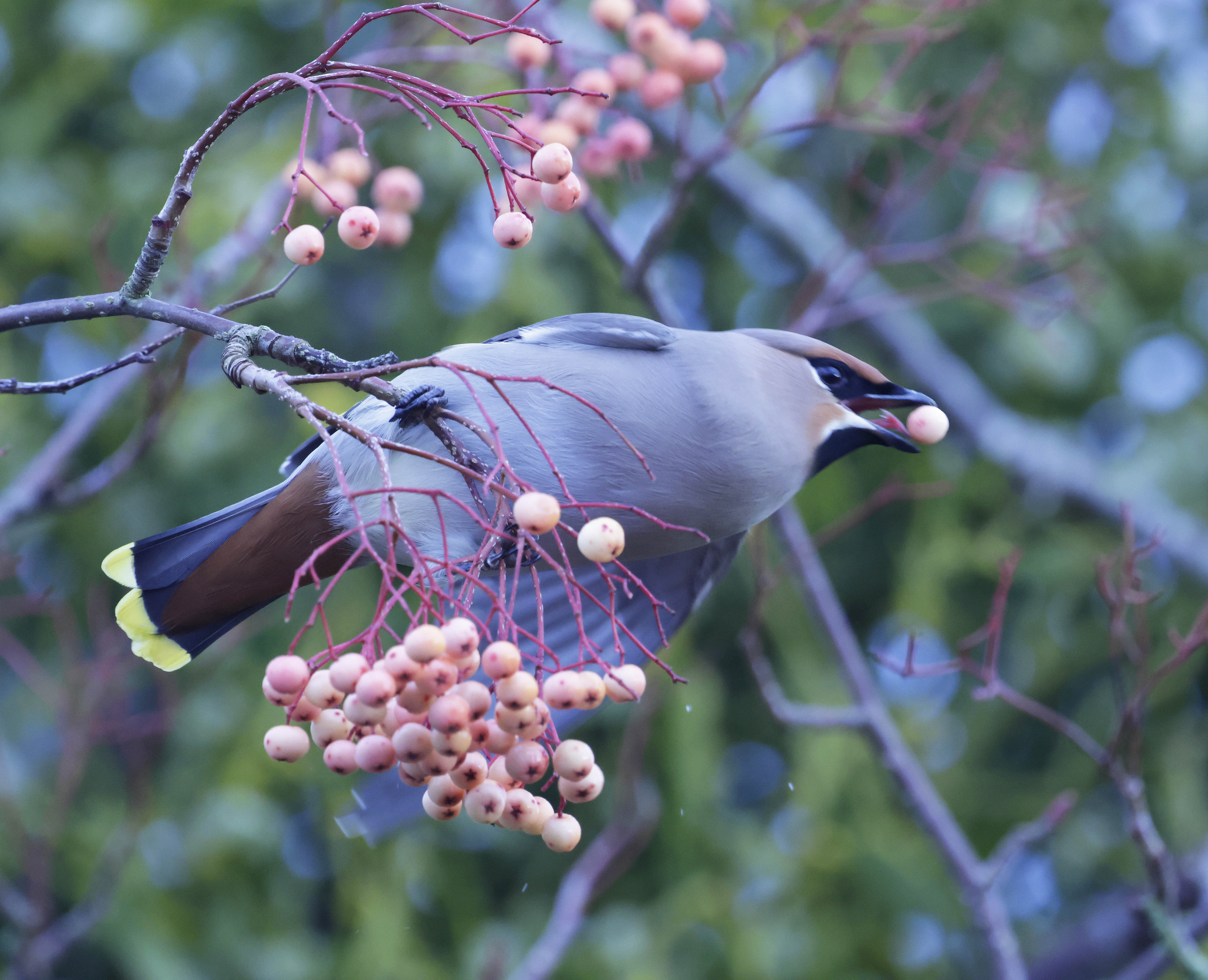
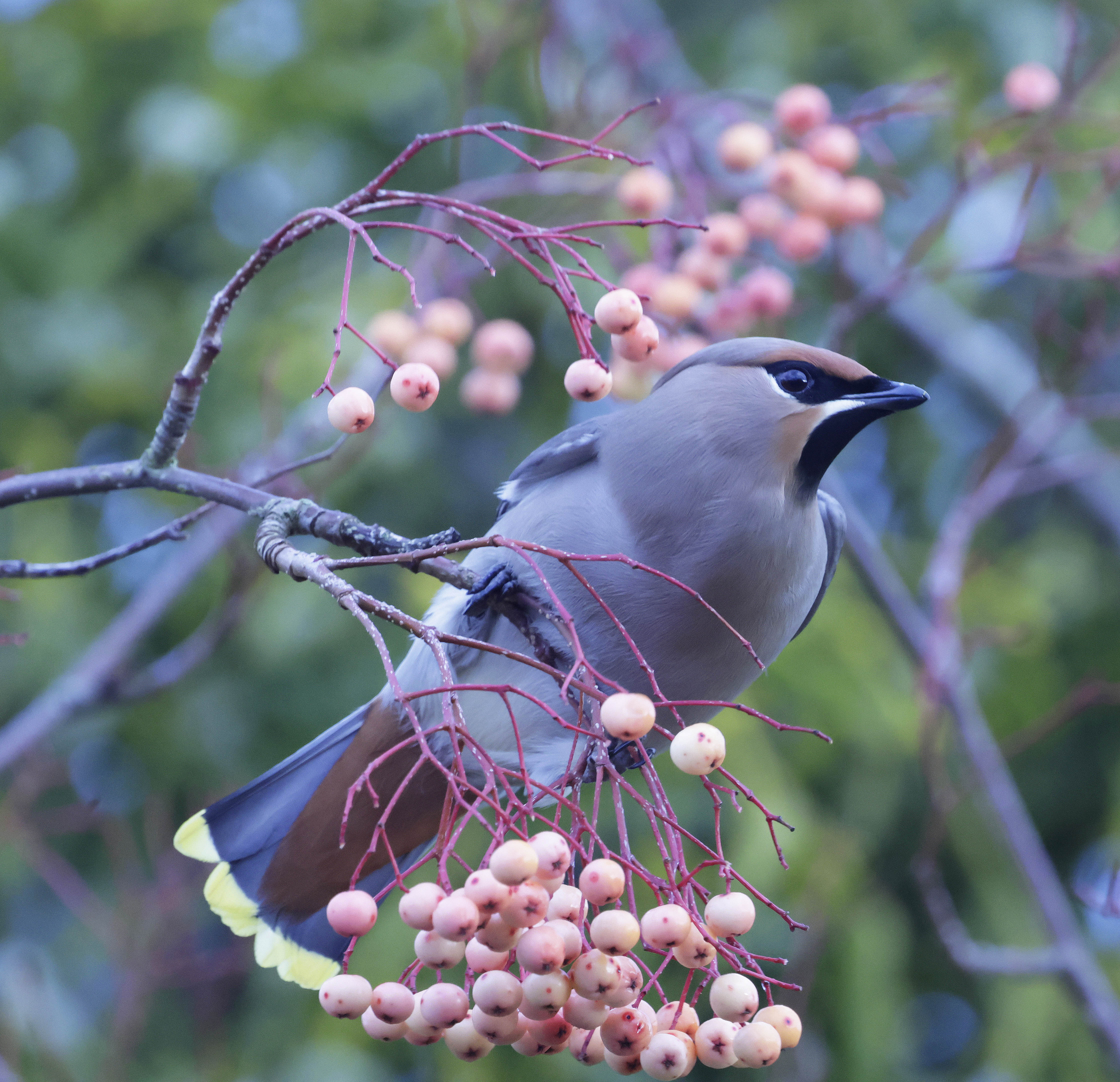
It was only today that I managed to catch up with a group of nine Waxwings that have taken a fancy to some ornamental rowan trees in a small patch of greenery known as Naunton Park in the town of Cheltenham,where they have been present for almost a week, delighting birders, photographers and public alike.

The small park consists of grass and mature trees with a number of flower borders and smaller ornamental trees. Surrounded by housing it is understandably popular with the public who use it for relaxation and dog walking..The Waxwings show no sign of being troubled by the constant passage of humanity, even the dogs fail to trouble them and one can get very close to them at times, even with a dog!


Having returned only yesterday from our usual Christmas and New Year break in Scotland I wasted no time in making a forty minute drive from our home to Naunton Park in Cheltenham.

Crossing a dank and waterlogged Cotswolds on a day which promised alternate cloud and weak spells of sunshine, I encountered only light traffic and duly arrived at Naunton Park at just on nine. I was able to park in a road right next to the park and was surprised to see only two other birders standing near to one of the larger mistletoe festooned trees that guard the perimeter of the park.

Joining them they pointed out a group of fifteen birds perched at the very top of another similarly tall tree.Were there more waxwings now than nine? I discovered that the group consisted of mainly Starlings and in amongst them and not looking dissimilar were four Waxwings rather than the expected nine.

I settled into the accepted routine one adopts with Waxwings, whereby you wait while they perch on high well out of harms way until they decide to descend to gobble berries from the berry tree of their choice. The half dozen trees in question, still well laden with pale orange berries rather than the expected red ones, encircled a crossroads of footpaths. .

For twenty or so minutes the Waxwings perched on their lofty perches. The Starlings departed but the Waxwings remained. It was now surely a formality to see when they would come down to feed but it did not quite work out that way. These were wild birds, unpredictable and not guaranteed to perform as expected. Whilst checking my camera, my attention diverted, they flew off and gave me and my two companions the slip.We had no idea where they had gone but one thing was for certain they were no longer in the park.

This was naturally disappointing, unexpected and concerning but despite checking every large tree in the vicinity there was no sign of them. All I could do was hope they might return and soon.Yesterday there was only one report of them and that said they had flown off at 10am. There were no further reports but that could well have been because no one bothered to report them during the rest of the day. Half an hour later it was not looking good and a creeping doubt began to assert itself.More people arrived and like me stood around, looking rather glum.

It was with some relief that on one of my periodic checks of the large trees I discovered they had returned to perch, typically, again at the very top of the largest tree. 

They remained in the tree for another long period and then one flew lower to a smaller tree.I prepared for action and moved towards the berry trees and in a few minutes the  remaining three joined their bolder companion and then all four flew to the berries.

The quiet, patient vigil for both photographers and birds now descended into a frenzy.The Waxwings modus operandi was to frantically gobble as many berries as possible in as short a time as possible before fleeing back to the sanctuary of their favourite tall tree. We the assembled photographers and birders, it is hard to differentiate these days, became equally frenzied as we endeavoured to make the most of this all too brief window of opportunity and get that clear shot, unencumbered by twigs and branches, of the restless hyperactive birds which were constantly and frustratingly, forever changing position as they sought that particular berry that took their fancy.

It is all over in less than a couple of minutes.The birds fly back to their tall tree while we check the images taken in that frantic minute or two, hoping one or two may be acceptable but often they are not up to scratch so one settles to await the next assault on the berries by the Waxwings.Sometimes it can be a long wait but they will eventually descend.


The four Waxwings having gorged themselves on the berries then spent a very long time sat in a smaller tree right above our heads and seemed in no hurry to revisit and feed on the berries or return to the taller trees.One commenced preening and this proved infectious as soon all four were at it, tweeking flight feathers and digging into soft breast feathers, stretching wings and tails, before they settled to remain quiet but vigilant above us.


I looked to the sky and as I did another five Waxwings flew in to join the original four. So now there were the usual nine.

Where these five had been was anyone's guess, presumably they had found another source of berries but for now they seemed content to rejoin the other four and remain as one flock.

Adam, an Oxonbirder colleague, joined me and we stood and admired the group which then did the decent thing and dropped down onto the berries, precipitating another hectic two minute togging session before the birds flew back up into the smaller tree. 


Now, their behaviour changed and rather than as one flock, only one or two at a time took it in turns to feed, presenting us with ample opportunities to take photos of them.


All nine eventually returned to perch in the large tree and started trilling, a thin sibilant call that often signals the birds impending departure.It went on for a minute and then all the birds flew as a group high and away from the park.They were gone.

A local birder told us they would not be back for an hour as this was what they did yesterday.

Fancy a coffee Adam?

Why not.

We walked down a couple of adjacent streets to arrive on a main thoroughfare where we found a very pleasant cafe which supplied us with coffee for me and tea for Adam.

Suitably refreshed we returned to find the Waxwings had also returned and were being photographed and admired by around twenty people.We joined them and now the birds seemed more hungry and came down to the berries regularly, again never remaining long, a matter of a minute or two but there was a constant 'tooing and froing' of Waxwings, so everyone was happy.


Adam had to return to Oxford so said goodbye and I was on my own again. A couple of Redwings, also from north of our shores but unlike the Waxwings regular winter visitors, commenced visiting the berry trees but always departed when the Waxwings descended.


Waxwings are extremely acrobatic when plucking at the clusters of berries. They cling like feathered baubles to the extremities of the rowans, grasping a berry festooned stem, tilting over or hanging downwards, sometimes overbalancing as they stretch to pull off the berries.


They do not necessarily swallow all the berries while in the berry tree but sometimes will fly with one in their bill, back to the top of the large tree.

Towards lunchtime the flock was now once again back in their favourite tall tree. The trilling started again just before one o' clock and, as before, the birds flew as a flock high and away out of sight over the surrounding roof tops.

I had thoroughly enjoyed my morning and felt fulfilled by my Waxwing encounter. so decided that now was as good a time as any to leave. It is only January after all and Waxwings will be around for at least three months yet.They are still being reported from widespread locations so there is plenty of time to catch up with some more. Maybe Oxfordshire will be blessed with their presence. A few have been seen in the county but have not remained.

I live in hope.