Saturday, 15 April 2023

A Prettywake at Farmoor Reservoir 14th April 2023


Many years ago when our now grown up daughter was but three or four and we lived near the sea in Sussex I would push her in her pram along Seaford seafront to Seaford Head where we would watch the Kittiwakes flying to and from their nest ledges on the chalk face. When I told her the 'seagulls' we were watchng were in fact called Kittiwakes she did not quite master the word and rather charmingly christened them Prettywakes.

That was over twenty five years ago and having lived in Oxfordshire for twenty of those years I know full well that Kittiwakes are a very much scarcer bird in Oxfordshire which is about as far from the sea as it is possible to be.

However this Spring has seen an unprecedented influx of Kittiwakes into Oxfordshire.Not in large numbers but just single individuals with an exception of two together at Port Meadow in Oxford. Grimsbury Reservoir in Banbury seemed to be the hub with up to four different birds occuring there over a period of a week or so. 

Grimsbury is a relatively small waterbody compared to Farmoor Reservoir but this did not deter the Kittiwakes from showing a marked preference to settling there and the two that spent an afternoon on the floods at Port Meadow, only added to the sense of injustice that Farmoor was ignored.

Kittiwakes have occured at Farmoor and the last one I saw was an ailing juvenile last year which sadly expired the day after it arrived but all the Kittiwakes seen in Oxfordshire so far this year appear to have been in good health.

 
Finally, today an adult Kittiwake arrived mid morning at Farmoor and settled itself at the far western side of the larger basin, busily picking flies from the water's surface, not the usual fare for a bird which normally feeds on shrimps and fish. Incidentally this bird was still in its winter plumage as evidenced by the dark smudge on each side of its head and the grey caste on the nape and hindneck. I would have expected it to be in breeding plumage by now so possibly it may not be going to breed this year.

Fortunately it remained for the rest of the day and for the main part decided to keep close to the reservoir's wall where the water was less troubled by the wind.


Kittiwakes are mainly pelagic outside of the breeding season and return to nest in colonies on cliffs and increasingly also on tall buildings where they are often not appreciated and met with netting and other devices, installed to deter them. Yet another sad example of our apparent unwillingness to connect with nature. There is a famous and very well known colony that has adopted the Tyne Bridge as well as The Baltic Centre in Newcastle upon Tyne, despite futile efforts to deter the birds with netting.I should add this has  resulted in not inconsiderable protest from the general public. and appears to have resulted in the netting being removed. .

These single birds in Oxfordshire this year are making their way north to their breeding colonies and may either be storm blown, as lately the winds have been very strong during March and April. They could  equally plausibly be making a short cut across England, saving a longer journey if they followed a course over the sea. I can recall a day or two before my wedding day in April 1987, rather than having a stag do, I went fishing for a day with a friend at Weir Wood Reservoir in Sussex and a sizeable flock of Kittiwakes passed over us heading inland and undoubtedly going north. 

So, finally this year a Kittiwake has graced Farmoor Reservoir, whose waters with white horses and pounding waves, stirred by the almost gale force winds for the last few days, have resembled the North Alantic.

Probably the Kittiwake felt quite at home.


Postscript

Sadly my optimism about the health of the Kittiwake proved unfounded as it was found dead on the reservoir causeway on Saturday afternoon although it had shown little sign of being unwell on Friday. Birds health can deteriorate quite rapidly, as a similar state of affairs occured with the juvenile that arrived at Farmoor last year and like this bird, similarly survived only two days, after seemingly arriving fit and healthy.

Saturday, 8 April 2023

Windflowers on the Downs 8th April 2023

I took a familiar track that curves away into the downland and gently rises through a narrow valley with the promise of more severe gradients further on that will require a greater physical effort to achieve the bow backed tops of the downs.

The exposed earth of the track is suffused with underlying chalk, turning it to a grey marl, that after the recent rain has become soft and cloying.The track has deep ruts on either side of a flat central strip of threadbare grass. Farm machinery has scoured the ruts ever deeper and now they are brimming with opaque, muddy water. 

This rutted passage to higher, drier ground is flanked on each side by hazel trees that have recently been coppiced by an unknown hand, the cut poles lying in neat bundles by the track awaiting collection. The absence of anyone on this particular day but with clear evidence that conservation work is underway serves to accentuate the sense of abandonment and solitude.It comes as a relief to not find anyone here but with ample evidence of their earlier presence I am needlessly fearful I may meet someone to break the spell.

Behind the  coppiced hazels, on steep slopes, hawthorn scrub holds sway, punctuated with the occasional froth of a flowering blackthorn tree, a shock of white amongst the dark bare branches of the hawthorns, hardly yet beginning to turn green.

It is quiet here, although  never truly silent for this is the commencement of springtime  so there is birdsong. A Corn Bunting, as dull in plumage as its surroundings, repeats an unremarkable song at regular intervals, a trickling jingle of notes, like tossing coins in a trouser pocket. A Chiffchaff's metronomic two note song rings out. Stray patches of daffodils have arisen from the marl.They are not truly wild but evidence of discarded cultivated bulbs that have somehow fallen by the wayside and defied the odds to root and throw up their huddle of yellow flowers for a few brief days of defiance before sinking back into anonymity.

After a quarter of a mile the track reaches a more open area as the contours of the downland move asunder, the slope to my left consisting of short  cropped grass, evidence of its earlier occupation by sheep; the slope to my right irregularly stained with dark green stands of juniper bushes in which blackbirds hide and thrillingly but rarely are joined by their montane cousin the Ring Ouzel, resting on its migration from north Africa to northern areas of England and further still.

Passing through a wooden gate, a sign tells me I am on a permissive path. I begin to ascend the scarp face to my left, pitted with the excavations of rabbits, that rises precipatively upwards to a sky of azure blue. Birds are scarce here and require searching out but today there are two female wheatears, bouncing from mossy clumps, flirting their black and white tails.They too are only taking a temporary pause before heading northwards, probably tonight, for it will be cloudless and the moon and stars will be their compass.

Half way up the slope a Red Kite passes close to me at eye level, the kite looking for maybe a dead rabbit to scavenge.Its long forked tail swings as a rudder and steers it away from me and out over the shallow valley to glide along the further side.

I climb a few metres higher in search of a very rare flower,  the purpose of my visit. My legs are wearied from the steep climb and the effort required. Resting  I look upwards to the ground rising before me, feeling slight vertigo on the steep angle of the slope and there, low in the grass, just an inch or two above the sward, is justification for my effort. A Pasque Flower. 


Their other name is windflower as they only grow on limestone grasslands or  exposed windswept chalk such as here.They are only now coming into flower, tradition having it that they come into bloom on Good Friday, reflected in their name which comes from the ancient greek word paschal meaning 'of Passover or Easter'. Each flower is a velvety blue or purple with a bright yellow orb of stamens at its centre, the large flower held on a single, anenome like, furry stem, extending  an inch or two only from a cushion of feathery, grey green leaves.


They are very much endangered and now virtually exclusively found in only five protected places and here is one of those, where, protected in a wire enclosure, they persist every spring, the blooms contriving to thrive on this lonely slope, a reassuring but perilous affirmation of the promise of Spring's rejuvenation.  

I sit with them, almost as a protective friend and feel an inner peace and comfort in their mute company.

The sun shines down as I look out over the valley below me and onwards to the distant folds and contours of the downs while blackbirds, just like those in Edward Thomas's famous poem Adlestrop, sing laconically in the valley below, one close, to be answered by another beyond and then another yet further. A succession of blackbird song fading  into the distance. Lying on the short springy turf and lulled by the  singing birds I drift into sleep.

Waking after a few minutes I am reluctant to leave.I like this place of natural quiet.A place to be alone and unafraid of one's innermost thoughts. I turn once more to the Pasque Flowers, their faces turned to the sun.One more reverential look at their simple beauty and I descend the slope.

I will return next year and we will meet again, both intent on rejuvenation.


Tuesday, 4 April 2023

Two Scarce Heathland Birds 3rd April 2023


At long last a decent spell of weather has arrived. Gone is the interminable rain, grey cloud and blustering cold wind to be replaced by sunshine, blue sky and a gentler airflow. Inevitably one feels a surge of optimism at this change of weather and thus stimulated I made a trip to Greenham Common to look for its two star residents, both scarce, the Dartford Warbler and the Woodlark, with a warm up act of my favourite stonechats for good measure.

It's a drive of around forty five minutes south from my home in Oxfordshire to Greenham Common in the neighbouring county of Berkshire. Not so long ago this whole area was one of high security, razor wire fences and much controversy and conflict, as Greenham Common was formerly a huge air base, housing nuclear missiles and the enormous military aircraft required to transport them.

The famous Greenham Women's Peace Camp where protestors lived for years is now long gone and but a memory while the huge runway used by the aircraft has been transformed by the Berkshire, Buckinghamshire and Oxfordshire Wildlife Trust (BBOWT) back into heathland and today was a mass of yellow flowering gorse that stretched like a carpet of gold into the far distance of what would have been the end of the runway.A truly remarkable transformation from a hostile, malevolent environment into one where nature has reclaimed the land and as a consequence has attracted all sorts of uncommon wildlife, none more so than the aforementioned birds I hoped to encounter.

The former runway

I arrived around ten in the morning and parking near the former control tower now converted into a cafe and visitor centre I left the dog walkers and visitors behind and walked out to find myself alone where the runway used to be, an unmistakeable broad strip that stretches  for over half a mile, flanked on either side by gold and green ramparts of flowering gorse.


It did not take long to encounter the stonechats, the males find you, making themselves all too obvious, perched on the highest twigs, flirting wings and tails and gently chastising your presence before flying to another sentinel twig to continue their protestations.

The female is much less obvious and will soon be incubating eggs, if not already. For now the males are only mildly anxious about my presence but if they had young it would be a different story. 


Today they content themselves by keeping an eye on me from the topmost twigs of saplings that rise like thorny aerials from the carpet of gorse and rank grass under which their nest will be concealed in a depression in the ground.


It was sheltered here, the banks of gorse absorbing what wind there was and leaving pockets of warmth for me to enjoy, such a luxury after the wind and cold of last week at my local patch, Farmoor's bleak reservoir.  I stood for a while imagining the bombers thundering down this strip, maybe right where I stood, engines screaming.Now all that remains is peace and birdsong but still the lesson has not been learned.

I was unsure that where I currently stood was best to look for a Dartford Warbler. It certainly looked the right place. The gorse thick and dense, all golden and spikey green.

The haunting song of a Woodlark came to me distantly, such sweet notes, more a sequence of diffident and melodic cadences than the outpouring cascade of song produced by its larger cousin the Skylark. Then the song came no more. I made a mental note to go and investigate in its general direction, later, after I had tracked down a Dartford Warbler. Still far from certain as to how or where to commence my challenge, I had been told to wait until I heard  one singing as this would betray their location so I opted to stand and wait.

Seconds later my dilemna was abruptly solved as a small, dark brown bird with a slender body and long tail silently flew up from the gorse into a small hawthorn, imminently to break bud but currently no more than a fretwork of bare spiky twigs. It could only be one thing. A Dartford and a male at that! What luck.Without hardly expending time or energy I had one here, right before me, a few metres away.


Its silence was now no longer a concern as its dark form hopped from twig to gorse and then back again.Obviously concerned about my presence, it moved closer, cocked its head and regarded me with eyes encircled with crimson, staring from a grey busby like head and with a bib of white speckles on a throat of deep chestnut, a throat swelling as it quietly churred, giving voice to its anxiety. 


The warbler persisted with a peek a boo cameo performance for a few minutes, hiding in the gorse then making its way though the tangle to emerge and perch more obviously, all the better to check me out.


Back and fore it hopped or flew from twig to twig and finally I managed to achieve  some images without the curse of intervening twigs to ruin my masterpieces. 


It continued its agitated progress through the twigs and I even caught a glimpse of a mate before they descended deep into the gorse and were gone. Five minutes, maybe just a bit more, was all I was granted and even though I remained silent and still for a good half hour they never returned. I like to think they were looking at me, unseen from within their fastness of gorse. 


It was done. I could not wish for more although you always do and why not as such an experience does not usually come so easily or so readily and you know absolutely that  this chance encounter is just that and you will do well to ever repeat it.

So, reluctantly deserting the gorse, I made my way back to where I had heard the Woodlark  which was near the car park and control tower cafe. Eschewing the inevitable confusion of dogs and humanity around the cafe and car park I slipped through a side gate onto an area of rough ground where notices informed I was free to roam at will. It looked ideal for Woodlarks, being open stony ground and short grass amongst a number of small silver birch saplings. 


This was, at a guess, approximately where I had heard the lark earlier but of course it was now silent and doubtless feeding here, quietly and unobtrusively, its brown streaked plumage concealing it against the similar variegated hues of the ground.

Where to look? I scanned with my binoculars and yet again luck was my friend or was it some innate sense of knowing where the lark would likely be? I would like to think the latter but it is of little consequence, the result was I discovered a small crouching bird hesitantly moving over the ground. It was a Woodlark, no doubt the singer that I had heard earlier.

I skirted around, giving it a wide berth and approached from the rear. The lark showed only moderate concern and allowed me to come reasonably close.


Then I took one step too many and it rose into the air and commenced singing its sweet lilting song.

Note the broad wings

Higher it rose, its wings as broad as a skylark's, the better to effortlessly support its circling in the air. Twenty five grammes of feather and fragile bone taking on a vastness of sky, it poured out its  passion. Ever higher it flew, ascending until it was a dark speck against the white billowing clouds and then becoming almost invisible against the blue but forever singing.I strained my neck backwards to stay with it, my ageing body protesting at such an imposition.


The lark continued its circling for a good fifteen minutes, dropping slightly and then rising as if reluctant to leave its airy domain.Finally the singing ceased and its tiny form was conspicuously absent from the sky above. It had landed without notice. I had lost it but then the song came again but this time from ground level. For seconds I was perplexed, unable to locate it and then there it was, closer than the volume of song would suggest, tripping slowly across the ground, singing and feeding as it progressed. I had learnt something new in that its song was delivered both on the ground and on the wing.


This area was obviously its chosen territory although I never saw a mate and I followed at a discrete distance as it alternately traversed the ground, periodically flew up to sing in the sky or, on a couple of occasions, chose to sing from small trees.


Early afternoon and it was done. I had no more energy to tramp the uneven ground but felt refreshed in spirit if not body by my encounters with these special birds that have made a home on Greenham Common.


Please note at breeding time you are instructed to remain on the marked tracks and not venture into the gorse. It is not necessary in order see the birds and provided you are patient and have some knowledge of their behaviour you should be rewarded with good views

This is for the bird's welfare.


Friday, 31 March 2023

Almost Wind in The Willows 31st March 2023

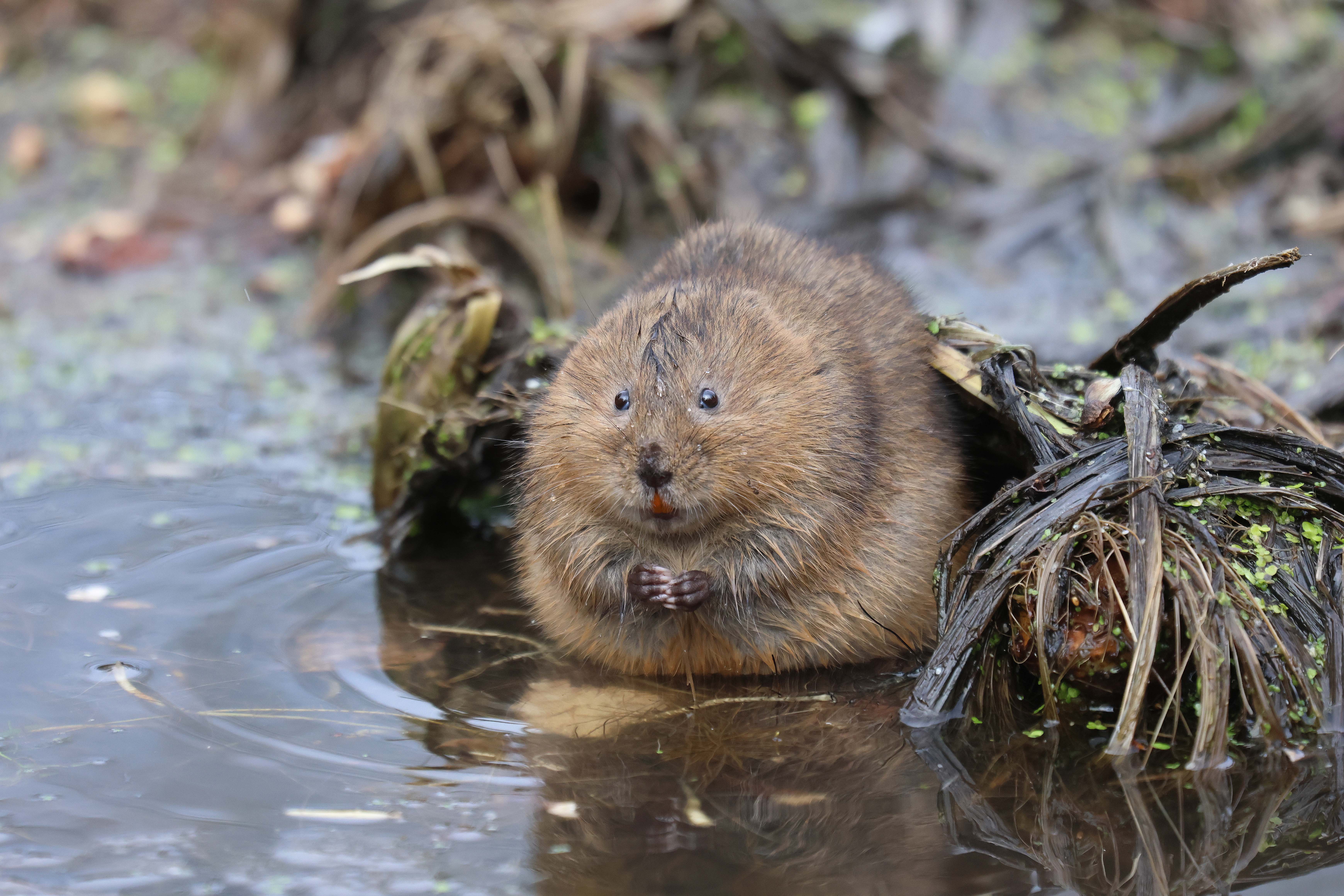
As he sat on the grass and looked across the river, a dark hole in the bank opposite, just above the water's edge, caught his eye, and dreamily he fell to considering what a nice snug dwelling place it would make for an animal with few wants and fond of a bijou riverside residence, above flood level and remote from noise and dust. As he gazed, something bright and small seemed to twinkle down in the heart of it, vanished, then twinkled once more like a tiny star. But it could hardly be a star in such an unlikely siuation and it was too glittering and small for a glow worm.


Then, as he looked, it winked at him, and so declared itself to be an eye; and a small face began gradually to grow up around it, like a frame round a picture

A brown face, with whiskers

A grave round face, with the same twinkle in its eye that had first attracted his notice.

Small neat ears and thick silky hair.

It was the Water Rat!'


With grateful acknowledgment to Kenneth Graham's immortal book The Wind in the Willows

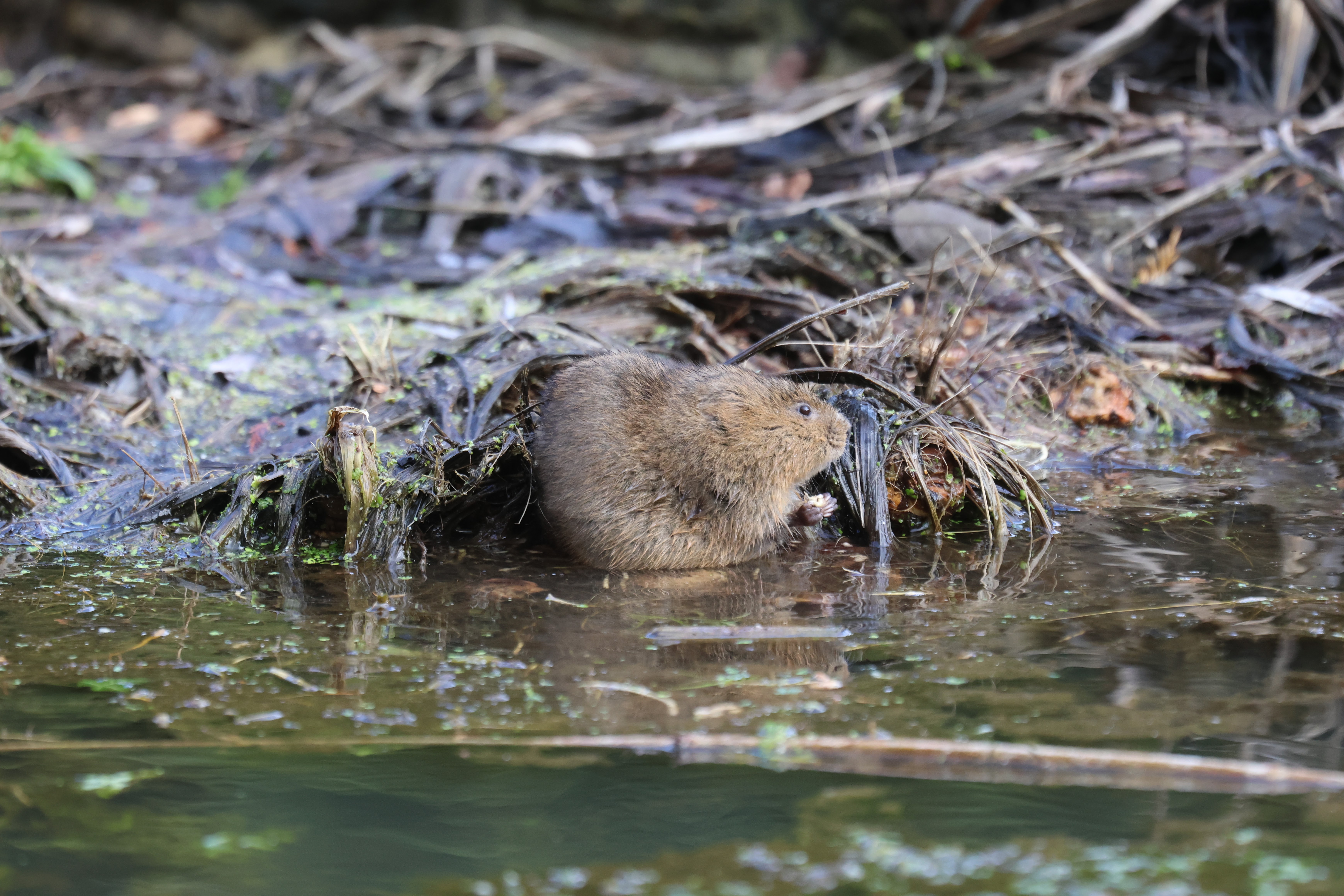
As most people are aware Kenneth Graham's Water Rat was in fact a Water Vole, once a common inhabitant of our streams, ponds and rivers but then decimated by North American Mink, originally released by animal rights protestors from mink fur farms in England and subsequently finding our rivers much to their liking, so much so they increased rapidly  on virtually every waterway in Britain. The Water Vole is Britain's fastest declining mammal and much effort is being made to protect them and their habitat, so far with only partial success.