

Last week, whilst sharing a coffee in the cafe at Farmoor Reservoir with Amanda and Dave, I learnt they had recently had the pleasure of really close views of a drake Garganey at the National Trust's Stowe Gardens in Buckinghamshire. I put it to the back of my mind as there was no opportunity for at least a week to make what would be an hour's car journey to go and see if I could find it, and anyway there were no further reported sightings in the days following. However yesterday, Oxonbirder John F-T posted some nice pictures of the Garganey and added that he had seen it really well.
I sent a text to John and he kindly gave me specific directions, telling me the Garganey came as close as ten feet. That sealed it. I needed no further encouragement and made plans to go to Stowe Gardens this Monday morning, reflecting on how different my surroundings would be from my recent visit to Wolverhampton.
Stowe Gardens comprises of 250 acres of landscaped gardens and 750 acres of woodland and once formed the grounds to Stowe House which dates from around 1571 but following the last owner's bankruptcy in 1922, it has been occupied ever since by Stowe School. To date £25m has been spent on restoring Stowe House and it is Grade 1 listed. The surrounding gardens had also fallen into neglect and they were taken over by the National Trust in 1989 and under their auspices the process of restoration continues to this day.

More relevant to my current birding interest, is the fact there are two large lakes, adjacent to each other, contained in the grounds, these being Octagon Lake and Eleven Acre Lake, either of which the Garganey could be on. John had seen it on Octagon Lake yesterday and he sent me a map showing the precise location.
 |
| Stowe House viewed from across Octagon Lake |
March is traditionally meant to be windy and today did not disappoint as a cold wind swept across the open fields on either side of the wide, tree lined drive. I turned right at the bottom of the drive to walk around Octagon Lake but before I did I checked the lake through my bins.

There was no sign of the Garganey, only a handful of Tufted Ducks and Gadwall, with a lone female Red crested Pochard to add variety. I walked the lake's surrounds, checking the area where John had seen it, stumbling over the uneven grass at the very edge of the lake where dead rushes and sedge lay in a tangle of flattened brown along the lake's margins, just in case it was hiding in there. No luck. Not a sign. A brief rustle in the tangle, a movement of a hidden bird that brought brief hope but it was a Moorhen, that fled to the opposite bank, skittering away from me in a confusion of long green legs and outspread wings, treading the water in its haste, as if fearing to get its toes wet.

 |
| Octagon Lake |
A Chiffchaff broke into song. Perched high, it was a small indistinct protuberance on a twig in the barest of the trees above me. Spring is almost here as evidenced by the singing warbler and so too, the arrival of the Garganey, one of the earliest of our summer migrants to return, often appearing at the end of February but with a peak during March and April. This year the influx has already commenced with another Garganey reported from Sussex today. Garganeys are distributed in summer throughout Europe and western Asia but in winter the entire world population migrate to central and southern Africa, India, Bangladesh and Australasia. In Britain it is a localised and scarce breeding bird in fluctuating numbers. No more than a hundred pairs or less, are found mainly in central, southern and eastern counties of Britain, with a marked concentration in Norfolk and Suffolk. I am pleased to say it has also recently bred in Oxfordshire. Migrant Garganey can turn up anywhere, often remaining in unsuitable breeding habitat for a few days before moving on. The random occurence of this drake at Stowe is typical of the species at this time of year.
I still relish an encounter many years ago, when seawatching one early morning on the Sussex coast, and experiencing the thrill of seeing a small flock of migrating Garganey hurrying up the English Channel in late March. The blue grey wings and head stripes of the males standing out amongst the duller females. A confusion of ducks, they sped past in a matter of seconds, with hardly time to register any detail before they were gone, their destination a mystery, the commencement of their journey thousands of miles to the south in Africa. When they were gone I pondered their route to Sussex. Had they come up the West African coast and then passed across the Bay of Biscay before turning into the English Channel or more likely had they come overland, passing over the Sahara and the Mediterranean in one flight to pass through northern France and on across the English Channel, maybe going to Scandinavia or Russia? The truth, whatever it is pales to insignificance when the reality of such a feat of flight is there before one's eyes. Their detachment, over the sea, from a coastline of which I am so familiar is a metaphor for the gulf between our two existences.
Garganeys rarely spend the winter in Britain although exceptionally they have done so, possibly encouraged by our warming climate. In Oxfordshire a Garganey has spent this winter on a re-constituted gravel pit, slowly moulting into male plumage. The record is a welcome first for the county.
I had walked around the entire lake, maintaining a perilous balance between dry land and waterlogged sedge but there was nothing to indicate the Garganey was here. I followed the path to Eleven Acre Lake and commenced the long walk around its perimeter. Apart from two Mute Swans and another Chiffchaff there was no bird life at the top end of the lake but I could see in the cold distance there was a gathering of Tufted Ducks, Black headed Gulls and some Mallards at the far end. Let's give it a go. You never know, although I had a feeling I knew all too well the predictable outcome. Fearful of missing my footing and sinking in the water that lurked unseen below the reeds and sedge, I gingerly walked the uneven wet banks around the entire lake but again with no positive result.
 |
| Eleven Acre Lake |
I spent some time standing on the bridge, confronting and coming to terms with reality, still ridiculously hoping for a miracle that would cause the Garganey to swim out from some undiscovered hiding place but I knew I had covered all such eventualities. My feet and legs ached from all the walking I had done around both the sizeable lakes, in the case of Octagon Lake twice.
I watched the Canada Geese arguing noisily, disputing nesting rights on the islands in the lake, alien interlopers from across the Atlantic, they have now established their noisy, intrusive and brash presence all over Britain. Much of the public welcome them as part of our natural environment but they are not and I find them annoying and disruptive. They do not fit in and let's face it if we want noise and brashness we have our own feral Greylags to fulfil that role.
Looking around I noticed a Little Egret, lazing away the morning, perched on one leg high up in a conifer on one of the islands, at a distance presenting a passable impression of a wind blown plastic bag caught up in the green fronds of the conifer.
An elderly couple joined me on the bridge. The lady had bins and enquired of me 'Looking for the Garganey?'
'Yes but there is no sign of it' I replied.
'Oh we saw it earlier this morning, it was hunkered down under the bank just over there by that gnarled tree'.
I looked to where she pointed, only some fifty metres away to my right. I wanted the ground to swallow me whole. I was mortified. Call myself a birder. How had I missed it? Needless to say it was not there now. They left me and walked on checking the banks I had covered only recently. I knew they would find nothing but hoped they might.
I chided myself on not being more diligent in searching the far bank of the lake when I first arrived but in fairness, an island was between me and the bank the Garganey had been sheltering under. It was my first time here so I was not familiar with the lakes and I had wrongly assumed the Garganey would prefer hiding in the rushes and sedge along the lake sides, just like all the other Garganeys I had found.
I walked around Octagon Lake - again - for the third time, checking the banks of the two islands in the lake just in case but there was no sign of the Garganey lurking there. I finally convinced myself it was not on Octagon Lake so begrudgingly decided on another tour of Eleven Acre Lake. I set off on the path along the southern side and after covering fifty metres I checked the far bank with my bins.
The Garganey! At last!
I was on the wrong side of the lake and had to double back and take the path on the far side. I ran, praying the duck would remain and eventually I got to the small triangle of sedge. There was no sign of it! A pair of Mallard, anxious about my sudden arrival, swam out from the sedge and then the Garganey flew out but not very far, its bluish grey forewings looking strikingly pale against the dark water of the lake.

It landed by the Mallard pair and began calling, giving vent to its strange, resonating, clicking call, hence the name 'Cricket Teal.' The unlikely trio swam further along the side of the lake, and then came in close to the bank once more. Here was my opportunity to use my camera and I made the most of it. The Garganey did not care as it was too busy trying to woo and ingratiate itself with the female Mallard and even threatened her mate at one point. Slowly they swam further until they joined some more Mallard drakes in an area of still and sheltered water that was crossed by a little wooden walkway leading to a small island.

It landed by the Mallard pair and began calling, giving vent to its strange, resonating, clicking call, hence the name 'Cricket Teal.' The unlikely trio swam further along the side of the lake, and then came in close to the bank once more. Here was my opportunity to use my camera and I made the most of it. The Garganey did not care as it was too busy trying to woo and ingratiate itself with the female Mallard and even threatened her mate at one point. Slowly they swam further until they joined some more Mallard drakes in an area of still and sheltered water that was crossed by a little wooden walkway leading to a small island.

 |
| The Garganey displaying to the Mallard pair |


 |
| The Garganey displaying |


The Garganey started displaying in earnest, rising up in the water and extending its neck and nodding its head. Its ardour made it feisty and again it threatened the Mallard drake, behaviour which became too much to tolerate and caused the Mallard to rush at the Garganey through the water causing it to fly out of harm's way but not very far and to return undaunted. For the most part it was tolerated by the Mallards, viewed probably as a duck smaller than them and therefore of no possible threat, although occasionally troublesome and an annoyance, like a small child needing to be put in its place every so often.


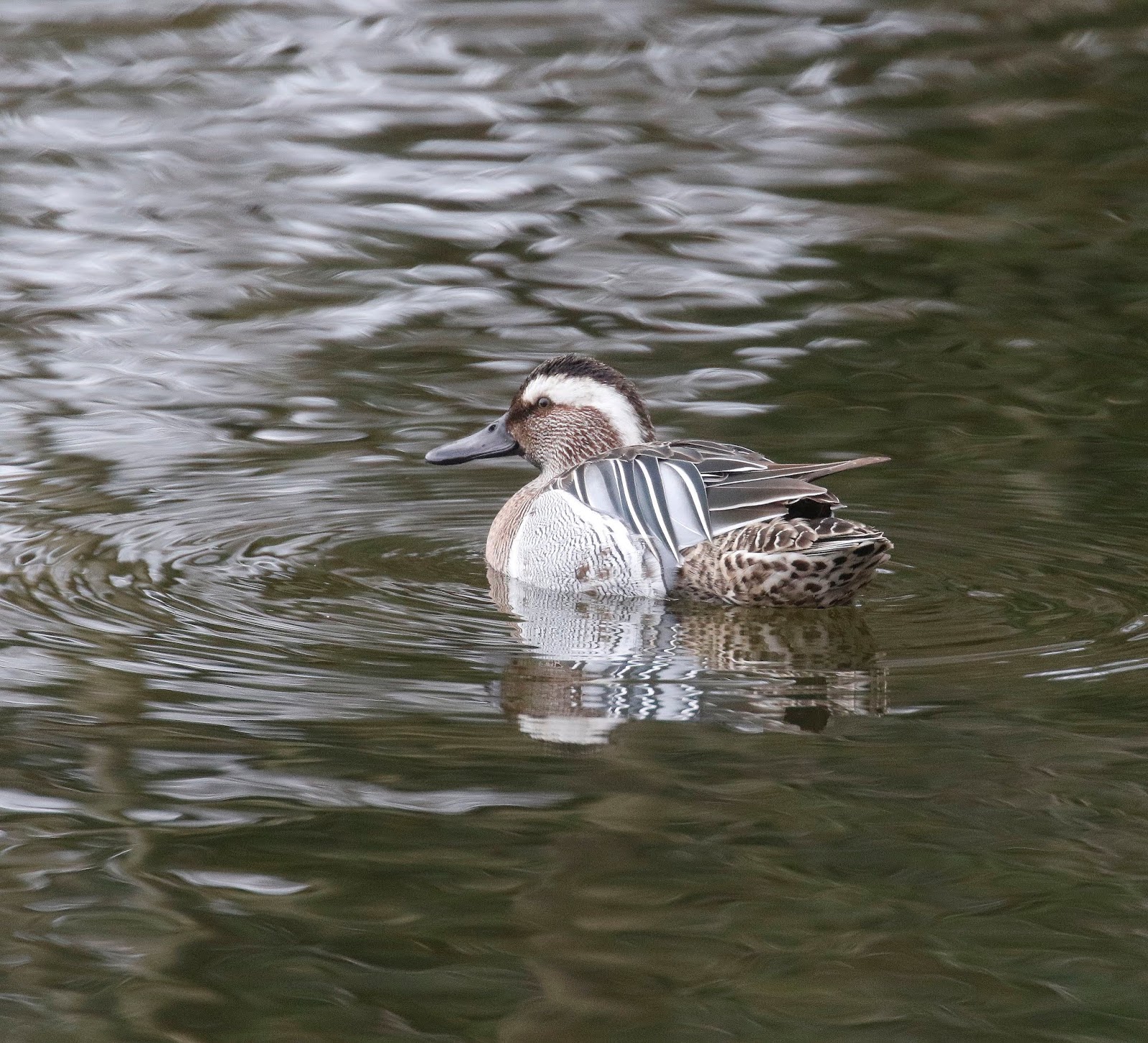
The Mallards loafed around on the still water and for a while the Garganey's ardour cooled and it perched on a submerged branch and commenced to preen extensively and thoroughly, rubbing its head over its body and nibbling at feathers as delicately as was possible with such a blunt instrument as its black bill. I am probably in a minority but I am always fascinated by the contortions and shapes birds adopt when preening or displaying and the Garganey was no exception. It was in virtually full breeding plumage apart from the odd unmoulted winter brown or eclipse feather on its rear flanks and also less noticeably on its fore flanks.


Satisfied with its preening the Garganey took to the water and started displaying, following the Mallards around once more. Another Mallard drake took exception to this pushy little duck, clicking for all its worth and bowing to its mate and chivvied it away.


The Garganey flew out of harm's way in a tight circle, its blue grey wings and similarly pale attenuated scapulars prominent in the dull light. I watched it for over an hour, feeling a grudging admiration for its dedication to such a lost cause. Hopefully it will find a female Garganey that with the genetic programming of her species will comprehend its display and respond accordingly. Even when far out on the lake its clicking calls would indicate where it was, faithfully following whatever pair of Mallard were nearest to it. In fact, to find it, one just had to check the Mallards and sure enough it would be doggedly following one pair or another.


The Garganey flew out of harm's way in a tight circle, its blue grey wings and similarly pale attenuated scapulars prominent in the dull light. I watched it for over an hour, feeling a grudging admiration for its dedication to such a lost cause. Hopefully it will find a female Garganey that with the genetic programming of her species will comprehend its display and respond accordingly. Even when far out on the lake its clicking calls would indicate where it was, faithfully following whatever pair of Mallard were nearest to it. In fact, to find it, one just had to check the Mallards and sure enough it would be doggedly following one pair or another.

The last I saw of it was as it swam with a pair of Mallard towards the far end of the lake, its clicking call proclaiming its presence, its white head stripes and pale flanks distinct against the dark waters of the lake.


