Monday, 5 October 2015

Spurn again! 4th October 2015


Spurn Bird Observatory and the surrounding area, located on the Yorkshire side of the Humber Estuary, hit a purple patch this weekend with reports on Saturday of not only around thirty Yellow browed Warblers being present but with the additional attraction of greater rarities in the form of a Citrine Wagtail, a Pied Wheatear and an Olive backed Pipit.

All very enticing but with the considerable deterrent that it would take a four and a half hour drive to get to Spurn from Oxfordshire. The major attraction for me was the Citrine Wagtail, a species I have never seen but it was being reported as being elusive so it hardly seemed worth the risk to drive all that way on the slim chance of seeing it, despite Gnome managing to see both the Pied Wheatear and the Citrine Wagtail on Saturday whilst driving his daughter back to Durham University. I was truly envious.

So Saturday  found me, instead, patrolling the uninviting concrete expanses of Farmoor Reservoir for another look at the Red necked Grebe and then in the evening attending Badger's surprise birthday party at a Greek Restaurant on the Cowley Road in Oxford.

My birding friend Clackers was also at the party and after a while as the wine flowed and life took on a rosy glow I enquired jokingly of Clackers and with no little bravado, if he was interested in going to Spurn on Sunday. I fully expected he would say no but the answer was in the affirmative. 'Really?' 'Yes why not' he replied. Andy, sitting next to me told me that access to where the Citrine Wagtail and Pied Wheatear were, at a place called Middle Camp, was banned on Sunday up until 1pm due to dangerously high tides. 'That's no problem' I glibly announced, 'If we leave at 9am we will not get there until after 1pm anyway'.
It was settled. Well almost. As we spilled out of the restaurant into the cosmopolitan delights of the Cowley Road I told Keith I would call him tomorrow around eight am with a definite yes or no about going to Spurn.
I rolled over in bed on a misty and still Sunday morning. It was eight. I groaned. I would like to say the spirit was willing and the flesh was weak but in fact neither was very enthusiastic at that precise moment  about a drive to Hull and beyond. I mused that just one different letter replacing the U in Hull would be more appropriate to my feelings about that distant city at this precise moment. Slowly however as the blood flowed and I stretched my limbs the competitive drive returned. A cup of tea, some toast and, 'Right, let's ring Clackers'. 'You still keen to go to Spurn Keith?'  'Sure am'. 'OK I will be at yours at 9am'.
Keith was ready and waiting as always, boarded the Audi in quick time and we were off. Up the M40, across country to the M1 and then ever northwards. Today was one of those welcome autumn days of sunshine and no wind. Tomorrow it was forecast to change very much for the worse so this really was our one and only opportunity.
It's a long and tedious journey to Spurn but we whiled away the miles chatting constantly about an eclectic mix of subjects and swapping anecdotes, ranging from Keith's experiences dealing with  celebrities promoting their books, (Keith worked for Blackwells in Oxford for more years than I can recall), past birding experiences, how wealthy the various Oxford Colleges really are and why they are so rich, to more mundane issues such as what is defined as 'The North' in England, have they cleared the viewing areas at our local Dix Pit, gossiping about various birding acquaintances, what really were our chances of seeing the Citrine Wagtail and why are the Motorways of Britain seemingly constantly being dug up by an invisible workforce. I said to Keith this was probably our most risky twitch yet but over the years I had never failed to see my target bird at Spurn. I thought as I spoke the words that  I had administered the proverbial kiss of death but honestly I have never failed there and have seen some very rare birds indeed, namely, Rufous tailed Rock Thrush, Great Snipe, Masked Shrike. Black Stork and Ivory Gull.

Clackers checked RBA on my phone and it told us the Citrine Wagtail was still present so our gamble appeared to be paying dividends but we were still cautious as a lot could happen in the ensuing time it would take to get there. Sadly it was reported there was no sign of the Pied Wheatear or Olive backed Pipit from yesterday but it was the Citrine Wagtail we desired most.
The dulcet tones of Marge the Satnav femme fatale guided us on to the M18 and then the M62. Fifty six miles to Hull or as Marge pronounced it HI ELL. She was probably right! The Humber was in full high tidal flow, its sun illuminated waters sparkling as we passed around a quiescent Sunday morning Hull. We traversed the eastern outskirts unscathed in mind or body and soon were back in rural surrounds as we took the interminably winding country road, complete with obligatory slow car towing a caravan, out through the wide expanses of flat farm fields towards Kilnsea and Spurn Bird Observatory,
The landscape now was one of vast, flat, pale brown fields ploughed and rolled, ready for sowing the winter wheat. By the side of the road those stalwarts of the hedgerow, hawthorn, elder and field maple, were now  turning various shades of yellow and orange. Soon enough the wind and rain will strip their leaves and then the winter thrushes will come and strip the berries. 
We approached Kilnsea and drew to a stop along the grass verge by the road just beyond the Crown and Anchor Pub. There were birders everywhere either peering intently up into trees, chatting or just walking along. We left the Audi in a long line of cars, parked precariously on the wide grass verge. Where to start? After such a long drive it is difficult for the first few minutes to concentrate and set an agenda. Our priority was the Citrine Wagtail as neither of us had seen one in Britain but where would we go to find it? Obviously it would not be here in the trees. We spoke to a passing birder who kindly directed us to drive further up the road and then to turn right at the end by the Bluebell CafĂ© and go to the Canal Scrape further down the road leading to the Bird Observatory. We got back in the car and drove the short distance to where the scrape was located. The small car park there was full so we joined another verge hugging line of parked cars along the narrow road.

The road from Kilnsea to the Bird Observatory

Foresaking our scopes we went with bins and camera, expecting to embark on a long vigil awaiting the arrival of the wagtail  and with some trepidation entered the Hide overlooking Canal Scrape. I expected the Hide to be filled to bursting with birders, judging by all the cars outside but was pleasantly surprised to find it only relatively full but not crammed solid. You could swing a cat if you had a mind to and if one was available. We sought the left hand corner and Keith  enquired in a whisper to a seated lady birder if there had been any signs of the Citrine Wagtail.
She replied 'Yes it's just there on the grass' and pointed through the viewing slat. Astonished we looked, we saw and we marvelled. Just a few metres away was a lifer for me and possibly for Keith too. A Citrine Wagtail in all its pale grey and white loveliness. I always wondered if I ever found one myself would I be able to tell it from a juvenile or first winter Pied or White Wagtail. Here was the answer. A resounding YES. It was so different. A suite of diagnostic features were all too obvious, starting with a noticeably broad white supercilium curling right round the ear coverts, two wide white wing bars on each wing and prominently white fringed tertials that shone in the sun and a broken necklace of black passing around its white throat. It was about the same size as its commoner cousins and for a wagtail had a shortish tail, with white outer tail feathers. At first it was running around gobbling up insects from the short grass and reed stubble as fast as possible but then stopped for an extended preen and some wing stretching, before it uttered a diagnostic buzzy chizzick, somewhat different to the more melodious note of a Pied Wagtail and flew to virtually underneath the hide's viewing slats to give point blank views. One joker said it was showing close enough to sign autographs!


We watched it avidly, hardly believing what had happened, indeed what was happening. To see it instantly, so close and without the expected anxiety riddled long vigil waiting for it to turn up was just incredible. I took many images with my camera and new lens and we just enjoyed the wagtail, constantly, actively, running after insects, back and fore in front of us. Half an hour passed in no time at all. Keith in the mean time also spotted a female Common Redstart in the hawthorn bushes at the far side of the scrape and then a volunteer warden stationed in the hide and in radio communication with colleagues announced that a Little Bunting had been trapped and ringed at the Bird Observatory just two hundred metres up the road and would be released in fifteen minutes and if anyone wanted to see it they should get up there as quickly as possible.


First winter Citrine Wagtail
He also mentioned that an Arctic Warbler had been trapped, ringed and released earlier in the morning at Church Field which is a small tree fringed area belonging to Yorkshire Wildlife Trust near to the Crown and Anchor pub. This was back where we originally stopped on first arriving.
We were in two minds. Both of us reluctant to leave the Citrine Wagtail parading before us but in the end our resolve weakened and we left the Hide deciding on the two hundred metre walk to the Bird Observatory to see a virtually guaranteed Little Bunting. I could see a long line of birders assembled on the skyline at the Observatory awaiting the bunting's release and prayed that both Keith and myself got there in time. We did and joined a throng of around eighty to a hundred birders. The warden appeared with the bunting and everyone crowded round, pressing forward and almost forming a circle around the warden.


This was when I began to have my doubts about what was happening. I too have been a bird ringer, for almost fifty years, and resigned some two years ago but I was a little unsure about the wisdom of inviting one and all to witness the bunting in the hand and its subsequent release. A few people was fine but not a crowd of almost a hundred. I understand that everyone wants to see a Little Bunting but does it need to be surrounded by almost a hundred birders and shown in the hand for at least ten to fifteen minutes? The bird's welfare is paramount and I just thought this was a little too much and it made me uneasy. However I joined the throng and had a good look at the bunting so really cannot complain too much. The warden walked around the encircling, excited birders so everyone got a close view and then eventually released the bunting which flew off strongly, so all was well in the end I suppose.


The Little Bunting before release
A sense of denouement now came over us as we had seen the Citrine Wagtail and had the bonus of a close up view of a Little Bunting, all in the space of an hour or so since we arrived. Birders, just like us wandered back down the road, discussing the day's events and what to do next.

Eee! It were reet grand!
'What do you fancy next Clackers?' 'It's entirely up to you old boy' he replied. 'Well we could go and have some more Citrine action in the Hide or we can go and look for the Arctic Warbler.' We decided on the latter as we  would probably have a good chance of finding some Yellow browed Warblers as well.  This would be a good test of our observational skills, as we had to first locate the Arctic Warbler and then identify it, the kind of birding challenge I like.

The Arctic Warbler had been trapped and released at a place called Kew Villa near to the Crown and Anchor pub. The tiny Kilnsea churchyard, the adjacent Kew Villa and Church Field both owned by Yorkshire Wildlife Trust and the Crown and Anchor car park, comprise the only area of mature trees for miles around and are a magnet for warblers especially the smaller ones colloquially called 'leaf warblers'. We first tried the churchyard, standing quietly on the path between the graves, in the sunshine and surveying the encompassing mature trees for the slightest movement. 

Kilnsea Church and graveyard
Dark silhouettes flitted through the tree branches, enigmatic and frustratingly hard to pick out but eventually we got our eye in and it became slightly easier. This was more like proper birding, testing our skills of both observation and identification as the mercurial shapes flickered in rapid, endless movement amongst the leaves. Keith espied a leaf warbler with a huge supercilium but it was gone in an instant amongst the foliage. It could have been the Arctic Warbler but no one else saw it. We waited patiently and quietly and other shapes revealed themselves to be Common Chiffchaffs and Goldcrests. Finally a tiny form, little bigger than a Goldcrest perched high up on the edge of a clump of sycamore leaves. It was a Yellow browed Warbler. Our first of the day. A vision of loveliness with its distinctive yellow supercilium and yellow double wing bars. A tiny sought after jewel of a bird amongst a sea of leaves. Truly a leaf warbler.  A few seconds view and it was gone, impossibly active, constantly seeking insects in the leaves. More Goldcrests and Chiffchaffs came and went, then another Yellow browed called from the trees and briefly showed itself at the top of an elm. Five Redwing flew over, their melancholy, breathy thin contact calls announcing their identity. Song Thrushes, also possibly migrants, hid lower in the bushes under the trees. Sadly, although we waited here for an hour there was no further hint of the presence of an Arctic Warbler and so we gave it up.

Clackers suggested we check out the trees a few metres further along surrounding the pub car park as there were quite a lot of birders there looking up at the trees. 'Any sign of the Arctic?' we enquired of one of the birders. 'Nah, just Yellow broweds and Chiffies' and at that very moment a Yellow browed Warbler did indeed show itself very well. Lines of pale yellow on mossy green upperparts, pale off white underparts, impressions of patterns and colour and then it was gone. We stood and waited, testing our skills at picking out the fluttering shapes that were not leaves moving in the gentle breeze. I scanned to my left and saw a small warbler in an Elder. It came to the top and was revealed to be yet another Yellow browed Warbler. Clackers got onto it and just as he did I noticed another small warbler appearing at the edge of the  Elder bush. It came further out. I alerted Clackers. He said quietly, 'That's it, isn't it?' 'Yep' was all I could say and there it was, the Arctic Warbler, its diagnostic long white supercilium, single wing bar, pale legs and bulkier body all too apparent. It was only on view for seconds before it flew into some elms never to be seen again. Clackers saw it briefly as did one other birder next to us but that was it. Word got out and the car park filled as other birders came to look. 

The Crown and Anchor car park with attendant birders
Other Yellow browed Warblers and Common Chiffchaffs  came and went in about equal numbers  but we never saw the Arctic Warbler again although it was seen nearby later that afternoon . A Great Spotted Woodpecker that landed on one of the trees created a bit of a stir as, with the acute lack of trees, they are something of a rarity here and therefore this individual was considered a  migrant.

We decided that we would leave  the other birders still hopefully scanning the trees and returned to the Hide overlooking Canal Scrape for one last look at the Citrine Wagtail, which by now had moved to the far side of the scrape and was not giving such close views. Shortly after our arrival it called loudly, flew up and then over the Hide and was gone. A Little Grebe chased fish in the shallows, the roiling water betraying its underwater progress and a single male Wigeon swam with some Mallards off the far bank of the scrape. 
Little Grebe
A Jack Snipe emerged from the reeds left of the Hide, standing quite still and then commenced its  unique bobbing action before retreating back into the reeds. The female Common Redstart was still feeding in the hawthorns on the far side of the scrape and two Tree Sparrows perched at the top of one of the windblown hawthorn bushes. A little later a small, pale warbler appeared in the same bushes and checking through the scope was identified as yet another Yellow browed Warbler. They seemed to be everywhere and estimates ranged from thirty upwards being present today in the general area. We estimated that we alone saw between twelve to fifteen. The sun was by now ever so gently declining, casting a golden pre-evening glow over the land as yet another Jack Snipe emerged from the reeds, this time on the far side of the scrape, its marvellous cryptic plumage only betrayed by its constant bobbing as it probed the mud.

It was time. We felt we had been here for much longer than the incredible four hours that was the reality. We stopped at the Crown and Anchor for a celebratory drink, a large red wine for the Clackmeister and a weak lager shandy for me - well I had to drive so it seemed sensible! I promised myself a large, very large malt whisky when I got home but that was  a distant four to five hours away. The birds I had seen on this incredible afternoon would sustain me on the long drive home along with the odd Red Bull!

Saturday, 3 October 2015

Costa del Farmoor 1st October 2015


It was a gorgeous afternoon. This late burst of sunshine and warm temperatures was just too inviting to resist so I left my desk, abandoning all cares, and headed out into the sun and warmth of an Oxfordshire afternoon.
 
My destination was Farmoor Reservoir for a couple of hours, to get both some fresh air and exercise. As I readily admit, Farmoor is only attractive to me if there is actually something to see there. Usually there is very little but today a Red necked Grebe was spending its second day there.
 
 
Quite remarkable as up until a couple of years ago a Red necked Grebe was rare in Oxfordshire but Farmoor seems to have become, for no reason I can fathom, singularly attractive to this particular species of grebe. Maybe it is the same bird appearing on both  its spring and autumn migration, birds are creatures of habit after all, but there was another, a juvenile which stayed here for just one day earlier this autumn so who knows how many are involved? Coincidentally there have been up to three together  at The Cotswold Water Park this autumn which as the grebe flies is just 'down the road' in the adjacent county of Gloucestershire.
 
The car park at Farmoor was relatively free of cars on my arrival signifying that the yachting and windsurfing fraternity were not out in force yet which was good news if one is looking for a water borne grebe. I walked up the familiar grassy bank to the concrete path surrounding the two reservoirs. A modest south west wind was blowing off the water, enough to persuade most of the waterbirds to seek the sheltered areas where the water was untroubled by the wind. The rest of the reservoir was an expanse of choppy, blue water being crossed by the occasional sailing dinghy and windsurfer.
 
I walked along the southern side of the bigger reservoir, known as Farmoor Two which is where Gnome had reported the grebe at around lunchtime. There were two distinct groups of birds feeding in the sheltered waters close in to the concrete wall and I felt confident the grebe would be in amongst one of these.
 
Out of the wind it was warm, hot even and I removed my fleece. The first group of birds I came to were mainly Coot with the odd pair of Mallard amongst them. Most remarkable of all were the number of Little Grebes close by and forming their own distinct group. Tiny, non descript brown, rotund balls of feathers with small heads and fluffy rear ends they sunned themselves on the sparkling blue water. I counted fourteen in all and one was even still in breeding plumage, its rich chestnut head and neck glistening wet from a recent dive into the murky depths. But there was no Red necked Grebe. Further along another group of loafing Great Crested Grebes held out further hope. I walked along the pathway to get opposite them as an unseen Chiffchaff called plaintively and anxiously from the bushes as I passed by.
 
I got to the larger grebes. They were mostly asleep, doing that peculiar thing grebes do when they are whiling away the time doing nothing, which is not to put their bill under their back feathers but to contort their sinuous necks into a bend so that their bill is snuggled down into their breast feathers. To me, in this position they always remind me of a sulky child pouting after a telling off. I checked each one but they were all Great Crested Grebes, one though, still retained the stripey cheeks of juvenile plumage. Not a trace here of the Red necked Grebe.
 
Disappointment then caused me to pause for a moment of consideration and rumination. I sat on a bench, warm in the sun and it was far from unpleasant. I knew it was unlikely that the Red necked Grebe could have left even though the reservoir was becoming increasingly populated by waterborne traffic in the form of wind surfers, sailing dinghies and fishermen. I was now confronted, if I wanted to locate the grebe, with the unenviable choice of walking around the full two mile circumference of the huge Farmoor Two reservoir, remaining on the sunny bench or beating a retreat for home. However this had become personal so I was not about to give in. Rationalising, I told myself the weather was glorious, not a cloud in the sky and the exercise would do me good if I walked round the reservoir. I set off back the way I had come and soon turned onto the central causeway which divides the larger reservoir from the smaller Farmoor One.
 
Irrepressibly cheery Pied Wagtails flew from my presence and up the causeway before diving over the wall, down onto the concrete apron and the water's edge. Their plumages are so variable, apart from the males, and it is sometimes impossible to sex them or determine their age. Not that they care. I regularly checked the concrete aprons below the causeway wall on both sides. It's always wise to do this as often a wader will be feeding here by the water's edge and sure enough there was a juvenile Dunlin, almost fully moulted into its drab grey winter plumage pottering along amongst the goose turds and feather detritus that is such a feature of the reservoir at this time of year. As is often the case it was ridiculously confiding and allowed a very close approach, looking up at me questioningly before continuing to feed by picking at invisible morsels along the slimy shoreline. I looked up and the sun glitter from the water created a temporary white out of my sight until I turned to look away.


The Dunlin flew a little way further  to land amongst a huge flock of mainly Greylag Geese  sunning themselves on the windless concrete apron. The very picture of indolence they squatted, wings akimbo on the hot concrete but as always greeting me with a cacophony of harsh, grating calls of complaint at my disturbing their reverie, as I passed along the causeway. With nothing else to look at I sought some form of amusement by counting how many geese there were. They stretched for virtually the whole length of the causeway and when I finally came to the end of this garrulous assembly I had reached a figure of five hundred and twenty one.
 
Nothing else of much note was to trouble me apart from a female Shoveler that swam out from the shore. She has been here for some while so it was not a surprise to see her again. 

Reaching the end of the causeway I turned despondently to survey the circumference of concrete I needed to cover to complete a circuit of the reservoir. The walk as always was mind numbingly tedious with hardly a bird to look at apart from the odd Tufted Duck and Great Crested Grebe. I doggedly carried on and eventually came to where I had been  looking at the group of Great Crested Grebes earlier. Another check confirmed there was indeed no sign of a Red necked Grebe amongst them. I moved on to the flock of Coots still idly upending for weed in the shallows with the Little Grebes now actively diving amongst them. But what was this? A grebe, in between the size of a Little Grebe and a Great crested Grebe. It was indeed the errant Red necked Grebe, now visible as large as life. Where had it been? So pleased was I to see it I forgot that I had walked two unnecessary miles only to finish up where I had started!  There was no point in bemoaning my fate. It was over and done with but I at least had the satisfaction of at last finding the elusive grebe.


Its winter plumage only hints at the glories of its breeding plumage and there is only a subdued impression of the red neck. The only strong feature was the straw yellow base to the bill. I watched it diving and feeding amongst the strangely benign Coot and nervy Little Grebes. One of the latter surfaced nearby with a stickleback in its bill and the Red necked Grebe lowered its head and torpedoed towards it. 
 

The Little Grebe seeing what was coming crash dived to be instantly followed by the Red necked Grebe. They surfaced well apart, with now no sign of the stickleback and the grebes distanced themselves further.  The Red necked Grebe set off for the centre of the reservoir and the last I saw of it was dodging a windsurfer far out on the blue waters of the reservoir on what had become not such a bad afternoon after all.
 
 
A Grey Wagtail, its citrone yellow rear glowing in the sun and with movements of supreme elegance danced its way along the reservoir edge as I walked back.
 

Thursday, 24 September 2015

It does not get better than this! 22nd September 2015

Acadian Flycatcher c Steve Nuttall
In 'fast lane birding' it does not often happen that everything coincides to bring about a beneficial outcome but today it certainly did. Allow me to take you back to the previous evening when felloe Oxonbirder Peter sent me a text asking if I would like to accompany him to Essex on Tuesday to see a Wilson's Phalarope, a rare wader from North America. After some thought I replied in the affirmative and we agreed to meet at his home in Garsington, near Oxford  at just after nine on Tuesday morning.

Tuesday morning duly arrived and was depressingly wet, grey and looking singularly unpromising, and frankly my enthusiasm for heading to distant Essex was fading fast, but after a quick phone call I arranged to meet Peter at the later time of ten thirty in the hope the rain would have passed by then. 

I completed the drive to Peter's home in a relaxed state of mind, stopping at Rectory Farm Shop in Beckley to buy the last of the autumn fruit before they closed for the winter. Then it was down to nearby Wheatley to fill up with fuel for the journey to Essex, managing to avoid no less than two police speed traps en route. Have they nothing better to do? 

I parked outside Peter's home at just after ten and went to knock on his door but just as I was walking to his door my phone rang. It was not the usual call involving work matters but a call from Chris, a Sussex birding colleague. 

'Hi Chris, how's it going?'  

'Good thanks. Where are you?' he enquired.  

I could detect an excited tone in his voice. 

'Oxford, just setting out for Essex to see a Wilson's Phalarope.' 

'Forget that'. he replied. 

'Get down to Dungeness as soon as you can, there is a first for Britain'. 

'There is? What is it?' I enquired anxiously  

'Don't know, nor does anyone else. It's one of those Empidonax flycatchers from the USA but no one can specifically identify it!' 

'Are you going for it Chris?' 

'Not straight away. I can't get away from work until this afternoon but will get there as soon as I can.' 

'OK. Good luck, maybe we will see you there.'  

And with that we parted.

Empidonax flycatchers are a group of nondescript flycatchers from the USA that are notoriously hard to separate as they all look so similar and the  jury was obviously out on the bird at Dungeness. I have seen one species of Empidonax flycatcher in Britain and that was an Alder Flycatcher in the Nanjizal Valley, near  Land's End, Cornwall  in October 2008, coincidentally in the company of Chris. 

This particular individual was thought to have been caught up in a fast moving Atlantic weather system and blown across the Atlantic to find landfall at a bleak, wet and windy Dungeness on the Kent coast. Not quite the ideal substitute for its normal winter home in South America and The Caribbean.

With the news from Chris my relaxed frame of mind dissolved in an instant and any ideas of going to Essex to see a bird that I had seen on multiple occasions before in Britain were unceremoniously consigned to oblivion. The adrenalin was flowing fast and free as I knocked on Peter's door in some excitement. The door opened and before he could say a word I blurted, 

'Forget the Wilson's Pete we are going to 'Dunge' to see a potential first for the Britain'. 

'We are?'  

'Yes we most certainly are. Now get a move on dear boy there is no time to waste. The Black Audi awaits'.

A few minutes later I was enlightening Peter about the events that were at this very moment occuring in far off Kent as we threaded our way down rainswept Oxfordshire country roads to turn onto an M40 Motorway that was so wet in the pouring rain you could barely see the fast moving cars and lorries ahead as they chucked out huge volumes of water. Visibility diminished alarmingly. Of all days why had this one to be so wet when we needed to get to Dungeness as soon as possible? Like many other drivers I decided that the maelstrom of spray from all the vehicles made ordinary rear lights inadequate, so put on my rear fog lights just in case anyone had a mind to drive into the back of us and the wipers were engaged at double speed to cope with the mini tsunami hitting the windscreen.

We headed southeast and conditions got no better. So much for the rain passing. Rain, rain and yet more rain hit us in varying volumes and strength. I was concentrating hard whilst driving at as fast a speed as safely possible in the horrible conditions. Peter indulged in playful banter 

'So this is what twitching is all about.' 

'Yes Peter, now how about getting a post code from Andy and sorting out the Satnav?' 

Both Chris and Andy were sending regular texts to us as we progressed. Chris updating us on the varying opinions of just what species the flycatcher was whilst Andy got us our post code and also updated us about the flycatcher's identity and the fact that sensational close up pictures of it were already on the internet. I gave Peter a brief tutorial on how to use my I-phone to keep in touch with Andy and also to get updates from my RBA app on the status of the flycatcher and specific directions as to where exactly it was at Dungeness. 

We were all set and now all that needed to be done was to get there as quickly as possible in the foul conditions.The Satnav estimated around one o' clock in the afternoon. Two and a half hours driving.

I excitedly regaled Peter that this is the ultimate in twitching, the buzz, the risk, the anticipation, the sheer unadulterated thrill of adventure and the possibility of seeing a rare and desirable bird was ours for the taking with, of course the added spice that it was by no means certain we would see it. We were making a long haul speculative dash to see a bird that was not just rare but ultra rare, a first for Britain. 

It does not get better than this Peter, believe me! 

I had become energised in a way that was startling and possibly disconcerting to Peter. I tried to keep calm and controlled but sheer exuberance sometimes got the better of me. Peter remained sanguine and counteracted my wild excursions into over excitement with dry humour. You could say our very different personalities cancelled the excesses on both our parts.  

We hurtled onward in the incessant rain, leaving the M40 and joining the living nightmare of the M25, negotiating the customary four lane semi gridlock of cars around Heathrow and then busied our way down the three lane concrete highway of hell towards Kent. We swept down the long hill past Reigate and then, later, traversed the M20 as Maidstone came and went in clouds of spray, blurring white and red car lights and continuous rain. The wheels hummed and the wipers beat a continued tattoo as the rain splattered on the windscreen but we had a clear run. At last, near Ashford we turned off the Motorway and took to  smaller, less busy roads leading us towards our ultimate destination. We crossed the bleak, rain sodden fields of Romney Marsh, turned left at Lydd and drove down the long straight road to Dungeness, The ramshackle profiles of a line of houses on the seashore skyline indicated we had reached the end of land and crossing the narrow gauge rails of the ninety year old, world famous Romney, Hythe and Dymchurch Railway, we followed the narrow metalled road across Dungeness Point, one of Europe's largest expanses of shingle, with its random miscellany of forlorn shed like homes, two lighthouses, discarded machinery, small boats drawn up on the shingle by the sea and general air of neglect.

It had almost stopped raining.

The atmosphere of abandonment and wildness at Dungeness is unique, despite the looming monumental presence of the huge nuclear reactor and power station. The scattered wooden dwellings, the acres of bare shingle and gorse, the huge skies and ever present sense of the sea nearby, contribute to an almost other worldly feel to the place, enhanced in no little way by the unique narrow gauge railway with its ancient steam engines and quaint wooden carriages that runs across it.

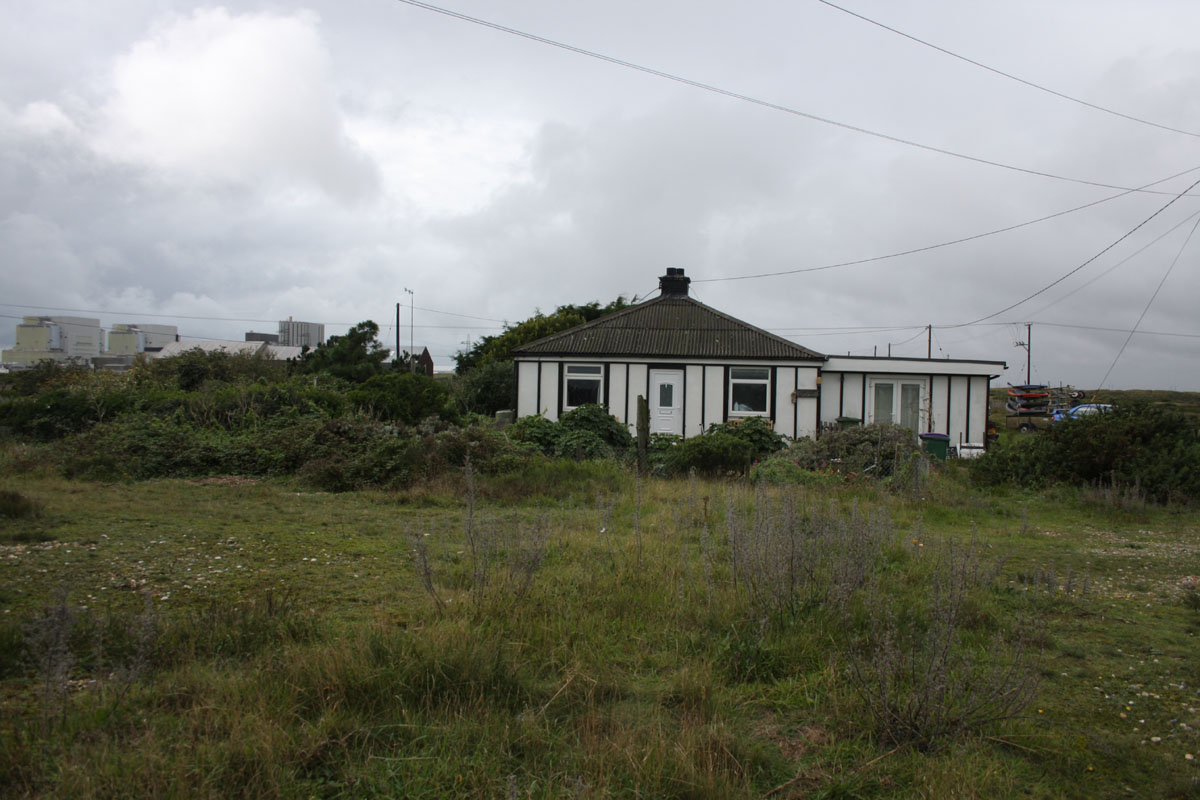
We could plainly see the cars of many birders parked along the side of the road and nearby a phalanx of birders standing on the shingle in a respectful semi circle of subdued clothing, eyeing 'Southview' a white, shack like wooden bungalow surrounded on one side by a garden full of dense shrubs and small trees.

Some of the amassed twitchers

Southview showing the bushes and water butt on the left side of picture and the
looming bulk of Dungeness Nuclear Power Station in the distance
I hit the express button and was out of the car and ready to go and join my fellow birders in seconds. Peter went into slow goods mode, changing his footwear and seeming to take an age but eventually we got together and headed down the road to join a throng of about one hundred birders.

The flycatcher had originally been found near the shoreline amongst the beached fishing boats, perching on the pebbles and the odd piece of sea bleached wood to hunt insects but as we had been heading south it had relocated to the more suitable habitat of the 'wild garden' around Southview and this is where it was currently seeking sanctuary.

We joined the ranks of those that wait to admire and a gentle enquiry of a fellow birder elicited the fact that the flycatcher had been in plain view just before we arrived but had disappeared into the cover of the bushes. We waited and in very little time, possibly ten minutes, it flicked up from ground level to perch on the top of a water butt by the side wall of Southview.

Our first sight of the Acadian Flycatcher on the water butt  c Peter Law
It was as sensational to see it as its rarity had promised.The sheer relief of seeing it after the long tense drive swept through me with a warm glow and I relaxed. The tension dissipated and now all we had to do was look and wonder and enjoy this waif from  far off North America.


Acadian Flycatcher c Steve Nuttall
There is nothing that looks quite like it in our native avifauna. A robin sized flycatcher with a noticeable green head and upperpart plumage and pale buff underparts, two very obvious creamy white wing bars and pale fringed inner flight feathers creating a stripey appearance . It was chunky in build with a stout, broad based bill and an obvious peaked crown. It behaved as all flycatchers do, whisking off at regular intervals in acrobatic flight after insect prey. I got about a two minute view of it perched on the water butt before it flew off. It  re-appeared on the butt after a few minutes and we got another two minute eyeful before it launched itself off into the bushes and was gone from view. It made one more visit to the favoured water butt before the steadily increasing wind strength and now returning rain persuaded it to change tactics and it retreated to ground level where it was generally invisible apart from occasional sorties into a buddleia bush behind the house. The rain and wind were now impossible to ignore and the sky was ominously and solidly grey and looked unlikely to yield to better weather. Grim indeed.

Whilst looking at the flycatcher it became apparent from the general gossip around us that most birders considered this individual to be an Acadian Flycatcher which was good news for me and Peter as it was a new species for both of us as well as for Britain. It certainly looked nothing like the Alder Flycatcher I had seen in Cornwall, which was much duller brown and did not have such a prominent eye ring. A minority considered it might be a Yellow bellied Flycatcher but I do not think so. Someone almost unbelievably managed to collect some droppings from the flycatcher which have been sent for DNA analysis. So I imagine fairly soon we may have confirmation of exactly what species of Empidonax flycatcher it is. 

I was becoming thoroughly soaked down the windward side of my supposed waterproof clothing and life was becoming increasingly uncomfortable but I stubbornly refused to bow to the elements. Peter was sensibly ever more keen to get back to the sanctuary of the car.

'Just one more view Peter and then we can go'. 

In fact we got several subsequent fleeting views of the flycatcher but it looked unlikely that it would come back to the water butt where earlier the best and most prolonged views of it had been.

The crowd of birders had by now increased considerably to around two hundred and fifty, and with the continued absence of prolonged views of the flycatcher it was becoming a bit chaotic as birders were rushing to wherever it  was possible to get a brief view of the flycatcher in the restricted viewing conditions of the garden surrounding the bungalow.

The owners of the bungalow, thankfully sympathetic to birders,  returned. The lady of the house commenced taking images of the assembled birders on her phone from her living room window. We waved to her and she waved back. Everyone joining in the spirit of this unique event. I was by now feeling very cold as well as wet. Peter asked one more time, 

'Shall we go?' 

I bowed to the inevitable, relented and we returned to the car. Never was I so glad to get out of the wind and wet, get back into the dry and get the heater working. We had been standing for over two hours in a combination of wind and rain that hammered into us mercilessly as there was absolutely no shelter or hiding place from the aforesaid elements coming relentlessly across the flat open expanses of shingle that make up this strange headland jutting out into the  English Channel.

Stoic but happy twitchersin the wind and wet at Dungeness
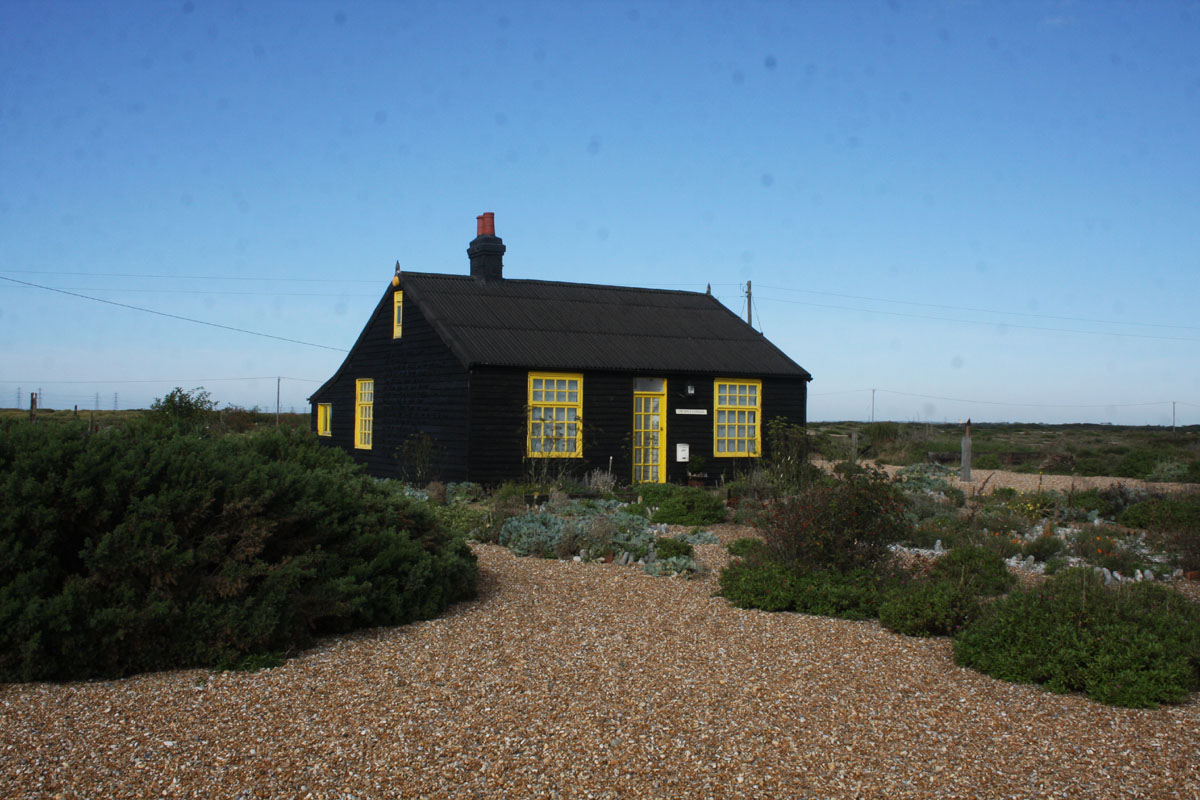
We drove back down the road past the late Derek Jarman's former home and garden, now a place of pilgrimage to admirers of his theatrical abilities and fame. The narrow gauge railway train passed, in a cloud of wind blown smoke and trailing empty carriages, behind the house and out across the shingle, its mournful whistle emphasising the inherent loneliness of the barren stony wastes that it traversed. The line of parked cars belonging to birders now stretched almost as far as one could see along the road with yet others still arriving. 

Derek Jarman's cottage and garden on a better day at Dungeness
Twitchers cars lining the road. Normally this road would be empty of cars
We left, rejoicing in our luck and at having seen this major rarity so well. Many birders that had arrived after us had to wait a long time to see it and then when they did only got the briefest of flight views.

We were tired and both of us were hungry, neither of us having eaten anything since the morning. It was now three thirty in the afternoon. We found a nice cafe in nearby New Romney and a quick meal and cup of tea put us in good spirits before heading north, now thankfully in sunshine and much more pleasant driving conditions. After dropping off Peter I was home by eight that evening. 

This was a day that I will remember for quite some time.

PS My friend Chris managed to see the flycatcher later in the afternoon. The flycatcher was last seen on Tuesday flying to a nearby gorse clump at around seven in the evening where it was lost to view. Despite many birders turning up at first light on Wednesday, there was no sign of the flycatcher and it was never seen again. Some speculated that weakened by its long and perilous journey it may have died in the night, others that the night was clear and starry and it may have moved on. 

We will never know.