Tuesday, 16 May 2023

North by Northwest 16th May 2023

Having recently returned from The Isle of Arran in Scotland Turnstones were very much in my mind as I saw them every day there, either feeding in the seaweed or resting on the rocky shores of Arran before continuing their journey north to breed.

Back now in Oxfordshire I was wandering along the reservoir causeway at Farmoor on a  late afternoon when what did I come across but two familiar stocky waders silhouetted in the bright sunshine. Walking nearer my suspicions were confirmed.They were Turnstones in summer plumage, feeding contentedly by the water's edge. 

Turnstones do not breed in Britain but are a familiar wader that spends the winter in Britain along rocky seashores and often become quite tame where they come into contact with humanity, such as in coastal towns and villages.They have an almost worldwide wintering distribution that consists of five populations but only three of these occur in Britain.

Turnstones are an occasional visitor to the reservoir on both their northward and return migration, stopping over for a day or so to feed and rest.

For the most part they are relatively confiding and untroubled by the increasing number of passers by (post covid) on the causeway and are generally ignored by all but us birders who enjoy seeing them here, however briefly, transformed from drab winter browns into their splendid tortoiseshell breeding plumage which makes them one of the most colourful of the four small wader species that visit the reservoir on migration. Occasionally a close pass by a yachting dinghy or windsurfer upsets their equanimity  and they fly but usually will choose to settle further along the causeway rather than depart the reservoir altogether.

For me, as I look at them and take far too many photographs, the wonder  of  what they are instinctively undertaking is never far from my mind and it cannot fail but catch at my emotions. For another year, on this pleasant afternoon the wonderful act of migration is personified by their presence.


The same questions arise every time I find myself in this situation. Where for instance have they come from? Probably they spent the winter on British shores or possibly they have come from further afield such as Southern Europe or even West Africa.

Where are they going? By crossing middle England, such as these two at Farmoor today, are they taking a short cut as they head northwest to somewhere I can only imagine in the far distant Arctic. Do some reach their destination in one flight while others stop off on the way, such as at Farmoor, before undertaking the next stage of their barely credible journey. 

Visible migration is always inspiring, even moving, bringing a sense of the wider world to otherwise unexceptional locations such as a prosaic inland reservoir in Oxfordshire, and instills within me an unexplained sense of urgency and excitement that has no relation to my personal circumstances. It is a heady feeling.

I found some of the answers to my questions about the Turnstone's migration in The Migration Atlas published by The British Trust for Ornithology.

The Turnstones that briefly stop at Farmoor have a formidable distance to go to get to their breeding grounds. The vast majority of Turnstones found passing through Britain are bound for the northeast Canadian Axel Heiberg and Ellesmere Islands or northern Greenland. Around  half will make a stopover in Iceland.

The main exodus from Britain is in April and May and depending on their fat reserves laid down to power their flight, some will fly to   Canada and Greenland directly, others will make it as far as Iceland where they will stop to feed and build up their fat reserves once more before flying on over the Greenland icecap to reach northwest Greenland and northeast Canada.Yet others will make several stops in Britain, moving progressively northwestwards  before heading out over the North Atlantic

It is a true wonder of the natural world.

So next time you see a migrating Turnstone, stop to consider the journey they will make twice a year, flying an incredible distance to breed and raise the next generation of Turnstones in a short window of six to seven-weeks in the Arctic. As you look at a Turnstone, maybe wandering along the mundane concrete shore of Farmoor in either spring or autumn, marvel at this small bird and its accomplishments.

Before our eyes is something that should cause us all to stop and ponder on this still wonderful world and the creatures that inhabit it, such as the familiar Turnstone whose existence in its natural course encompasses travels at which we can only marvel.

This week is Mental Health Awareness Week and the concept of mindfulness is much bandied about these days, especially as a result of burgeoning mental health problems exacerbated by the recent pandemic.This blogpost is probably reaching those of us who are well aware of the healing qualities of the natural world and birds in particular. Birds are all around us, although in alarmingly reduced numbers and their obvious presence apparently catches the general public's imagination.These triumphs of nature, such as the Turnstone's incredible life story, can and will cause others to see that nature is of huge worth and we should not ignore or take it for granted but rather reflect on its marvels as well as its benefits to our mental well being and lives in general.

A general acceptance of this fact will, in my opinion, make this world a happier place to inhabit..


Monday, 15 May 2023

A Nightingale Sang in ............ 15th May 2023


Each year I try to find the time to go and see Nightingales in the neighbouring county of Berkshire as they are now virtually non existent in Oxfordshire.

I got up very early this morning to make an hour long drive to a location where I know they are usually present. Leaving my home at 6am it was chilly and misty. I drove south and the visibility gradually improved but remained dull. It was also markedly cold for mid May. Would this mean the Nightingales would not be singing?

Arriving at my destination so early on a Sunday morning meant I had the place to myself. It is a popular location for dog walking so it is best to avoid arriving after nine. Getting out of the car I expected to hear Nightingales singing but instead there was nothing. In the still and cold air other birds were singing, notably a Garden Warbler, belting out its song, close to where I had parked.

I walked along a couple of tracks in the surrounding woodland hoping to hear a Nightingale but the woods were devoid of any intimation of their presence. Now what to do? Go back to the car and wait for them to commence singing as surely they were here?

I could not face sitting in the car so walked to another area  of woodland bordered by scrubby gorse and bushes.I knew from past years that this location was often inhabited by a pair of Nightingales so I stood inside the edge of the wood and scrub and waited.Half an hour later I was still waiting.Nothing.

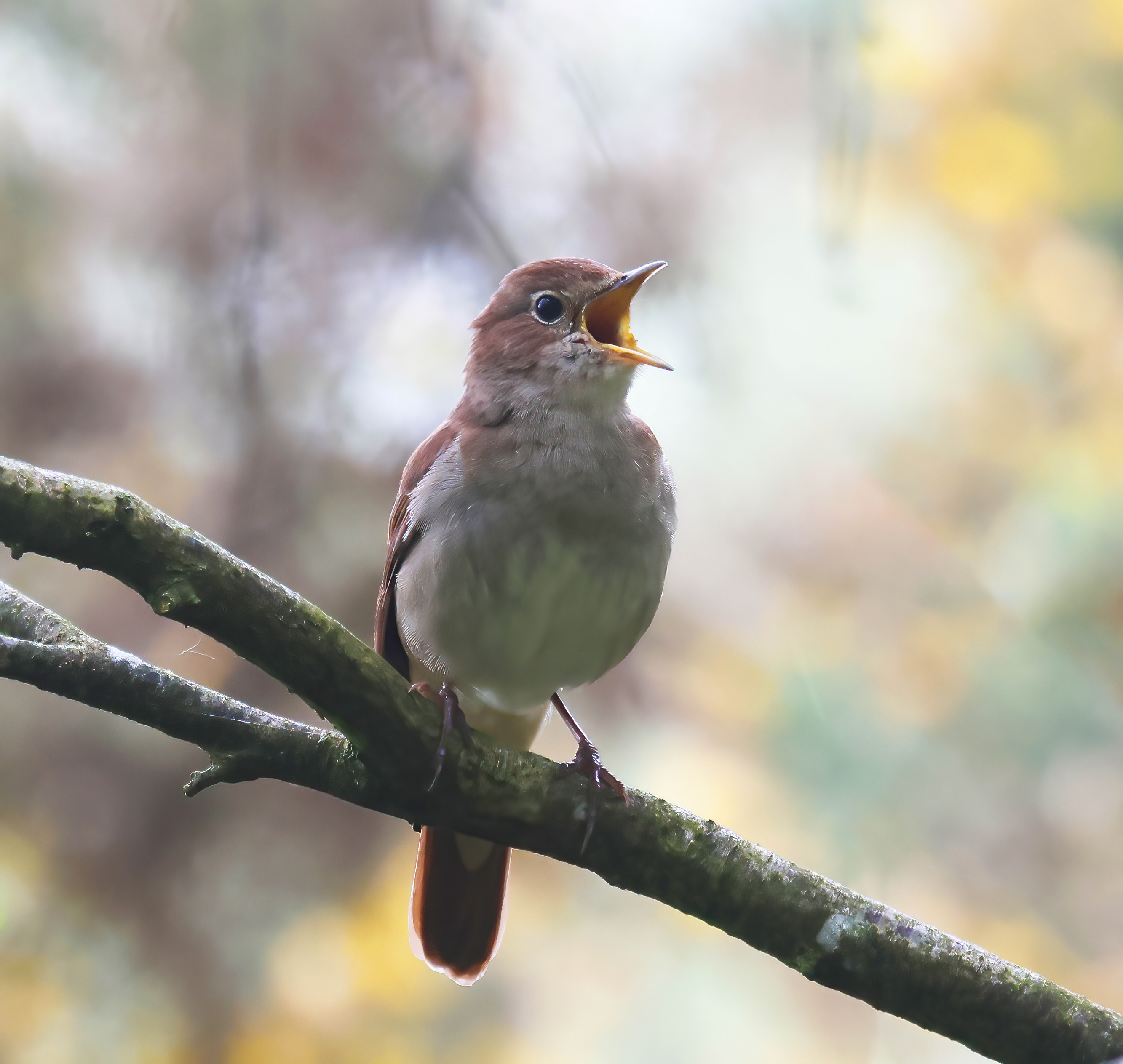
A Nightingale's song is unmistakeable. Loud, amazingly loud for such a small bird and we all know how beautiful and fabled is its song, encompassing rich, throaty warbles and long beseeching, single notes,  the delivery of each phrase interspersed with a small interval of silence and rarely do the same notes come in the succeeeding phrase.

How I longed to hear it now but the wood remained silent.

Then a small rendition of unmistakeable Nightingale song came from my right, so brief and so unexpected it was gone almost before it registered. Did I imagine it? Another spell of standing and waiting ensued but with more expectancy now and then there it was again, those rich notes, more prolonged and seemingly closer.

I scanned the gorse scrub but it was not there.I looked higher at the trees and there was a Nightingale, perched close to the thin trunk of a birch. 

I moved closer praying that such a notoriously shy bird would not flee on detecting me. It remained silent for a moment and then broke into full song, its bill opened wide and white feathered throat swelling as it  delivered those fabled notes.

My decidedly downbeat mood instantly changed on seeing and hearing this bird.Singing its liquid notes on a dull and cold early morning. Its body trembling with the effort. It was only 8.00am.

Nightingales in Britain never truly sing in the open but prefer to sing from deep cover, unlike in the rest of Europe where they sing more openly, and they are really hard to photograph due to the dull light which is an inevitable consequence of where they choose to sing in this country. To see this one, relatively in the open was remarkable and I settled to see what would happen with this particular bird and to endeavour to take advantage of its unusually confiding behaviour.


I could not have known in advance it would be so comparatively untroubled by my presence and although wary it would frequently appear fairly close to me, singing loudly. It was obvious that where I was standing was at the heart of its territory and it would regularly commence to sing from various perches in the gorse and birch scrub to both the left and right of me.Standing with my back to a larger tree I masked my profile and I am sure this meant that the bird was not so wary. If I moved but an inch to get a better view or angle for a photo it would immediately drop down into cover and disappear for minutes on end, only to fly up from a different part of the scrub to sing once again.


I stayed where I was and eventually came to recognise that one particular area of the scrub and gorse was regularly revisited by the Nightingale. Here it would perch quietly, preen and occasionally sing.


While it was preening, on one occasion I detected some movement on the ground below and on checking in my bins discovered another Nightingale, walking on the litter of last year's dead leaves. This must therefore be a pair, something I have never observed before and for me, an ex nest recorder for the BTO (British Trust for Ornithology), quite exciting.

Presumably this was where they are intending to nest  and I felt it prudent to absent myself.

Walking back though the woods, worryingly there was no Nightingale song. I had heard no other Nightingale singing in two hours when usually there are at least three singing males on their territories here. I do hope the Nightingale I saw and heard this morning is not the only one.

As is the case with many bird species, Nightingales are declining in Britain. They are in any case restricted to southern Britain, being more a southern  European species and in Britain are on the northern extremity of their breeding range. Not only do they make a hazardous journey from equatorial Africa where they winter but now are having to cope with loss of habitat due to human activities and the burgeoning deer population in England which removes the understorey, below which is where they build their nest on or near to the ground

I may return to see if there are more Nightingales than on this visit but feel glad that for another year I have heard a Nightingale sing.


Thursday, 11 May 2023

Going for a Song 9th May 2023


Having arrived home last night from three glorious weeks on our favourite Isle of Arran I decided to ease myself back into the less exciting birding at my local Farmoor Reservoir in Oxfordshire. I was in no real hurry and got there around 9am and set about re-familiarising myself with the concrete shores of the reservoir. Not quite up there with the atmospheric stony beaches of Arran and the adjacent waters of Kilbrannan Sound but it would have to do.

There were, at least, some new birds to add to my year list, with a few Swifts high in a cloudy sky and Garden Warblers singing in the trees near the Thames Path but frankly my heart was not in it. It was too soon to forget the Golden Eagles and displaying Hen Harriers I had been enjoying two days ago.

It always takes me this way on returning from Scotland and the exciting birds I see there.

About to commence walking back down the causeway and make my way home, my phone rang.

It was Mark. It was 10am.

'Do you need Song Sparrow?'

'Err, yes. Why?

'There's one on Bardsey Island. It has just come on Birdguides. I saw the one on Fair Isle so I am not bothered but you need to go and go now. There is a number to call to book yourself on a boat'.

Still assimilating this startling news and feeling the first intimations of excitement I rang the number.  It was answered by Steve, the warden of Bardsey Island which is in Gwynedd, North Wales and lies off the scenic Llyn Peninsula, that extends for thirty miles into the Irish Sea.

I asked about the boats and was told there were hourly sailings from a place called Porth Meudwy, up to the last boat at 3.30pm.Leaving now would get me to Port Meudwy at 3.30pm as it is a five hour drive from Oxford. The timing was too tight and involved too much risk. Anything could happen on the way, traffic holdups on the motorway for instance. 

I resigned myself to missing out on this opportunity to see a very rare transatlantic vagrant.

Song Sparrows are an abundant species of New World Sparrow found across both Canada and the USA, inhabiting brushland and marshes but also found in close contact wth human habitation in suburbs, parks and roadside verges.Northern populations migrate south in winter to the southern states of the USA.There have only been nine accepted records of a Song Sparrow in Britain. This one found by Ed Betteridge,one of the Bardsey assistant wardens, on the observatory roof, will be the tenth.

I asked Steve if there might be later sailings but he was unsure as he did not know how many birders would respond to the news but he would call me back if it looked like there would be sufficient numbers to put on extra sailings.

By the time I got to the other end of the causeway Steve had called to say there was now another sailing at 4.30pm.That was just about doable but again it would be tight as I now learned that it was a half hour walk from where you parked your car in a National Trust car park, down to the boat's departure point.

I asked if there would be any chance of one at 5.30pm but he did not know and would have to talk to Colin who was the skipper of the boat.He said he would ring me back but thought it likely as many birders were ringing him to book seats on the boat.

The later time would be ideal for me as it meant I could drive in a relatively relaxed manner and arrive with time to spare. I decided to gamble on an extra sailing at 5.30pm and set off for North Wales with Steve promising to call me as soon as he could to confirm the extra sailing or otherwise.

Already dressed for birding and with everything I needed I returned to the car, set the satnav and rang my wife.

I won't be back for lunch. I  am going to Wales for a really rare bird.

What is it this time?

A Song Sparrow from North America.

When will you be home?

I have no idea as it's a very long way to Bardsey.Don't wait up.

She wished me luck and I set off with that familiar tingling of excitement and apprehension that commences coursing through my body in circumstances such as this.

Anxiety levels had risen considerably by the time I reached Birmingham as Steve had still to call back. I was about to call him when my phone rang.It was Steve and yes there would be a boat at 5.30pm.

I was in business and set about concentrating on the long wearisome drive to North Wales. I had left Farmoor in dull grey weather and now intense heavy showers hit the motorway and traffic slowed in the torrent of water and resulting miasma of spray from fast moving cars. I then noticed I was short of fuel so had to make a stop to refill the car.Whilst in the services I got myself a sandwich and something to drink. There would be little opportunity to do it later. Despite the stop and the rain I was still on course to arrive at Porth Meudwy with an hour to spare.

Once back on the motorway yet more heavy showers and the inevitable average speed checks made driving miserable.Then the satnav commenced playing up. Why me! I railed at this latest frustration.Yet another unscheduled stop had to be made to sort out the satnav.It was not an immediate problem as I know the route as far as Bangor but I would certainly need the satnav for the remaining part of the journey to Porth Meudwy.

Time was still OK though with one hour to spare predicted on the satnav after my arrival.

The sun commenced to shine and the day became very pleasant as I drove into Wales.Eventually turning off the main road at Bangor I commenced traversing through narrow switchback roads, some no more than narrow lanes. I was now entering the Llyn Peninsula, an Area of Outstanding Natural Beauty. I met the school bus and had to reverse several hundred yards to allow it to get past,setting my already sorely tested nerves further on edge. I had never been to this part of rural Wales, you could almost call it isolated, with an other worldly atmosphere. Strange and very beautiful all at once. Twisting roads, took me up and down deep valleys on what felt a never ending journey westwards. Finally I caught a glimpse of the sea.I must be close to my destination.Surely?

That was the plan but due to the again misbehaving satnav I could not find the right lane to take me to the National Trust car park which was where I needed to be and I ended up in a farmyard.This was obviously not right and.time was now beginning to run out.In desperation I called Steve and told him I was lost.For another fifteen minutes we tried to sort out where I was so he could guide me but.every place name was in welsh and all the farms looked the same. Mild panic set in. .

All this way only to fail at the last moment. It was unbearable. Tired, fraught and anxious I somehow managed to hold it together and the ever patient Steve remained on the phone until I found the car park hidden behind a hedge and accessed through a tiny opening.There were already a number of cars on its grassy surrounds, birders cars, and there was the track leading down a narrow valley to Porth Meudwy, the boat's departure point.

I still had an hour to spare and finally could relax. With much relief I got out of the car, stood for a few moments in the sun and absorbed my rural surroundings before gathering bins and camera and setting off on the track.

It was shortly after 4.30pm and I met some very cheerful birders returning up the track. 

Success? I enquired.

You bet.It's been showing really well.

My spirits lifted at this news and I meandered down the track to the picturesque cove that is Porth Meudwy. I had forty five minutes until my boat arrived.

I felt I had got the worst over.The long drive finished, the uncertainty about finding the location resolved, the news the sparrow was still on Bardsey and showing well, combined to give me confidence all would be well.

The gamble had paid off - well almost. So close and yet so far. I had still to see the bird. A lot could happen to frustrate me.

I sat on a grey rock and looked out to sea. A deep blue sea below a pale blue sky, the cove surrounded by grass topped cliffs on each side, over and around which flew stiff winged Fulmars, with others cackling from their nest ledges.

I was joined by two other young birders, Lewi and Morgan but no one else came down the track.

The boat arrived on time and disgorged three returning birders who confirmed they had seen the sparrow. Colin ushered us onto his boat, a little surprised there were only three of us and in no time away we went, out from the cove and across the blue waters to the looming bulk of Bardsey Island.

Half an hour later we were towed up onto the island's shore by a tractor and got off the boat. Then came some bad news. Something all twitchers dread but are all too familiar with. The sparrow had not been seen for over an hour and no one could relocate it. The time was now 6pm and we had two hours to find it before having to return to the mainland. With hopes distinctly lowered the three of us walked up to the area where it had last been seen. Bardsey is not small and there is an awful lot of habitat to search.This was looking somewhat ominous.We knew the bird was still here but where?.

The Song Sparrow was reported as being very mobile and moving from one location to another but usually to be found somewhere in the vicinity of the main track across the island, near the observatory. We met another birder on the track who told us that where we were standing was the last place it had been seen before flying off to the east. There were now not that many birders left on the island, around ten, so it was going to be hard work re-finding the bird and even if one of us independently found the bird there was no phone signal to alert others. Only the wardens had two way radios.

We stood, slightly depressed at the distinct prospect of failure, the task before us daunting. Every small bird that moved was closely scrutinised, stonechat, whitethroat, robin, dunnock, all briefly held out hope before disappointment took over. We walked further along the track towards a house with an overgrown garden full of flowers and shrubs, its perimeter enclosed by a stone wall. 

Walking towards the house I looked away from the track and could see Steve and his assistant Ollie, having checked some gorse patches, walking back across a field towards the house and into its garden. I thought no more about it.

They disappeared from view but looking back to the house a minute or so later I saw Steve motioning with his arm to come and join him. This could only mean one thing! 

The Song Sparrow had been refound.

Adrenalin surged through me.

We were the only three near the house at this moment and rapidly made our way to join Steve who told us..........

'We have just seen the sparrow.It's in the garden but out of view'.

We walked around the house and stood by the back door and looked at the overgrown garden, a mass of vegetation. All very nice but providing plenty of hiding places for a species that likes nothing better than the security of cover such as this, from which it can emerge to feed unseen.

For a minute or so we saw nothing but then someone said 

'There it is!'

And so it was, perched openly on a stone wall for seconds only but enough for me to get it in my bins and see it in all its understated magnificence.

A tsunami of relief swept through me. I had done it. I had seen a Song Sparrow. Only the tenth to be recorded in Britain.

Others joining us failed to see it before it flew down below the other side of the wall. Groans of frustration from them but pressure off for me.

We waited but there was no further sign, so we walked out of the garden and around to the far side to overlook the garden from there and then we saw it again but only very briefly, perched in the top of a small tree.All of us managed to see it this time.

It flew again but no one was quite sure where.The focus was now most definitely on the garden but either waiting or circumventing the garden for another forty five minutes we  failed to see anything apart from two Spotted Flycatchers.

Then a birder standing on the track by the garden wall inadvertently flushed the sparrow from almost at his feet.It flew up into a tree and preened for a minute or two and had obviously been bathing.I got some record shots but there were too many twigs for comfort or a clear view.Then, once again it dropped down into the garden which appeared to be its favoured feeding place.


We waited but there was no sign. Shortly afterwards it was re-discovered feeding in a very secluded area of the garden right by the house, exactly where it was when first re-found by Steve and Ollie. Now was our big chance to get really good views, as by using a dividing wall as cover we could sneak down to the house unseen and stand in a line on another wall and look over and down into the secluded patch of garden where.the sparrow was feeding on dandelion seeds in the grass and occasionally hopping about on a wall under an apple tree. 

The Song Sparrow fed at the far point of the grass and also perched on the
wall at the far end under the apple blossom tree

The views we were now getting were over and beyond what anyone had been waiting and wishing for.


Here is not the place to go into a detailed plumage description but I noted the following features in particular. Its tail was rufous and long, there were also areas of rufous on its wings and its head was striped grey and brown with a marked broad, grey supercilium and central crown stripe.Two distinct black patches either side of its throat and a black tip to its bill were also prominent. Overall it superficially resembled a female Reed Bunting.

For the next half an hour we watched, we photographed and just enjoyed these supreme moments.  The sparrow eventually hopped into cover and did not re-emerge. 


You always want more in such situations and we were reluctant to leave,but the light was fading and we had to go to catch the boat which required a half hour walk back to the landing point.

But there was still time enough to chat, share the enjoyment of a successful twitch, visit the shop and make a donation to the reserve and above all thank Steve and his staff for a truly memorable day.


The Song Sparrow could not be found the next day and had obviously departed that night as the skies were clear.


Friday, 5 May 2023

Double Mega! 3rd May 2023

c Mark

Myself and Mrs U are on The Isle of Arran for a three week holiday which commenced on 16th April and will coincide with her birthday and give us an opportunity to miss all the nonsense concerning old jug ears coronation.

My twitching pal Mark was concerned and told me I was taking a huge risk as April and May invariably bring something  good birdwise to these shores.

Torn between worrying about missing rare birds and holidaying with my wife in my beloved Scotland at the nicest time of the year, I reconciled myself to the fact there was no option but to take a chance and hope nothing exceptional would turn up to upset my equanimity..

Two years ago at this time, and again while on Arran, I came spectacularly unstuck when both a Red necked Stint in Northumberland and a Sulphur bellied Warbler on Lundy, the latter a first for Britain no less, were found. I need both for Britain so it was hard to take, especially as Mark had arranged a charter boat to see the warbler and of course saw it as did most of my twitching pals. All were only too happy to tell me how delighted they were to see it.

This year nothing much had happened so far, with reference to rare birds while we were on Arran, and I thought I might get away with it but no, a White crowned Sparrow was found on one of my former patches at Seaford in Sussex. It would have been nice to see it but I felt reasonably relaxed as I had seen one before in Britain, at Cley in Norfolk. The Sussex bird was initially elusive but latterly was coming regularly to seed put out for it and looked like it would be around when I got back from Scotland.

Of course it disappeared.

All went quiet again on the bird front and hopes rose that nothing to upset the status quo would occur before we returned home to Oxfordshire. I contented myself with Arran's Golden Eagles, Hen Harriers and Otters.

Mark rang.

It was Saturday morning the 29th April

The drake Stejneger's back.It's at a place called Lower Largo. I am going for it on Bank Holiday Monday!

My heart skipped a beat and I swallowed down a bitter pill of despair. It had happened again, just like two years ago, but there was only myself to blame.Then again Mark is not married but I am and that is a major factor. Twitching and hardcore birding has ruined many a marriage and that's not the way I wish to go, so for me it has to be a compromise but it is frustrating nonetheless when I have to accept that compromise and make a difficult choice.

The Stejneger's Scoter was a first for Britain.A mega amongst megas.The ultimate. A must see.


Drake Stejneger's Scoter showing the distinctive marked step at the
top of its bill,the large white 'tick' mark under the eye and the pink
bill with yellow surround

This is an image I found on the internet as it was impossible to
photograph  the one at Lower Largo due to the distance it was
offshore and the bad light so early in the morning

The Stejneger's Scoter (Stej for short) had in fact been first seen over the Christmas period past but was seen from the southern side of the huge Firth of Forth, at Aberlady Bay, but was always very distant and eventually disappeared. By sheer serendipity we were staying at Lower Largo on the northern side of the firth, for Christmas and New Year, and I was planning to try and drive to see it after Christmas, as I was in the general area but the reports ceased, it was forgotten about and indeed its identification was queried by some. I even checked the huge Velvet and Common Scoter flocks at Leven just down the road from Lower Largo in case it was there but only found a potential White winged Scoter but that was too distant to be certain of so I discounted it.

Now the Stej, a vagrant from Siberia was on the Lower Largo side of the firth, amongst a huge number of Velvet Scoters and not only that, but up to three each of the rare White winged Scoter and less rare Surf Scoter, both from North America, were in the same scoter congregation plus a few of our native Common Scoter. A veritable scoter fest.

This time the identification of the Stej was in no doubt as it had been seen well and was by all accounts fairly close, well as close as any scoter can be, which is usually a fair distance offshore and requiring a scope to see it well. It had first been seen from a small concrete jetty adjacent to a large pub/restaurant called The Crusoe Inn, right by the sea. So named because Daniel Defoe's novel Robinson Crusoe, was based on the true story of Alexander Selkirk, a naval officer in the seventeenth century, being marooned on a desert island in the Pacific Ocean  for four years and four months. Selkirk was born in Lower Largo and there is a statue of him in the village. Serendipity again, as our rented cottage  at Christmas was right opposite the pub so we could see both The Crusoe Inn and the jetty from our window, no more than two hundred metres away.

All my twitching pals urged me to go and see the scoter as I was already in Scotland. I tried to explain my situation and such things as marital harmony and the problems of getting on and off Arran due to the unreliable ferries, which I will explain later.

I was met with little sympathy.

Then matters became even worse.

On Monday Justin, another twitcher pal sent me a text asking if I had heard about the Grey headed Lapwing discovered in Northumberland on Sunday.

What!!

No I had not.

There was no news about it on RBA (Rare Bird Alert) as unbeknown to me RBA had serious internet problems and were out of action. Of all times it had to be now. The lapwing was an even bigger mega than the Stej as only four have ever been recorded in the western Palearctic. The lapwing is normally found breeding in northeast China and Japan and winters from northeast India to Cambodia. You can imagine what effect this news had on my already scrambled emotions.

I rang Mark mid morning on Monday to ask how he had got on with seeing the Stej. Rather too gleefully he told me he had already seen the Stej really well and also the White winged and Surf Scoters and was now on his way to twitch the lapwing. Through gritted teeth I said how pleased I was for him. 

The Grey headed Lapwing was another first for Britain so now two firsts for Britain were going to be missed by me.I was metaphorically on my knees. It was too cruel for words. All too much but what could I do?.The answer was nothing.There was no way I dared ask my wife  if I could leave in the middle of our holiday and go to see a rare bird.

I tried really hard to remain upbeat but it got even harder when Mark posted some superb pictures of the lapwing on social media that evening.and despondency set in big time on my viewing the images.

I had to accept Arran is an island and I was on holiday with my wife. That was that. There was no way, surely?

Mrs U noticed my rather withdrawn demeanour and asked what was wrong.I explained about the Stej.

'Well you better go and see it if you can get off the island.'

'How long will you be gone?'

Almost speechless at this unexpected lifeline to twitching glory I replied in shocked tones.  

'You mean you don't mind me going for a day and a half off the island and leaving you on your own?'

'Frankly it would be a relief as you are in such a miserable mood'.

It was left to me to try and sort out how to get on and off Arran in as short a time as possible.

This would not be easy as the two Scottish Government subsidised Calmac vessels that serve the island and are the island's lifeline with the mainland, are very old, too old and are forever breaking down. Only one is in service at the moment. It is in fact a scandalous situation, as many islanders are virtually trapped on the island which is also a prime tourist destination and due to one vessel being out of service bookings for cars and people are like gold dust.

It was Bank Holiday Monday. Consulting Calmac's website I found the ferry was almost full until Saturday.There was only one booking left, on the last ferry from Arran tomorrow, at 8pm.Coming back there was no availability at all until the following Sunday. I snapped up the outbound booking and had a brain wave. Luckily there is  a small ferry that  sails every hour from the mainland at Claonaig on Kintyre to Lochranza on the northern end of Arran and you do not have to book .You just turn up. 

It adds hours to one's journey but I had no choice but to use it.

So now I could get off Arran on Tuesday night and drive to Lower Largo from the ferry port at Ardrossan and come back via Claonaig on Wednesday, getting the last ferry sailing to Lochranza at 7pm

So that was me sorted getting off and back to Arran and in reasonable time.

It is only ninety miles from Ardrossan to Lower Largo  a matter of two hours driving.I would be at Lower Largo by around eleven at night.Emboldened by my success so far I breezily told Mrs U I would sleep in the car and be ready to see the scoter at first light on Wednesday, which is around 5am this far north

Do you not think you are too old for sleeping in cars?

Don't worry it will be fine

No more was said.

That night in bed, mulling over my plans, I added a further twist to the plan.I checked the journey times from Lower Largo to Low Newton by the Sea in Northumberland where the lapwing currently was. It was three hours.Then the journey time from there to Claonaig was five hours.It was just about doable provided I saw the Stej fairly quickly in the morning.Certainly I had to be gone from Lower Largo by 7.30am. This would give me two hours max for the lapwing before having to make the long drive to Claonaig on the Kintyre peninsula to catch the last ferry to Lochranza.

This of course all depended on whether both birds would be there on Wednesday, The scoter looked fairly certain, the lapwing not so.

It was crazy but it had to be done. Anything could go wrong at any moment but this is twitching where normality is shown the door and abnormality takes over

So my itinerary was as follows

Tuesday evening 2nd May. 

Depart from Brodick on the Calmac ferry at 1900. 

Arrive Ardrossan 2000.

Fill up with cheap diesel at Asda Ardrossan.

Drive to Lower Largo and arrive at 2200.

Sleep in  the car  near The Crusoe Inn.

Get on the jetty by 5.30am.

Scope the scoters and see the Stej. which was the priority but also if possible see the White winged and Surf Scoters.

Depart Lower Largo 7.30 am latest.

Arrive Low Newton by the Sea 1030 am.

Two hours for the lapwing 1030-1230.

Depart Low Newton for Claonaig, a 5 hour drive, 1230-1730.

Stop for lunch and sleep 1 hour, maybe.

Arrive Claonaig approx 1830.

Get last ferry Claonaig to Lochranza. Sailing time 30 minutes 1900 -1930.

Home 2000.

It has been a long time since I have slept all night in a car. It was sheer self inflicted torture. Sleep evaded me and it was so frustrating constantly trying to get comfortable as the cold slowly permeated the car's interior. I donned gloves and thick jacket and finally in desperation read from my Kindle until through sheer exhaustion I must have nodded off around 3am.

I woke just after 4am with the sky already lightening.The dark of night slowly turning to deep blue.I dozed until 5am and now it was light enough  to go birding if I wished.Blackbirds had commenced to sing but all around me the holiday cottages remained dark and silent.Who else would want to be up at such an hour?

Stiff and cold I planned to resist leaving the car until 5.30am. 

The Stej had been reported daily as being off the jetty by The Crusoe Inn at around 6am each morning so three guesses where I was bound for. Due to local knowledge gained from our Christmas stay I had secured an overnight parking place only a couple of hundred metres from the jetty. I was all set. 

I sat almost comatose in the car, sleep deprived and having had nothing to eat apart from a bag of crisps and a dubious cheese sandwich from a local garage the previous evening, and with two bottles of Diet Pepsi to wash it all down.

Slowly the light improved. As the Stej was never being reported before 6am there was still time to kill. My patience ran out at 5.15 am.Sod it, rather than sit here in the car feeling awful I headed for the jetty. At least I would be birding, my sole reason for being here.

I was not the first. One other birder was already on the jetty.

We greeted each other and he told me he had not seen the Stej yesterday despite looking for it all afternoon, only a White winged Scoter.

Not what I wanted to hear but the Stej had been reported by someone else yesterday morning so there was hope.

Soon enough other birders joined us, until there were around a dozen of us ranged across the jetty, looking out at the scoters.The light was still dull and it would be another twenty minutes at least until it improved enough to be able to check individual scoters.Discerning the Stej and White winged Scoters would require close scrutiny as the differences are subtle  and would require good visibility.


The current state of the weather was what is described by weather people as light cloud but it was windless which meant the sea was calm, almost glass like, which would help with our examination of the huge number of sea ducks scattered on the sea before us.

There were over a thousand Velvet Scoters, dotted like blackcurrants across the silvery sea. Some swimming aimlessly, others diving and yet others flying in small groups hither and thither 

It will be 'interesting' finding the Stej in this lot I muttered to the birder to my left

We silently scoped the ducks

I've got a male Surf Scoter by the right hand pink buoy I  announced.

The others got onto it and I felt more upbeat at this minor triumph. 

But who was kidding who. We were all wanting to see Mr Stej.

For forty minutes there was no word from anyone and then someone said he thought he had seen a scoter whose bill looked 'different'

Could it be?

Where? we all enquired.

He gave some vague directions but then announced

I've lost it. Sorry

We all said not to worry and went back to grilling the scoters

Ten minutes later and unequivocally the Stej was located. Relatively close but still requiring a scope. It was just after 6am

A number of us got onto it and kept on it so as not to lose it amongst all the other scoters .

Superficially similar to a male Velvet Scoter its main distinguishing feature is the marked step on the bill where it joined its forehead. It was obvious and to my mind the bird looked slightly bulkier than the Velvets, especially around its neck.Maybe the whole bird was slightly larger.

The  white tick mark, running from under each eye, was also more extensive than on a male Velvet and another distinguishing feature to admire

It was swimming with a female Velvet Scoter, pressing its amorous attentions on her which she firmly rebuffed by extending her neck and lunging at him with an open bill, a decidedly no chance mate gesture.  Stej was not one to give up though and followed her closely and every so often would fly low over the water for a few metres in front of her, crash land in the water and then rejoin her as if to say, 'what do you think of that', resulting in a predictable show of indifference from Mrs Velvet.

We followed them as they swam amongst the other scoters and then every one of us, having seen it so well, took our eyes off it and it was lost from sight.Mind you it was far from easy as when viewed from behind as it swam away it was impossible to tell if it was the correct bird or not. 

I checked the time and it was just after 6.30 am.

Half an hour later one of the male White winged Scoters was located although more distant than the Stej but the smaller less obvious bump on its upper mandible was there for all to see as was its duller coloured bill.

We found a Red necked Grebe and a few Common Scoters too. A pair of the smaller Surf Scoters were found diving and surfacing and then another drake was swimming with some Velvets fairly close in, the white square on its nape very visible and its huge bulbous multi coloured bill a joy to see.

I remained until 7.30 am as planned, pressure now off,, enjoying the scoters and  eventually getting more views of the Stej.

The tide was ebbing and the scoters drifted further out with it. I knew I would not get better views than those I had already so left bang on my self imposed deadline.

Now for a three hour drive to Low Newton by the Sea in Northumberland. I made good progress crossing the mighty Forth Road Bridge and despite heavy morning traffic on the notorious ring road around Edinburgh eventually turned onto the southbound A1. Now  it was just a tedious slog, although my spirits were high having seen the Stejneger's Scoter and friends. The sun coming out also helped.

Almost three hours later I turned off the A1 and followed a zig zag course across Northumberland. I like this area of the world, driving down deserted rural roads through farming country, the large farm buildings and imposing farmhouses each sheltered by their skirt of trees in an otherwise open landscape of field and hedgerow.

It was noticeable how much more advanced Spring was here than further north, Daffodils had already faded  to be replaced by bluebells, the pink of Red Campion and white of Wild Garlic poking out at the base of  hedgerows already bright green with fresh growing leaves.

My erratic course, following the Satnav's guidance, brought me to a narrow lane that led through a small settlement to an isolated car park, just beyond another large farm, Link House Farm. I had arrived at my destination, Newton Steads car park, not quite full to capacity with birder's cars.

I paid for two hours parking and with this achieved I set off along a track through grassland, past the farm, to join an obvious gathering of birders looking across a series of grass fields to where presumably the lapwing was. On its first day it had been showing well and much closer in a nearby location but the day after had absconded to these fields and settled in one of the furthest.To say it was distant was an understatement. Even with the scope I struggled but eventually found it stood motionless by a fence beyond a field of cows. I could just make out the salient features of its plumage.

The best I could say was I had seen it and could now legitimately tick it.

Another birder had told me, at the car park, to walk to some obvious caravans as you could get closer to it there but it would still be distant. I decided to try this. I wanted better views after all my effort to get here.

I left my fellow birders and walked back to turn through a huge farmyard, complete with the traditional ducks and chickens running around. A playground for children and separate holiday cottages indicated the farm was supplementing its income as a holiday destination.

I made my way through the farmyard and walked out to a small area enclosed by high banks on three sides-a sort of dumping ground for the farm.The farmer had kindly granted us birders permission to stand on the bank which overlooked the fields and allowed us to get closer views of the lapwing.

Still relatively distant, through the scope I could see it very well and admired all its plumage details, following its progress as it stop started around the field on long yellow legs, stooping in typical plover fashion to pick prey from the ground and then move on a metre or so.

Its plumage was a striking combination of coffee coloured upperparts, white underparts, grey head and breast with a striking bright yellow, black tipped bill. Across its chest was a broad band of black and when it opened its wings they showed areas of black and brilliant white, the latter gleaming in the sunshine.


c Mark 

I watched it and took some record shots. Mark has kindly sent me some of his images from when he saw it much closer and has kindly let me use them in this blog. I checked the time and found I had thirty more minutes to watch this ultra rare bird  and so settled to just enjoy it, in the time that remained in this very pleasant part of the country.

It was 1230, time to go and I made my way back to the car park and packed everything away in the car. So very tired now I double checked to make sure nothing was left behind.

Driving back down the lanes to the A1. I turned north and set about the five hour journey to Claonaig sustained by sheer willpower and the knowledge of having seen two really rare birds for Britain. The first part of the journey was inevitably attritional, driving on fast motorways, skirting around Edinburgh then Glasgow. I got to Loch Lomond and then Crianlarich and slowed the car on less busy roads to drive through the spectacular sunlit scenery of mountain and loch that accompanied me northwards.

Finally I arrived at Claonaig and sat awaiting the ferry, the blue waters of Kilbrannan Sound lapping at the slipway, the hazy outlines of Arran's mountains just across the Sound. A flock of Whimbrel stood on the shoreline, resting like me, they on a much longer journey from Africa to Scandinavia.

I reflected on what I had done and how distant the early morning scoter seemed now, after the hours that had passed. But it was all true. It was not a dream and I could relax with that feeling of fulfilment that all twitchers can recognise.


My grateful thanks to Mark for allowing me to use his images of the Grey headed Lapwing