It sounds so innocuous does it not but this was no ordinary event.The bird in question this time was only the eighth of its kind to be recorded in Britain and for the vast majority of birders represents the ultimate prize in birding cum twitching, especially as it was a male in all its splendid ruby throated finery. We saw it. In fact we saw it fifteen times over a period of six hours whilst standing at one end of a windswept drive leading to a house sheltered by ornamental bushes and wind stunted trees. It took us three days, 1102 miles and 16 hours of driving plus two 12 hour ferry crossings from Aberdeen to Lerwick and back in heavy seas,but we achieved it.
This is the sequence of extraordinary events leading to our successful twitch.
Badger alerted me by a text, on the 19th October, to the fact that there was a male Siberian Rubythroat at a place called Gulberwick which is on Mainland, Shetland. Shetland! My initial reaction was 'You have to be joking, that's virtually Scandinavia! No wait a minute it is Scandinavia! To get there will cost a fortune and the only way in situations like this is to fly, as birds as rare as a rubythroat never remain for long. I cannot afford the airfare and anyway it will be gone tomorrow'. Tomorrow arrives and the rubythroat is still there. I call Badger who sensibly declines any blandishments on my part about going for it but suggests trying Paul. I call Paul to find he is already asking his wife Vicky to look into flights to Lerwick. Although I cannot afford the airfare I still find myself agreeing to look at flights and logistics for the two of us.Why am I doing this? I am definitely not going. Certainly not after confirming the cost of flights to Aberdeen and onwards to Lerwick from various airports around Britain. I call Paul and tell him it is out of the question. He responds with the fact there is an alternative - a car ferry. 'Pardon?' 'A ferry, it sails from Aberdeen'. 'But'. I respond. 'Aberdeen is a very long way away and we will have to drive for eight hours before we even get on the ferry'. Paul replies 'You're right let's forget it - but it is a male. The phone goes dead. I go to bed that night with no further thoughts other than it would be nice to see a Siberian Rubythroat that was about five hundred miles nearer, preferably in my garden.
I wake at six the next morning, Monday, with an IDEA! Any idea at this time of day is not good news but I persist and by half past six I have formulated a plan. Normally such plans become forgotten as sleep recedes and common sense prevails but I cannot let go. I will wait until seven, then call Paul and suggest we meet at nine am today at the latest, drive five hundred miles to Aberdeen, catch an overnight ferry which we have not even booked and which takes twelve hours to get to Lerwick, drive off the ferry and go and see the bird which is but a few miles from the ferry terminal.We should be there on Tuesday morning. What could be easier? The only remotely encouraging and sensible part of this unlikely plan is the fact that the bird is very near the ferry terminal. A voice of reason in my head tells me it will undoubtedly have gone by the time we get there tomorrow as birds such as Siberian Rubythoats, especially males only show themselves to elite birders who can afford to charter small planes at a vast cost. Forget it and get on with life.
Seven am arrives and I call Paul with my master plan and astoundingly he agrees to it, telling me he is already at work but has his bag packed with all his birding gear - 'just in case you understand'. How does he know? I now, having had my bluff called, find myself hastily packing everything I need, inform my ever supportive wife that I have decided to go to Shetland and head off into the morning traffic to meet and collect Paul at Woodstock. We are on the road north at bang on nine am. It really is happening. Paul tells me the bird has been reported this morning as still there. Is there a chance after all? It has already remained for far longer than normal for such a gem. En route on the M40 Paul books us and the ever faithful Black Audi onto the ferry for tonight. We are now twitching big time. This is it. A huge gamble. The big adventure has begun.
A steady drive north ensues with two stops for coffee and petrol and we arrive in the Granite City at 5.30 pm fully in the rush hour. It has become a bit surreal. We find the ferry terminal with 'nae bother' and line up the car on the dockside to await boarding time onto the huge Northlink ferry, the MV Hrossey. We drive onto the ferry, leave the car and settle in the combined bar and cafeteria. Sailing time arrives - seven thirty and it is dark as we slowly creep out of the harbour past huge brightly illuminated oilrig support vessels. 'I told you we were almost in Scandinavia, they all have Norwegian names!' Not a trawler in sight. Oil is now king. The lights of the vessels and Aberdeen recede as we sail into an ink dark North Sea and contemplate the daunting prospect of twelve hours of doing nothing but trying to get some sleep on the not so reclining 'special' chairs. They are not comfortable. In fact they are so unaccommodating we try the floor. Even less comfortable. Horribly hard in fact and cold. We try the seats again. We close our eyes hoping when we open them it will be all over. We open our eyes and it is only nine pm. Another ten hours of this purgatory. Groan. Back to the floor. Then the seats. Then the floor. Finally in sheer desperation we try the seats once again. I throw my fleece over my head to cut out the lights and I must have passed out, exhausted both mentally and physically. I am awakened by an announcement that we are one hour out of Lerwick. I have no idea how long I was asleep but do not feel that bad considering the night of hell that has just passed. The ferry docks in a grey dour looking Lerwick. We go down to the car deck and drive off the ferry at 7.30am just as it is getting truly light. Paul, having been to Shetland before, has local knowledge so we soon find ourselves at Gulberwick Church which is the designated spot for our tilt at eternal happiness or despair.
Paul is nervous, edgy, convinced the bird will have flown away overnight but I am, for no justifiable reason, optimistic that it will still be here. We are soon going to find out, that's for certain. There is no logical reason for my confidence. I know just as much or little as Paul but throughout the journey north and on the ferry crossing I just felt the rubythroat would not have gone and we would see it.
Leaving the car by the church at just before 8am we walk up a drive to where there is a wooden gate across it and off which hangs a sign which says 'For RUBYTHROAT stay in this area for best views.'

We are the first to arrive, so get the prime position to look up the drive and we set up our scopes so they are focused on the far end of the drive where there are bushes and trees.

Shortly after, some other birders join us from a taxi. 'Have you seen it?' they enquire. 'No not yet' I optimistically reply.
I keep looking at a particular spot at the end of the drive which looked the most likely place for a rubythroat to appear. Not that I know anything about rubythroats apart from the fact they behave much like a robin and are similarly skulking and highly strung. A Robin duly appears out of the bushes, feeding furtively on the drive. I manage to not make a fool of myself.
I keep my eyes glued to my scope grilling the hallowed spot. Some fifteen minutes later there is a flick of wings and another bird flies low from the bushes on the left, across the drive and perches for a second atop a large stone on the other side. Tail cocked jauntily and wings drooped. Just like a robin but it had a grey brown body, white stripes on a black face and a shining red throat. Oh my lord! There was no time to be excited. I just quietly say 'There it is -on the large stone' but even as I spoke it flicked its wings and was gone further right and out of sight. It was so quick no one else saw it but me. Paul didn't see it as it was just too sudden. However the major worry was dispelled. It had not gone overnight and was most certainly still here. Paul and the other birders could at least partially relax in that knowledge. Another very tense wait ensued. At least forty minutes passed with just the odd Blackbird landing on the drive and then, finally the rubythroat flew back, passing low across the drive from the right and a few seconds later showed itself from under the same bushes on the left that it had flown from when first seen by me. It hopped along the side of the drive, perching on low growing plants and then flew up onto the large stone before finally disappearing back into the bushes. A variety of exclamations and gasps of sheer relief came from all around me as everyone connected with this beautiful and much desired Siberian waif.


Again it all happened so quickly that it is difficult to remember what I saw but this is what I noted at the time or maybe amassed over the fourteen subsequent times we saw it. Who really cares.What a picture of loveliness it presented, showing a magnificent, iridescent red chin and throat, huge white stripes over its eyes, broad white stripes running down the sides of its throat from the base of its bill contrasting with a black face. Its upperparts were more grey than brown. The underparts showed grey on the breast and a warm shade of tawny buff on the flanks with pure white undertail coverts. Its behaviour was very like a robin, bobbing on long thin legs and flicking its tail and wings, constantly nervous and rarely still for longer than a few seconds. It appeared slimmer, almost elegant and possibly slightly smaller than a robin.
The relief of tension amongst my fellow birders was all too evident. Paul was now one very happy and relieved man, grinning and punching the air and shaking my hand. We had a bond that would last a lifetime. Up until this point there had been absolute silence as everyone waited to see the bird but now the volume levels increased considerably as the adrenalin took over and birding decorum rapidly went south. Despite all this distraction we decided to remain here for as long as possible and to see as much of the bird as we could because this would probably be a unique occurence for both of us and we really felt we should make the most of it. We had, after all, travelled an awfully long way to see it. The rubythroat seemed to have developed a vague routine and would show itself briefly every forty minutes, usually in the same general area of bushes. Some of the views were excellent, others more brief and tantalising but it was constantly thrilling just anticipating the next glimpse and by the time we left at two thirty we had seen it from all angles no less than fifteen times and really felt our huge effort and long journey had been fully justified. We had not only seen the bird but seen it really well. No Bagnallesque micro second only views for us! I estimated that over a six hour period we had seen it for around seven to eight minutes in total.
I must also mention a huge kindness from Mr Ockendon, the friendly owner of the property, who about four hours into our vigil at his gate drove down his drive, passed through the gate and parked his car immediately behind us. What was going on? Had we done something to upset him? He duly opened the tailgate of his car to reveal thermos flasks of coffee and packets of digestive biscuits and invited us to help ourselves, no charge. What a truly magnificent gesture which Paul told me was typical of Shetland folk. The sustenance and kindly gesture revived my spirits no end and I am sure the same sentiments were felt by everyone else present.
The wind, meanwhile, had been steadily increasing in strength and was blowing directly into our backs. It was cold but thankfully there was no rain so we stuck it out for a while longer and were rewarded with further views but we had agreed that two thirty was to be our deadline.

So a successful end to our mad cap twitch arrived and it was back to the car. Both of us were ravenous by now, not having eaten anything since the night before, except a few digestive biscuits courtesy of Mr Ockendon. We went in search of fish and chips of which there appeared to be no shortage in Lerwick. We settled on the Happy Haddock which had the twin attractions of being warm and had tables and chairs so we could sit and eat inside the premises. With hunger satisfied we did a bit of birding around the quaysides, the main highlight being very close views of winter plumaged Black Guillemots in the harbour.
Finally, as the light began to fade we made our way back to the ferry terminal to check in for the return trip to Aberdeen. The weather forecast was dire with gales and strong seas predicted. Our spirits began to waiver at the prospect of another twelve hours lying on the floor of the ferry or trying to sleep in the not so reclining and very uncomfortable chairs. Grown men should not cry but it was coming close. I spoke to the girl on the check in desk about the weather prospects and whether the ferry would in fact sail. She told me that the ferry was definitely sailing and then almost as an after thought I asked if it would be possible to upgrade our tickets to get a cabin and how much extra would it cost? 'Just a wee minute I will have a look' says she and then announced there were plenty of cabins available but it would cost another £84.00. I looked at Paul and he looked at me. There was something in his eyes. Probably the same went for me. Neither of us spoke for a minute.The world turned and then I uttered the fateful words 'We'll take it.' The sense of relief and warm glow that enveloped me and I am sure Paul will stay forever. One of the best calls I have ever made. The nightmare prospect of another night on the floor was banished. Paul broke into a smile and was obviously as relieved as me. I was relieved Paul was relieved. Let's face it, if the check in girl had said double the price we would have taken it. We boarded the huge vessel with just a few other passengers, found our cabin and looked in awe at what was now available to us - a mattress and a duvet for each of us, a bathroom, shower and tea making facilities. The night was now not to be feared and would be totally bearable. In fact it would be brilliant.We had after all just seen a Siberian Rubythroat, a superb male in fact and no one could take that from us. I confess to lying on my bunk and just kicking my legs in pleasure. We were like a couple of kids released from school and the world was now a much better place. A change of clothes and then it was up to the bar for a few celebratory single malts - Glen Morangie for Paul, Old Pulteney for me. We watched some football on the TV, a repositioning trawler crew proceeded to drain the bar as the ferry slipped out of Lerwick and began to roll on the raging seas.We looked at the time, it was only eight in the evening. We tried to spin it out to nine but it was hopeless.We were more tired than we cared to admit.
Inwardly content with that indescribable feeling of a successful long haul twitch under our belts we hit the pillows and felt the ship being bounced around on the seas as we slept on soft mattresses.Pity the poor souls who were roughing it on the floor.They would be rolling in the aisles - literally! The ferry was inevitably delayed getting into Aberdeen due to the heavy seas and we docked two hours late at around nine thirty am. It was then a long drive south with a couple of hours stop in Glasgow to see my daughter Polly. We were home in Oxford by eight that night. It seemed we had been away for weeks. We had done it. We had gambled. We had won. We had seen the birder's holy grail. A Siberian Rubythroat.

I wake at six the next morning, Monday, with an IDEA! Any idea at this time of day is not good news but I persist and by half past six I have formulated a plan. Normally such plans become forgotten as sleep recedes and common sense prevails but I cannot let go. I will wait until seven, then call Paul and suggest we meet at nine am today at the latest, drive five hundred miles to Aberdeen, catch an overnight ferry which we have not even booked and which takes twelve hours to get to Lerwick, drive off the ferry and go and see the bird which is but a few miles from the ferry terminal.We should be there on Tuesday morning. What could be easier? The only remotely encouraging and sensible part of this unlikely plan is the fact that the bird is very near the ferry terminal. A voice of reason in my head tells me it will undoubtedly have gone by the time we get there tomorrow as birds such as Siberian Rubythoats, especially males only show themselves to elite birders who can afford to charter small planes at a vast cost. Forget it and get on with life.
Seven am arrives and I call Paul with my master plan and astoundingly he agrees to it, telling me he is already at work but has his bag packed with all his birding gear - 'just in case you understand'. How does he know? I now, having had my bluff called, find myself hastily packing everything I need, inform my ever supportive wife that I have decided to go to Shetland and head off into the morning traffic to meet and collect Paul at Woodstock. We are on the road north at bang on nine am. It really is happening. Paul tells me the bird has been reported this morning as still there. Is there a chance after all? It has already remained for far longer than normal for such a gem. En route on the M40 Paul books us and the ever faithful Black Audi onto the ferry for tonight. We are now twitching big time. This is it. A huge gamble. The big adventure has begun.
A steady drive north ensues with two stops for coffee and petrol and we arrive in the Granite City at 5.30 pm fully in the rush hour. It has become a bit surreal. We find the ferry terminal with 'nae bother' and line up the car on the dockside to await boarding time onto the huge Northlink ferry, the MV Hrossey. We drive onto the ferry, leave the car and settle in the combined bar and cafeteria. Sailing time arrives - seven thirty and it is dark as we slowly creep out of the harbour past huge brightly illuminated oilrig support vessels. 'I told you we were almost in Scandinavia, they all have Norwegian names!' Not a trawler in sight. Oil is now king. The lights of the vessels and Aberdeen recede as we sail into an ink dark North Sea and contemplate the daunting prospect of twelve hours of doing nothing but trying to get some sleep on the not so reclining 'special' chairs. They are not comfortable. In fact they are so unaccommodating we try the floor. Even less comfortable. Horribly hard in fact and cold. We try the seats again. We close our eyes hoping when we open them it will be all over. We open our eyes and it is only nine pm. Another ten hours of this purgatory. Groan. Back to the floor. Then the seats. Then the floor. Finally in sheer desperation we try the seats once again. I throw my fleece over my head to cut out the lights and I must have passed out, exhausted both mentally and physically. I am awakened by an announcement that we are one hour out of Lerwick. I have no idea how long I was asleep but do not feel that bad considering the night of hell that has just passed. The ferry docks in a grey dour looking Lerwick. We go down to the car deck and drive off the ferry at 7.30am just as it is getting truly light. Paul, having been to Shetland before, has local knowledge so we soon find ourselves at Gulberwick Church which is the designated spot for our tilt at eternal happiness or despair.
 |
| Gulberwick Church |
Leaving the car by the church at just before 8am we walk up a drive to where there is a wooden gate across it and off which hangs a sign which says 'For RUBYTHROAT stay in this area for best views.'

We are the first to arrive, so get the prime position to look up the drive and we set up our scopes so they are focused on the far end of the drive where there are bushes and trees.

Shortly after, some other birders join us from a taxi. 'Have you seen it?' they enquire. 'No not yet' I optimistically reply.
I keep looking at a particular spot at the end of the drive which looked the most likely place for a rubythroat to appear. Not that I know anything about rubythroats apart from the fact they behave much like a robin and are similarly skulking and highly strung. A Robin duly appears out of the bushes, feeding furtively on the drive. I manage to not make a fool of myself.
I keep my eyes glued to my scope grilling the hallowed spot. Some fifteen minutes later there is a flick of wings and another bird flies low from the bushes on the left, across the drive and perches for a second atop a large stone on the other side. Tail cocked jauntily and wings drooped. Just like a robin but it had a grey brown body, white stripes on a black face and a shining red throat. Oh my lord! There was no time to be excited. I just quietly say 'There it is -on the large stone' but even as I spoke it flicked its wings and was gone further right and out of sight. It was so quick no one else saw it but me. Paul didn't see it as it was just too sudden. However the major worry was dispelled. It had not gone overnight and was most certainly still here. Paul and the other birders could at least partially relax in that knowledge. Another very tense wait ensued. At least forty minutes passed with just the odd Blackbird landing on the drive and then, finally the rubythroat flew back, passing low across the drive from the right and a few seconds later showed itself from under the same bushes on the left that it had flown from when first seen by me. It hopped along the side of the drive, perching on low growing plants and then flew up onto the large stone before finally disappearing back into the bushes. A variety of exclamations and gasps of sheer relief came from all around me as everyone connected with this beautiful and much desired Siberian waif.

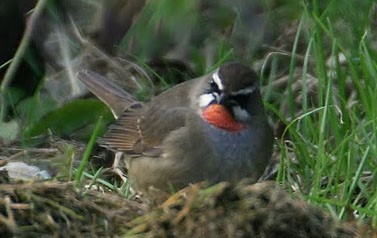

Again it all happened so quickly that it is difficult to remember what I saw but this is what I noted at the time or maybe amassed over the fourteen subsequent times we saw it. Who really cares.What a picture of loveliness it presented, showing a magnificent, iridescent red chin and throat, huge white stripes over its eyes, broad white stripes running down the sides of its throat from the base of its bill contrasting with a black face. Its upperparts were more grey than brown. The underparts showed grey on the breast and a warm shade of tawny buff on the flanks with pure white undertail coverts. Its behaviour was very like a robin, bobbing on long thin legs and flicking its tail and wings, constantly nervous and rarely still for longer than a few seconds. It appeared slimmer, almost elegant and possibly slightly smaller than a robin.
The relief of tension amongst my fellow birders was all too evident. Paul was now one very happy and relieved man, grinning and punching the air and shaking my hand. We had a bond that would last a lifetime. Up until this point there had been absolute silence as everyone waited to see the bird but now the volume levels increased considerably as the adrenalin took over and birding decorum rapidly went south. Despite all this distraction we decided to remain here for as long as possible and to see as much of the bird as we could because this would probably be a unique occurence for both of us and we really felt we should make the most of it. We had, after all, travelled an awfully long way to see it. The rubythroat seemed to have developed a vague routine and would show itself briefly every forty minutes, usually in the same general area of bushes. Some of the views were excellent, others more brief and tantalising but it was constantly thrilling just anticipating the next glimpse and by the time we left at two thirty we had seen it from all angles no less than fifteen times and really felt our huge effort and long journey had been fully justified. We had not only seen the bird but seen it really well. No Bagnallesque micro second only views for us! I estimated that over a six hour period we had seen it for around seven to eight minutes in total.
I must also mention a huge kindness from Mr Ockendon, the friendly owner of the property, who about four hours into our vigil at his gate drove down his drive, passed through the gate and parked his car immediately behind us. What was going on? Had we done something to upset him? He duly opened the tailgate of his car to reveal thermos flasks of coffee and packets of digestive biscuits and invited us to help ourselves, no charge. What a truly magnificent gesture which Paul told me was typical of Shetland folk. The sustenance and kindly gesture revived my spirits no end and I am sure the same sentiments were felt by everyone else present.
 |
| Birders and the Mr Okendon's car with coffee and biscuits |

So a successful end to our mad cap twitch arrived and it was back to the car. Both of us were ravenous by now, not having eaten anything since the night before, except a few digestive biscuits courtesy of Mr Ockendon. We went in search of fish and chips of which there appeared to be no shortage in Lerwick. We settled on the Happy Haddock which had the twin attractions of being warm and had tables and chairs so we could sit and eat inside the premises. With hunger satisfied we did a bit of birding around the quaysides, the main highlight being very close views of winter plumaged Black Guillemots in the harbour.
Finally, as the light began to fade we made our way back to the ferry terminal to check in for the return trip to Aberdeen. The weather forecast was dire with gales and strong seas predicted. Our spirits began to waiver at the prospect of another twelve hours lying on the floor of the ferry or trying to sleep in the not so reclining and very uncomfortable chairs. Grown men should not cry but it was coming close. I spoke to the girl on the check in desk about the weather prospects and whether the ferry would in fact sail. She told me that the ferry was definitely sailing and then almost as an after thought I asked if it would be possible to upgrade our tickets to get a cabin and how much extra would it cost? 'Just a wee minute I will have a look' says she and then announced there were plenty of cabins available but it would cost another £84.00. I looked at Paul and he looked at me. There was something in his eyes. Probably the same went for me. Neither of us spoke for a minute.The world turned and then I uttered the fateful words 'We'll take it.' The sense of relief and warm glow that enveloped me and I am sure Paul will stay forever. One of the best calls I have ever made. The nightmare prospect of another night on the floor was banished. Paul broke into a smile and was obviously as relieved as me. I was relieved Paul was relieved. Let's face it, if the check in girl had said double the price we would have taken it. We boarded the huge vessel with just a few other passengers, found our cabin and looked in awe at what was now available to us - a mattress and a duvet for each of us, a bathroom, shower and tea making facilities. The night was now not to be feared and would be totally bearable. In fact it would be brilliant.We had after all just seen a Siberian Rubythroat, a superb male in fact and no one could take that from us. I confess to lying on my bunk and just kicking my legs in pleasure. We were like a couple of kids released from school and the world was now a much better place. A change of clothes and then it was up to the bar for a few celebratory single malts - Glen Morangie for Paul, Old Pulteney for me. We watched some football on the TV, a repositioning trawler crew proceeded to drain the bar as the ferry slipped out of Lerwick and began to roll on the raging seas.We looked at the time, it was only eight in the evening. We tried to spin it out to nine but it was hopeless.We were more tired than we cared to admit.
Inwardly content with that indescribable feeling of a successful long haul twitch under our belts we hit the pillows and felt the ship being bounced around on the seas as we slept on soft mattresses.Pity the poor souls who were roughing it on the floor.They would be rolling in the aisles - literally! The ferry was inevitably delayed getting into Aberdeen due to the heavy seas and we docked two hours late at around nine thirty am. It was then a long drive south with a couple of hours stop in Glasgow to see my daughter Polly. We were home in Oxford by eight that night. It seemed we had been away for weeks. We had done it. We had gambled. We had won. We had seen the birder's holy grail. A Siberian Rubythroat.