Sunday, 22 December 2019

Merganser Magic on The Isle of Arran 22nd December 2019


We have taken ourselves off to the Isle of Arran for this Christmas and New Year, renting our favourite cottage at Catacol, a tiny hamlet which lies on the quieter and wilder northwestern side of the island, overlooking the Kilbrannan Sound and across to Kintyre. It is remote and quiet and suits us just fine.


At night no un-natural sound disturbs the peace, We can lie in bed and listen to the sea lapping at the stony shore less than fifty metres from our window, through which we watch a million stars in a sky untroubled by artificial light of any sort.

The western side of the island is rocky for the most part, relatively unpopulated and is a favourite habitat for wintering Red breasted Mergansers which are present on Arran in large numbers, nationally significant numbers in fact, scattered in pairs or small groups all along the deserted winter coastline. Resident birds are joined by migrants that come from Iceland and Fenno Scandia  to spend the winter here. 

Red breasted Mergansers are slim, long bodied seaducks that live on small fish that they capture underwater with their bright red, uptilted bills, the mandibles serrated to allow them to seize their slippery prey firmly and give no chance of escape. The most characteristic and prominent feature of both sexes is an unkempt tuft of spiky feathers on their crown, that imparts to them a certain eccentricity and devil may care schtick


The male is quite dashing with an iridescent bottle green head that looks black at any distance, a white neck band and streaked breast of cinnamon brown. The upperparts are black with a prominent white gash of feathers along each side and a series of white mirrors.The flanks are silvery grey with fine vermiculations.Their legs and feet as crimson as their eyes.


In comparison the female is dull with a chestnut brown head and overall grey body plumage

The slim forms of the mergansers dot the sea close to shore as they hunt for fish. At this time of year many are paired but there are occasional groups of males frantically displaying to a female even though she has already selected her mate.

I found such a group consisting of three males, competing for a female who already had a mate, the couple stoically ignoring the three suitors as they contorted their bodies in display to the female or chased after each other, seemingly more intent on stopping their rivals rather than impressing the female. Only occasionally would they stop chasing each other to dip and stretch head and body into an extraordinary contortion as they briefly remembered the main purpose of their presence.


The display of the male is entertaining but brief, lasting only a few seconds, as he extends his head and neck upwards with bill held open, bobbing his breast and lower neck below the water while at the same time raising his posterior clear of the water but with  tail depressed, He then continues to swim as close to the female as he can get before indulging in another of these rapidly executed convulsing, curtseying movements, And so it continued at random intervals.


It was rather comical watching the amorous drakes endlessly chasing each other, as well as the female, but all to no avail. Two males appeared obsessed with getting the better of each other, with one paddling frantically to get near the female while the other male would attempt to head it off by paddling equally frantically towards its rival, eventually charging through the water towards the other which fled but refused to give up and returned time and again to try its luck, only to be forever  rebuffed by the other. Although they came close these encounters never resulted in physical contact, only theatening with an opened bill and an aggressive rush through the water. 


The female would dive with her partner, whether to feed or get away from the suitors I could not tell but such was their ardour the suitors immediately followed her underwater. What occured there I was unable to know but all the birds quickly resurfaced and the frantic chasing on the surface would begin again.

I watched for some time as the three suitors endlessly tried to entice the female away from her partner or chased one another. The female was having none of it. Having selected her partner she was content while mayhem carried on around her.

I left them on a grey sea churned into a minor localised turbulence by the amorous males.

Wednesday, 18 December 2019

The Black throated Thrush revisited at Whipsnade Zoo 18th December 2019


I felt more than a little underwhelmed with both my views and images of the Black throated Thrush at Whipsnade Zoo last Saturday and, with its continuing presence at the zoo, I determined to return and try to see the thrush closer, for longer and achieve some half decent images of it.

The question was, when could I manage to go, and crucially would the weather co-operate? With Christmas looming ever closer and my impending departure with Mrs U on Thursday, for two weeks on the Isle of Arran, time was definitely at a premium. Monday and Tuesday were taken up with voluntary duties with MIND, so Wednesday was the only available day.

Fortunately the weather was predicted to be sunny on Wednesday, well sort of, and the wind, so chilling on Saturday would be less fierce and from a milder quarter.

I spoke to Mark, who also fancied a return visit so we agreed to meet at the Zoo when its doors opened at 10am. It was foggy when I left my home and even before I left our village there had been a  road accident by the local primary school, necessitating a detour into the wilds of Oxfordshire but eventually I got back on track and the rest of the hour long drive to Whipsnade was blessedly uneventful.


I arrived at the zoo just as the sun broke through the mist and paying my entrance fee made my way to Hullabazoo, the childen's play area based around a small, currently unoccupied pig pen and the now familiar large berry tree. I had hoped, being a weekday, there would be less of a scrum of birders than on Saturday but on rounding the corner, there before me were over fifty birders all pointing scopes, cameras and lenses of varying lengths at a twiggy bush to the right of the berry tree.

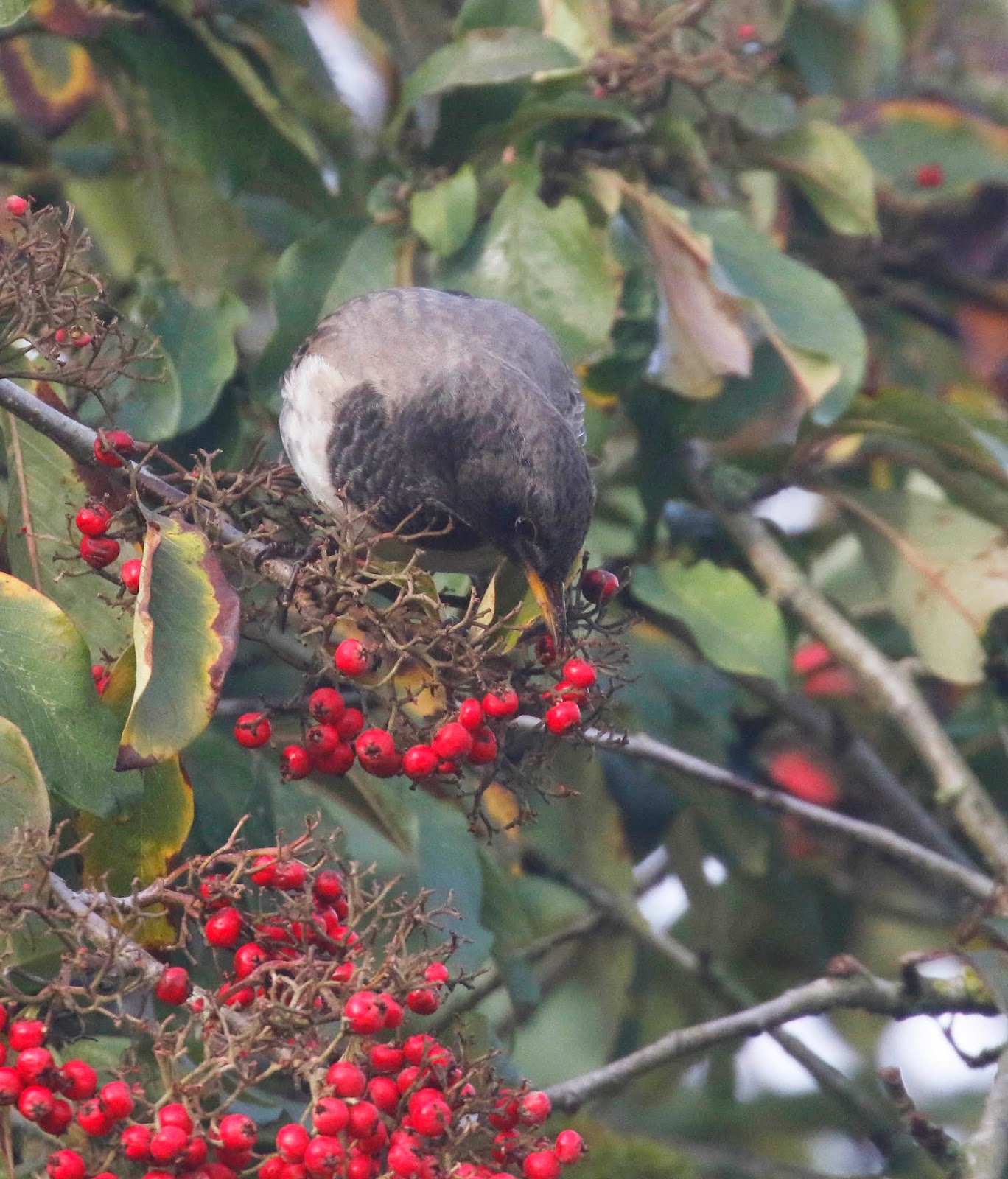
I joined the throng and found Mark in their midst, who pointed out the thrush, which was sat on a twig in the bush and reasonably visible. It was facing us and appeared as half black, namely its face, throat and breast, and half dull greyish white, this being the rest of its underparts. The yellow on its bill was also very noticeable.


It was as quick and easy as that to see the thrush and in marked contrast to my experience last Saturday. The thrush sat, immobile on its chosen twig for a few minutes but there was dissent in our ranks. Mark, never one to be afraid to venture an opinion suggested everyone was too close, so the thrush would not fly into the berry tree, and we should all move back. Of course no one took any notice and when someone else said the same thing he was ignored also.

So the thrush did not fly to the berry tree but instead flew onto the grass below the berry tree, joining a Blackbird and a couple of Redwings. Its behaviour on the ground was very similar to a Fieldfare as it progressed with bounding hops and head held erect, in between hops.Sadly it was soon disturbed from here by a couple of ordinary visitors and flew back into the twiggy bush. It remained here for some time before flying towards us and landing  behind us in the vacant pig pen whose fence we were all standing by. The thrush then proceeded to hunt for worms and invertebrates amongst the woodpiles, logs, mud and waterloggged grass of the pig pen. 

The Berry Tree -much favoured by the Black throated Thrush


The Pig Pen- another favourite feeding area for the Black throated Thrush
Everyone just about managed to control their desire to rush to surround the pig pen and clicked away with their cameras from a sensible distance, so presumably anyone who had a mind to got at least one half decent image. The thrush did not remain feeding in the pig pen for long but flew back to the bush it had originally been in and ascended to the top of it and then flew even higher to the very top of a large tree on one side of the pig pen before flying off towards the miniature railway sidings some six hundred metres or so distant, calling a series of high pitched, squeaky shree shree shree notes as it went.


This prompted a mass exit of birders towards the railway, us included, but when we got there the thrush was nowhere to be seen, just a few Redwings feeding on the grass under the trees. It seemed futile to remain here for long so we made our way back to Hullabazoo and got a coffee from the cafe there.

Redwing
Then, for some of us, it was back to stand by the pig pen fence and stake out the berry tree. Nothing happened for a while apart from some Redwings and Blackbirds flying in to feast on the berries but finally the Black throated Thrush flew in and landed in the pig pen once more. Now with less birders around it was more at ease and this allowed me to get some really nice images of it feeding on the ground and perched on the wooden fence surrounding the pig pen. It then flew from here to the berry tree and we made our way there to stand and hope it would come out from the centre of the tree and feed on the clusters of red berries. This would give everyone the chance to get the image they were really waiting for - the thrush and the berries in the same frame.


At first the bird was completely hidden by the foliage. Then you could see its tail and occasionally its bill but finally it popped out and unobstructed by foliage, facing us, perched on top of a cluster of red berries. It remained virtually immobile for what seemed an age as if it was not quite certain whether it was safe to commence feeding on the berries but finally it bent its head down to pluck a berry from the bunch. A fusillade of camera clicks recorded the moment. Every move of its head and plucking of a berry was faithfully recorded multiple times by everyone with a camera


By now every birder had made it back to the play area and a phalanx of fifty to sixty birders/photographers papped away at the thrush as it sat in the tree, gobbling berries. Really, one could not ask for more, although some with enormous lenses and expensive cameras were forever self critical but finally even they seemed to be  content with their efforts.

I certainly was and could not have asked for better views of the thrush or opportunities to take its picture. Eventually the object of our desire flew off back towards the railway sidings, calling loudly and we pursued it there but again to no avail.


In the end I decided that running around after the thrush was both a waste of time and energy and considered it was highly unlikely I would see it anywhere else but here by the berry tree and pig pen. So I mounted a vigil with a few others in the hope it would return but it never did.

No sign of the Black throated Thrush
However, standing and waiting was not an unpleasant way to while away the time as I chatted with Mark and other birding acquaintances such as Graham, Richard, Chris and Joan. The situation today, after the initial tense moments and bickering when I first arrived, was much more relaxed and friendly which in itself is a nicer aspect of twitching.You know you will always bump into someone familiar and possibly only see at events such as this, giving an opportunity to renew an acquaintance or friendship, have a good old natter and usually start dissing someone else's behaviour at a previous twitch, such is the nature of twitching folk. In general such criticisms are usually harmless, just gossip and rarely malicious.

By one in the afternoon the sun was becoming blurred by cloud and the light, which was never good, was now dull and flat. The wind had also begun to strengthen and that time had arrived when you just know there is no point in hanging on any longer. Even if the bird was to return I would not get better images than those I had obtained earlier in the morning.

I departed but not before visiting the Lynx Enclosure, something I had promised myself before I arrived at the zoo. I was not disappointed as a magnificent Lynx sat, regal and inscrutable on an elevated platform, regarding me, while another slept below in its den.


A final visit was made to the zoo shop for some last minute  minor Christmas presents and, before I left, the lady at the counter told me the arrival of the Black throated Thrush had been a godsend for the zoo as they had been so quiet. It is estimated that over six hundred birders have so far visited the zoo to see the thrush, bringing much welcome revenue to the zoo.

I said goodbye and headed home to Oxfordshire. 

Tomorrow we go to Arran.  

Monday, 16 December 2019

A Black throated Thrush at Whipsnade Zoo 14th December 2019

Adult male Black throated Thrush c Mark Rayment
December is generally a quiet month with regard to rare birds being discovered in Britain. Personally I felt this was no bad thing this year. after a hectic late autumn chasing rarities the length of the British Isles. However it was all change on December 11th when a 'strange thrush' was reported with a flock of Redwings, feeding on berries in the grounds of Whipsnade Zoo, near Dunstable in Bedfordshire.

Fortunately a very good photo was taken of the bird in question and publicised on social media with the result the bird was soon identified as an adult male Black throated Thrush, a very rare visitor to Britain with only eighty four previous records and none for Bedfordshire. The fact it was a smart adult male with a striking black face, throat and breast, contrasting with dark grey upperparts and dull white underparts rather than the drab, poorly marked mainly immature or female individuals that have arrived here previously, only served to make it doubly attractive and enticing.

Black throated Thrushes breed from the Ural Mountains in eastern European Russia to northern and central parts of Siberia and southwards as far as northwest Mongolia. They are migratory and spend the winter from the Middle East across to the Himalayas and southwards as far as southern China and northern Burma.

The Black throated Thrush went missing from the zoo the next day but the day after, sensational photos appeared of it still in the zoo's grounds, feeding on a berry laden tree and on the ground around 'Hullabazoo' the children's play area in the zoo. It looked to be very confiding and at times gave exceptionally close views. This was too much to resist so I made plans to visit the zoo the next morning. It was only about an hour's drive from my home and there was no need for an early start as the zoo does not open until 10am. My only concern was that tomorrow was a Saturday which inevitablty would mean the zoo would be very busy with many birders rushing to see the thrush plus ordinary folk coming for a day out at the zoo. It would be unlikely that I would get as close views as the lucky few had got yesterday.

I was about to leave home the next morning when I got a text from Peter informing me he was going for the thrush too and he would see me there if I was going. To save both of us driving I called him back immediately and told him I would pick him up on route. There was no sense in both of us driving especially as we live relatively close to each other. The company would also be welcome.

We got to the zoo in good time and drove into the very welcome free car park at just after 9.30 in the morning but grey clouds had ominously gathered over this part of The Chilterns and soon it was raining hard, the rain whipping across the car park, propelled by a strong, viciously cold north wind. There were a number of other cars parked around us obviously containing birders. Most of us remained in our cars awaiting 10am and in our case for the rain to ease.

When the zoo opened it was still raining hard but a number of birders braved the rain and headed for the zoo's entrance. We stayed put, not relishing getting soaked and, in my case, fairly relaxed as I had already seen two Black throated Thrushes in Britain. Peter however had never seen one.

Checking my phone at around 1030am there was news on RBA (Rare Bird Alert) that the thrush had already been seen in the grounds. The rain eased shortly afterwards so we promptly got ourselves together and headed for the zoo's entrance. Relieved of the princely sum of £21.97 each to get in, we headed for 'Hullabazoo' where the thrush, according to RBA, had been feeding in the tree full of berries. Although the sun had now made an appearance it was still a thoroughly raw and cold day due to the bitter wind that discomfited us with regular and prolonged icy blasts.

It did not take us long to see where the thrush was meant to be, as sixty or more birders were standing around the play area and looking at a large tree festooned with bunches of bright red berries. There was. however. no sign of the thrush but enquiries revealed it had been here a few minutes earlier but had then flown off towards some distant trees beyond the miniature railway.


Adult male Black throated Thrush c Adrian Webb
The popular opinion was that it would return to the berry tree so we stood and waited, braving the relentless wind. Redwings and Blackbirds regularly flew into the tree to consume the berries but the large number of birders standing around, none too quietly, was I felt sure, acting as a deterrent to the Black throated Thrush making a return and so it proved.


Redwing
After about forty minutes with most of us standing about and getting progressively colder there was a concerted surge of birders away from the play area, heading for the miniature railway and the landscaped grounds beyond. The thrush had just been sighted there feeding with some Redwings. Frankly the chance to move and get some circulation going was more than welcome.

We followed the crowd, crossing the railway line by a small bridge and making for the grassy areas beyond but there were just too many birders, with some insisting on encroaching too close to the feeding flock of Redwings which apparently contained the Black throated Thrush. The sudden appearance of many frantic birders, some running, unsurprisingly persuaded the Redwings to fly off. We never saw a sign of the Black throated Thrush just brief views of fleeing Redwings.

I felt tired and irritable surrounded by such a large number of birders some of whom  demonstrated an annoying lack of consideration and we decided to return to the play area to continue our vigil by the original berry laden tree. Mark. a twitcher friend of mine arrived. He had managed to take some brilliant photos of the thrush yesterday due to the fact that only about half a dozen birders were present rather than the hundred or so now milling around the grounds. 

Mark has kindly allowed me to use some of his images to illustrate this blog as has Adrian who saw the thrush really well on Sunday.


Adult male Black throated Thrush c Mark Rayment
A few Redwings and Blackbirds flew in to feed in the berry tree but they never stayed for long. The wind was now beginning to make me feel very cold as there was nowhere to shelter from it. I gave in to the elements and went to the nearby cafe for a welcome coffee to warm me up and then returned to the tree.

Another alert prompted a second mass evacuation of birders back in the direction of the railway and the grounds beyond. The thrush had been re-found. Peter went with them while I stayed with Mark, hoping for a miracle return of the thrush to the tree in front of us.

Fifteen minutes later Peter called my phone to tell me the thrush was feeding in a berry tree way over by the engine shed and he had seen it. I was pleased for him but stood my ground. Peter called again ten minutes later to say the thrush was still there and this time I made a move and headed for the engine shed and hopefully a sight of the elusive Black throated Thrush.

I found about forty birders lined up along the edge of a small partially flooded road, looking across to the engine shed some hundred metres distant. I enquired of a birder as to the whereabouts of the thrush and he very kindly gestured to his scope and invited me to look through it at the Black throated Thrush which was perched on the edge of a large tree with the now familiar bright red berries.  

I reflected that this is the paradox of birding in a crowd such as this. Most of my fellow birders are always willing to offer help or assistance if required and extend the common courtesies expected in such situations but there is always a minority that seem to lack any social grace or awareness or protocol and feel no remorse in pushing in and/or ignoring your presence and obscuring your view. I encountered both extremes but you just have to put up with it these days as it will never change.


Crowd scenes
Although the thrush was a little distant I could clearly see its overall grey body plumage and striking black face and breast, as it sat on a twig in the sun. Its mainly yellow bill was particularly noticeable. It remained perched for a few minutes and then was lost to view as it moved its position in the tree.


The distant berry tree favoured by the Black throated Thrush
Ten minutes later it was re-located but now on the ground, feeding on a carpet of fallen berries below the tree but all too quickly it worked its way around a corner and was not seen again.


We hung around for thirty or so minutes but there was no further sign of the thrush although many Redwings were still flying in and out of the tree, feeding on the berries. Getting increasingly chilled we returned to the original play area and sought sanctuary from the wind in the welcome warmth  of the cafe where we had another coffee before braving the cold once more to stand with Mark near the original berry tree, but the thrush was not there and it never really looked like it would return.

We gave up the unequal struggle with the wind and having spent a large amount of money to get into the zoo decided to make the most of it and visited the nearby butterfly house, finding more welcome warmth therein. It was far from unpleasant, entering from the cold into a humid tropical environment, albeit artificial, especially when we saw the gigantic and colourful tropical butterflies floating around. I was immediately transported back to Ecuador, as two huge and familiar butterflies I had encountered on a visit to that country last year, revealed themselves to me. They were a spectacular electric blue Morpho and a number of equally enormous Owl Butterflies.

Owl Butterfly


Tropical Butterflies
I confess I would have liked to have seen the Black throated Thrush closer and for longer but sometimes you have to accept that it will not happen as you hoped. Really there was just too much disturbance from the host of birders, plus, being a Saturday, families on a day out with their children did not help. The main thing was that I had seen the thrush perfectly adequately, so really I could not complain.

It transpired the thrush was not seen again on Saturday after we saw it by the engine shed but it was back on Sunday, this time frequenting an area around the Asian Elephant Enclosure. Presumably it will remain at the zoo until the berries run out so there may be another opportunity to try and see it closer before I go to Scotland for Christmas and New Year.

We will have to wait and see.