Monday, 10 February 2014

Oh I do love to be beside the seaside! 9th February 2014


Saturday evening and I contemplated the prospect of a Sunday with little to do and a bleak weather forecast. I decided late in the evening on another birding adventure despite the forecast for rain and high winds. I'm getting more than a little resigned to it now!  A Kumlien's Gull and an adult Glaucous Gull had both been seen yesterday at Littlehampton, West Sussex and it was just too much to resist. So a 5.30 early morning start found me wending my way down wet Motorways and finding the grey dawn on the Surrey/Sussex border. The rain had stopped but I was made very aware of the gale force winds as periodically the car would be shuddered by vicious gusts of wind funnelled through the embankments shouldering the road. I also periodically skirted random large tree branches hurled onto the road by the force of the wind. By the time I reached LA (Lil 'ampton - as the locals call it) there was the novelty of sunshine breaking through but the wind was still ferocious.

The Kumlien's Gull had been seen yesterday at the mouth of the River Arun as it flows through Littlehampton and out into the sea. I decided to try the west side of the river mouth for no other reason than everyone yesterday saw it from there. Driving up to the car park by the west side beach I could see some birders already cowering behind the cafe and trying to look at a mass of gulls feeding along the east side beach on the other side of the river outflow. 


I did not even bother to get out of the car as the gulls were all on the other side of the river and consequently distant. I just turned around and drove back the way I had come, back over the River Arun and headed for the east side of the river mouth. I would be much closer to the gulls as I would now be looking directly onto the beach over which they were feeding. I got out of the car in a deserted car park and was promptly blown against the car by the force of the wind. In wind such as this all sorts of inanimate objects seem to take on a life of their own. Car doors unexpectedly blow shut and anything not firmly attached suddenly takes to the air like a mad thing. Try putting on waterproof overtrousers in a Force Eight. It's not easy believe me.

Finally I got everything to my satisfaction and headed for the nearby seafront.The wind was coming from the southwest but there were some closed and shuttered cafes right on the seafront where I could shelter in the lee of the wind and hopefully use my scope on the feeding gulls. It worked a treat, the buildings providing an oasis of calm but there were hundreds of gulls to look at. Some feeding in the roiling brown surf and others sheltering on the beach, standing stoically head into the wind. The roar of the surf and the wind was incredible and exhilarating. Normally the seaside at a town like Littlehampton is a very sedate place but with weather such as today it took on a much more elemental and unpredictable character. 


There was just one other birder nearby braving the elements but between us we could not find anything resembling the Kumlien's or the Glaucous Gull. It was dizzying trying to scan through the swirling mass of gulls but we kept at it, sadly with no success whatsoever. Thirty minutes passed and I resolved to wait for as long as it would take. It was going to be attritional but so be it. The other birder, who was local came over to me and told me that he had just received a phone call telling him the Kumlien's had been found sheltering on the Golf Course. The Golf Course was, inevitably, on the west side of the river so it was back in the car, back over the river and back to where I had originally started. A short walk up a very muddy footpath resulted in my joining another ten or so birders looking forlornly at the alleged top of a Kumlien Gull's head. The rest of the bird was virtually invisible as it was hunkered down out of the wind in a fold of ground somewhere near the seventeenth tee. It appeared to be asleep in the company of about thirty other assorted gulls.

Can you see it? It's the gull asleep just left of the flying gull!
I waited and sure enough, gulls being gulls, it woke up, moved and now I saw not only its head but the top half of its body.Woooeee! Then at last the flock rose in the air, at some unknown concern and the Kumlien's was visible for a minute in flight. Its pale brown primaries almost translucent in the morning light and its body plumage slightly paler than any other juvenile gulls around it. Then it returned to earth and again sunk behind a fold in the ground rendering itself once more almost invisible. A little deflated at such brief and disappointing views, my mood was depressed even more when I learnt that the adult Glaucous Gull had been seen just minutes before I got to the Golf Course, flying over towards the East Beach.

I gave it up and decided to return to the east side of the river. Others were of the same opinion as me. Sooner or later the Kumlien's would come to the river mouth to feed and join all the other gulls or that was the theory anyway. So back I went and indulged myself in some more fruitless gull scoping. I met some young Sussex birders, the names of two I recall were Luke and Dan and we teamed up. It was so refreshing to see their enthusiasm and their friendliness and let's face it they are the future so should be encouraged as much as possible.


Littlehampton East Beach
Our combined forces nevertheless failed miserably and turned up just one partially summer plumaged Mediterranean Gull. That was it. Time dragged on, the wind remained at jet velocity and we cowered meekly behind the sheltering walls. Finally the Kumlien's was spotted by Dan coming to the river mouth to feed, joining all the other gulls in a melee of feathered forms dipping up and down above the waves. We all went out to the end of a small concrete pier as this would bring us nearer to the gull. The wind was at our backs but was so strong it made holding a scope or bins very difficult as the buffeting gusts kept blowing one forwards or sideways. It was not fun. The light was also atrocious with bright sun reflecting off the waves and wet sand. The Kumlien's, not without some difficulty, was re-found and lost again at frequent intervals amongst the feathered throng. Whoever found it  or re-found it then had to try and give directions to the others which was impossible. 'It's by an adult Herring Gull' - there were hundreds. 'It's at the edge of the waves' - there were miles of waves but what can you do, and we all did our best with some humour and birders being birders we all eventually saw it or re-found it. 


Having spent many years braving the wind on Newhaven Pier seawatching I decided a bit of advice might not go amiss with my young friends. "Why don't we go down on the beach and stand in the lee of the pier. That way we will be out of the wind and get much better views?" Agreed. We descended onto the sandy beach with the tide receding fast. This was much better. Perhaps because they are used to dogs and people wandering the beach the gulls here seemed less fearful of people than usual and just carried on feeding at the edge of the tide. If you were cautious you could get relatively close to them. Noting the gulls seemed unworried by some members of the public standing very close further up the beach I suggested we move across the sand to a nearby groyne as this would bring us really close and enable us to get some good views and photos of the Kumlien's Gull. Agreed again and that is what we did. 


The next hour or so was spent happily taking the  Kumlien's photo although we  had huge problems concerning the light, with dazzlingly bright reflected sun coming off  both sand and sea. The Kumlien's seemed to be less troubled by us than any of the other gulls and was usually the nearest to us, feeding frantically with the other gulls as they picked off crabs and other crustaceans from the shoreline, driven onto the sand by the strong tide and surf. It really was a feeding frenzy and in itself an incredible sight to see as gulls walked, flew and inevitably squabbled amongst themselves on the shore


Shouldn't the dark tail band be at the tip of the tail?
The Kumlien's I suppose is a birders bird. Not even a species but considered a hybrid between Iceland Gull and Thayer's Gull its subtle differences and rarity mean it is always a welcome sight. The main features of its plumage are the pale brown flight feathers, not very dark brown like a juvenile Herring Gull nor usually as pale as a juvenile Iceland Gull. They can vary tremendously in the strength of colouring on the primaries and some it has to be said cannot safely be separated from a juvenile Iceland Gull. This one however was strongly marked brown on the primaries which removed any doubts on that score


Eventually we all had our fill of the Kumlien's Gull and slowly various birders drifted off. I was left alone on the beach and contemplating whether to go to nearby Shoreham to see if I could  find the second winter Glaucous Gull that has been hanging around the Southwick Canal. I decided to look at the gulls on the beach for a few more minutes. The tide was now fully out and gulls were scattered far and wide over the exposed sand, making the most of it before the tide would shortly start to come in again. I scanned them with my scope and there was the adult Glaucous Gull stood amongst the throng of gulls.


A really mean looking gull with its pale eye and hulking presence but a real prize and no one was more delighted than me to find it. I walked slowly out on the sand, closer and closer and it did not appear to be concerned in any way. I noticed how other gulls maintained a respectful distance from it as it picked desultorily at bits of seaweed. Another birder joined me as I watched it and the Kumlien's. Half an hour with the Glaucous was enough and you know when it is time to go. For me this was the time.

From an inauspicious start I had now seen both the Kumlien's and Glaucous Gull. It was only one o' clock so I had the whole afternoon before me and decided to go to try and see the other Glaucous Gull at Shoreham. A half hour drive further east found me parking by Hove Lagoon and making the short walk to the head of the Southwick Canal in what can only be politely termed an industrial area.

Southwick Canal looking west from the head of the canal
 There is a fish shop here and the trawlers berth alongside the nearby quay to unload their catch


The Glaucous Gull apparently has sussed that there are easy pickings here and if not it can always mug a Cormorant  or two which come to fish in the canal.


Great Cormorant
I walked through the gates and up to the quay and the first bird I saw was the second winter Glaucous Gull. Startlingly white and close to the quay, riding out the choppy waves blowing up the canal. If I thought the Glaucous at Littlehampton was mean this one was in another league. It looked even bigger, a monster of a gull and fixed me with a stare that left me in no uncertainty that it was not to be trifled with. Periodically it would fly around with the other gulls, riding the wind surges with consummate ease and grace. I watched it for an hour or so, listening to the ceaseless waves slap against the trawler hulls and watching an adult Kittiwake which also came very close to me, picking scraps from the restless water. 

Glaucous Gull

Kittiwake
A sudden stinging hail shower sent me running for cover and then the sun returned. A flock of Starlings, hurled through the sky by the wind, careered over the warehouse roofs like a demented hologram. The cause of their alarm followed upwind. A Sparrowhawk. Being Sunday all was quiet by the quay and the hustle and thrust of a weekday was temporarily stilled. I stood quietly at the back of the fish shop contemplating the world  and the  wide canal,  amongst old nets, fishing boxes, plastic buoys and all the other paraphernalia that goes with fishing at sea and watched the Glaucous Gull riding the wave chop. This one was, unlike the adult at Littlehampton almost bleached white on its upperparts, with only brown barring prominent under it's tail and occasional brown marks on its body and underwings. Its eye was only just beginning to turn pale but if anything the dark eye made it look more sinister.


I love this kind of environment. Industrial, tacky, cluttered with the junk of human endeavour but always with the romance of the sea and the boats moored along the quay to give it a semblance of difference, elevating it above the mundane. A promise of wider horizons


Friday, 7 February 2014

To the Woods 7th February 2014


Well to the Forest to be precise. The Forest of Dean. A modest little jaunt in Terry's car from my home in northwest Oxfordshire, traversing the northern Cotswolds, across the River Severn and into the Forest of Dean, where time seems to come to a halt in a huge area of woodland betwixt England and Wales.

The weather was not good as we left Kingham but  crossing the Cotswolds we could see the retreating edge of the weather front and by the time we arrived in the forest the rain had gone and the sun was high in an azure blue sky with just a breath of wind. We knew it would not last as yet another weather front of torrential rain and winds was heading our way from the wastes of the North Atlantic but thankfully for today the weather was going to be pleasant. Personally I blame the Tories and that disgrace of an Environment Minister and global warming denier Owen Paterson. Greenest Government ever Mr Cameron? I don't think so but as long as one has gone to Eton who gives a toss.

Our first destination was Serridge Ridge near Brierely. This is an area of Larch trees with a woodland track running along the top of the ridge and from which it has been possible for some weeks now to see various numbers, estimated from three to seventeen, of Two barred Crossbills feeding in the tall larches beside the track. Well that was the theory but the practicalities were somewhat different today. 

The short walk up to the ridge from the car was pleasant enough. Three Jays, one after the other flew across in front of us whilst a Raven went cronking over the approach road and away above the trees into the forest. We turned onto the track and walked down it and then back again and back down it and back and ... well I guess you get the picture. It was not an unpleasant stroll back and fore but there were no crossbills.


The track atop Serridge Ridge looking West with larches on the left
The track atop Serridge Ridge looking East.
The Two barred Crossbills were feeding in the tops of the larches on the right
Over an hour or so later it was not looking good. We had seen a few Chaffinches, assorted tits, a Tree Creeper and I even heard a flock of Two barred Crossbills briefly, flying around above the trees calling but then frustratingly they disappeared into the distance. The words highly mobile used in previous reports to describe the antics of the Two barred Crossbills were now beginning to haunt me. There is an awful lot of forest in which they could be and some people have been several times and still failed to see them. A Nuthatch went through its entire vocal repertoire and a Great spotted Woodpecker volleyed out its explosive alarm call, clinging to an impossibly thin twig at the top of a tree. We split up. Terry walked up and down the track. I stood half way along the track and just waited. A couple of lady runners in lycra provided a brief interlude of distraction and fantasy. A lone Brambling flew over me, calling just once, and Coal Tits occasionally moved in the tops of the larches. A couple of Goshawks were calling loudly but intermittently, a short way off in the woods below the ridge. 

Two and a half hours had now dragged by since our arrival. I persuaded Terry to come off piste with me and we walked down a mossy ride into the depths of the wood. The Goshawk called again. On soft, spongy, bright green moss we cautiously trod our way through the obviously thinned out and spaced larches towards the call. Another call came from further away. The Goshawk had clearly moved. We followed more in hope than expectation. Then a huge accipiter took off from one of the larches and winged its way across in front of us. A female Goshawk. No doubt about it. It was huge. Greyish brown above and barred white below. We followed it as it circumvented us and disappeared from view.

This partial success raised our spirits and we ascended yet another mossy ride and back onto the track. Still nothing and certainly no crossbills. Terry suggested we go and look for Hawfinches at Parkend and come back later to try our luck with the elusive crossbills. Three hours had now elapsed. I agreed that this might be for the best. We set off down the track and as we passed some larch trees I could hear a subdued singing coming from some invisible birds high in the larch trees to our right. 

Hang on Terry! I can hear a flock of small birds singing in the trees. 

Follow me, they are up there somewhere but I cannot see them from here. 

I don't think they are the crossbills. 

I don't know what they are but would like to find out. 

We went back a few metres and off the track into the wood. 

"Damn it they have stopped singing. 

We stood for a moment under the larches. The singing started again. Where were they? Which larch were they in? I walked a few paces right and saw two birds perched high up on spindly twigs on the left hand side of a larch tree. 


Two barred Crossbills
Bins up. The first one I saw was bright cherry pink with two huge white wing bars. 

Terry! 

They're here! 

Look! 

Hurry! There's a male Two barred up on the left of that tree! 

Terry promptly joined me and quickly saw it too and he in turn alerted another forlorn birder wandering the track of shame who also quickly joined us. No wonder I could not recognise the singing as it was a male Two barred Crossbill that was singing. I had never heard one sing before. A male with its red flank feathers fluffed out, sat on high in the sun, a picture of contentment, singing away as a green female fed on tiny larch cones just below him. Occasionally he would stop singing to preen and then recommence singing. Others previously un-noticed joined them from the tops of adjacent larches. It was incredibly hard to pick them out in the tangle of branches and cones. We counted four, five, then no, six at least. Five males and one female. We circled around beneath them to try and get some photos but they were too high up so we were mainly looking at their undersides. I went back up to the track and managed to get some not very good images as they fed avidly on the larch cones. 


Always they were at the wrong angle or obscured by branches and cones but I did my best. It was however just great to see them, especially after such a long wait and the males in the scope were simply magnificent in their pleasing combination of  pink, white and dark brown. We watched them for around fifteen minutes and then, as is the way with crossbills, loud, excited metallic chipping calls signified their imminent departure and they flew as one flock out of the tops of the larches and away. 

Another lone one followed a few seconds later which made a total of seven. We tried to follow where they went but despite searching they had clearly travelled some distance and we could not find them again. No matter we had achieved our aim. I recollected that there had been no calls to alert us as to their arrival and but for the pure chance that the male was briefly singing as we passed we would never have known they were there.

Thrilled with our success we headed for Parkend for a try at the Hawfinches. Perceived wisdom was that to see them close, if at all, it was sensible to remain in the car. You could park relatively close to the Yew trees below which the Hawfinches would feed if undisturbed. My heart sank as we arrived at the Yew trees to see a small line of very obvious birders standing out in the open scanning fruitlessly for Hawfinches, which being the ultra shy species they are were remaining well hidden in the trees if they were there at all. Eventually all these birders left and we were alone in the car with just one other person insisting on standing under a tree out in the open on the other side of the Yew trees. Needless to say no Hawfinch came down to feed under the Yews. We did however have the satisfaction of seeing no less than five or six Hawfinches arrive and perch, as they do, at the very tops of some high trees under which the annoying person was stood and noting that he was totally unaware of their presence. 


Distant Hawfinch cTerry
After some thirty minutes he disappeared and we thought no more of it. Chaffinches, Greenfinches, Blue and Great Tits, a Nuthatch and best of all at least one male Hawfinch, immediately started to come down under the Yew Trees to feed. Imagine our dismay when he then appeared behind us and boldly walked up to our car and asked if we had seen any Hawfinches. It gave me immense pleasure, despite seething inside at his inconsiderate behaviour to tell him we had seen at least six. 

Where were they? says he, to which with even more pleasure I told him 

They were in the tall trees over there "

Not the tall trees under which I was standing?

Yes those trees. 

I didn't see them 

"No" I said.It is best to remain in your car as then they come down to the ground. 

I left it at that hoping he got the message. But no. He then stood behind our car having effectively scared off the commoner birds we were looking at in the Yew tree near to us. I was about to get very cross when he walked off and went back to standing where he was before. Some people never learn. 

Needless to say he saw nothing. Nor would we with him now back in his former position. While he was around no Hawfinches would show themselves so we resigned ourselves to the fact the day was to all extents and purposes over, congratulated ourselves on having seen three very good and elusive species of bird and headed for home.


Monday, 3 February 2014

Scaup - Great and Small 2nd February 2014


Lesser Scaup
A northwards jaunt today to Staffordshire, in the company of Terry  to see a Lesser Scaup that has taken up residence on the delightful Tittesworth Reservoir situated in the Peak National Park just the other side of Leek in Staffordshire. An early morning Sunday drive up the M6 was relatively painless apart from the dreaded 'Average Speed Check' that seemed to stretch for endless miles and for no apparent reason but once clear of this we made good time and soon arrived at the reservoir. 

Unlike the concrete horrors of our own Farmoor, this reservoir is in a natural basin so consequently there is not a concrete wall in sight but just a large surrounding area of green banks, trees and bushes apart from where the minor public road (called The Causeway) crosses the northern tip of the reservoir. This is truly how reservoirs should be. Couple this with the novelty of having a day of sunshine and no rain and you can understand how pleased with ourselves we felt. Even a Mistle Thrush was singing from the very top of an ancient tree.

Arriving, as we did, early on a Sunday morning  meant there were not many people around and we were unsure of where to look for the Lesser Scaup but a gentle enquiry with a local birder put us in the right location for the Lesser Scaup. In fact it was easy. We ended up in the first car park we came to right next to the reservoir entrance. Standing by the car and overlooking the reservoir we soon saw the Lesser Scaup lurking under some sallows on the other side of the narrowest part of the reservoir with a small group of Tufted Ducks and Common Pochard. Although fairly distant we could see it quite clearly and we were advised that it would probably come much closer during the course of the day. Once we had obtained a good look at the Lesser Scaup we amused ourselves by standing near to a bird feeding area next to the car park and photographing the various birds, mainly finches that were visiting the bird table.


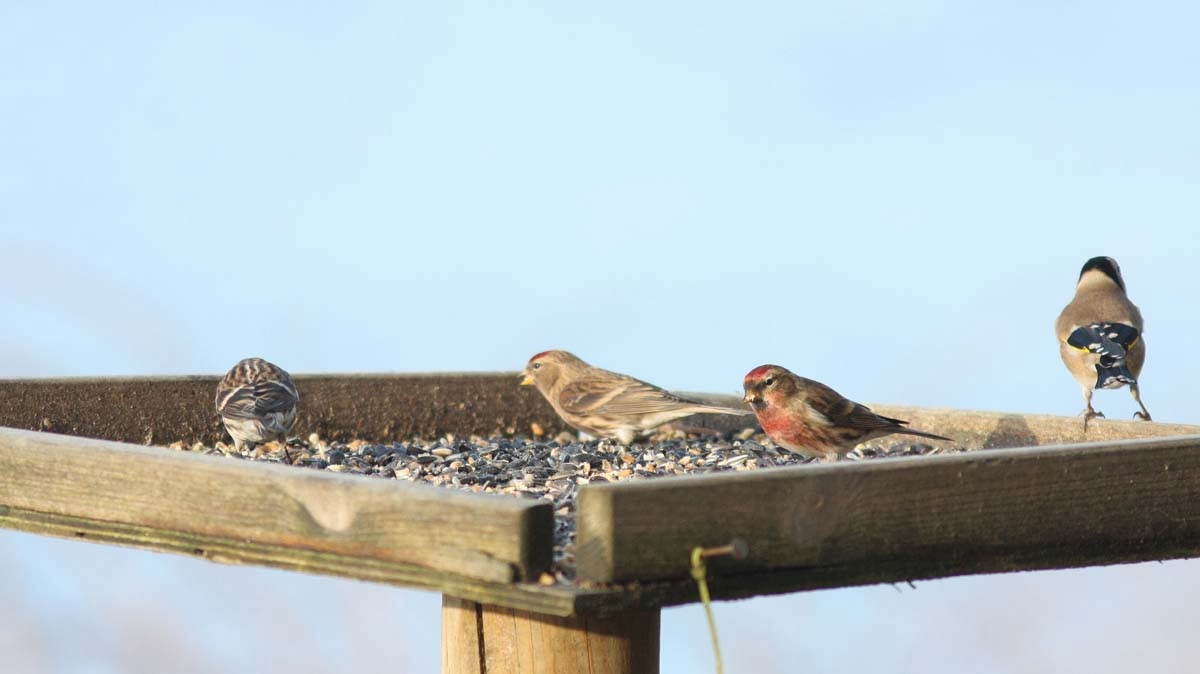
The highlight for both of us was undeniably a male Brambling. They always send a frisson of excitement through me and I guess Terry also. So much more attractive in their brighter multi coloured plumage than our lowly Chaffinch. It mixed in with a variety of other finches; Greenfinches, Chaffinches, Goldfinches, Lesser Redpolls, one male of which was wonderfully suffused with rose pink on its underparts and a single male Siskin. Below the bird table some opportunistic Mallard drakes waited for seeds dropped from above, muttering to themselves like fat old gentlemen. Not a bad start to the day


Brambling, Greenfinches and Siskin

Lesser Redpolls and Goldfinch
Mallard

There were also two Greater Scaup reported from here and we found out they were to be seen on the Conservation Pool which was the small area of water on the other side of The Causeway, that crosses the northern tip of the reservoir. It was only a five minute walk from the car park so I suggested to Terry that we make good use of our time and go look for the Greater Scaup with the hope the Lesser Scaup would desert the sallows and maybe come closer in our absence. 

The Conservation Pool is actually a part of the reservoir set aside specifically for birds, principally ducks and has a bird hide on each side of it. We decided to give the hides a miss and concentrated our search from The Causeway itself. At first we could find no sign of anything resembling a Greater Scaup and most of the ducks, principally Tufted were sheltering from the brisk wind at the far end of the pool in a sheltered bay on the left with only a restricted view due to overhanging bushes. There were also Teal, Mallard and a scattering of Common Pochard sharing the pool with the Tufted Ducks and a single Common Snipe was almost invisible, crouching in the dead stems by the water's edge. Its buff, brown and black plumage rendering it superbly camouflaged in the similar coloured surroundings.

Quite some time passed with our frustration levels rising, then a brown diving duck with a huge white blaze around the base of its bill swam out from behind the  bushes and there was a female Greater Scaup. A little while later and an adult male Greater Scaup, all pale grey upperpart vermiculations and bottle green head joined her. So we now had seen a pair of Greater Scaup. Excellent.

We watched them, albeit distantly, for some time but they were diving, feeding and obviously intent on remaining in their sheltered bay with their Tufted Duck companions so we went back to the feeders for some more finch action. The Brambling was still there but all the finches scattered as a Black headed Gull boldly took over the bird table and despite threatening movements from yours truly steadfastly refused to be intimidated and vacate the bird table. At the rate it was gobbling up food there would be little left for any finches or anything else in a very short time.

"Come on Terry let's go over the other side of the reservoir and see if we can get closer to the Lesser Scaup and get some photos". Terry was sceptical. We walked a short distance up the road and took the gate leading to the far reservoir bank. Fortunately there was ample cover of bushes, trees and reeds to screen us from the ducks sheltering in front of them on the water. They were slowly drifting towards the Causeway anyway, being blown by the wind and by some miracle of chance the Lesser Scaup separated itself from the Tufteds and drifted ever closer to us. The light was not brilliant with the sun dangerously close to shining straight into the camera lens but we got what are euphemistically called 'record' shots. We watched it diving and loafing on the water for around thirty minutes and took its photo many times  and then returned to the car park happy with our morning at Tittesworth.


It was now lunchtime and we decided on visiting Ham Wall Industrial Area located at Coleshill, a not very attractive area of the West Midlands but at least on our route back to Oxford. Our interest was in a Hume's Leaf Warbler which by rights should be spending the winter in northern India but by some random quirk of nature was spending its winter in a large area of brambles, scrub and scattered hawthorns backing onto some huge industrial warehouses. A rural idyll this certainly was not. The area it favoured was bordered by a muddy and waterlogged 'unofficial' motorcycle track, on which we stood, with lethal mud slides and deep puddles that had to be circumvented, the whole area embellished with the traditional urban accompaniment of various discarded bottles, cans, Pringles tubes and trashed footpath signs. The Sunday peace and quiet was intermittently punctuated by the roar of engines as the local 'lads' hurtled up and down the motorcycle tracks on their motorbikes. Not a crash helmet in sight. To give them their due they did keep well clear of us but the noise was still deafening.

When we arrived there were around twenty five people hanging about. Bored and stoic they just stood in the mud hopefully staring at the brambles and scrub. We joined them. The warbler had not been seen or heard for over an hour. Slowly people drifted off, presumably just fed up with standing in mud and staring at acres of brambles seemingly devoid of life. A Common ChiffChaff hooeeted it's way along the hedgerow behind us and a couple of Long tailed Tits messed around in a bramble clump but soon moved on. That was it for birdlife. Another hour, or it seemed like it, passed. The sun slowly sinking below the warehouses. Suddenly a group of birders sprang to life, pointing at the brambles and we all ran a short distance to join them.The Hume's had been heard and apparently seen briefly. Sure enough it called again, an anxious and breathy ppsssseet. Unmistakeable. Where was it though? Another birder cried out, "There it is, in that hawthorn. Unfortunately there were quite a few hawthorns to choose from. It had appeared in a hawthorn far back in the brambles. Too late. Before I could raise bins to eyes it dropped down into the brambles out of sight. Every birder knows the disappointment and frustration of such situations and the landscape now became infinitely more depressing with this near encounter. Most of us had missed it and you could almost feel the will for it to re-appear emanating from the ten or so of us still waiting to see it. Fifteen minutes passed. It re-appeared and I missed it again due to being some way left of the other birders and looking in the wrong direction. It dropped down into the brambles just as I got my bins on the right tree. I was now feeling even worse than before. Terry was the same. Then thirty more minutes passed very, very slowly. Silence. Not a sign. No one knew quite where it was. "Listen! there it is again, calling loudly, off to my left". I was the only one to hear it and rushed to the approximate spot followed by the others and finally there it was flicking around in a lone bare hawthorn. 

Hume's Leaf Warbler c Terry
Up, down, left and right it whizzed with incredible speed around the twigs and branches, seizing tiny invertebrates and calling frantically all the time. I got it in the scope, another minor triumph, for following this will o' the wisp was immensely difficult as it zipped about in random directions in the tree. Now full on in the scope I could see the dull green upperparts and greyish white underparts with a dull yellow wing bar and supercilium. Very much a drab watered down version of its close cousin the Yellow browed Warbler, and just as the books describe it.

We watched it for around five minutes before it flew further and disappeared in the brambles but then up it popped again in another bare hawthorn and for a couple of minutes gave an encore to its earlier performance. Then it was gone, right over to the back of the brambles by the warehouses. The light was now slowly going but we were happy. Some of the best views I have  had of this rare warbler and for Terry another lifer.We slithered our way through the mud and detritus back to the car. 

Triumphant