Monday, 7 January 2013

Waxwings and Motorway Madness 06 January 2013


Verily I awoke on the Sunday morning and as if yesterday's experiences at various flooded sites in Oxfordshire was not enough to act as a deterrent decided to inflict further punishment upon myself by entertaining a visit to Beaconsfield Motorway Services (now fully open you will be pleased to know) on the M40, in the hope of seeing some Waxwings. 

It was dark when I left for the one hour drive but as the morning finally dawned, I feared no evil and drove southwards through the Valley of the Thames. It became apparent that a wet mist had descended, and I was sore afraid, with gloom and a mighty dread at dipping all around. I now thoroughly regretted my decision but it was too late. On into the valley I drove with car fog lights twinkling in the swirling mist .Visibility as well as any remaining optimism was now at a premium but I carried on and with other pilgrims of the road arrived at the designated temple of despair and despond. Yes, a Motorway Service Station, the ultimate portal to indifference, mediocrity and over priced junk food, on a damp, grey Sunday, shrouded in fog. It does not get much worse than this. Veritably a trial of will over common sense. The Waxwings were reported to be frequenting the ornamental berry bushes dividing the entrance road from the lorry park and petrol pumps. Huge eight wheel, even ten wheel lorries from many lands thundered around me, spewing Yorkie bars, testosterone and diesel fumes.  I sat in the Audi, no correct that, cowered in the Audi in a distant and relatively deserted corner feeling I had crossed into a parallel world of naffness and numbing mundaneness. Finally, nay courageously, I decided to leave the sanctuary of the car and walk around the perimeter of this soulless oasis of fumes and noise to see if I could find solace in the form of the flock of Waxwings. I wandered round the back of the service area with my bins, onto a litter strewn track snaking through some bushes, trying to give the impression this was normal behaviour and there, high in a tree, shrouded by the fog, were thirteen visions of ornithological loveliness. Waxwings. I watched them for fifteen minutes as they just sat in the tree preening and getting as damp and possibly as edgy as myself.  I went back to the car to try to shut out the sheer awfulness of my surroundings. I was about to leave when I looked out of the side window and there was the same flock of Waxwings now descending onto the berry laden ornamental bushes incorporated in the landscaping of this concrete temple to petrol heads and bemused travellers. I grabbed the camera and approached them but they flew off up into the surrounding tall trees. 

Now I know a thing or two about Waxwings from my previous experiences during this winter of invasion. They were going nowhere and if I staked out the berry bushes, as sure as the petrol prices here would be a guaranteed gazillion percent above anywhere else, they would descend from the trees  again. Now it is hard to remain inconspicuous in the middle of a service station, standing on a vast expanse of open concrete looking up into trees with  binoculars and a camera slung over one's shoulder. There is nowhere to hide. Most people are here to refuel their cars or buy a coffee, hopefully Costa and not Starbucks and get out of the place as quickly as possible. No one comes here for a day out or birdwatching. Do they? I became aware of curious looks from motorists at the petrol pumps but in true British fashion no-one quite dared approach me but adopted a 'I have seen it all before' studied nonchalance. I on the other hand felt like a man with no clothes. Come on Waxwings for God's sake get down here and we can get it over with and I can go home with my pics, and you can go back up to the top of your tree. Twenty minutes masquerading as eternity dragged by and then, in a flurry of trilling, the nordic berry gobblers descended and with their usual gluttinous frenzy, totally belying their beauty, scoffed berries as fast as their little throats could open and close. 


Come to think of it something similar involving full English breakfasts was probably going on at this very moment in the cafeteria on  the other side of the lorry park, possibly without the trilling. I stood by the entrance road to the services, close to the bushes and trying to remain heedless of the curious looks from the occupants of the incoming vehicles. I  noted that the Waxwings showed a marked aversion to large container lorries and Eddie Stobart vehicles in particular but can find no mention about this under the behavioural section in BWP. I think they should be informed. 

A car hooted and a man waved at me. Bit early for cottaging? I ignored him. Oh oh! He drove around and drew up beside me and wound down his window. 'Taxi?' 'No thanks. I'm watching Waxwings'. Bemused he drove off. This was the final indignity. It was getting silly now as more and more vehicles entered the service area. So finally armed with some reasonably good photos considering the lack of light I returned to the car, steered the Black Audi back into what passes for normality on a Motorway and we departed north back into the increasing fog and gloom. 

Even Dix Pit seemed an attractive proposition after my Beaconsfield experience and so it transpired, as we headed back into Oxfordshire, that the fog lifted and visibility improved so much that viewing the watery expanses of Dix became viable. I had the place to myself when I arrived. Why am I not surprised? The lake was covered in ducks but nothing as good as the two male Smew of yesterday was evident, apart from two lovely male Red Crested Pochards. It was nevertheless nice to see so many birds in almost natural surroundings. Around fifteen scattered male Pintails floated in detached and elegant fashion amongst the hordes of Wigeon. A group of ten Goldeneyes swam close to the bank with the five males throwing their heads back in an ecstacy of courtship and the females responding in a similar but more muted fashion. They were close enough to hear the males explosive, wheezy display call. Male Shovelers pootled about under the far bank, their all white breasts distinctive in the distance against the dark background of  bankside vegetation. Gadwall's 'duck decoy' calls punctuated the stillness of the late morning and Coots, ever pugnacious, skittered back and fore indulging in their constant petty squabbles. 

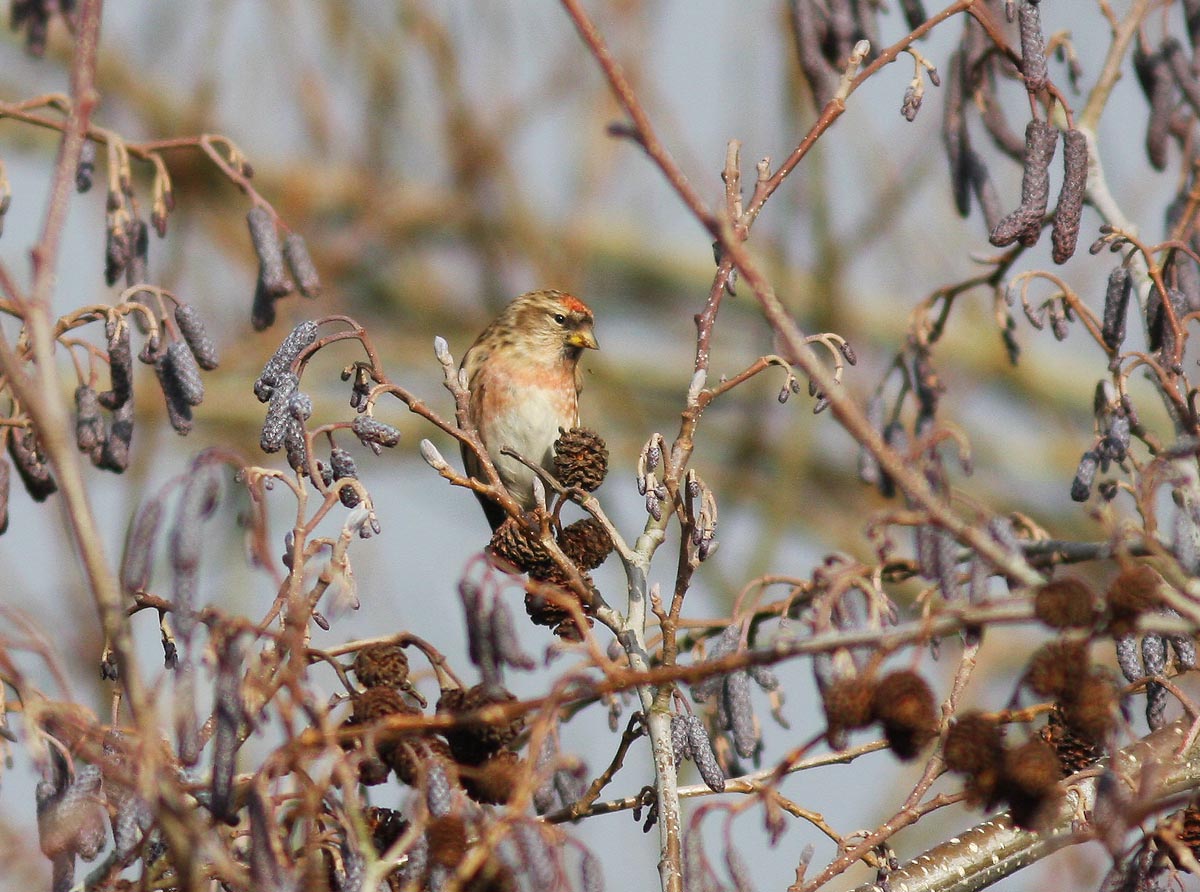
Eventually I grew tired of counting and watching this wildfowl spectacular and wandered back to the car. Uncertain of what to do next I meandered down a grassy ride to look at a copse of Alders between the lake and the road. This copse is often good for Siskin and indeed I found a dozen or so feeding quietly in the tops of the  trees with some Chaffinches. Buoyed by this success I decided to check the Alders by the lakeside itself. Approaching the first Alder a small group of half a dozen  redpolls flew out and then suddenly there was an eruption of redpolls as a flock of around forty flew up and around before settling back into the same tree. They were relatively approachable and I watched them, entranced by their acrobatic feeding on the catkins. Some were flushed with pink on the breast and showing the bright red patch on their head from whence they are named. The sun came out and further enhanced their beauty.


I checked through the flock constantly, seeking their slightly larger and greyer cousin the Mealy Redpoll but they were all Lesser Redpolls - our native subspecies. Delighted with this find I called it a day.

Monday, 31 December 2012

Christmas in the Highlands 21st-28th December 2012


Friday the 21st December found myself and my wife heading for Glasgow with the Black Audi loaded to the roof with presents, food, and everything else that is required these days for a successful period away from home. I felt an unaccustomed freedom as for once we were staying in Britain so had no worries about the disgraceful money making opportunism of cheap airlines and their weight restrictions. In my case the most important items were my camera equipment, telescope, tripod, bins, suitable clothing and a large bottle of Old Pulteney Whisky,' The Maritime Malt' as it says on the label. 

Christmas this year was going to be spent in an isolated cottage on the shores of a sea loch called Loch Sunart on the Ardnamurchan Peninsula not too far from Fort William in the West Highlands of Scotland. I am from the highlands but on the eastern side of Scotland so this was going to be a new experience for all of us as we were also picking up my daughter Polly from Glasgow University, on the way through. 

Arriving in Glasgow we rendezvoused with Polly and headed quickly for the lively 'Stravaigin' pub/restaurant ( stravaigin is a Scots word meaning to wander aimlessly about) and many in Glasgow seem to do this naturally, usually under the influence of alcohol. Stravaigin is also where my daughter does part time waiting in between studies at the University. It was fairly swinging in a packed Stravaigin when we arrived with everyone seemingly celebrating the oncoming festivities and the long drive was soon forgotten as a few Deuchars (local beer) revived my spirits along with a great meal. 

The next morning we set off from Polly's flat, leaving a rainy Glasgow and a stop at a garage on the west side of Glasgow brought a first for me as I noted a cold fish finger baguette on offer as we filled up the car with  fuel. Sheer class. It is less than a hundred miles to Fort William from Glasgow but once we had left the city behind and driven through water covered roads around Loch Lomond it could be another world with mountains rising to the sky on all sides and bleak, windy, rainswept moors and deserted roads. We traversed the wilds of Rannoch Moor with the West Highland railway away to our right and descended through the oppressive and atmospheric Glen Coe, scene of an infamous incident in ancient Scots history when the Clan Campbell  returned the traditional hospitality of the resident Clan Macdonald by massacring them. My grandmother to her dying day maintained a distinct antipathy to anyone called Campbell. Such were the tribal or clan loyalties evident in this part of Scotland until comparatively recently. We pressed on down the glen into Fort William with our destination being the Corran Ferry a few miles west of Fort William. Here we could make the short ten minute ferry crossing with the car over Loch Linnhe to Ardgour in western Lochaber. We were now in Clan Cameron country.

Corran Ferry looking towards Ardgour
Then it was driving on single track roads until we got to Achleek cottage, our home for the next seven days, overlooking the tidal Loch Sunart. The Highlands of Scotland, especially in the west, is where the most dramatic scenery is found, with roaring, tumbling burns, lochs, miles of moorland and towering mountains often with snow covered peaks as far as one can see. The density of birds and animals is relatively low but those that are here are generally to be savoured and well worth the time, patience and effort it takes to find them. All this with very few people around, so when you find something it is a very personal affair and the memory becomes as permanent as the timeless contours of the mountains


I do not intend to go into the day by day detail of what we did but just concentrate on the highlights and boy was I in for a pleasant surprise but more of this later. The weather throughout was, as expected grim, with rain on all but one day but this is the West of Scotland and it always rains in winter and this winter as we all know is even worse than usual. Achleek cottage was roomy and yet cosy with an open log fire and a huge kitchen.We settled in.

View from Achleek cottage door

Achleek Cottage
I had a whisky, pulled up a chair by the fire and we were all set for Christmas apart from one required trip back into Fort William to collect the joint of beef and brace of pheasants ordered earlier by my wife from the local butcher. The less said about Fort William probably the better. The only thing in it's favour at this time of year was the towering presence of a snow covered Ben Nevis rising above it. Quite magnificent with other mountains disappearing into the distance behind it.

Ben Nevis with Fort William below
A grey town with a depressing air about it is maybe being unfair to Fort William but all of us felt better for leaving it. The early morning spell of shopping in Morrisons did not help the mood nor did the constant rain and low cloud and it was with relief we headed for the hills and our cottage. On the 23rd December I decided to take a short drive around the head of Loch Sunart to Strontian on the opposite side of the loch to our cottage and where the element Strontium, named after the town, was discovered.  


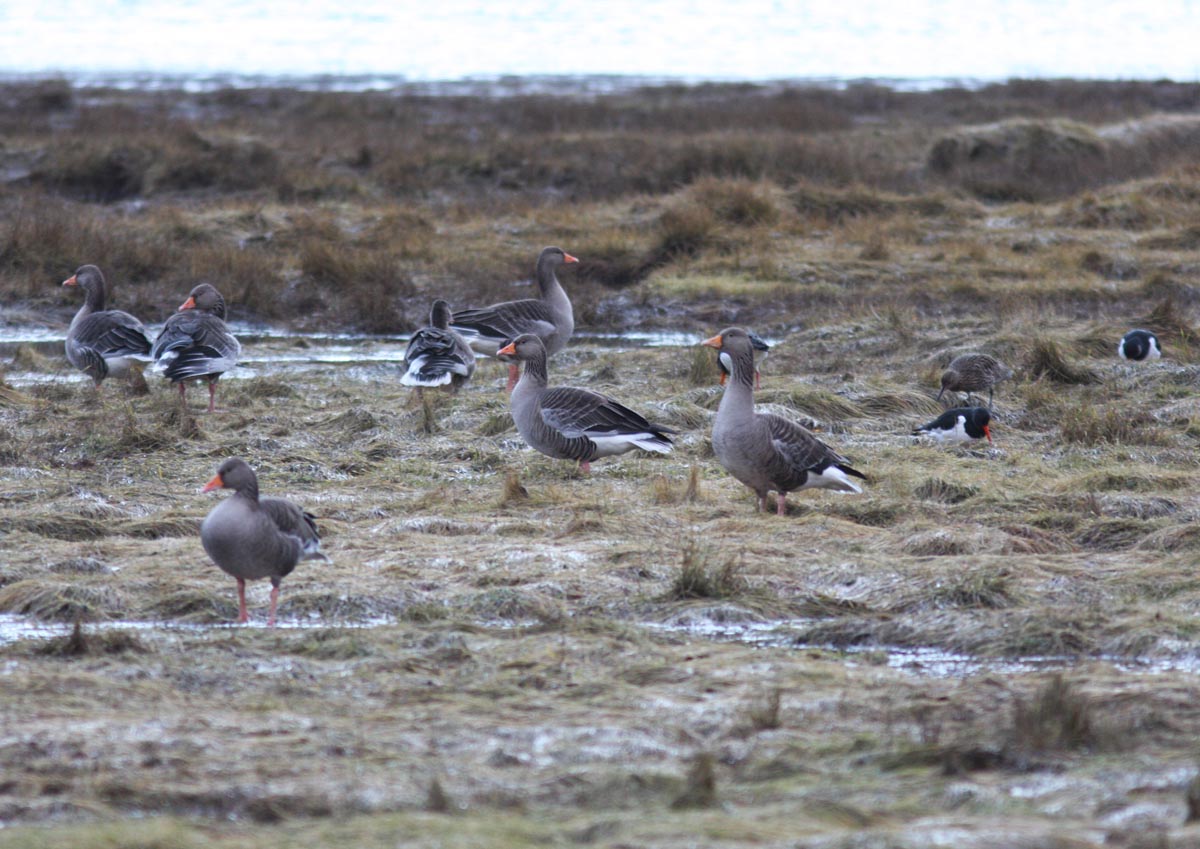
A pleasant surprise came immediately as I left the cottage, with a flock of around sixty Siskins feeding in alders by the lochside. The single track road follows the contours of the loch very closely  all the way round and is ideal for using the car to look for Otters. I was out of luck today and eventually arrived in Strontian and parked by a small area of saltmarsh to look at some Greylag Geese. Yes, real wild ones, none of your Farmoor Reservoir, southern softie ferals here! There were also some Curlew and Oystercatchers fiddling about on the saltmarsh, the only resident waders at this time of year

Greylag Geese


Curlew

Looking at them I became aware of some Mallard emerging from under a bank and dabbling in the flooded vegetation. One looked darker than the rest. I looked at it in the bins. For a moment I was flummoxed. What was it? A hybrid of some sort? Mallards are notorious for this after all but no this was not a Mallard pure or hybrid. It suddenly registered. This was an American Black Duck and a drake what's more. It was paired to a female Mallard and quite happily feeding and coming ever closer on the incoming tide. I did not shout expletives, I was not stunned or started shaking but quietly did a mental jig of joy and called my wife to share my excitement. I took images as fast as I could with the camera. I was aware of the problems and pitfalls of hybridisation with Mallards as the two species are so closely related but with no reference books or articles to help me just took as many images from as many angles as possible and made copious notes, all to be consulted later. I knew the speculum was an important feature but the duck was constantly feeding, mainly with its head under water and it looked unlikely to flap its wings. I waited almost two hours, which frankly was no hardship with such a rare bird in front of me, until finally it gave up feeding and started preening and I at last saw the crucial speculum.  Blue with no white on the inner side and only the thinnest of white lines on the trailing edge. It looked good, very good but I was still cautious. Now of course it was too dark to get an image of the speculum for future reference. Never mind. My day closed with the duck asleep and darkness descending at only four in the afternoon. I returned to the cottage and after some discussion with Angus at Birdline Scotland we agreed that it was a genuine, pure Black Duck and he would put the news out on Birdline Scotland. Reeeeeeeeeeesult. Christmas had now come early for me. I also noticed that there was a hybrid male Mallard with it which was also paired with a female Mallard, so presumably the Black Duck has been here for some time and has already bred.

The Saltmarsh at Strontian favoured by the Black Duck


The drake Mallard top right is probably a hybridMallard x Black Duck.The Black Duck is next to it
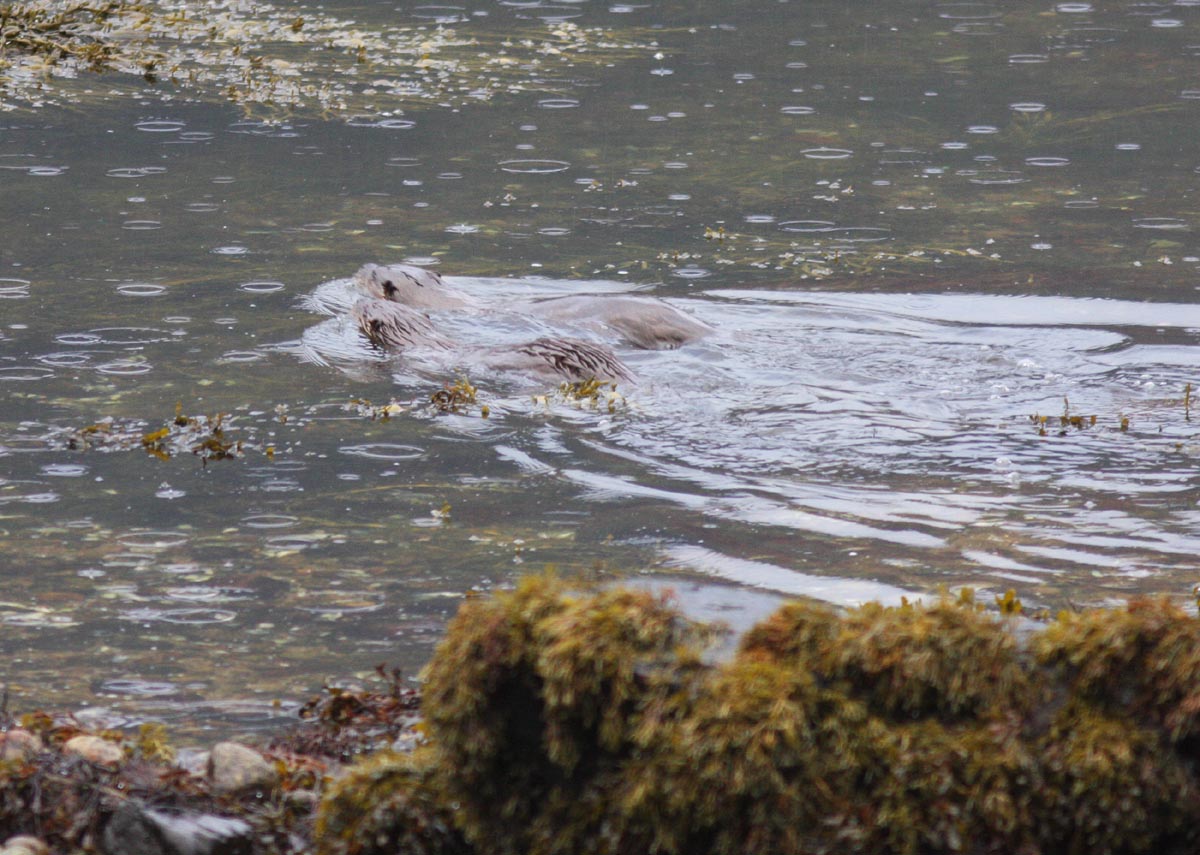
What a great start to the holiday. The next day I made the same drive around the loch, again looking for Otters and approaching Strontian found two Otters playing with a fish. It looked like they were a mother and a full grown cub.Of course they were in possibly the most difficult place to park a car on a single track road but eventually I found a passing place in which to leave the car, sneaked out of the car with the camera and got some images as they came out of the water and messed about on some seaweed covered rocks. Then back into the water they went and off out into the middle of the loch, fishing and playing. I moved on to try and see the Black Duck again but there was no sign of it or any Mallards. In fact I only subsequently saw it once more, on the day before we left, so my initial extended sighting was really lucky.


I cannot say that the birdlife or animal life was prolific at this time of year but the creatures I saw were of high quality and more importantly rarely seen in Oxfordshire so I was not complaining and let's face it a Black Duck and Otters in unbelievably beautiful and isolated surroundings was worth a thousand Fieldfares in vast, flat Oxfordshire fields or a Caspian Gull on a Didcot landfill site. 

After Christmas Day we made various family journeys to local sites of interest and always in sensational surroundings. We visited the ruined 13th century Castle Tioram at Dorlin on Loch Moidart, featured in the films Rob Roy and Highlander 3 and a walk around the deserted bay and out to the castle produced Common Goldeneyes, Eurasian Wigeons, Mallards and a nice flock of fifteen Rock Doves. By the way on the whole holiday we did not see one Woodpigeon. Who would have guessed that?


Castle Tioram 
We then drove on a seemingly endless but only twenty five mile long, winding, single track road right out to the very tip of the Ardnamurchan Peninsula, the westernmost point of mainland Britain. My daughter who is not really known for extreme sports apart from an interest in taxidermy and trapeze decided she wanted to swim from the westernmost point of mainland Britain. So in her underwear took to the sea scaring both a Great Northern Diver which surfaced nearby along with her amazed parents. It was zero degrees but she insisted and was in for about five minutes before admitting it was very, very cold. 


Ardnamurchan Lighthouse

Crazy daughter
Sensibly dressed wife with now very cold daughter
The efficient car heater thankfully rectified matters quickly and hypothermia was averted. Back at Achleek cottage we tried enticing Pine Martins to the cottage with the jam on bread routine but ended up with something much larger in the form of a Red Deer stag on the doorstep next morning, which promptly hoovered up all the bait, in between snacking on Holly. He was what is termed a Royal as he had twelve points on his antlers. The one to really get excited about is an Imperial which has fourteen points on its antlers but our friend with twelve was good enough for me


Looking for jam sandwiches which were on the doorstep

We heard the Pine Martins outside during the night but sadly never got to see them as we did not fancy sitting up all night. I also visited the eco-friendly Garbh Eilean bird hide at Ardery for an afternoon which provided welcome shelter from the incessant rain showers and allowed me to do some quiet bird watching and recover from the excesses of Christmas Day.


Garbh Eilean Hide

Sightings board at Garbh Eilean Hide
It is meant to be a good area for Otters but for the first hour there was no sign just ten or so Common Seals loafing on the seaweed covered rocks, numerous Grey Herons (there is a heronry on one of the islands just offshore) a Shag, a male Goldeneye and some Red breasted Mergansers. A distant and dark shape way out in the middle of the loch turned out to be a Great Northern Diver when viewed through the telescope. An hour passed. A Little Grebe surfaced amongst the seaweed. Then a dark head appeared well out in the loch. Common Seal again? I got the scope on it and it was the  long awaited for Otter. It was fishing and feeding constantly and coming closer to the shore all the time. It surfaced with a flounder, crunched it up with apparent relish whilst standing on a submerged rock and then slid effortlessly back into the water still slowly heading for the shore, fishing as it went. I last saw it right by the shore and then lost it in the onsetting gloom of rain and low cloud. I must have watched it for over thirty minutes all on my own before retreating home to an open fire and the warmth of the cottage. The one big regret was that due to the weather conditions we did not see any eagles until the last day, when on the drive out two White tailed Eagles gave us a brief glimpse by Loch Linnhe before they disappeared round a hill side never to be seen again. My wife is planning for us to go back in June and I will not be complaining. 

HAPPY NEW YEAR

For interest I saw the following birds and mammals during our holiday

White tailed Eagle/ Common Buzzard/ Common Kestrel/ Common Raven/ Hooded Crow/ Rook/ Jay/ Great Black backed Gull/ Herring Gull/ Common Gull/ Black headed Gull/ Great Northern Diver/ Little Grebe/ Goosander/ Red breasted Merganser/ Mute Swan/ Greylag Goose/ Canada Goose/ Eider Duck/ Common Goldeneye/ American Black Duck/ Mallard/ Eurasian Wigeon/ Eurasian Teal/ Oystercatcher/ Eurasian Curlew/ Ringed Plover/ Dipper/ Common Pheasant/ Red Grouse/ Grey Heron/ Cormorant/ Shag/ Rock Dove/ Common Starling/ Blackbird/ Song Thrush/ Redwing/ Robin/ European Stonechat/ Dunnock/ Siskin/ Common Chaffinch/ House Sparrow/ Rock Pipit/ Great Tit/ Blue Tit/ Coal Tit/ Long tailed Tit/ Wren/ Goldcrest

Otter
Common Seal
Red Deer