Monday, 22 October 2012

And now I'm feeling EPIC!! 20th October 2012

Kilminning Picnic Area, Fife.
All roads lead to a Mega.
For the whole of the preceding week a mega rarity in the form of an Eastern Olivaceous Warbler had been reported daily from a place called Kilminning in the Kingdom of Fife. 

Where? 

You may well ask. Kilminning is the name given to a Wildlife Reserve and also to an adjacent Picnic Area owned by Fife Council but does not appear on any map that I could find. The nearest village on the map is Crail, about as far east as one can get in Fife before falling into the sea. 

Work commitments just kept getting in the way all week until finally a window of opportunity appeared to be available on Saturday. The plan was however hatched much earlier on Thursday, although at first it seemed madness. I would go at midnight on Friday if the bird was still there, drive seven hours through the night and arrive at 7am on Saturday morning, which I calculated coincided with dawn in Scotland. This was right up there with my long haul twitches to Shetland (Siberian Rubythroat ) and Orkney (Sandhill Crane) and hopefully it would be just as successful. The combination of high risk and long distance plus the bonus of returning, however briefly to my native country, all added to the excitement and trepidation. 

Tracey my assistant at work declared me mad. Again. 

My wife just said 

'What is it this time' and pretended to be impressed with my excitable declaration 

"Only an Eastern Olivaceous Warbler. A mega !" 

On Thursday, to add to the excitement, there had also been two Radde's Warblers and a Red Breasted Flycatcher discovered at the same location but these had not been seen on Friday. Never mind, the Olivaceous was the prime target. 

Being my own boss I was able to leave work at lunchtime on Friday and came home and went to bed to prepare for a midnight departure that same day. It was going to be a very long drive so the more rest I could accumulate the better. I like late night driving, it's almost romantic with comparatively empty roads, the sharp edges of daylight gone to be replaced by the soft contours of night and the comforting glow from the car's instrument panel lights. Me and my beloved Audi on the road again but not so alone this time. I have never seen so many lorries as on this night. Were they all trying to get home for the weekend? There were convoys of them, ten or more strong at times cruising up the inside lane of the Motorway. 

I sped on past them and made a stop at 3am just south of the border. There is something almost surreal about Motorway service stations at this time of night. They are apparently devoid of human life, but all the lights are on and usually there is some dire, totally inappropriate, keep you happy mood music blaring out in the toilets. Has anyone seen The Shining starring Jack Nicholson? Well you almost expect something similar could happen here. But no one attacked me with an axe and no one announced themselves as Johnny so I regained the security of the Audi intact in body if not in mind and continued North across the border, Failte ghu Alba - Welcome to Scotland - and on through the hills to Glasgow and east across to Edinburgh. Then it all went slightly wrong. 

It is said the body's metabolism reaches it's lowest at this time of night and if something does not go according to plan, from my experience it's sometimes difficult to cope. The M90 spur road specifically to take you to the Forth Road Bridge and which should have been open was closed. I found myself with no choice, stuck on the M90 going West, heading in the wrong direction and with no apparent way of getting off it. I decided to get off the Motorway at the first exit I came to which after what seemed an eternity, eventually materialised. I zoomed up it and there in all its glorious luminosity was a sign saying Diversion for the Forth Road Bridge. Really? I had found it by sheer chance. Why were there no signs further back down the Motorway? Have my fellow Scots become psychic? The diversion directed me over the Motorway and back down the other side along a minor road now going in the right direction-East. No sign of the Forth Road Bridge or anymore diversion signs so I carried on in hope and eventually found a left turning which indicated I should turn here for the Forth Road Bridge. 

Back on track. 

Over the bridge I went. No tolls! Mine was the only vehicle crossing this triumph of engineering, allowing free access to Fife and an Eastern Olivaceous Warbler. Off to my right was the even more impressive Forth Rail Bridge with its celebrated three arches, illuminated to show off their full magnificence. 

We were nearing our destination and Scotland was stirring, with other cars now on the road. An hour later found me arriving in the village of Crail and obeying instructions I followed the road through the village and after a couple of miles turned right into Kilminning Picnic Area, parking at the far end to await the approaching dawn. Shortly after 7.30 there was enough light and I ventured out of the car. Kilminning appeared to be a flat area of rough grassland, almost wasteland, complete with abandoned trainers and other items of clothing, scattered shrubs and trees, bounded respectively on three sides by a golf course, the sea and a disused airfield. 

All was quiet and the whole area just said 'BIRDS'. It was that kind of habitat and must be a dream to have as your local birding spot. I said all was quiet but shortly after nine that morning the peace and quiet was shattered by the roar of high powered, very expensive looking cars racing up and down the disused runaway. Presumably this was a Scots version of the Jeremy Clarkson driving experience as it even had the male macho men, watched lovingly on the sidelines by their devoted babes. They were still at it when I left five hours later. 

The Olivaceous Warbler was apparently to be found in a fairly restricted area of dog roses and scrub near to the seaward side of Kilminning Picnic Area. In fact looking at this area it would appear to have been part of the airfield in the past as much of it was derelict. Reports also indicated that the warbler could be best located by it's almost constantly uttered tack tack tack call. I listened in the quiet of post dawn and pre whacky races. Lots of Robins were ticking away, a Fieldfare chackered in an Ash tree and then un-mistakeably I could hear a distant but distinct tack tack tack call. I wandered around trying to locate it and eventually came to what appeared to be a drying shed or some such building surrounded by thick briars or rose bushes. Another birder was already there and indicated that the warbler was in these bushes. I rapidly joined him and for a few frustrating minutes could hear the bird but not see it. It was keeping well under cover and moving steadily along the inside of the bushes. Eventually I got good but fleeting views of it through the bins as it passed through a leafless area of the bushes. 


Eastern Olivaceous Warbler
The main thing I noted was how grey  it was on the upperparts and dull white below with a long, pale bill noticeably orange on the lower mandible. It's plumage was nothing like the more familiar warm brown tones of a Reed Warbler. It also moved its tail up and down regularly and kept up an insistent tack tack tack call, making it easy to follow as it moved through the bushes. It was on the move constantly and virtually always remaining in cover. Occasionally it would come out in full view but never for more than thirty seconds at a time. About another twenty five birders were present at first light with more joining throughout the morning but the number of birders watching the warbler later in the morning was never more than just a few. 


The Eastern Olivaceous Warbler favoured the thick leafy dog rose adjacent to the
birders.This appeared to be its favoured habitat wherever it was
There was no fuss or scrum as everyone apart from the dreaded photographers had ample space to stand and watch it. I just do not understand why some, but in fairness not all photographers have to insist on getting so close. One individual did not even have bins or scope. His sole mission appeared to be to try and get as close as  possible to get his photo which on occasions meant he would regularly stand bang in front of me or others until our patience finally ran out. I take photos too but the light was initially very dull and the bird too well hidden to get anything half decent so preferred to actually watch it through my bins. 

In the end I got fed up with the crowd and wandered off. I stood on a bank overlooking some briars and there was the warbler. I watched it on my own for a few minutes until it disappeared. Occasionally it would stop calling which I learnt from experience meant that it had flown to another area nearby and then would recommence it's monotonous tacking call. On one such occasion when it was silent I went to another area and it appeared high up in a tree calling but also using the rain on the leaves to wash and preen. Again I had it to myself and I watched it frenetically jumping about in the wet leaves for around five minutes. 

First winter Eastern Olivaceous Warbler
You can just see the white fringe to the outer tail feather.
Also the medium  primary projection, the fairly thick grey legs and pale orange lower mandible.
Note also the comparatively featureless pale face with dark eye 
Overall it was on constant view or its presence could be heard for all the time I was there, which was five hours. Apparently when the sun came out in the afternoon, after I had left for home, it showed itself much more in the open which was a little annoying. When I was there it was overcast and presumably that was why it remained in cover although with patience there were more than adequate opportunities to see it well. I was happy with my encounter with the warbler and even managed some photos in the end. 

While chatting to a birder from Manchester mid morning we got an alert that there was a Radde's Warbler a few hundred yards away and we could even see the small group of birders watching it. This would be a new British species for me so with due respect to the Olivaceous Warbler I was off post haste and joining the small group saw the Radde's almost immediately, perching low down in the base of bushes and behaving very much like a Cetti's Warbler i.e more invisible than visible but without the voice. Eventually it showed well and what a subtly attractive bird it was with dark brown upperparts, a long, broad and creamy supercilium and rufous undertail coverts. It played hide and seek in the bottom of the bushes and the rough grass but I did get some great views of it so was very happy. Especially as it was so unexpected. Was this one of the birds from Thursday or another? It certainly was not in the same place as the other two had been reported from. Still, I was hardly worried by such trivialities. 

I went back afterwards to renew my Olivaceous Warbler experience but now was running against the clock. I had to be in London at eight the next morning and even my unbounded optimism told me that I should head south at twelve noon which would get me back home by around 7pm. Enough time to get some sleep before driving to London at six the next morning! 

I had an hour left of the morning and as things seemed to be going my way went to the area where the Red breasted Flycatcher had been seen a couple of days ago. It had not been reported today or yesterday but I could see no good reason why it would not still be around. I stood about with a few other birders but there was no sign of it. Four Whooper Swans flew over bugling. Someone claimed to have heard a Yellow-browed Warbler. Then a small shape flicked into a sycamore.

First winter Red breasted Flycatcher
First winter Red breasted Flycatcher.
Note the pale tips to the greater coverts and tertials showing it to be a first winter bird
So quick and ill defined it was easy to miss it. Bins up and there was a first winter Red Breasted Flycatcher. They are such a delight to see. A veritable woodland sprite with a flycatcher's engaging way of  looking at you almost benignly and knowingly. It was a real trial of tired eyes following it through the trees as it rapidly flitted around especially with the constant falling of leaves. Many a call was stifled as people realised that the flycatcher they thought they saw was a falling leaf. Eventually the real thing would turn up and engage us all with it's charm and perky demeanour. Tail cocked, wings akimbo, the epitomy of restless energy.

First winter Red breasted Flycatcher.

It even gave it's ticking call and also a rattling call which they are said to use only on migration, very similar to a Wren. What a great bird to see. So my high risk twitch paid off big time. Forgive my self satisfaction, understandable after the triple dip in Ireland. Now it was a long haul back to home, via St Andrews to stock up on Scotch Pies and organic Venison sausages to take back a taste of home for the freezer. Seven hours, four power naps and 895 miles later I was home with a large Old Pulteney malt whisky in hand.

'Did you see it dear'. 

"Yes.Thanks for asking". 

"Goodnight". 


Tuesday, 16 October 2012

I may be onto something 16 0ctober 2012


The main criteria for distinguishing adult from first winter Purple Sandpipers is given in reference books as the  difference in shape, colour and patterning of the lesser and median coverts on their wings. Adult birds have square ended  lesser and median coverts with diffuse grey fringes which provide little contrast whereas first winter birds have rounded tips to the lesser and median coverts with prominent white fringes providing a marked contrast and scaly appearance to the closed wing, much different to adult birds. 

The following images are ones I took of both first winter and adult Purple Sandpipers in early winter at Brixham where there is a regular wintering flock. Note the difference in colouring to the legs, feet and base of the bill of  first winter birds compared to adults. The first winters show bright orange legs and feet combined with a reasonably extensive orange base to the bill whereas  adults have duller greenish yellow legs, feet and base to the bill. The colouring on the bill base of the adult also appears to be less extensive. The difference in colouring of the bare parts was very obvious at the time and appeared to be consistent amongst the seventeen individuals present on the rocks. This feature was easier to use than the wing covert patterning to distinguish between the two ages. I cannot find any reference to this difference in any reference book including BWP but it may be worth using when next a Purple Sandpiper turns up in Oxfordshire or anywhere else you are lucky enough to encounter one or more. Please note this observation was in early winter and as the winter wears on there maybe changes in the bird's plumage and colouring but it certainly seems to work for the period before January of the following year

First winter Purple Sandpiper.

Note the orange legs, feet and bill base combined with the retained juvenile lesser and median wing coverts showing rounded tips with prominent white fringes


First winter Purple Sandpipers


Adult winter Purple Sandpiper. Note the dull greenish yellow legs, feet and bill base combined with the diffuse grey fringes to the square ended lesser and median wing coverts showing much less contrast than on first winter birds


Adult winter Purple Sandpipers


Monday, 15 October 2012

Clinging on 14 October 2012


Pagham North Wall
A sunny autumn Sunday proved enough to get me out of bed and down the A34 to one of my former haunts in West Sussex - Pagham Harbour. How I miss the sea, those huge skies and wide horizons and with what joy I found myself on the North Wall of Pagham Harbour mid morning. Sadly the four Spoonbills that had been here for the last few days did not share my enthusiasm and had moved on. I met Chris Janman, one of the locals, intently surveying a reed bed. 'There's a warbler in there showing itself intermittently and it looks quite grey. It might be interesting'. said Chris. 'OK I'll hang about. We chatted about this and that but the warbler did not show itself so we moved along the wall and then back again covering all the angles and extent of the reed bed. I was just about to give up when said warbler shot up into the air, flycatching from the reeds. It disappeared but then was up again. Then down again. Frustration. Finally it allowed us to get it in our scopes and obtain a good view of it. It now appeared warm brown. Just a late Reed Warbler then but nice to see all the same and it had provided a frisson of excitement and anticipation for an hour.

Chris left for home but I remained on the wall enjoying the surroundings. Before me was what is called the Breech Pool and which over the years has harboured many a rarity. The last one was a wintering Paddyfield Warbler earlier this year, in exactly the same reed bed as our Reed Warbler of today. Behind me the open harbour, still with the tide well in, stretched to the open sea and the water on the horizon became invisible in the bright sun. 

Pagham Harbour 
Little Egrets roosted on a grassy island waiting for the water to recede. Wigeon whistled and floated around in groups. There was that unique quiet calm of a high tide on a still day as everything ceased moving and waited, waited for the tide to recede and the saltmarsh to become once more exposed. Before me the edges of  the Breech Pool sheltered dozing Teal, the drakes still only half way to acquiring their full beauty. A Shoveler drake swam out of the reeds, its harlequin colours shone bright on the blue, sky reflecting water. Three Black tailed Godwits slept in the lee of some reeds, the birds pivoting on one leg as they kept one eye on their surroundings and Common Snipe hid in the long grass by the water's edge. A Greenshank, very pale in the sunlight, flew inland calling loudly and a flock of Curlew took off from the fields behind the Breech Pool and headed out into the harbour, their wild, loud cries accompanying them into the distance. A much harsher squealing betrayed a Water Rail concealed in the reeds. Finally a small brown passerine flew across the Breech Pool and perched right on the top of a small hawthorn. Not the usual Reed Bunting this time. Oh no! A female European Stonechat, but unusually not accompanied by a male. Perhaps she was a migrant getting ready to, as one of the old bird books I regularly read, charmingly said of this species, ' take the tour of the Continent'. Yes, it was a very old book but quite readable and how much more gentle and quaint birding seemed to be in those days. The first two weeks of October are the peak time for passage of stonechats on the south coast. 

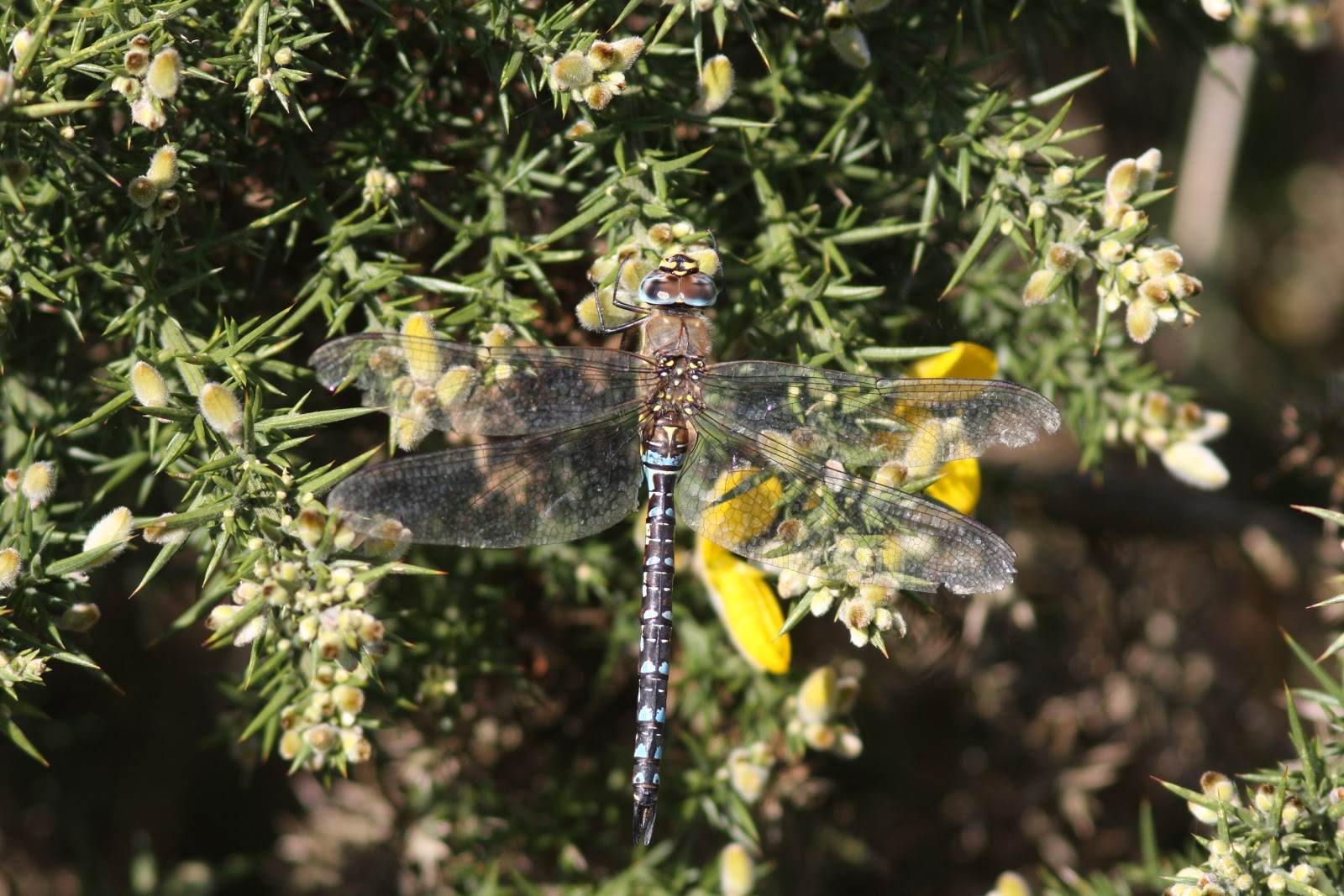
My plan was now to go for the remainder of the afternoon to the other side of the harbour at Church Norton looking for Firecrests in the Churchyard, a favourite spot and possibly also to seek them in the wind blasted gorse and bushes sheltering the footpath running along the western edge of the harbour. Both failed to deliver a Firecrest but I did find two Goldcrests in the Churchyard. Along the harbour footpath a male Migrant Hawker was flying in a sheltered recess behind the gorse, shielded from any wind coming in off the harbour. 

Field Parasol
Nearby a Field Parasol fungus lurked like, well, a parasol, in the long grass under the gorse. The hawker sailed around aimlessly in it's little warm arena and then settled on some sun soaked gorse all ambition gone. Maybe this was the day when the sun on its tattered wings would be it's last. 

Migrant Hawker male
Back in the Churchyard a couple of Red Admirals spiralled listlessly upwards, parted and drifted like separate, spent leaves down onto the grass. Their tired, energy expired flight pressaging their oncoming nemesis. Similarly a Peacock, resplendent in paint box colours, found a warm, sun soaked gravestone to fuel one last day and one last flight. 

Peacock
No birds were to be found in the churchyard but plenty were now out on the exposed saltmarsh. Common Redshanks and Little Egrets were regularly spaced out across the harbour. Five Knot, all fussy and dumpy probed the mud in a small channel and a single Sanderling fed with a Grey Plover. The plaintive echoes of Grey Plover calls permeated the harbour and Turnstones flew back out to the rocky seashore. In the binoculars I found a large, all white wader, quite distant and in fact so distant I had to get the scope on it. What on earth was it? I increased the magnification and to my surprise saw it was a leucistic Curlew. This was definitely a first. It was not pure white but a very pale off white with the occasional random pale brown streak on the upperparts. The bill was the normal black and the legs the normal grey green colour. I like to imagine it had a close encounter with the local Peregrine and the shock turned it white. 

Leucistic Curlew
While looking through the bins at the Curlew I also saw a Brent Goose mixing with the loafing Cormorants on their favourite island out in the middle of the harbour. I have been WeBS (Wetland Bird Survey) counting Brent Geese for twenty four years at nearby West Wittering so know something unusual about a Brent Goose when I see it. This one appeared to have very white flanks. The sub-species of Brent Goose that winter in the south of England and especially around here is the Dark bellied Brent Goose which do not have white flanks. Virtually annually now we get a vagrant Black Brant, the North American version of our Dark bellied Brent Goose, mixed in with the flocks of Dark bellied Brent and less often we get a displaced Pale Bellied Brent Goose which normally winter in Scotland or Ireland. I needed the scope again to confirm my suspicions but the identification was not difficult. An adult Pale bellied Brent Goose. Quite early and a very nice find to round off an unspectacular but very fulfilling day by the sea.

Sunday, 14 October 2012

Still here 14 October 2012


Some years ago our then new neighbours cut down a lovely mature ash tree that grew in their garden next to our house. Residents in Kingham like cutting down trees to make way for extensions or conservatories that add value to their property. 'You must be really pleased we have removed that dreadful tree' they enthused in their naivete. Well no, actually. This tree for years had attracted all manner of bird species and Nuthatches always bred in it every year bringing their young to the feeders in our garden. With the loss of the tree they disappeared along with the Spotted Flycatchers, assorted tits and finches that used the tree for shelter and as a food resource. I was therefore delighted to see a single Nuthatch hanging upside down on our peanut feeders the other day. It is now a regular visitor. So welcome back and long may you remain.


House Sparrows have declined by over 70% and are extinct as far as I know in London and other large cities. Here in our garden at Kingham we still have a regular flock of around 20-30 birds that visit in a garrulous group to feed on the peanuts, often monopolising the feeders, fighting off the tits and moving in and around the overgrown hedges surrounding our garden, always as a group. They chatter away incessantly in the high holly hedge that runs alongside our drive when I leave for work in the morning and are there when I get back in the early evening. The holly hedge seems to be their headquarters, providing refuge from the daily marauding Sparrowhawk, a place to loaf and preen and a secure roosting site. 


The Great Spotted Woodpeckers are still regular visitors to our feeders, flying first into the huge Acacia tree before flying down to the feeder. We have both female and male visiting but never at the same time.They are very intolerant of the smaller birds and if one of the tits or sparrows gets too close it is seen off with a vicious jab of it's beak. Sometimes the woodpecker will just cling on the feeder apparently resting, quite content, and can be there for up to twenty minutes just doing nothing before flying back into the Acacia tree. The minute it has gone the tits immediately return and recommence feeding


Saturday, 13 October 2012

White's Thrush. Lucky for some. 13 October 2012


This enigmatic species is a very rare visitor from Siberia to the UK, usually found in September and October following strong north easterly winds and is much desired by UK birders, especially twitchers. So far this autumn there have been at least four that have arrived on our shores. One caught on the Farne Islands, one seen flying over South Ronaldsay in the Orkney Islands, a third seen briefly in the far west of Cornwall and another recorded from Barra in the Outer Hebrides today. 

For this species this is an almost unprecedented annual influx into the UK. They are notoriously hard to re-locate once they have been initially flushed, although you know they are somewhere nearby and for such a large thrush (it is larger than a Mistle Thrush)  they manage to conceal themselves so well as to become virtually invisible. Only the lucky original finder that flushes them, usually from deep cover gets to see them and those that dash to see them afterwards often fail or only get the briefest of views although there have been exceptions. 

I have never been lucky enough to see one in the UK as they are typically only seen once and never again and I have never been near any of the locations when they have been found. Realistically one's only chance of seeing one is to be near enough to the location to get there the same day and even then your chances are very slim at best, although again there have been exceptions where a bird has remained for some days and allowed visiting birders adequate views of it


However, I  have been lucky enough to see no less than four separate individuals in China and two of these very well indeed. The first was in the middle of Shanghai, in the Botanic Gardens surrounded by high rise flats with all the concrete and noise of a large and bustling city. It was flushed from under some trees and flew up into one of the  trees and perched there immobile but in full view for at least thirty minutes allowing me to study it at leisure in my telescope. I could not believe my luck as I had, until this encounter, always assumed, based on reports of birds seen in the UK, that they were exceptionally hard to see and never gave prolonged views. Not in China apparently. Apart from the wonderfully patterned plumage two features of it's appearance struck me. The first was the large dark eyes and the second the bright pink legs. The latter are  really quite striking in the flesh. It remained absolutely still throughout, just occasionally changing its position ever so slightly and appeared relatively relaxed although keeping a close eye on me. In fact towards the end I was getting a little bored as it  remained so still. I left it there still motionless when time ran out and I had to be elsewhere. Maybe the fact they remain so still and well up off the ground is one of the  reasons they are not easily re-found in the UK as most people would look at ground level for a thrush and also by remaining immobile with their patterned plumage they would not attract attention. 

The second encounter with this species was on the coast, a couple of hours from Shanghai, in some small trees by a path through a village. It  repeated the same performance as the first by flying up into a tree as I approached unaware of its presence, and then remaining there motionless, but unlike the first, after about forty minutes when I moved away, it dropped to the ground behind me and commenced feeding, allowing me to take some photos with a digital camera attached to my scope. 


Note the large dark eye and bright pink legs
Looking at these photos I confess to being tempted by the bird just found on Barra. If it stays I might try my luck.There again I am due to go on a business trip to China early next year so maybe I will wait until then but it would be nice to see one in the UK

Wednesday, 10 October 2012

Ain't this Boogie a Mess. 6th October 2012

Eastern Kingbird

Belted Kingfisher

Myrtle Warbler
                                 We could have seen all three of these but didn't!

Friday afternoon, the 5th of October and all is quiet on Otmoor as I trudge around The Pill. My mobile rings. A call from Badger. A mega of all megas has been discovered on the Aran Islands in Southern Ireland. An Eastern Kingbird. Not only a first for the British Isles including Ireland but also for the Western Palearctic. This is big time. It does not get bigger. Everyone will be booking trips to Ireland. 

Frantic plans are made by Badger to book himself, Justin and myself on the dreaded Ryanair flight to Shannon tomorrow morning and the onwards ferry to Inishmore, the largest of the Aran Islands,  lying off the Galway coast and where the Eastern Kingbird is flycatching from a wall. 

Back and fore go the phone calls with Badger acting as Master of Ceremonies. The Ryanair flight at the outset is £60.00 each but by the time we get organised there are just a few seats left and the price has risen to £130.00. Badger ducks out as does Justin. I am now the sole survivor but also drop out as I do not fancy the trip on my own. Badger suggests he comes round to my house tomorrow morning and we will go to Slimbridge. Hardly compensation for what had been tantalisingly in store a few hours ago. 

I must admit I was really up for an adventure and the adrenalin rush of a high risk twitch and was not prepared to give in easily. In the meantime to add to the drama a suspected 'grey kingfisher' seen at Lough Fee in nearby Connemara turns out to be a Belted Kingfisher! Another mega. I go to work that evening on the internet and have an alternative travel plan all worked out in a few hours by using sea ferries instead of Ryanair to get to the Emerald Isle.

We will go overnight by Stena from Holyhead to Dublin, taking the Black Audi and then drive through the rest of the night across Ireland to Galway. We will have loads of time as the ship gets to Dublin at 0045 and in theory it then only takes two hours to get from Dublin to Galway and then another hour to Rossaveal which is the location for the ferry to Inishmore. What could be more simple than that? 

Saturday morning duly arrives, sunny and mild. Badger arrives a little bleary and over a cup of tea is confronted with me in my best salesman mode waving printouts of vessel sailing times and ferry schedules and although at first sceptical he slowly warms to the idea. We decide to sit and await news of the birds whilst eating chocolate biscuits. The Eastern Kingbird has apparently disappeared without trace but the subsequent search for it by visiting birders reveal there are also possibly two Myrtle Warblers, yet another mega, on the island. The Belted Kingfisher however has been seen first thing in the morning so is definitely still around. We decide that the kingfisher is priority - so it is all now go, go, go. 

Mid afternoon Saturday and we are finally on our way to Holyhead. The Stena ferry sails at 2130 hours from Holyhead. We arrive just before dusk and manage distant views of two winter plumaged Black Guillemots in Holyhead Harbour. After a long wait we get on board, a Stella for Badger and a Budweiser for yours truly at the usual depressingly extortionate prices and then we crash out on the bench seats. The ferry is due to arrive at Dublin at 0045. It's going to be a long night. I manage one hour of sleep.We negotiate our way out of Dublin and onto the two lane motorway that will take us right across Ireland to Galway. We discover that Irish motorways have tolls and also the most cheerful of attendants even at 2am in the morning. 

On arriving in Galway in the dark we unsurprisingly get lost and do an involuntary tour of that fine city before finding the relatively minor road that will take us to Rossaveal. This is where we plan to park for a while and sleep before heading further into Connmemara to look for the kingfisher at dawn. Rossaveal in the early hours of the morning was bleak and deserted. An expanse of concrete, wasteland and rusting trawlers illuminated by very unforgiving neon lighting. I feel very down.We slept fitfully in the car and decided to head for Connemara, about an hour's drive away and by which time we calculated it would be dawn. I think it was the road signs that were confusing but maybe it was us in our dazed state that confused ourselves but eventually we got mind and body together and somehow we managed to get to the right location. We carefully drove around sheep encamped on the narrow roads and first passed Lough Nee where the kingfisher had originally been seen before it flew off on Saturday morning only to be re-found later on Lough Maladrolaun in the grounds of Kylemore Abbey a few miles up the road. The abbey was closed until 9am so we checked the other loughs but drew a blank. This part of Connemara is a National Park and is spectacularly beautiful. Even with the non appearance of the kingfisher one could not fail to find one's spirits lifted by the presence of such awesome surroundings. So no Eastern Kingbird and no Belted Kingfisher. Plan Z then was to take the ferry to Inishmore and find a Myrtle Warbler.Our last chance at a mega.

Inishmore Ferry. It's surprisingly spacious inside
The ferry was crammed with tourists of all nationalities but we were the only birders. There had been over 250 birders yesterday. Somewhat worrying. I narrowly avoided an international incident when a Japanese tourist, in his haste fell over my feet, going headlong in the aisle and accusing me of being responsible for his loss of dignity when in fact he should have been more careful. Inishmore is very reminiscent of the Hebrides and indeed the inhabitants are all native Gaelic speakers and regard it as their first language. They are also some of the most friendly and accommodating souls you could wish to meet and everywhere on the island we were met with courtesy and interest about all the birders that had invaded their island the day before and what they had hoped to see.

View from Kilmurvey. Anything could be in those hedges and fields
On docking at Kilronan we first headed for the school as that was where a Myrtle Warbler had been seen and checked out what was an awful lot of potential habitat. We failed to find anything except numerous Coal Tits which along with Dunnocks seem to be the default bird for here. The most noticeable thing about the tits was the yellow hue to their cheeks which is a characteristic of this species in Ireland. Thomas, in a red van stopped by us and offered for 30 Euros to drive us around the island to wherever we wanted to go. There are numerous modes of transport available to the tourist ranging from pony and trap to the more popular bike hire. We opted for the comfort of Thomas and his red van. So, via a few stops to view European Stonechats on the numerous dry stone walls, we headed for Kilmurvey House at the north end of the island which is where the kingbird had been doing it's stuff on Friday. Thomas told us most tourists came to see the ancient Celtic Fort  Dun Aonghasa above Kilmurvey House but our minds were on other matters today. Although not overly hopeful of seeing it, another Myrtle Warbler had been seen in the vicinity of Kilmurvey House yesterday so we reckoned we had a slim chance. Needless to say we did not find it. If there were warblers in the trees and bushes they kept very well concealed from the increasingly strong wind. 

Warbler habitat! Kilmurvey
Eventually after staring at and into trees and bushes I saw a flicker of movement in a Sycamore and got a brief glimpse of a warbler with greyish underparts, a yellow wash to it's breast and olive green upperparts. Then it was gone. Badger saw it fly across a gap into another tree, above a fuschia hedge, but both our views had been inconclusive. The mystery warbler disappeared. Two Choughs flew over us. Badger wandered off around the other side of the fuschia hedge and houses but I stayed put by the hedge. Suddenly a warbler popped out of the hedge and perched openly for a minute or two on the very edge. A pale bill, open expression, yellow underparts, no wing panel on the olive upperparts and greyish legs all pointed to a Melodious Warbler. 

Melodious Warbler location, Kilmurvey
Fantastic. I tried to call Badger on my mobile but there was no signal. I shouted to him but by the time he got there the warbler had gone back into the hedge and we never saw it again. We saw the other warbler a few more times and got good enough views to put it down as a northern race of Willow Warbler. By now I was tired but not disappointed. Although we had failed on all fronts I was still getting a buzz from birding an island where literally anything could turn up and I had found myself a Melodious Warbler after all. Badger wandered off still hoping, whilst I retired to the nearby cafe for a reviving soup and homemade bread.

Gaelic speaking Cafe!
Most of the people in the cafe were speaking Gaelic but were perfectly friendly and indeed I was yet again asked about the strange birds that had caused such a commotion on the island the day before. So the time came to leave Kilmurvey to catch the ferry back to Rossaveal. Thomas drove us back to the school at Kilronan where we had one last look for an American Warbler. But no joy, just lots more jaundiced Coal Tits flitting about with Goldcrests. Thomas told us the population of the island was 750 and the main income of the island was fishing and tourism and there was nothing to do in the winter. We bade him goodbye and got back on the ferry with a united nations of tourists many clutching bags with Aran sweaters or other similar tourist  purchases.


Get your Aran sweaters here!
Badger's pager went off as the ferry was half way to Rossaveal. A Blackpoll Warbler had just been found in a garden  at Kilronan on Inishmore! If we had turned left instead of right when we got off the ferry earlier that day we would have had a good chance of finding it. Downhearted? Not a bit of it. We just laughed. This is birding in the modern age. Disembarking at Rossaveal, we collected the Audi and it was then just a hard slog back to Blighty. A brief detour to show Badger Nimmo's Pier in Galway City, where up until recent years one could see all manner of white winged gulls in the winter and then on to Dublin and back on the ferry for a 2am sailing to Holyhead. 

We slept soundly on the almost deserted ferry, arriving at Holyhead at 5.45am and getting home to Oxfordshire at around 10am. It felt like we had been away for days but in fact it was only 43 hours door to door, for most of which I was awake or felt I was! Were we disappointed and fed up? Well frankly, no and I can say that truthfully. It would have been nice to see one of the rare birds we set out to see but we did not and there was little point in dwelling on the fact. Despite everything we had a lot of fun, we had been to some beautiful and stimulating locations, met some very nice people and when all is said and done we were just big kids 'jumping the fence' of convention and going for it. 

Roll on the next one

Kilronan, Inishmore