Monday, 5 July 2021

Elegant at Cemlyn 4th July 2021


Well, two lifers and two ticks for my British List in the space of seven days has been a totally unexpected but very welcome surprise. Having notched up the Black browed Albatross at Bempton Cliffs in East Yorkshire last Tuesday, today I added a superb Elegant Tern to my list of species seen in Britain.

Sunday morning started slowly as per usual. I had a vague plan to possibly travel to Norfolk to see a Pacific Golden Plover but it was reported as flying off high in the early morning. I was relieved,  being only half convinced I wanted to drive all the way to Norfolk but the plover's disappearance solved that dilemna.

Ten minutes later a further consultation of RBA (Rare Bird Alert) put me back into another birding dilemna. The Black browed Albatross, after an absence of six days had returned to Bempton and by all accounts was showing well, while an Elegant Tern had just been discovered in the Sandwich Tern colony at Cemlyn Bay, which is on the Isle of Anglesey in North Wales.

I discounted the albatross as I had already seen it and have a pre-planned visit to Bempton this coming Tuesday and Wednesday, so I may well be renewing my acquaintance with it. The prospect of notching up an Elegant Tern, a bird I have never seen in Britain and therefore a mega, was a wholly different matter and raised my anxiety quotient considerably.

I was tired after a sleepless night, courtesy of eating too much pizza and ice cream while watching a certain football match. Self inflicted I know,  so I deserve no sympathy but there we are. Did I mention a couple of bottles of the  local brewery's highly recommended Boat Race lager that came with the pizza?

I dithered around, yet again racked by self doubt. Should I not go for the tern? I was only too aware of what it took to get to Cemlyn, having made two previous trips to see a Sooty Tern in July 2005 and then in June 2006, a tern thought to be a Cayenne Tern but which annoyingly turned out to be an aberrant Sandwich Tern with a yellow bill.

Cemlyn is a challenge. It is a very long way from anywhere and from my home in Oxfordshire is, give or take, 250 miles distant and requires four and a half hours of driving to reach. Still I hesitated about going as the time passed but the tern was being regularly reported as remaining on view at Cemlyn. An inner voice spoke. 

'Call yourself a twitcher, anyone worth his or her salt would be well on their way by now'. 

The time was already approaching mid morning and I reviewed the prospect of driving on busy roads on a summer Sunday. More used to relatively empty roads whilst driving to twitches overnight this was altogether a different and unappealing prospect.

However, almost in a trance or at least it felt like that, I loaded the car and set off on the marathon journey, still consumed by inner doubt. My head was spinning.What was I doing? Four and half hours is such a very long time and all in daylight with heavy traffic.I know it is a trick of the mind but I find journeys at night seem to pass more rapidly. 

An hour later I passed Birmingham and north of there, at Stafford Services, made a stop for a coffee. I consulted RBA and found the tern had not been seen for an hour from 10-11am. There was another 170 miles to go. 

'Right that's it. Let's go home'. 

I regained the southbound motorway and was well south of Birmingham when Mark rang to advise the tern was back at Cemlyn! 

'Ye gods.What do I do now? 

I felt the memory of the Tengmalm's Owl twitch to Shetland coming to haunt me, when I was confronted with a very similar situation, made a split decision while driving south and turned north and was ultimately triumphant.I inwardly chided myself on being so timid this time and recalled I was the same person who boldly bet everything last year on multiple occasions and as a consequence saw a Siberian and Eye-browed Thrush, both a Yellow bellied and a Taiga Flycatcher, a Tennessee Warbler and a Rufous tailed Bushchat.

Shamed I took the next available slip road to go up and over the motorway and resumed my journey north, now made an hour longer by my dithering. Sheer lumacy but that is what obsession and a competitive nature can do to one.

I continued north in a rainstorm, to turn off one motorway onto another somewhere near Liverpool, then headed west to the Land of Leeks. It was attritional driving and I had to keep my wits about me on the busy roads.The coffee inevitably required another stop to relieve myself in some services and refuel the car and then it was a wearying slog down the road that never seems to end, winding as it does along the North Wales coast to cross the Menai Strait into Anglesey 

Finally and with some relief I turned onto a quieter minor road that the satnav intoned would take me to Cemlyn after nine miles. A few twists and turns down a, by now, single track road brought me to the National Trust's Car Park at Cemlyn Bay, which unusually for such a money orientated organisation  is totally free and is located by a large semi derelict house called Bryn Aber.

Bryn Aber was purchased in 1930 by a wealthy and eccentric gentleman going by the name of Captain Vivian Hewitt who, as luck would have it, bought it because he had a passion for birds and wild places.What is now the permanent brackish lagoon with two tiny islands of vegetation where the terns nest, used to dry out in the spring and summer but Captain Hewitt created a dam and weir so that a lagoon was formed which would remain all year round.The two islands in the lagoon were safe from predators and the terns found this to their liking and moved in.The house and lagoon were subsequently purchased by the National Trust and the reserve is managed by the North Wales Wildlife Trust who appoint a warden every summer to look after the terns.


The Lagoon and larger island at Cemlyn

The lagoon at Cemlyn harbours a Sandwich Tern colony of over one thousand pairs. The numbers fluctuate from year to year and at its peak it has contained around two thousand breeding pairs, all situated on the larger of the two islands. It is also the only Sandwich Tern colony in Wales.The terns are very successful in raising young, averaging one chick per pair and this success is thought to be the reason the colony has continued to thrive, as there is always a plentful supply of young birds that will return to breed the next year.There are also healthy numbers of Common and Arctic Terns breeding on a smaller adjacent island in the lagoon.

Heavy rain showers had been predicted for North Wales and indeed I drove through any number getting to Cemlyn but there was no sign of rain when I left the car, just grey cloud and a strong breeze as I trudged along Esgair Cemlyn, the shingle ridge which separates the lagoon from the sea.

Esgair Cemlyn- the shingle bank dividing the sea (on the right) from the lagoon

I expected more birders to have come to see the tern but was pleased to find only around twenty lined up on the ridge overlooking the lagoon. A lady, rather too enthusiastically, told me the tern had not been seen for forty minutes, having flown off when a Peregrine spooked the entire colony. Not the news one wishes to hear but I was not too worried as rare terns often do this and this tern had already disappeared for an hour in the morning and then returned.


A rather edgy wait commenced and as the time passed inevitably the doubts set in.They always do in situations like this but I told myself to stop being silly.The tern was bound to come back.It's only out there at sea feeding. I was certain of it. I tried to feel convinced and exude an air of confidence.

I chatted to a fellow birder and scoped the assembled terns, finding a Roseate Tern in the process, perched on some rocks with Common and Arctic Terns, its black bill and subtly paler plumage distinctive. A constant stream of  mainly Sandwich Terns were returning to the colony from the sea, flying over our heads, some carrying a sandeel or small fish crossways in their bill, bringing it back to feed their young while others carried nothing and possibly had been feeding for themselves or had no parental duties. 

Terns can do little without making a lot of noise about it and as this ceaseless procession of terns arrived from the sea and crossed the stony beach they would cry in excitement kirrrrick kirrrrick, adding their harsh calls to the cacophony coming from the birds already on the island.


The sight that greets one at the colony is a pageant of endlessly active Sandwich Terns, with birds constantly arriving or departing from the colony, pairs parading and displaying with their wings held 'akimbo' as they walk, stiff legged around and beside each other, progressing with peculiar mincing steps and heads held high. Forever graceful. Others wander around with a sandeel held in their long bill, seeming distracted and uncertain what to do with it. Some tried to feed it to their young but were rebuffed
 while others appeared to be presenting the fish to a mate as a courtship offering. 


The sheer spectacle of ceaseless activity is something to marvel at, accompanied as always by a similar constancy of raucous calls delivered, without fail, at high volume.There is never a second of silence. Yet through all the noise and commotion the all round experience is somehow calming.


Movement emanates also from the many juvenile birds, almost full grown, their bodies freckled brown with matching brown caps, wandering around on the muddy margins of the island. It looked like most of the well grown young had gravitated here with their parents, while birds still incubating or with very small young remained concealed in the vegetation at the centre of the island.


An anxious forty minutes elapsed before a birder, to my immediate left, quietly announced he had the Elegant Tern in his scope. Cue a mad rush of other birders to his side, nearly knocking me sideways. All decorum forgotten. Words of remonstration.The inevitable panicked enquiries. 

'Where is it mate? '

'Any directions'. 

Totally unnecessary, as it was easy enough to locate the tern, for it could not have perched more conveniently. Stood on the flat top of a nest box, which elevated it above the lush vegetation, it showed little inclination to drop down into the vegetation which would render it almost invisible. Apparently this had been a problem for birders earlier in the day but not now. The tern went into a vigorous preening session, inbetween disputing possession of the box with the surrounding Sandwich Terns which it stabbed at with a formidably long, orange yellow bill.


It remained on the box for a good twenty minutes preening, then stilled and relaxed, if ever a tern is capable of doing such a thing. It was obviously calling every so often but it was impossible for my ears to discern its call from the myriad calls of the Sandwich Terns.


It took off and flew low over the island and round, to land back in the vegetation and was almost invisible  as it bickered with nearby Sandwich Terns, the occasional sighting of its yellow bill pointing above the vegetation was all that indicated where it was. 


Suddenly one of those familiar and periodic 'dreads' seized the colony and en masse the terns rose into the air in a swirl of white movement, screaming for all their worth and just as quickly swung round and settled like snow flakes to resume their daily activities. It was as if nothing had happened.

The Elegant Tern when compared to the Sandwch Terns was a fraction larger, its bill noticeably long and downcurved, slightly deeper at the base and conspicuously pale orange. Its black cap and crest were shaggier and extended further down the nape too.The body plumage was similarly grey above and white below and when it flew I could see the rump and tail were white, which distinguishes it from a Lesser Crested Tern and there were markedly dark areas on the outer primaries and trailing edge of the secondaries. The latter feature might suggest this is a second summer bird.

The Elegant Tern's normal summer range is along the Pacific Coast of southern USA and Mexico and they move south in winter to Peru, Ecuador and Chile. In May this year an unauthorised drone crashed onto one of the only four known nesting colonies, this one at Bolsa Chica Ecological Reserve south of Los Angeles in Orange County, California, causing the terns to completely abandon the colony at a total loss of 1500 nests. A huge and totally avoidable tragedy. 

The first record for Europe was of one seen in France in 1974 and since then it has been recorded almost annually in Europe involving around 20  individuals with many returning to the same Sandwich Tern colony for successive years and occasionally hybridising with the Sandwich Terns.

Since 2009 eight or more Elegant Terns have bred near Valencia in Spain, either pairing with a Sandwich Tern or pairing with one of their own species.This has resulted in  both hybrid juveniles and also at least seven 'pure' juveniles.

It has been recorded in Britain on four previous occasions and in Ireland on six. The first record for Britain was one at Dawlish Warren in Devon on 18th May 2002. I can also recall spending a fruitless day at Pagham Harbour in mid June 2017 waiting for one to show up, that had been present for over a week while I was in Scotland, only to learn at the end of a long hot day it had settled further west in the Sandwich Tern colony on Brownsea Island in Dorset! It was gone the next day and never seen again.


I waited for a brief time to see if the Elegant Tern would re-emerge from the vegetation that concealed it but there was no indication it would. Most had left when it disappeared into the vegetation, just five of us remained as late arriving birders came huffing and puffing along the shingle bank, anxiety writ large on their faces.

Is it showing?

No but it's here. Wait a while and you will see it.

And with that it was six pm. Time to leave.

I had been here an hour and a half.

A long drive awaited me but I would take it easy.

Relaxed and content.

There is no sense of urgency now 

Elegant Tern. 

Number 513 on my British List......


Thursday, 1 July 2021

The Black browed Albatross at Bempton Cliffs 29th June 2021

Black browed Albatross c Chris Griffin


For quite a few years now one, or possibly more Black browed Albatrosses, a species normally found in the southern hemisphere and breeding in The Falklands and South Georgia, have wandered the seas of the northern hemisphere, often spending the northern summer in a gannet colony, where presumably they feel slightly less lost. Whether it is the same albatross that has been recorded in Britain over thirty times up to now, (they can live for over seventy years), no one knows. The first record of a Black browed Albatross arriving in British waters was in the 1960's when one, predictably nicknamed Albert, visited a number of remote coastal and island locations in Scotland and the additional records that have come since, include Dungeness in Kent at the southernmost tip of England to Hermaness on Unst in Shetland, the furthest north you can go in Britain.

An adult Black browed Albatross was first seen at the RSPB's reserve at Bempton Cliffs in East Yorkshire in 2014  but did not linger. It then appeared again at Bempton in May 2017.  Last year, in early July, an adult Black browed Albatross was again discovered at Bempton Cliffs, no doubt attracted by the gannet colony there. Those lucky enough to be present had eye watering views  as it cruised past the various viewpoints on the cliffs. Mark, myself and Les went to Bempton the day after the sighting, along with many other birders and despite waiting all day the albatross never returned.This was disheartening to say the least as Les  and myself  had dipped what was presumably the same albatross when it was seen passing The Lizard in Cornwall in February 2019. Again we had travelled the day after the sighting only to find it was not going to re-appear.

On Monday evening the 28th July, news came through that a Black browed Albatross had re-appeared at Flamborough Head, being seen at just before 7pm flying north towards Bempton Cliffs. At first I was hardly enthused, having dipped twice and if history repeated itself, knowing only too well we would dip again as the albatross would surely be gone the next day. Later that evening Mark called me and we spoke about the albatross and I became more enthusiastic. We discussed going immediately so as to be there first thing in the morning but decided to wait on news and, it was still there the next morning, head for Bempton.

I left my phone off silent that night and next morning at just before 6.30am there was a discrete ping from the phone.This could signify only one thing. I looked at the phone's screen and there was a text from Adrian, 'BBA is there this morning'. Now we were in with a chance. A slim one admittedly but the albatross had remained for a second day. The big unanswered question was would it remain all day?

I called Mark who is usually asleep at this hour but not today. He answered on the first ring. 

'It's still there isn't it?'  

Yes, let's go. I replied. 

Mark's response was instantaneous 'I can be on my way in ten minutes'. 

'Great. I will rendezvous with you at Leicester North Services in an hour and a half. 

The final word came from Mark 'I'll drive us to Bempton'

I was dressed and on the road before 7am, leaving a note for my wife on the kitchen table. 

'Albatross at Bempton. See you later.'  

Now well used to such occurences she would understand. 

Always when leaving in such haste there is the nagging doubt that you have left something behind. I did a mental check as I drove down the rural road from our house. Bins, camera, scope, wallet, phone and these days, facemask! No, all were present and correct. Onwards!

A familiar and tedious journey commenced across middle England towards Leicester.Thankfully the roads were quiet so I made good time.

My phone rang. It was Mark

Where are you?

Near Coventry.

How long for you to get to the services?

Forty five minutes.

I will be there before you. I'll get us a coffee each and a sandwich.

'Do you have any facemasks? I've forgotten mine' he added

Yes I have loads in the car No worries.

It transpired we arrived almost simultaneously at the services and while Mark got the coffees I  loaded my gear into his car and was ready to go when he returned.

Five minutes later we were heading north, through a rainstorm, then into sunshine, passing an accident on the opposite carriageway. Traffic seemed to be heavy in the other direction but thankfully not on our side.

On the way north I was reluctant to consult my RBA app, fearing the news would tell me the albatross had gone but no, on the first of many consultations, a message confirmed it was still there. The regular checks of RBA on the journey north continued to inform us that the albatross was still present and was sat on the sea and drifting northwards.

Some hours later, near to our destination Les, who was fifteen minutes ahead of us and driving up independently from Essex, called

'Where are you guys at the moment?' 

Near Bridlington

My satnav's on the blink whereabouts exactly is the albatross?

Just follow the signs to Bempton Les. We will meet you in the car park!

Images taken of the albatross earlier this morning were sensational, showing it to have flown very close to the cliffs.We could have kicked ourselves for not having gone last night but it was too late now for recriminations and we just had to hope we might see it as well as it had been earlier. Just to see it was however the main priority for me as it would be a lifer.

We were worried that, what with covid restrictions and the large number of birders mixed with the general public, visiting Bempton Cliffs at its peak time of popularity would mean delay and frustration but we were pleasantly surprised to be able to drive straight in, park and walk down to the cliffs in a matter of minutes. 

Anxiety levels were now of course sky high as we walked rapidly down the track to the cliffs. Enquiries from returning birders elicited the fact the albatross was still sat out on the sea. Distant but visible. Only minutes now and a long held desire to see what would be a mega should be realised. The viewpoint was crammed with birders and a smaller number of bemused public, wondering what on earth all the fuss was about.

As is customary when we made it to the viewing platform we were offered a look through someone's scope and there, a very long way out on the sea was the Black browed Albatross, its black upperparts and huge pale pink bill utterly distinctive. It was impossible to see it with bins and I did not want to go back to collect my scope  from the car as I would lose my place on the very crowded viewing platform.The albatross drifted further out to sea and became increasingly harder to detect but there was always someone who had it in view in their scope so if it commenced to fly closer, as we all hoped, we would know.

The crowd had by now grown to close on to a hundred but the albatross showed no sign of doing anything, other than sitting in splendid isolation on the sea as gannets and auks flew above it. 

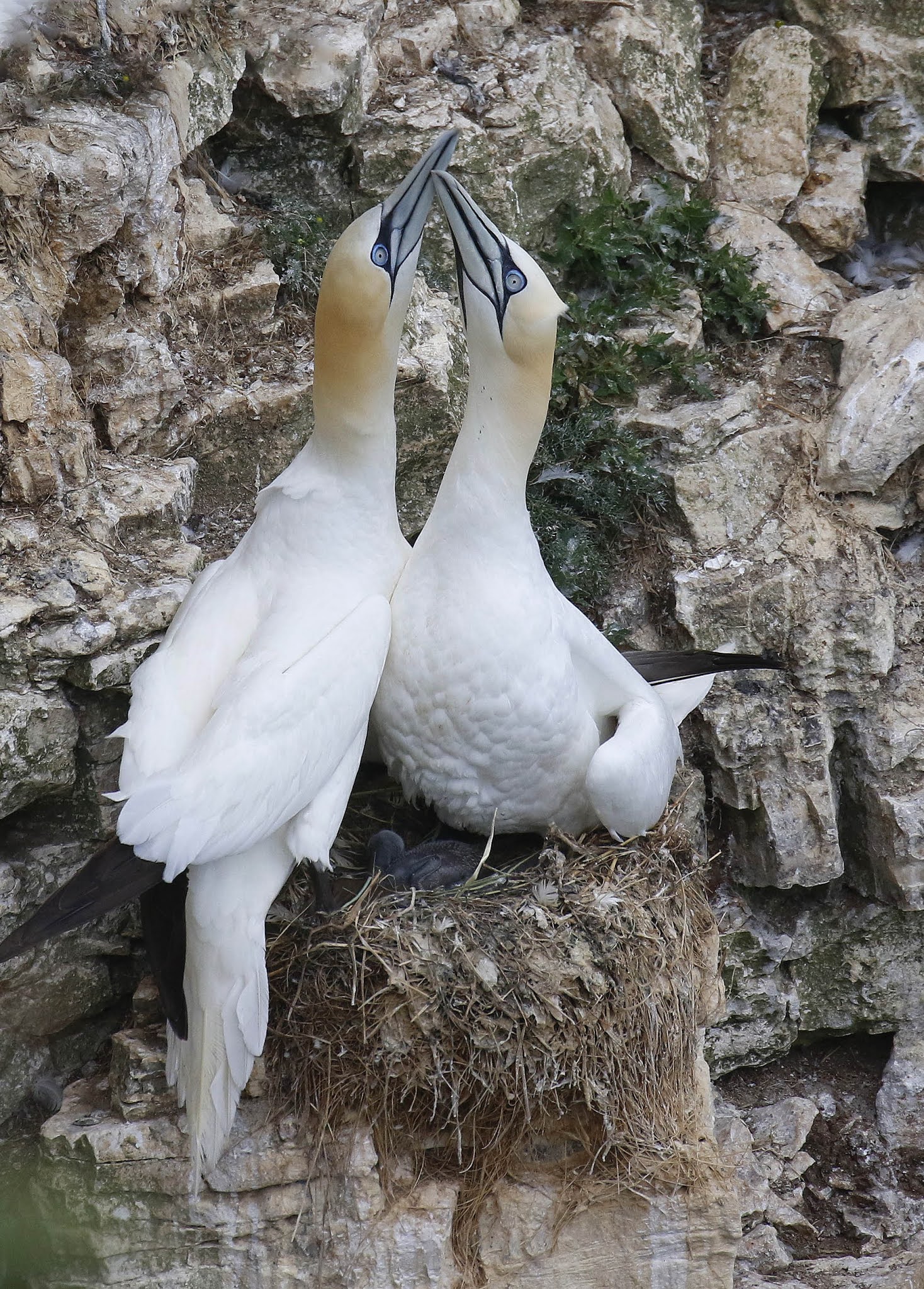
Expectations slowly subsided as it appeared we would be in for the long haul on this one. Fairly certain the albatross would eventually return nearer to the cliffs, everyone stood waiting in anticipation. Boredom was not an issue as there was plenty to see, with a continuous procession of Gannets of all ages passing above, below and before us. Lower on the cliff faces nesting Gannets stood guard over their grey fluffy young. Every ledge, even impossibly narrow ones, was occupied by a seabird. A line of pure white Gannets were strung along a narrow ledge across the cliff face, like a string of pearls, every bird facing inwards and sheltering a chick or egg.


Razorbills, black and enigmatic and Guillemots, brown and svelte, stood upright and statuesque on other ledges or outcrops of stone, some guarding their egg or youngster with drooping wings, as others of their kind dropped from the cliff face ledges down to the sea. Others arrived to perch on the cliff, barging their way unceremoniously onto a ledge, despite it already being occupied. Somehow the arriving bird always managed to squeeze in, although subject to an admonishing sharp peck or two. Kittiwakes also had young on the cliff, the adult birds hardly able to fully stand on the perilously narrow ledge on which they had chosen to raise their young.


A small number of Puffins stood on the cliff near to the top, where the earth and grass allowed them to burrow and in which they could lay their single egg. Those present who were not hardcore birders were delighted to have the everlastingly popular Puffins, with their endearing habits and behaviour, pointed out to them and without fail went away happy.


Bempton is also a well known place to see Tree Sparrows which buck the trend in the rest of the country by being almost prolific, many frequenting the bushes around the Visitor Centre where boxes have been erected for them to nest in.They also breed on the cliffs and their cheery calls are everywhere as they fly to and from the fields to feed on the seeding grasses


The hours slowly passed by and the seabird colony maintained an endless cacophony of noise movement and variety as the albatross remained on the sea. The sun was now an intermittent presence and a stronger northeast wind had arisen making it cold standing on the viewing platform for any length of time. Still we waited. Five hours had now passed and there was little sign of movement from the albatross.

The RSPB's Yorkshire Belle, their seabird viewing vessel, arrived below the cliffs, edging ever closer to the nesting seabirds. I will be on it next Tuesday when I  come back to Bempton for two days, having booked an Air B and B at nearby Filey, long before I knew of the albatross's presence. Watching the vessel I became aware of dark grey dorsal fins breaking the surface of the sea. It was a pod of Bottle nosed Dolphins,about ten in all, that commenced breaching and falling back into the sea with a huge splash, playing around the vessel. The flocks of  nearby auks, resting on the sea, scattered in alarm.


Despite a fleece I was feeling distinctly cold and had no option but to return to the car to get another layer of clothing to insulate me better against the wind chill. I was nervous of leaving as the albatross could at any minute decide to fly nearer to the cliffs and I would miss the moment  I took the chance and made for the distant car park, donned another layer of clothing  and as I was returning to the viewpoint, Mark rang my phone

My heart gave a lurch as I knew what he was going to tell me. . 

'Get yourself back to the viewing platform pdq as the albatross is on  the move and coming towards us. Where's Les?

No idea. I stammered, already breaking into a run.

There was no time to waste and I ran as fast as possible back to the viewing platform, dodging members of the public idling along who had no knowledge of the albatross.  They stood back as I hurried to the viewing platform. Another birder, just arrived, sensed the urgency and commenced running with me. By now, in late afternoon, the crowd had thinned considerably on the viewing platform and those left were almost exclusively birders and here for one thing, and one thing only. A Black browed Albatross! I commandeered a place by the rail as various shouts came to me 'Its coming closer. Its weaving in a zig zag over the sea'. I could not find it amongst the incessant movement of gannets and auks in front of the cliff.

'Its by the orange buoy' came a disembodied cry.There were several buoys to choose from. A rising. feeling of panic took hold of me as more and more shouts went up as to where it was.

Another cry, this time from Mark. 'Its almost below us!' . 

c Chris Griffin

I still failed to pick it up and then was advised it had gone behind a fold in the cliff face.I hung on, aware that I was in with the distinct chance of not seeing the albatross. After such a very long wait it would be a personal tragedy.A total nightmare.

My despair changed  rapidly to euphoria as the albatross rose above the clifftop, floating on flexed and enormously long wings. It was as clear as could be, although a bit distant and I watched it cicling above a small group of birders further along the clifftop.

I watched it bend its extraordinarily long and narrow wings into angles as it mastered the wind, presenting a profile quite  different to the Gannets around it. Circling, it drifted north along the cliff top.

I joined a mini stampede to follow it along the cliff but we were a long way behind and getting to another rise there was no sign. It had passed over here, as some birders confirmed the sighting, but no one was sure where it had gone since..

Exultant but wanting more we stood about in a mental vacuum hoping the albatross would somehow show itself once more but it was not to be. Someone swore they had seen it land on the cliff face and felt it had gone to roost.No one believed him. Basilisk eyed Gannets passed along the cliff edge using the wind currents to carry them along. Not one wing flap was necessary, just a bend of the wings and uplifting of tail with huge paddle shaped feet stuck out and acting as  rudders.


Slowly I wandered back to another viewpoint and decided to wait there and see what if anything happened. I watched some Gannets and Puffins for a while and then someone said 'Its back on the cliff with the Gannets at the southern end of the reserve'. How it had got there no-one knew as we had been scanning the sea and not seen it pass.

To get to the required viewpoint entailed another taxing yomp of half a mile, to join another crowd, crammed on yet another restricted viewing area. Mark was there and I joined him, squeezing in behind a row of birders looking out to a relatively distant cliff face thronged with Gannets. I was directed to look at the very edge of the cliff as it plunged down to the sea and there almost on its own, between two distinct areas of Gannets was the albatross sat on the cliff edge

At last, here it was, clearly visible through my bins.No more chasing around. Such was the scrum of birders there was no room for a scope on the platform even if I had brought it from the car. I leant back against a supporting rail, relaxed and just enjoyed the moment. I admired its striking, salmon pink bill and black and white plumage.Its all white head with the iconic black brow, which is really a sooty black line encompassing the eye.When it stood I could make out its huge and grey, webbed feet and short grey tail almost hidden below the furled wings.

Seven hours had passed since we got here and this was our hard earned reward. We deserved it.The views were distant and we had not enjoyed the exceptional views that had been granted in the early morning but, and no one could take this away from me, I was enjoying my first ever albatross at the third attempt, a Black browed Albatross no less and a lifer. Number 512 on my British List.

It was obvious we were not going to get the close up shots we had hoped for, we were unlucky in this respect but sometimes you have to accept the situation and get on with it. Maybe next year!

The main thing for me was that I had finally seen this mega rare bird after two previous failed attempts. 

c Chris Griffin

We watched it for a half an hour as it sat or stood on the cliff, occasionally stretching its long wings and taking one brief flight from the cliff to circle around amongst some gannets, utterly distinctive in the air, before returning to its former perching place

The surrounding light slowly dulled but the light in my heart would not be extinguished so easily.

My grateful thanks go to a birding colleague, Chris Griffin who has kindly lessened the pain by allowing me to include the exceptional images he took the next day from the very viewpoint where we had watched the albatross on the cliff.